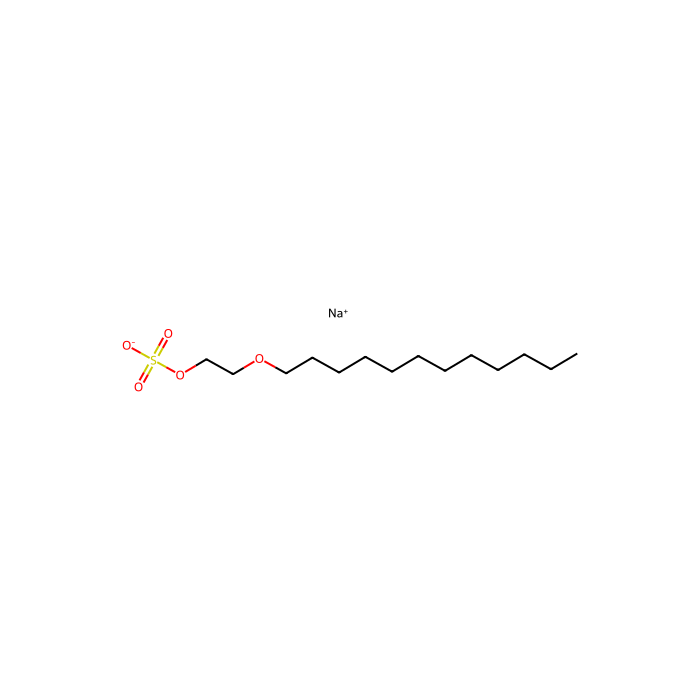
Natriumlaurylpolyoxyethylenethersulfat - ≥25% , CAS No.9004-82-4

CAS: 9004-82-4 Cat. No.: S196294 Summenformel: C12H25(CH2CH2O)nSO4Na EG-Nummer: 688-491-3 PubChem CID: 23665884
Zu bestellen verfügbar
GRADE & PURITY ≥25%
Synonyms
2-(Dodecyloxy)ethyl Natriumsulfat | Sodium Lauryl Ethoxy Sulphate | Kalium Dichromat, Yanagishima Pharmaceutical Co. Ltd. | SCHEMBL675596 | UNII-SUY7YR7K8F | FT-0699797 | Tox21_302374 | NCGC00255215-01 | DSSTox_CID_9298 | DTXSID70274019 | Ethanol, 2-
Storage
Room temperature
Shipped In
Normal
★
Size
Deutschland (EU)
USA*
Price
Qty
25ml
S196294-25ml
—
2 Auf Lager

30,28€

38,09€
Speichern 7,81 € (20.50%)
100ml
S196294-100ml
—
2 Auf Lager

94,50€

120,53€
Speichern 26,03 € (21.60%)
500ml
S196294-500ml
—
1 Auf Lager

226,39€

358,29€
Speichern 131,90 € (36.81%)
Enter a quantity for the sizes you want to add.
🧪
Why this grade

≥25% for sensitive chromatographic and analytical workflows requiring minimal baseline interference.

🌡

Storage & shipping

Room temperature Ships Normal Check lot-specific COA for exact specifications.

📋

Quality documents

SDS, COA, datasheet, and spec sheet available for download. Lot-specific COA accessible via lot number lookup.

📚

Literature proof

Cited in 10 peer-reviewed publications across chromatography, organic synthesis, and cross-coupling reactions.

Specifications

Synonyme
2-(Dodecyloxy)ethyl Natriumsulfat | Sodium Lauryl Ethoxy Sulphate | Kalium Dichromat, Yanagishima Pharmaceutical Co. Ltd. | SCHEMBL675596 | UNII-SUY7YR7K8F | FT-0699797 | Tox21_302374 | NCGC00255215-01 | DSSTox_CID_9298 | DTXSID70274019 | Ethanol, 2-
Spezifikationen & Reinheit
≥25%
Storage
Room temperature
Verschickt in
Normal
Aktionsart
INHIBITOR
Reinheit
≥25%
Namen und Kennungen
Pubchem Sid
Pubchem Sid Url
https://pubchem.ncbi.nlm.nih.gov/substance/504769518
Kanonisches Lächeln
CCCCCCCCCCCCOCCOS(=O)(=O)[O-].[Na+]
IUPAC Name
sodium;2-dodecoxyethyl sulfate
InChIKey
ASEFUFIKYOCPIJ-UHFFFAOYSA-M
INCHI
1S/C14H30O5S.Na/c1-2-3-4-5-6-7-8-9-10-11-12-18-13-14-19-20(15,16)17;/h2-14H2,1H3,(H,15,16,17);/q;+1/p-1
Isomere SMILES
CCCCCCCCCCCCOCCOS(=O)(=O)[O-].[Na+]
PubChem CID
23665884

Documentation

📋 Safety Data Sheet (SDS)

Comprehensive hazard, handling, storage, and regulatory compliance document.

Download SDS →

✅ Certificate of Analysis (COA)

Lot-specific quality data. Enter your lot number to retrieve the exact COA.

Look up COA →

📊 Datasheet

Quick-reference summary of product specifications and applications.

View datasheet →

🔬 Specification Sheet

Full quality attributes and acceptance criteria for this grade.

View spec sheet →

Advanced Data

Taxonomic Classification

Taxonomy Tree

KingdomOrganic compounds
SuperclassOrganic acids and derivatives
KlasseOrganic sulfuric acids and derivatives
SubclassSulfuric acid esters
Intermediate Tree Nodes Not available
Direct ParentSulfuric acid monoesters
Alternative Parents Alkyl sulfates  Dialkyl ethers  Organic sodium salts  Organic oxides  Hydrocarbon derivatives  
Molecular FrameworkAliphatic acyclic compounds
Substituents Alkyl sulfate - Sulfate-ester - Sulfuric acid monoester - Organic alkali metal salt - Ether - Dialkyl ether - Organic oxygen compound - Organic oxide - Hydrocarbon derivative - Organic sodium salt - Organic salt - Organooxygen compound - Aliphatic acyclic compound
BeschreibungThis compound belongs to the class of organic compounds known as sulfuric acid monoesters. These are organic compounds containing the sulfuric acid monoester functional group, with the generic structure ROS(O)(=O)=O, (R=organyl group).
External Descriptors Not available
3D-Struktur
Interaktives chemisches Strukturmodell


Zertifikate (CoA, COO, BSE/TSE und Analyse-Diagramm)
C of A & Other Certificates(BSE/TSE, COO):
Analytical Chart:

Find and download the COA for your product by matching the lot number on the packaging.

16 results found

Lot NumberCertificate TypeDatumArtikel
J2614058Certificate of AnalysisOct 19, 2026 S196294
H2611036Certificate of AnalysisAug 15, 2026 S196294
J2218337Certificate of AnalysisJul 30, 2026 S196294
I2529496Certificate of AnalysisJul 03, 2024 S196294
G2008078Certificate of AnalysisApr 07, 2024 S196294
A2422190Certificate of AnalysisJul 07, 2022 S196294
A2425041Certificate of AnalysisJul 07, 2022 S196294
A2507040Certificate of AnalysisJul 07, 2022 S196294
G2227356Certificate of AnalysisJul 07, 2022 S196294
G2227357Certificate of AnalysisJul 07, 2022 S196294
G2227359Certificate of AnalysisJul 07, 2022 S196294
I2311043Certificate of AnalysisJul 07, 2022 S196294
L2403094Certificate of AnalysisJul 07, 2022 S196294
L2406133Certificate of AnalysisJul 07, 2022 S196294
L2510015Certificate of AnalysisJul 07, 2022 S196294
A2218048Certificate of AnalysisJan 24, 2022 S196294
Chemische und physikalische Eigenschaften
LöslichkeitSoluble in ethanol; Insoluble in xylene,
Molekulargewicht332.430 g/mol
XLogP3
Hydrogen Bond Donor Count0
Hydrogen Bond Acceptor Count5
Rotatable Bond Count15
Exact Mass332.163 Da
Monoisotopic Mass332.163 Da
Topological Polar Surface Area84.000 Ų
Heavy Atom Count21
Formal Charge0
Complexity290.000
Isotope Atom Count0
Defined Atom Stereocenter Count0
Undefined Atom Stereocenter Count0
Defined Bond Stereocenter Count0
Undefined Bond Stereocenter Count0
The total count of all stereochemical bonds0
Covalently-Bonded Unit Count2
FAQs und Artikel
Alcohol Ethoxylates (AEO) Explained: Structure, Key Parameters, Application Scenarios, and Aladdin’s Selection Tables (Main + Appendix)
A Panoramic Guide to Surfactants: Definitions & Mechanisms, Key Metrics, Application Scenarios, and Selection Navigation (Tables 1–3)
Potassium Fatty Acid Soaps: Structure and Formulation Applications—Production Processes, Alkalinity, Foam Control, and Low-Foam Cleaning
Application of Fatty Acid Methyl Ester Sulfonate (MES) in Household Detergent and Cleaning Formulations: Detergency, Hard-Water Tolerance, and Selection Criteria
K12 (Sodium Lauryl Sulfate/SLS) Is More Than a Foaming Agent: Structure, Properties, and Applications in Personal Care and Household Care Formulations
What Is the Difference Between Triethanolamine and Diethanolamine: Understanding Their Formulation Functions, Application Differences, and Selection Logic from a Molecular-Structure Perspective
Thickening, Suspension, Auxiliary Stabilization, and Agglomeration Mechanisms of Xanthan Gum in Personal Care Formulations: From Molecular Structure to Processing Applications
Why Can 6501 (Cocamide DEA) Stabilize Foam and Build Viscosity? Structural Mechanism, 1:1/1:1.5 Differences, and Application Selection
Why Limonene Can Soften Greasy Soils Yet Is Difficult to Dissolve in Water: Understanding the Cleaning Mechanism and Formulation Applications of Naturally Derived Solvents from Molecular Structure
Degreasing Agents from a Molecular-Structure Perspective: How AEO, APG, and Related Surfactants Can Replace Nonylphenol Ethoxylates (NPE)
Understanding CAPB from Its Structure: How Cocamidopropyl Betaine Improves Foam, Enhances Mildness, and Supports Thickening
Why Do Daily Chemical Products Become Opaque? Formation Mechanisms of Milky Turbidity, Pearlescence, and Coverage, and How to Select the Right Ingredients
Interfacial Mechanism and Formulation Applications of AEO-9 (Fatty Alcohol Polyoxyethylene Ether): An Analysis of Emulsification, Wetting, Oil Soil Removal, and Co-Formulation Compatibility
Sodium Metasilicate in Cleaning Applications: Hydration-Form Differences, Mechanisms of Action, and Selection Logic
Analysis of the Foaming Performance Differences Between K12 and AOS: Structure, Acid–Base Stability, and Formulation Selection
Understanding Anionic Surfactants in Household and Personal-Care Formulations from a Structural Perspective: Structural and Performance Differences among Representative Raw Materials such as LAS, AES, K12, AOS, MES, and FMES
The Structural Logic of Amphoteric Surfactants: Representative Ingredients, Performance Mechanisms, and Formulation Applications in Personal Care and Home Care
Mechanisms and Troubleshooting of Foam Reduction in Personal and Household Care Formulations: Film Rupture, Weak Interfacial Films, Insufficient Surfactant Supply, and Phase-State Disturbance
Why Are Daily Chemical Products Prone to Viscosity Thinning in Summer? Core Mechanisms, Troubleshooting Methods, and Solutions
Understanding the Four Classes of Surfactants Through Molecular Charge: Application Logic of Anionic, Cationic, Amphoteric and Zwitterionic, and Nonionic Surfactants in Personal Care and Home Care
Citations of This Product
Lösungsrechner
Bewertungen

Kundenbewertungen

Shall we send you a message when we have discounts available?

Remind me later

Thank you! Please check your email inbox to confirm.

Oops! Notifications are disabled.