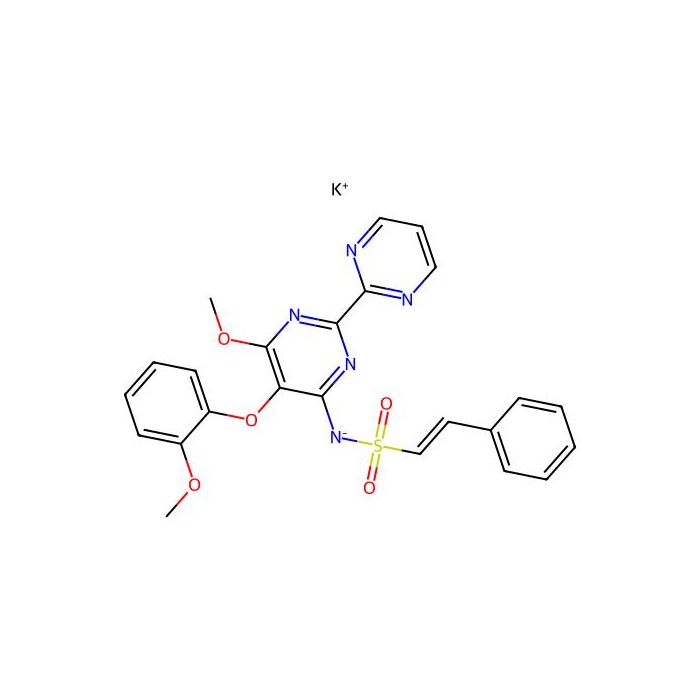
Nebentan potassium (YM598) is a potent, selective and orally active non-peptide endothelin ET A receptor antagonist through the modification of Bosentan . Nebentan potassium inhibits [ 125 I] endothelin-1 binding to cloned human endothelin ETA and ETB receptor, with K i of 0.697 nM and 569 nM, respectively YM598 can ameliorate the progression of cor pulmonale and myocardial infarction in vivo .
In Vitro
Nebentan potassium inhibits the specific binding of [ 125 I] endothelin-1 to endothelin ET A and ET B receptors in a concentration dependent manner, K i values are 0.697 nM and 1.53 nM for human and rat endothelin ETA receptors, respectively. In contrast, YM598 exhibits low affinities for human and rat endothelin ET B receptors, with K i values of 569 nM and 155 nM,respectively. In measurement of intracellular Ca 2+ concentration, Nebentan potassium concentration-dependently inhibits the increase in [Ca 2+ ]i induced by 10 nM endothelin-1 in both CHO cells and A10 cells, the IC 50 values are 26.2 nM for CHO cells and 26.7 nM for A10 cells, respectively. MCE has not independently confirmed the accuracy of these methods. They are for reference only.
In Vivo
Nebentan potassium (oral administration; 0.1-1 mg/kg; 4 weeks) significantly inhibits the progression of pulmonary hypertension and the development of right ventricular hypertrophy. Nebentan potassium (oral administration; 1 mg/kg; 30 weeks) significantly ameliorates the poor survival rate of CHF rats, it markedly reduces the hypertrophy of both ventricles as well as pulmonary congestion. MCE has not independently confirmed the accuracy of these methods. They are for reference only.
IC50& Target:ET A 0.679 nM (Ki) ET B 569 nM (Ki)
Spezifikationen
Spezifikationen & Reinheit
10mM in DMSO
Biochemische und physiologische Mechanismen
Nebentan potassium (YM598) is a potent, selective and orally active non-peptide endothelin ET A receptor antagonist through the modification of Bosentan ( HY-A0013 ). Nebentan potassium inhibits [ 125 I] endothelin-1 binding to cloned human endothelin ETA
Storage
Desiccated,Store at -80°C
Verschickt in
Dry ice packs + Cold packs
Dieses Produkt erfordert Kühlkettenversand. Grundversand und andere Economy-Optionen sind nicht verfügbar.
Zertifikate (CoA, COO, BSE/TSE und Analyse-Diagramm)
C of A & Other Certificates(BSE/TSE, COO):
Analytical Chart:
Lösungsrechner
Molarity Calculator
Determine the necessary mass, volume, or concentration for preparing a solution.
Dilution Calculator
Determine the dilution needed to prepare a stock solution.
Reconstitution Calculator
Bewertungen
Kundenbewertungen
Application Protocols
No tested applications are supplied in the product data. The following general protocols are commonly used for small-molecule library members in discovery workflows (non-item-specific):
Preparation of DMSO stock solutions
Equilibrate vial to room temperature in a desiccated environment. Quickly weigh the required amount.
Add anhydrous DMSO to achieve 10–50 mM. Vortex and, if needed, sonicate briefly. Inspect for clarity; filter (0.22 µm PTFE) if particulates persist.
Aliquot into low-bind tubes or 96/384-well plates; cap/seal to minimize moisture ingress.
Serial dilutions for assays
Prepare intermediate DMSO dilutions (e.g., 10-point 1:3 or 1:2 series).
Transfer to assay buffer or media, targeting final DMSO ≤0.1–0.5% v/v. Mix thoroughly to avoid precipitation.
Include vehicle controls matched for DMSO and ionic strength.
Short-term stability check
Incubate working solutions at assay temperature/time; analyze by LC–UV/LC–MS for degradation or adsorption losses.
Plate management
Minimize freeze–thaw of plates; store sealed at −20 to −80 °C with desiccant. Use inert gas backfill (N2/Ar) where available.
Note: These are general procedures. Optimize concentrations and handling to your assay modality (biochemical, cell-based, biophysical).
Biological Roles
Item-specific biological function, mechanism of action, and target engagement are not provided for Nebentan potassium in the current product record. The following guidance reflects how small-molecule salts are typically used in research contexts (not item-specific and strictly for research use only):
Tool compound candidate: May be evaluated in biochemical or cellular assays to probe pathway modulation, phenotype changes, or as part of focused libraries in chemical biology studies.
Chemotype exploration: If Nebentan represents a distinct scaffold, salt forms can be used to assess effects on uptake, solubility, and assay performance compared to neutral or alternate counterions.
ADME and profiling: Researchers may perform in vitro stability, permeability, protein binding, and solubility measurements to characterize compound-like behavior; such data are experiment-specific and not provided here.
Ion effects: The potassium counterion is generally considered inert in most biological assays at the micromolar concentrations used for test articles; nonetheless, control experiments should match ionic strength when feasible.
Important limitations:
No target, pathway, or phenotype specificity is stated for this product. Any biological roles must be assigned empirically by the end user under controlled experimental designs.
No medical or clinical use is implied or supported. This product is supplied strictly for laboratory research use.
Buffer Applications
Nebentan potassium is not a designated buffering agent, and no pKa values or buffering ranges are provided. Therefore, dedicated buffer formulation guidance is not applicable. The following notes focus on practical handling of small-molecule stocks used within buffered assay systems (general guidance, not item-specific):
Stock solutions: Prepare concentrated stocks in DMSO (e.g., 10–50 mM) or water if soluble. Filter through a 0.22 µm PTFE or PES filter if particulate is observed.
Dilution into buffers: Add stock slowly into vigorously mixed buffer (e.g., PBS, HEPES, or assay-specific media) to minimize localized supersaturation and precipitation. Maintain final DMSO ≤0.1–0.5% v/v where assay permits.
pH considerations: Without known pKa, avoid extreme pH; start near physiological pH (7.2–7.4) for cell assays or select assay-optimized buffers (e.g., HEPES pH 7.5, Tris pH 8.0) and check for precipitation/carryover.
Compatibility: Validate compound stability in the chosen buffer over the assay timeframe (1–24 h) using LC–MS or LC–UV. Adsorption to plastics can occur; low-binding plates/tubes help at low micromolar concentrations.
Documentation note:
Since buffering capacity and ionization specifics are not provided for this item, do not use it as a buffer component. Treat it as a test article introduced into pre-formulated buffers.
Green Alternatives
As a solid small-molecule reagent rather than a process solvent, “green alternatives” primarily concern solvent choices for dissolution, handling, and any upstream/downstream synthetic steps. Item-specific data are not available; the following are general, non-item-specific recommendations:
Greener dissolution/processing options (vs common high-impact solvents):
Water or buffered aqueous media: Prefer when solubility permits and compatible with the assay or analysis.
Bio-based alcohols (ethanol) over methanol or isopropanol when feasible; ensure assay compatibility.
ACN over DMF/NMP for LC workflows when possible, considering lower reproductive toxicity concerns; recover via solvent recycling where available.
2-MeTHF or CPME for synthetic operations (if upstream derivatization is performed), as greener alternatives to THF/Et2O—note changed polarity and peroxide risks.
Comparison (general guidance):
DMSO: Excellent solvency, widely accepted in bioassays; high boiling point complicates removal and has moderate EHS footprint.
Ethanol/water: Low EHS impact, excellent compatibility; may not dissolve hydrophobic ionic species well.
ACN: Good for LC–MS; toxicity and waste burden require controls.
Operational tips to reduce footprint:
Minimize DMSO concentration in final assays (≤0.1–0.5% v/v) to lower solvent burden.
Use micro-volume dissolution and serial dilution to limit waste.
Implement solvent recycling and closed-loop waste segregation for polar aprotic streams.
Note: No item-specific environmental metrics (biodegradability, aquatic toxicity) are available; consult SDS for hazard and disposal guidance.
Pharmaceutical Uses
No pharmacopeial status, excipient role, or formulation specifications are provided for Nebentan potassium. This product is supplied strictly for research use only. The following are general, non-item-specific research contexts:
Reference standard: May be employed as a research analytical standard for LC–MS/LC–UV method setup, retention-time indexing, and stability-indicating methods in discovery settings.
Preformulation research: Salt forms are often explored to understand solubility, hygroscopicity, and solid-state behavior (PXRD/DSC/TGA) in early discovery; such studies are exploratory and non-clinical.
Counterion screening: Conversion among salts (K+, Na+, H+, organic ammonium) can be used to examine physicochemical impacts on dissolution and crystallinity for medicinal chemistry research.
Important caveats:
No medical, diagnostic, or therapeutic use is implied. Do not use in human or veterinary applications.
No compendial monograph or GMP grade is indicated here. If regulated-use suitability is required, this product is not appropriate.
Documentation note:
For any development-type investigations (e.g., stability, photostability), create internal documentation and controls (ICH-like conditions) as the product record does not supply specification limits or validated methods.
Physical Properties
Item-specific physicochemical parameters are not listed in the current product data.
Appearance: Not specified for this item; refer to CoA/Spec Sheet.
Melting point (MP): Not specified for this item; refer to CoA/Spec Sheet.
Boiling point (BP): Not applicable/typically not defined for ionic solids prior to decomposition (general note).
Density: Not specified for this item; refer to CoA/Spec Sheet.
Solubility: Not specified for this item; refer to CoA/Spec Sheet.
LogP/logD: Not specified for this item; refer to CoA/Spec Sheet.
pKa(s): Not specified for this item; refer to CoA/Spec Sheet.
Refractive index: Not applicable for a crystalline solid (general note).
General literature guidance for potassium organic salts (not item-specific):
Many potassium salts of organic acids show improved water compatibility relative to their free acid/base, though absolute solubility depends strongly on the anion structure (aromaticity, hydrophobic surface, multiple charges, etc.).
DMSO is commonly used to prepare concentrated assay stocks (e.g., 10–50 mM) for library compounds, including ionic salts.
Hygroscopicity can vary; some potassium salts absorb moisture readily, which can impact weighing accuracy and apparent assay concentration.
Thermal behavior: Ionic salts often decompose before a clean melt; TGA/DSC characterization is preferred to assess stability profiles.
Actionable recommendation:
If solubility or thermal data are critical to your workflow (e.g., for high-throughput screening or preformulation), request the CoA/Spec Sheet for this lot or perform a small-scale solubility screen in intended diluents (water, PBS, culture media, DMSO, mixed aqueous-organic).
Quality and Grades
Product-specific quality attributes are not listed in the record.
Grade/purity: Not specified for this item; refer to CoA/Spec Sheet.
Stabilizers/inhibitors: Not specified for this item; refer to CoA/Spec Sheet.
Context for small-molecule library compounds (general guidance):
Identity confirmation typically leverages high-resolution MS, NMR, and/or LC–MS purity analysis. When available, Aladdin Scientific provides identity/purity metrics on the CoA for the shipped lot.
Purity descriptors (e.g., “≥98%,” “HPLC-grade,” “screening grade”) reflect analytical methods and acceptance criteria. Absent a stated value here, defer to the CoA/Spec Sheet.
Counterion content and water/solvent of crystallization can affect assay concentrations. For ionic materials, the reported molecular weight on the CoA (including counterion and solvation state) should be used for concentration calculations.
If UV transparency or metal content is critical (e.g., for photochemical or catalytic experiments), check the CoA. If not specified, a small pre-qualification study is recommended.
Recommended QC-on-receipt (practical tips):
Record exact lot and weigh-by-difference in a dry glovebox or desiccator pass-through when feasible.
Verify identity/purity by quick LC–MS where throughput allows, especially before HTS or dose–response campaigns.
Establish an internal reference concentration by quantitative NMR (qNMR) if absolute potency data are central to your workflow.
Reaction and Applications
Manufacturer application field: Not provided in the product record. The points below outline typical research uses for catalog small molecules and their salts (general guidance, not item-specific):
Screening and profiling: Employed as a member of chemical libraries for biochemical or cell-based assays, target deconvolution workflows, and SAR hypothesis testing.
Reference standard: Can serve as an analytical reference for LC–MS method development, retention-time indexing, or impurity profiling in related synthetic campaigns.
Salt/form switching: Potassium salts can be transformed to the corresponding free acid/base or exchanged to alternate counterions (e.g., H+, Na+, TBA+) for solubility or crystallization studies, enabling material property optimization.
Crystallization and co-crystal investigations: Ionic form may facilitate solid-state characterization (PXRD, SCXRD) or co-crystal screening with pharmaceutically acceptable coformers (research use only).
Derivatization workflows: If the anion bears a handle (carboxylate/sulfonate/phenolate), it may be leveraged in coupling, alkylation, or acyl activation reactions after converting to a reactive intermediate (e.g., acid chloride, activated ester)—contingent on the actual structure.
Practical tips:
Validate identity and purity by LC–MS prior to assay inclusion.
Establish DMSO stock stability (freeze–thaw, benchtop exposure) using LC–UV or LC–MS checkpoints.
For salt conversion, employ mild ion-exchange or acidification followed by extraction and rebasification as appropriate, tracking by LC–MS.
Reaction Conditions
No reaction condition data are provided for Nebentan potassium. If synthetic manipulation is planned, consider the following general (non-item-specific) conditions relevant to organic salt handling and conversion:
Salt neutralization to free acid/base: Dissolve/suspend in minimal water or alcohol; add a stoichiometric mineral acid (for potassium carboxylates/phenolates). Extract the neutral species into an organic solvent (EtOAc, MTBE, DCM) if sufficiently lipophilic. Dry and concentrate under reduced pressure.
Counterion exchange: Employ ion-exchange resins (H+-form for acidification; NH4+-form for ammonium salts) or metathesis in mixed solvents (e.g., aqueous MeOH) followed by filtration and drying.
Solvent systems: Polar protic (MeOH, EtOH, H2O) for ion handling; switch to aprotics (DCM, EtOAc, ACN) after neutralization for downstream transformations.
Temperatures: Typically ambient to 40 °C for dissolution/exchange. Avoid elevated temperatures without stability data.
Monitoring: LC–MS or HPLC with ELSD/UV to confirm completion of salt exchange/neutralization and to check for decomposition.
Yields and kinetics:
Highly structure-dependent; no item-specific yield/rate data are available. Perform small-scale scouting to establish feasible conditions.
Note: Defer to the CoA/Spec Sheet to identify the ionizable functionality. Avoid strong dehydrating agents or oxidants unless the structure is known to be compatible.
Safety and Handling
Safety classifications are not provided in the current record. Always consult the SDS for authoritative guidance.
GHS classification: Not specified for this item; refer to SDS.
Signal word and H-statements: Not specified for this item; refer to SDS.
Pictograms: Not specified for this item; refer to SDS.
General laboratory safety for small-molecule potassium salts (not item-specific):
PPE: Wear appropriate laboratory PPE (lab coat, safety glasses, and chemical-resistant gloves). Handle powders in a fume hood or ventilated enclosure to minimize inhalation of dust/aerosols.
Avoid moisture uptake: The product is to be kept desiccated; limit ambient exposure during weighing and immediately reseal with desiccant present.
Thermal sensitivity: Store at the specified ultra-low temperature to mitigate degradation; avoid repeated freeze–thaw of the bulk container.
Incompatibilities: Strong oxidizers and strong acids/bases may be incompatible depending on the organic anion. Do not assume compatibility—consult SDS and perform small-scale tests if needed.
First aid (overview): Move to fresh air if inhaled; rinse skin/eyes with copious water if contacted; seek medical advice if symptoms persist. If ingested, rinse mouth and obtain medical attention. Follow institutional emergency procedures.
Spill/cleanup: Avoid dust generation. Sweep or HEPA-vacuum solids; dispose according to local regulations.
Storage and shipping (item-specific):
Storage: Desiccated, Store at -80°C (per product data).
No item-specific solubility data are provided. The following guidance reflects common practice for small organic potassium salts and screening compounds (not item-specific):
Primary stock solvent: DMSO is typically preferred for library stock solutions due to broad solvating power and biological assay compatibility. Start with 10–50 mM trial stocks and verify clarity.
Aqueous solubility: Potassium salts can be water-soluble; however, hydrophobic anions may limit solubility. Evaluate water, PBS, and assay buffers at target pH. Co-solvent strategies (DMSO:buffer 1–5% v/v) are often effective.
Alcohols: Methanol and ethanol can aid dissolution and are miscible with water; they may be preferable for mass-spec workflows due to volatility.
Polar aprotics: DMF or NMP can dissolve challenging materials; weigh their assay compatibility and safety profiles.
Decision pointers:
If rapid biological assay deployment is needed: Try DMSO stocks, then dilute into buffer/media keeping final DMSO ≤0.1–0.5% v/v where feasible.
If LC–MS quantitation is planned: Favor MeOH/H2O or ACN/H2O systems with 0.1% formic acid or ammonium buffers as appropriate.
If precipitation is observed upon dilution: Increase temperature slightly (25–37°C), adjust pH (consistent with assay), or employ co-solvent micropercentages.
Documentation note:
Definitive solubility, pKa, and partitioning data for Nebentan potassium are not provided here. For method-critical decisions, consult the CoA/Spec Sheet or perform a short solubility screen under intended conditions.
Storage and Reconstitution
Item-specific storage and shipping:
Storage Conditions: Desiccated, Store at -80°C (per product data).
General reconstitution guidance (non-item-specific):
Equilibration: Before opening, allow the vial to warm in a desiccator or dry box to prevent condensation on the material.
Weighing: Minimize atmospheric exposure; weigh by difference if possible. Immediately reseal with desiccant.
Solvent selection: If solubility data are unavailable, first attempt dissolution in anhydrous DMSO (e.g., 10–50 mM). If aqueous solubility is anticipated, test in water/PBS at room temperature with gentle agitation.
Filtration: If particulates remain, filter through a 0.22 µm PTFE (for organic) or PES (for aqueous) membrane.
Aliquoting and stability (general recommendations):
Prepare single-use aliquots of stock solutions to avoid repeated freeze–thaw. Store frozen, protected from light if chromophores are suspected.
Working solutions at 2–8 °C are typically used the same day. Absent item-specific stability data, avoid storing aqueous working solutions beyond 24 hours.
Documentation note:
Exact solubility, stability, and appearance are not specified for this item; refer to the CoA/Spec Sheet or perform a small pilot test under your exact conditions. Maintain detailed records of lot number, concentration calculations (accounting for salt form/hydration), and storage history.
Research use only: Not for human or veterinary use.
Structure and Identity
Brief overview: Nebentan potassium (SKU N654865) is listed as a small-molecule catalog member supplied as a potassium salt. Detailed structure data are not provided in the product record.
CAS: 342005-82-7
PubChem CID: 12093171
InChIKey: Not specified for this item; refer to CoA/Spec Sheet.
SMILES: Not specified for this item; refer to CoA/Spec Sheet.
Molecular formula: Not specified for this item; refer to CoA/Spec Sheet.
Molecular weight: Not specified for this item; refer to CoA/Spec Sheet.
Structural features (general notes):
The “potassium” designation indicates a monovalent K+ counterion paired with an anionic organic moiety (e.g., carboxylate, sulfonate, phenolate, or related). The exact functional group architecture for Nebentan is not specified in this record.
As a potassium salt, the solid is expected to be ionic, with the organic anion bearing the structural determinants (rings, heteroatoms, stereochemistry) that define Nebentan. These features are not disclosed here.
2D description (general):
Typical potassium organic salts are represented as [K+][A−], where [A−] is the deprotonated organic framework. Without the provided SMILES/InChI, ring systems, substituent pattern, and stereocenters cannot be enumerated.
Documentation note:
For definitive identity (exact structure, stereochemistry, and indexing identifiers), please consult the item’s Certificate of Analysis (CoA), Spec Sheet, or the SDS. When available, these documents will include authoritative SMILES, InChI, InChIKey, empirical formula, and precise molecular mass.
Synthetic Utility
Item-specific functional groups and reactivity are not disclosed in the current record; therefore, detailed synthetic transformations cannot be prescribed for Nebentan potassium. General considerations for organic potassium salts (not item-specific) are provided below:
Salt-to-free-acid/base conversion: Protonation with a suitable acid (e.g., HCl, H2SO4, or an ion-exchange resin in H+-form) can yield the neutral compound, enabling standard organic transformations otherwise impeded by ionic form.
Counterion exchange: Metathesis with salts such as NaCl, KPF6, or tetrabutylammonium salts (phase-transfer conditions) can deliver alternative counterions for solubility or crystallization studies.
Activation/derivatization: If the anion is a carboxylate, conversion to acid chloride or active esters (e.g., NHS, HOBt-derived) enables coupling; phenolates/sulfonates may undergo alkylation or sulfonylation under appropriate conditions—subject to the actual structure of Nebentan.
Solid-state utility: Ionic form may facilitate purification by trituration/precipitation or allow selective extraction in biphasic systems.
Practical tips:
Confirm the exact structure and ionization site from the CoA or independent analysis prior to planning derivatizations.
Track salt form and hydration level when calculating equivalents; these materially affect stoichiometry and yields.
Use non-nucleophilic bases/acids during conversions to avoid undesired side reactions with sensitive motifs in the organic anion.
Target Specificity
Target, pathway, or receptor specificity is not provided for Nebentan potassium in the product record.
Antigen/epitope, clone, isotype, or species reactivity data are not applicable to this small-molecule product.
No biochemical target annotations (e.g., enzyme class, receptor family) are supplied. Any target engagement must be established experimentally by the end user.
Documentation note:
If Nebentan potassium is to be used as a tool compound, record the assay conditions, controls, and concentration–response data that define its activity profile in your specific biological system. Cross-validate with orthogonal assay formats where possible.
Häufig gestellte Fragen
How should this product be stored?
Store at ?80 °C, desiccated. Keep the container tightly closed with desiccant — the material is moisture-sensitive.
How is this product shipped?
This product ships frozen with dry ice and cold packs. Unpack on arrival and transfer it to the storage condition stated above; handle dry ice with insulated gloves in a ventilated area.
What are the CAS number, molecular formula and molecular weight?
The CAS Number is 342005-82-7, the molecular formula is C24H20KN5O5S, and the molecular weight is 529.61 g/mol.
What documentation is provided?
Available product documentation, including Certificates of Analysis (COA), Safety Data Sheets (SDS), and specification sheets, is shown in the product document area. Document availability and access follow the current site policy.
Wir verwenden Cookies, um die ordnungsgemäße Funktion der Website sicherzustellen und, soweit zulässig, Ihr Nutzererlebnis zu verbessern. Sie können Ihre Einstellungen jederzeit unter „Einstellungen“ verwalten. Weitere Informationen finden Sie in unserer Cookie-Richtlinie.
Dürfen wir Sie über Rabattaktionen informieren?
Später erinnern
Vielen Dank! Bitte überprüfen Sie Ihren E-Mail-Posteingang, um zu bestätigen.
Products are supplied to verified businesses, institutions, and qualified professionals for research and development use only. Not for use in humans, animals, diagnosis, or therapy.