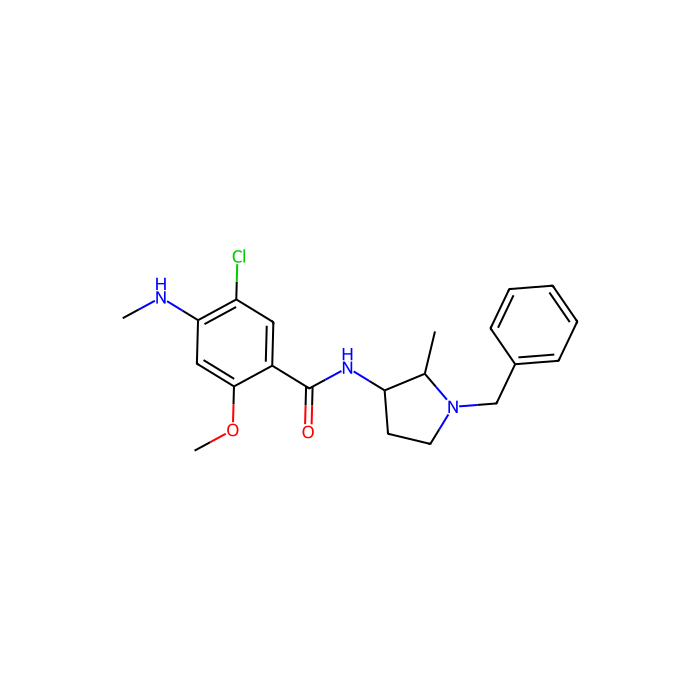
Nemonapride - Moligand™, ≥99%(HPLC) , Antagonist of D 2 receptor;Antagonist of D 3 receptor;Antagonist of D 4 receptor, CAS No.75272-39-8, Antagonist of D 2 receptor;Antagonist of D 3 receptor;Antagonist of D 4 receptor
Nemonapride - Moligand™, ≥99%(HPLC) , Antagonist of D 2 receptor;Antagonist of D 3 receptor;Antagonist of D 4 receptor, CAS No.75272-39-8, Antagonist of D 2 receptor;Antagonist of D 3 receptor;Antagonist of D 4 receptor
QUALITÄT & REINHEITMoligand™?Moligand™ — Aladdin's line of ligands and bioactive small molecules. Use for receptor, pathway, and binding studies needing defined small-molecule tools.≥99%(HPLC)
(+/-)-cis-N-(1-Benzyl-2-methyl-3-pyrrolidinyl)-5-chloro-4-(methylamino)-o-anisamide | (+-)-cis-N-(1-Benzyl-2-methylpyrrolidin-3-yl)-5-chloro-2-methoxy-4-methylaminobenzamide | 5-chloro-2-methoxy-4-methylamino-N-[(2R,3R)-2-methyl-1-(phenylmethyl)pyrrolidin-3-yl]benzamide | Emilace (TN) | (2R,3R)-nemonapride | (+)-nemonapride | Emilace; Emo Show more
Spezifikationen & Reinheit
Moligand™, ≥99%(HPLC)
Biochemische und physiologische Mechanismen
Highly potent dopamine D2-like receptor antagonist; selective over D1-like receptors (Kivalues are 0.1 and 740 nM for D2-like and D1-like receptors respectively). Also potent 5-HT1Areceptor agonist (IC50= 34 nM) and has affinity for sigma receptors.
Storage
Room temperature
Verschickt in
Normal
Note
Moligand™
Aktionsart
ANTAGONIST
Mechanismus der Wirkung
Antagonist of D 2 receptor;Antagonist of D 3 receptor;Antagonist of D 4 receptor
This compound belongs to the class of organic compounds known as aminobenzamides. These are organic compounds containing a benzamide moiety with an amine group attached to the benzene ring.
1. Djoumbou Feunang Y, Eisner R, Knox C, Chepelev L, Hastings J, Owen G, Fahy E, Steinbeck C, Subramanian S, Bolton E, Greiner R, and Wishart DS. ClassyFire: Automated Chemical Classification With A Comprehensive, Computable Taxonomy. Journal of Cheminformatics, 2016, 8:61.
Determine the necessary mass, volume, or concentration for preparing a solution.
Dilution Calculator
Determine the dilution needed to prepare a stock solution.
Reconstitution Calculator
Bewertungen
Kundenbewertungen
Application Protocols
Per the instruction to include only product-data–supported protocols: no tested applications, recommended dilutions, or validated assay formats are provided in the Product Data for this item.
Tested applications: Not specified for this item; refer to CoA/Spec Sheet.
Recommended working concentrations: Not specified for this item; refer to CoA/Spec Sheet.
Positive controls/standards: Not specified for this item; refer to CoA/Spec Sheet.
Users should develop and validate protocols suited to their assay systems (binding or functional readouts) and confirm compound handling (solubility, stability) under those conditions.
Biological Roles
Biochemical context (literature, general):
Nemonapride is widely cited as a high-affinity ligand for dopamine D2-like receptors and is used in receptor pharmacology to interrogate dopaminergic signaling. It has also been employed as a reference compound in binding studies with labeled tracers (e.g., [3H]-nemonapride) to quantify receptor density (Bmax) and affinity (KD). These roles are research-oriented and non-clinical.
Mechanistic role: functions as an antagonist in GPCR-mediated pathways, enabling dissection of basal vs agonist-stimulated signaling in heterologous expression systems and native tissues.
Systems biology applications: assists in mapping receptor distribution, receptor reserve, and downstream pathway coupling (Gαi/o inhibition of adenylyl cyclase, β‑arrestin recruitment) in cell lines and membrane preparations.
Important caveats:
The Product Data for this catalog item do not specify target specificity, potency, or selectivity. Any use in biological experiments should begin with confirmation of identity, purity, and activity using internal controls.
Experimental variables (membrane composition, receptor expression, assay temperature, and DMSO content) can strongly influence apparent pharmacology; standardize conditions and include appropriate reference ligands for comparison.
No medical or therapeutic claims are made. This material is intended strictly for laboratory research use.
Buffer Applications
This compound is not a buffering agent and is not used to establish pH control directly.
Practical notes for assay buffers (general guidance for ligand studies):
Vehicle: deliver from concentrated DMSO stocks; maintain final DMSO at ≤0.5–1% v/v to minimize vehicle effects on cells and receptors.
Typical binding assay buffers: 50 mM Tris-HCl, pH 7.4, with 120 mM NaCl, 5 mM KCl, 2 mM CaCl2, 1 mM MgCl2; include 0.1% BSA to reduce non-specific binding (optimize per system).
Functional assays: HEPES-buffered saline (10–20 mM HEPES, pH 7.3–7.4) or assay‑specific media (e.g., HBSS) with low serum/protein as needed to control ligand binding kinetics.
Item-specific buffer compatibility, pKa, and solubility are Not specified for this item; refer to CoA/Spec Sheet and validate experimentally in your assay matrix.
Green Alternatives
While nemonapride itself is the active research ligand (no greener “substitute” for the analyte), greener choices can be made in solvent use and assay workflow.
Greener solvent considerations (general):
Prefer aqueous buffers with minimal DMSO (≤0.5–1% v/v) in final assay media.
For organic stock preparation, DMSO is commonly used; consider glycerol or propylene carbonate as alternative high‑boiling, lower‑volatility co‑solvents if compatible with your assay.
Avoid chlorinated solvents for any cleanup or workup associated with analytical method development; use ethanol or isopropanol where feasible.
Comparison (general, not item-specific specifications):
DMSO vs propylene carbonate
Pros (DMSO): very high solubilizing power; complete water miscibility; established toxicology and assay baselines.
Pros (propylene carbonate): lower toxicity profile and volatility; may reduce plasticizer extraction.
Tradeoffs: viscosity and assay compatibility must be validated case by case.
Methanol/Acetonitrile in analytics
Where possible, increase aqueous content, use ethanol as a greener modifier, and employ shorter columns/shallower gradients to reduce solvent consumption.
Operational sustainability:
Use microplate formats to minimize reagent volumes.
Aliquot compound stocks to reduce waste from stability losses.
Implement solvent recycling for HPLC mobile phases where compliant with analytical requirements.
Pharmaceutical Uses
No clinical or therapeutic uses are claimed or supported for this catalog item. For research use only.
Reference standard: can serve as a reference compound during analytical method development (e.g., LC–MS/MS) for dopamine-receptor–targeted program support, provided identity/purity are verified from the CoA.
In vitro pharmacology: benchmarking antagonist responses across engineered cell lines or tissue membranes in discovery screening.
Stability-indicating methods: useful as a challenge compound when developing stability-indicating chromatographic methods for related scaffolds.
Regulatory note: No pharmacopeial monograph or compendial status is provided in the Product Data. Any use outside basic research (e.g., GLP/GMP settings) requires independent qualification of identity, purity, and stability to program-specific standards.
Physical Properties
Appearance (product data): Not specified for this item; refer to CoA/Spec Sheet.
Melting point, boiling point, density, refractive index: Not specified for this item; refer to CoA/Spec Sheet.
Solubility (item-specific): Not specified for this item; refer to CoA/Spec Sheet.
General/literature guidance for handling small-molecule GPCR ligands similar to nemonapride (informational, not item-specific specifications):
Physical state: typically solid at ambient conditions for the free base or salt forms used in screening collections.
Solubility trends: often readily soluble in aprotic polar organics (DMSO, DMF) and moderately to sparingly soluble in alcohols (MeOH, EtOH). Aqueous solubility depends strongly on ionization state (free base vs. hydrochloride or other salt).
pKa/logP (literature expectations for benzamide amine ligands): basic pKa for the aliphatic amine side chain commonly ~8–10; logP typically in the 2–4 range, supporting membrane permeability in receptor assays. Specific values for this item are not assigned here.
Practical tips (general):
Prepare concentrated DMSO stocks (e.g., 10–50 mM), then dilute into assay buffer keeping final DMSO ≤0.5–1% v/v to minimize vehicle effects.
If salt form is unknown, perform a small-scale solubility screen (water, PBS pH 7.4, DMSO, MeOH) before large preparations.
Verify hygroscopicity and polymorphic behavior, if any, via CoA before quantitative solution preparation.
Quality and Grades
Item-specific grade: Moligand™ (per Product Data)
What Moligand™ implies (general description of grade intent):
Moligand™ denotes a small‑molecule ligand quality suitable for discovery screening, target engagement studies, and pharmacology research. Emphasis is placed on identity verification and suitability for bioassay use rather than chromatographic solvent performance.
Typical controls for a ligand-grade material (general): structure confirmation (e.g., NMR/LC–MS), purity suitable for screening assays, and guidance for solution preparation in DMSO or aqueous co‑solvent systems. Exact purity percentage, counterion content, residual solvent, and water/peroxide/metal limits are Not specified for this item; refer to CoA/Spec Sheet.
How to use this grade effectively:
Recommended for receptor binding/functional assays, SAR benchmarking, and as a reference standard in analytical development.
If using in quantitative studies (KD/IC50 determination), confirm batch-specific purity and counterion/salt form from the CoA to ensure accurate molarity calculations.
For light-, heat-, or moisture‑sensitive ligands, minimize exposure during weighing and solution prep; if sensitivity is unknown, adopt protective handling (amber vials, desiccation) until verified.
Regulatory note:
This product is provided strictly for research use only; it is not intended for human or veterinary use, diagnostic procedures, or clinical applications.
Reaction and Applications
This product is primarily a research ligand rather than a synthetic reagent. No manufacturer application notes were provided beyond research use. The following focuses on research assay applications (general, literature-based) relevant to nemonapride-like compounds:
Receptor pharmacology
Competitive binding assays against labeled ligands (e.g., radioligands such as [3H]-labeled antagonists) to derive Ki/IC50 for dopamine D2-like receptors; item-specific target data are not provided here and should not be inferred.
Functional GPCR assays (G-protein or β‑arrestin biosensors) to assess antagonist behavior and probe receptor reserve.
Target engagement and profiling
Off-target screening across GPCR panels to build selectivity profiles; useful in SAR benchmarking.
Analytical use
Reference compound for LC–MS method development and retention time locking in complex matrices; purity and exact MW must be verified on the CoA before quantitative use.
Practical assay tips (general):
Prepare fresh DMSO stocks and avoid repeated freeze–thaw. Validate absence of adsorption to plastics by recovery checks at low nM–µM levels.
Use balanced salt buffers at near-physiological pH (7.2–7.4) and include BSA (0.1–0.5%) where non-specific binding is problematic.
Confirm ligand stability during assay windows via spot LC–MS or HPLC, especially at elevated temperatures or light exposure.
Note: No item-specific receptor potency/selectivity is provided in the Product Data; consult primary literature and the CoA for definitive guidance.
Reaction Conditions
Nemonapride is provided as a research ligand, not as a reagent for chemical synthesis; therefore, standard “reaction conditions” are generally not applicable.
For researchers conducting receptor assays (general, literature-based guidance rather than item specifications):
Binding assays: incubations typically at 22–30°C for 30–120 min in Tris or HEPES buffers (pH ~7.4), with membranes expressing receptors of interest. Include appropriate radioligand or fluorescent tracer and define non‑specific binding with an established high-affinity competitor.
Functional GPCR assays: exposure times 5–60 min depending on readout (cAMP, calcium flux, β‑arrestin), with careful control of DMSO (≤0.5–1% v/v) and temperature (ambient vs 37°C) as required by the biosensor system.
Data analysis: derive IC50 from concentration–response curves and convert to Ki with the Cheng–Prusoff equation using tracer KD determined under the same conditions.
These conditions are general literature practices and must be optimized per system. No item-specific kinetic or potency data are provided in the Product Data.
Safety and Handling
Safety data for this catalog item is limited in the provided Product Data. Always consult the SDS for authoritative guidance.
GHS classification, signal word, hazard statements, pictograms: Not specified for this item; refer to SDS.
Research use note (product data): For research use only.
General laboratory precautions for small-molecule receptor ligands (informational):
PPE: lab coat, safety glasses, and appropriate chemical-resistant gloves (e.g., nitrile). Handle powders in a fume hood to minimize inhalation exposure.
Avoid contact with skin/eyes and prevent aerosolization of fine particulates. Wash thoroughly after handling.
Pharmacologically active compounds can have potent biological effects at low doses; minimize exposure and implement good containment practices.
Incompatibilities: avoid strong oxidizers and strong acids/bases during storage unless the salt form and compatibility are known. Keep away from ignition sources when using organic solvents for dissolution.
First aid (general): in case of skin contact, wash with soap and water; for eye exposure, rinse cautiously with water for several minutes; if inhaled, move to fresh air; if ingested, rinse mouth. Seek medical attention if symptoms occur. Provide SDS to responders.
Spill response: cover solids with inert absorbent, avoid dust generation, collect mechanically; for solutions, absorb with appropriate material and dispose per institutional hazardous waste procedures.
Solvent Selection
Nemonapride, like many benzamide-type GPCR ligands, is commonly handled as concentrated DMSO stocks for bioassays. Item-specific solubility is not provided and should be confirmed on the CoA.
Polarity/miscibility (general expectations):
DMSO: excellent solvent for stock solutions; fully miscible with water for subsequent dilutions.
DMF, NMP: strong solvents if DMSO is contraindicated; consider toxicity and assay interference.
Alcohols (MeOH, EtOH): moderate solubility; can assist co‑solvent systems.
Aqueous buffers: solubility depends on ionization state and salt form; add last, after preparing a small DMSO concentrate.
Practical strategies:
Prepare 10–50 mM stocks in anhydrous DMSO; store aliquots to reduce freeze–thaw.
For aqueous work, add DMSO stock to vigorously stirred buffer to reach ≤0.5–1% DMSO v/v final.
If precipitation occurs on dilution, increase surfactant-free co‑solvent fraction slightly (e.g., 1–2% DMSO or ≤10% MeOH) or adjust pH to favor protonation of basic amines (literature guidance).
Comparison (general):
DMSO vs MeOH: DMSO gives higher solubility and stability but can affect some cell-based readouts above ~0.5–1%; MeOH has greater volatility and may extract plastics.
PBS vs HEPES: both are compatible vehicles; ensure buffering capacity at the intended assay pH and verify compound stability.
Note: Do not treat these as specifications. Confirm the actual solubility and salt form for this item from the CoA/Spec Sheet.
Appearance, stabilizer, and packaging: Not specified for this item; refer to CoA/Spec Sheet.
General guidance (informational, not item-specific specifications):
Solid storage: keep tightly capped in a dry, well‑ventilated area. Protect from prolonged light exposure. If hygroscopicity is unknown, store with desiccant.
Stock solutions: prepare concentrated solutions (e.g., 10–50 mM) in anhydrous DMSO. Filter through 0.2 µm PTFE only if particulate matter is observed and the compound is known to be stable.
Aliquoting: dispense small single‑use aliquots to avoid repeated freeze–thaw. If frozen, store at −20 to −80°C in amber vials; record preparation date and solvent.
Thawing and use: equilibrate to room temperature before opening to prevent moisture condensation. Mix gently; inspect for precipitation or discoloration prior to use.
Critical note: The exact reconstitution solvent, concentration limits, and solution stability for this item are Not specified for this item; refer to CoA/Spec Sheet. Validate stability in your intended matrix (buffer/media) before committing to large experiments.
Structure and Identity
Brief overview: Nemonapride is a small-molecule research ligand supplied in Aladdin’s Moligand™ grade, widely used in receptor pharmacology and binding assays.
Item-specific identifiers (from Product Data)
CAS: 75272-39-8
CID: 156333
InChIKey: 187937 (as provided)
SMILES: Not specified for this item; refer to CoA/Spec Sheet.
Molecular formula: Not specified for this item; refer to CoA/Spec Sheet.
Molecular weight: Not specified for this item; refer to CoA/Spec Sheet.
2D description (literature): an aromatic benzamide ring bearing electron‑donating/withdrawing substituents, linked via the amide to a tertiary/secondary amine–containing aliphatic tether that engages GPCR orthosteric sites.
Stereochemistry (literature): some reports discuss enantiomeric preference in receptor binding for related scaffolds; item-specific stereochemical specification is not provided here.
Note: Exact structural string identifiers (SMILES/InChI) and confirmed formula/MW for this catalog item are not specified above and should be verified on the item’s CoA/Specification Sheet before use in regulated workflows.
Synthetic Utility
This product is supplied as a finished small-molecule ligand and is not typically employed as a general synthetic building block.
Potential roles in a synthetic/analytical context (general):
Reference in SAR: nemonapride-like benzamide antagonists can act as benchmarks to gauge the effect of structural modifications (ring substituents, amide/linker variations) on GPCR affinity and selectivity.
Analytical control: a convenient standard for validating extraction recovery, matrix effects, and ionization efficiency in LC–MS workflows for dopamine receptor ligand panels.
If derivatization is desired for probe development (general literature considerations):
Amide nitrogen or pendant amine functionalities on related scaffolds can be leveraged for coupling to fluorophores/affinity tags via NHS esters or isothiocyanates; however, site modification may markedly alter receptor affinity—re-validate activity post-derivatization.
Note: No item-specific functional-group map, salt form, or reactivity profile is provided in the Product Data. Consult the CoA/Spec Sheet for structural details before planning any chemical modification.
Target Specificity
Only product-data–verified target attributes may be listed here. For this item, the Product Data do not specify any validated targets, affinity values, or selectivity profiles.
Verified targets: Not specified for this item; refer to CoA/Spec Sheet.
Species reactivity or panel coverage: Not specified for this item; refer to CoA/Spec Sheet.
Note: Although nemonapride is discussed in literature as a dopamine receptor ligand, no item-specific target testing data are provided here. Users should generate or consult their own validation data under their assay conditions.
Häufig gestellte Fragen
What is the purity of this product, and how is it determined?
This product is supplied at ≥99% purity, determined by HPLC. Lot-specific values are stated on the Certificate of Analysis.
What is Moligand??
Moligand? is one of Aladdin Scientific's premium product lines, formulated for high-purity applications across multiple workflows. Compared to standard grades in the same workflow, Moligand? products typically offer tighter specifications, more rigorous QC, and stronger lot-to-lot consistency.
How should this product be stored?
Store at room temperature.
How is this product shipped?
This product ships under standard ambient conditions. No temperature-controlled packaging is required.
What are the CAS number, molecular formula and molecular weight?
The CAS Number is 75272-39-8, the molecular formula is C21H26ClN3O2, and the molecular weight is 387.91 g/mol. InChIKey KRVOJOCLBAAKSJ-RDTXWAMCSA-N.
What documentation is provided?
Available product documentation, including Certificates of Analysis (COA), Safety Data Sheets (SDS), and specification sheets, is shown in the product document area. Document availability and access follow the current site policy.
Benötigen Sie Hilfe bei der Auswahl der Qualität?
Unser Leitfaden zur Qualitätsauswahl behandelt Reinheit, Stabilisatorstatus und Anwendungseignung für alle Varianten in unserem Katalog.
Wir verwenden Cookies, um die ordnungsgemäße Funktion der Website sicherzustellen und, soweit zulässig, Ihr Nutzererlebnis zu verbessern. Sie können Ihre Einstellungen jederzeit unter „Einstellungen“ verwalten. Weitere Informationen finden Sie in unserer Cookie-Richtlinie.
Dürfen wir Sie über Rabattaktionen informieren?
Später erinnern
Vielen Dank! Bitte überprüfen Sie Ihren E-Mail-Posteingang, um zu bestätigen.
Products are supplied to verified businesses, institutions, and qualified professionals for research and development use only. Not for use in humans, animals, diagnosis, or therapy.