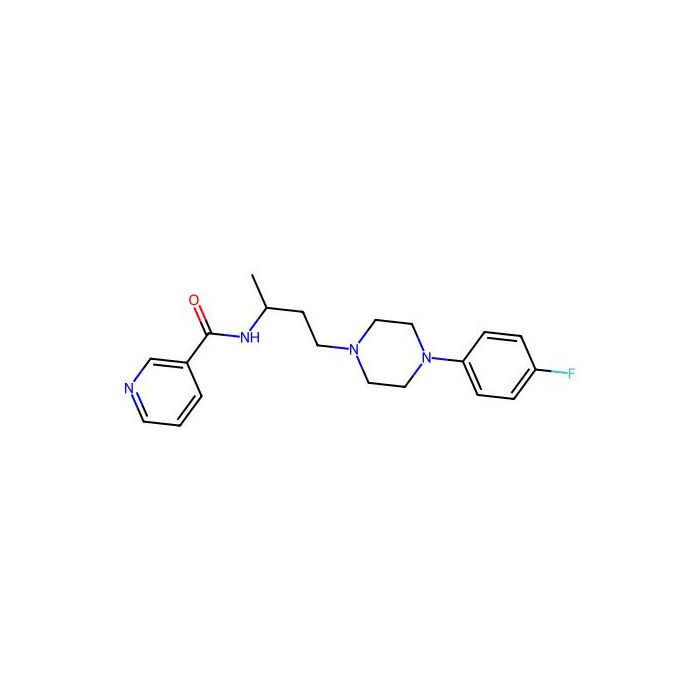
Niaprazine is a histamine H1-receptor antagonist. Niaprazine has antihistamine and antiserotonin activities and can be used for sleep disorder research.
In Vitro
Niaprazine exhibits a low affinity for the vesicular monoamine transporter and for D2, α2, β, H1 and mAch receptors. Niaprazine, particularly the (+)stereoisomer, has a higher affinity for α1 (Ki = 77 nM) and 5-HT2 (Ki = 25 nM) binding sites, but is poorly recognized by 5-HT1A and 5-HT1B binding sites. MCE has not independently confirmed the accuracy of these methods. They are for reference only.
In Vivo
Niaprazine (60 mg/kg; i.p.; once) treatment increases rat brain 5-hydroxyindole acetic acid (5-HIAA) concentrations 30 min after treatment, and reduced them at 3-8 hr after treatment. Niaprazine also produces a short-lasting depletion of rat brain noradrenaline (NA) and dopamine (DA). MCE has not independently confirmed the accuracy of these methods. They are for reference only. Animal Model: Male Sprague-Dawley rats (150-200 g)Dosage: 60 mg/kg Administration: Intraperitoneal injection; once Result: Increased rat brain 5-hydroxyindole acetic acid (5-HIAA) concentrations 30 min after treatment, and reduced them at 3-8 hr after treatment.
Niaprazine is a histamine H1-receptor antagonist. Niaprazine has antihistamine and antiserotonin activities and can be used for sleep disorder research.
Storage
Store at -20°C
Verschickt in
Ice chest + Ice pads
Dieses Produkt erfordert Kühlkettenversand. Grundversand und andere Economy-Optionen sind nicht verfügbar.
This compound belongs to the class of organic compounds known as phenylpiperazines. These are compounds containing a phenylpiperazine skeleton, which consists of a piperazine bound to a phenyl group.
External Descriptors
Not available
1. Djoumbou Feunang Y, Eisner R, Knox C, Chepelev L, Hastings J, Owen G, Fahy E, Steinbeck C, Subramanian S, Bolton E, Greiner R, and Wishart DS. ClassyFire: Automated Chemical Classification With A Comprehensive, Computable Taxonomy. Journal of Cheminformatics, 2016, 8:61.
Zertifikate (CoA, COO, BSE/TSE und Analyse-Diagramm)
C of A & Other Certificates(BSE/TSE, COO):
Analytical Chart:
Chemische und physikalische Eigenschaften
Löslichkeit
DMSO : 100 mg/mL (280.55 mM; Need ultrasonic)
Molekulargewicht
356.4
XLogP3
2.600
Hydrogen Bond Donor Count
1
Hydrogen Bond Acceptor Count
5
Rotatable Bond Count
6
Exact Mass
356.201 Da
Monoisotopic Mass
356.201 Da
Topological Polar Surface Area
48.500 Ų
Heavy Atom Count
26
Formal Charge
0
Complexity
434.000
Isotope Atom Count
0
Defined Atom Stereocenter Count
0
Undefined Atom Stereocenter Count
1
Defined Bond Stereocenter Count
0
Undefined Bond Stereocenter Count
0
The total count of all stereochemical bonds
0
Covalently-Bonded Unit Count
1
Sicherheit und Gefahren (GHS)
Signal
Warning
Gefahrenhinweise
H302:Harmful if swallowed
H315:Causes skin irritation
H319:Causes serious eye irritation
Lösungsrechner
Molarity Calculator
Determine the necessary mass, volume, or concentration for preparing a solution.
Dilution Calculator
Determine the dilution needed to prepare a stock solution.
Reconstitution Calculator
Bewertungen
Kundenbewertungen
Application Protocols
No tested application protocols are provided for this item. The following general procedures are commonly used for small-molecule tool compounds; optimize for your assay.
DMSO stock preparation (general)
Equilibrate vial to room temperature in a desiccator.
Prepare a 10–50 mM stock in anhydrous DMSO. Vortex, gentle warm (≤40°C), and sonicate as needed.
Aliquot in low-bind microtubes; store at −20°C. Avoid repeated freeze–thaw.
Biochemical assay dosing
Prepare intermediate dilutions in assay buffer containing the same final DMSO concentration as vehicle control (commonly 0.1–0.5% v/v).
Include positive/negative control ligands and run duplicates or triplicates with ≥8 concentration points for CRC fitting.
Cell-based assay considerations
Verify compound compatibility with plastics; pre-wet tips and plates with buffer containing 0.1% BSA or 0.01% Tween‑20 if adsorption is suspected.
Limit exposure of concentrated DMSO stocks to cells; perform stepwise dilutions into pre-warmed media.
Analytical reference use
Build a calibration curve (at least 6 levels) in matrix-matched solutions for LC–MS quantification; confirm linearity and carryover.
These are general research-use suggestions, not validated protocols for this specific item.
Biological Roles
No item-specific biological activity data are provided in this listing. The following is general, literature-oriented context to help plan experiments; verify with primary sources and your own assays. No clinical/therapeutic claims are made.
Literature context
Niaprazine is described in the literature as a small molecule within the aryl‑piperazine chemical space, frequently studied for interactions with histamine H1 receptors and certain serotonergic receptor subtypes (e.g., 5‑HT2 family). Reports often characterize it as exhibiting antagonist behavior in these systems. Exact binding affinities, functional profiles, and off‑target panels must be sourced from peer‑reviewed studies and confirmed in-house.
Experimental applications
Radioligand binding assays to derive Ki values at candidate GPCR targets.
ADME profiling (microsomal stability, plasma protein binding, permeability) to contextualize in vitro activity.
Considerations
Receptor pharmacology can be species- and cell-line-dependent; standardize assay conditions (expression level, temperature, buffer composition) and include orthosteric/antagonist controls.
Confirm the exact form supplied (free base vs. salt) as ionization state can impact membrane permeability and apparent potency.
Data integrity
Include internal reference ligands and run concentration–response curves (≥8 points, 0.5-log spacing). Report Hill slopes and replicate statistics to ensure robust conclusions.
Buffer Applications
This product is a small organic research compound and is not itself a buffering agent. Therefore, classical buffer-system formulation (e.g., phosphate, HEPES, Tris) is not typically applicable.
Practical guidance for assay buffers (general)
When using this molecule in biochemical/cellular assays, select a buffer system appropriate to your target biology (e.g., HEPES 20–25 mM, pH 7.2–7.5 for many cell assays; PBS for binding assays) and confirm compound stability in that matrix.
Maintain consistent DMSO content across wells and controls. Pre-dilute compound stocks into assay buffer immediately before dosing to minimize precipitation.
Filter buffers (0.22 µm) and include surfactant (e.g., 0.01–0.05% Tween‑20) where nonspecific adsorption is suspected.
Green Alternatives
While the compound itself is fixed, greener choices can be applied to its handling and analytics.
Solvent choices for dissolution and chromatography
Prefer ethanol or isopropanol over methanol when compatible with your assay (lower toxicity, better green profile), acknowledging potential differences in solubility and assay performance.
Replace DMF with N‑butylpyrrolidone (NBP) or Cyrene where feasible for synthesis/processing; validate solubility and stability.
In LC, consider water–ethanol or water–acetonitrile gradients instead of water–methanol when sensitivity allows. Modern bio-based acetonitrile alternatives are emerging but require validation.
Process and waste minimization
Use miniaturized screens (96/384-well) to reduce solvent/compound consumption.
Adopt analytical methods with shorter run times and sub-2 µm columns to cut solvent usage.
Recycle and segregate solvent waste streams to improve recovery.
Energy and packaging
Consolidate cold shipments and use reusable cold packs where permitted.
Thaw only what you need; store aliquots to avoid repeated freeze–thaw cycles (reduces waste from degraded material).
Trade-offs (balance performance vs. sustainability)
DMSO remains a high-performing solvent for many small molecules; greener replacements often have lower solvating power or higher viscosity. Pilot small-scale tests before broad substitution.
Pharmaceutical Uses
No item-specific pharmacopeial grade, excipient status, or formulation role is provided in this listing. The product is designated For research use only and is not for human or veterinary use.
Research and QC contexts (non-clinical)
May be employed as a reference standard for analytical method development (e.g., LC–MS retention/fragmentation libraries) in R&D environments where niaprazine is a known analyte of interest.
Useful for in vitro target engagement, SAR benchmarking, or comparative profiling in discovery programs.
Compliance reminders
Not GMP-certified; not suitable for clinical trials, API manufacture, or diagnostic applications.
If a pharmaceutical context is anticipated (e.g., preclinical PK), procure appropriate grade and documentation (GMP, DMF) from qualified suppliers.
Documentation to request if needed
CoA with identity/purity, residual solvents, and water content.
TSE/BSE statements and impurity profiles when required by institutional policy (for nonclinical studies).
Stability data or recommended retest dates to support storage and handling.
Physical Properties
Item-specific specifications are not disclosed in this listing. Use the CoA/Spec Sheet and SDS for authoritative values.
Item-specific specs
Molecular formula: Not specified for this item; refer to CoA/Spec Sheet.
Molecular weight: Not specified for this item; refer to CoA/Spec Sheet.
Appearance: Not specified for this item; refer to CoA/Spec Sheet.
Melting/boiling point, density, refractive index, water/peroxide/metal content, UV cutoff: Not specified for this item; refer to CoA/Spec Sheet.
Solubility and partitioning (general guidance)
Stock preparation: Many research groups prepare small-molecule stocks at 10–50 mM in anhydrous DMSO for screening; dilute into assay media immediately before use to keep residual DMSO ≤0.1–0.5% v/v.
Aryl–piperazine-type compounds are typically sparingly soluble in water as free bases but dissolve readily in polar aprotic solvents (DMSO, DMF, acetonitrile) and alcohols (methanol, ethanol). Formation of water-soluble salts (e.g., HCl) can increase aqueous solubility. Verify with your batch.
Literature characterization pointers (no numeric claims)
Typical solid-state form: literature reports for analogous arylpiperazines indicate crystalline solids, with polymorph/salt-form-dependent melting ranges. Confirm for this item.
LogP/pKa: Aryl‑piperazines often present basic pKa values for the secondary amine(s) and moderate lipophilicity; obtain exact values for niaprazine from peer-reviewed sources or experimental titration.
Analytical checks
Confirm identity and purity by NMR, LC–MS/HRMS, and HPLC/UPLC purity prior to critical experiments.
Quality and Grades
Item-specific grade/purity: Not specified for this item; refer to CoA/Spec Sheet. The CoA should list assay purity (e.g., HPLC/GC), water content (Karl Fischer), and residual solvent profile if applicable.
What to expect in Aladdin Scientific CoA/Spec Sheet for small molecules:
Identity: 1H/13C NMR, LC–MS or HRMS, and sometimes IR.
Purity: HPLC/UPLC area% with method details (column, gradient, detection wavelength). If chiral, enantiomeric excess may be provided.
Content: On a solvent-free basis, with correction for water/volatile content if measured.
Impurity control: Limits for key process impurities or isomers when relevant.
Stabilizers/additives: Not specified for this item; refer to CoA/Spec Sheet. If the compound is supplied as a salt (e.g., hydrochloride), the counterion and stoichiometry will be explicitly stated on the CoA.
Practical guidance:
Upon receipt, record lot number and retain a CoA copy with your ELN entry.
For sensitive assays, verify purity by in-house LC–MS and confirm identity by NMR, especially if converting between free-base and salt forms.
If UV detection is used, confirm low baseline absorbance at your analytical wavelength; request chromatogram if needed.
Reaction and Applications
This product is intended primarily as a research small molecule for screening, target engagement, or analytical reference. No manufacturer application notes are provided for this item; the following are general, literature-informed use cases. Validate all conditions experimentally.
Analytical/reference material
Use as a system suitability or reference standard for LC–MS method development (retention time, fragmentation pathway mapping, calibration curves) in studies where niaprazine is a target analyte.
Reported in the literature as an aryl‑piperazine small molecule studied for interactions within histaminergic and serotonergic receptor systems. Such studies typically include radioligand binding, functional antagonism/agonism assays, and off-target profiling. Confirm target panel and EC50/IC50 from primary sources.
Sample preparation/handling tips
Prepare concentrated DMSO stocks (e.g., 10–50 mM) and aliquot to minimize freeze–thaw.
For aqueous assays, dilute into buffer immediately before use; final DMSO ≤0.1–0.5% v/v is common to avoid assay artifacts.
Complementary techniques
Use SPR, DSF, TSA, or CETSA to corroborate target engagement alongside functional readouts.
Employ orthogonal analytical techniques (NMR, HRMS) to verify integrity after long storage.
Not typically used as a building block in synthetic sequences; see “Synthetic Utility” if using as a comparator or impurity standard in route scouting.
Reaction Conditions
No manufacturer-specified reaction conditions are provided, and niaprazine is generally used as a final research compound rather than a reagent. If you intend to derivatize or perform analytical transformations, consider the following general, literature-oriented guidance for aryl‑piperazine chemistry and solution handling.
Stock solution preparation (common lab practice)
Dissolve to 10–50 mM in anhydrous DMSO; sonicate and gently warm (≤40°C) if needed. Filter through 0.22 µm PTFE to remove particulates.
Representative transformation conditions (for analog synthesis; verify structure first)
N‑Acylation: Acid chloride or activated ester (HATU/EDC·HOBt) in DMF/DCM with base (DIPEA, Et3N), 0–25°C, 1–16 h.
N‑Sulfonylation: Aryl/alkyl sulfonyl chlorides, base (pyridine or DIPEA) in DCM/MeCN, 0–25°C, 1–6 h.
Reductive alkylation: Aldehyde/ketone with NaBH(OAc)3 in DCE/MeOH, 0–25°C, 2–12 h.
Workup and purification
Partition between aqueous base and organic solvent (EtOAc/MTBE); watch for emulsion formation with amines.
Purify by flash chromatography (silica) or preparative HPLC; salt-switch at the end if a defined counterion is desired.
Stability checks
Monitor by LC–MS for degradation during heating or exposure to strong acids/bases. Record exact conditions to ensure reproducibility.
All conditions above are general literature guidance and not item-specific specifications.
Safety and Handling
Safety details are not fully specified in this listing. Always consult the product-specific SDS for authoritative guidance.
GHS/Signal word/Pictograms/H-statements: Not specified for this item; refer to SDS.
General hazards for small organic amines/heterocycles (contextual):
May cause skin/eye irritation; avoid inhalation of dust or aerosols. Handle in a fume hood.
Some arylpiperazines can be harmful if swallowed; prevent ingestion and use good laboratory hygiene.
Personal protective equipment (PPE):
Lab coat, nitrile gloves, safety glasses. Use a certified chemical fume hood for weighing and solution prep.
First-aid overview (defer to SDS for details):
Inhalation: Move to fresh air; seek medical attention if symptoms persist.
Skin/eye contact: Rinse with water for ≥15 minutes; remove contaminated clothing; obtain medical advice.
Ingestion: Rinse mouth; do not induce vomiting; seek medical attention.
Handling and storage:
Storage per Product Data: Store at −20°C. Protect from moisture; keep container tightly closed. Allow to warm to room temperature in a desiccator before opening to minimize condensation.
Incompatibilities: Strong oxidizers and strong acids/bases may cause degradation; verify stability via CoA/SDS.
Waste disposal:
Dispose of in accordance with institutional and local regulations for organic chemical waste. Avoid release to the environment.
Transportation: Shipped in ice chest with ice pads per Product Data; do not refreeze gel packs onto product vials to prevent label damage/condensation.
Solvent Selection
Because item-specific solubility data are not provided, select solvents based on common behavior of aryl–piperazine-type small molecules and confirm empirically with your lot.
Primary stock solvents (screening workflows)
DMSO (anhydrous): Typically offers high solubility and chemical stability; suitable for 10–50 mM stocks.
Methanol or ethanol: Useful for spectroscopy or preparative work; watch for protic solvent effects in bioassays.
Acetonitrile or DMF: Alternative polar aprotic media; validate compatibility with downstream assays and plastics.
Aqueous work
Free base often shows limited water solubility. Salt formation (e.g., HCl) or co-solvent systems (DMSO 1–5% + buffer) can improve dissolution. Filter-sterilize through PTFE/RC membranes if needed.
MeOH/EtOH: easy to dry/evaporate; consider volatility and toxicity in cell systems.
MeCN: LC–MS friendly; moderate solubility.
Tips
Warm (25–40°C) and sonicate to aid dissolution. Avoid strong acids/bases unless making a defined salt; confirm stability first.
Storage and Reconstitution
Storage conditions (item-specific from Product Data)
Store at −20°C.
Shipped in an ice chest with ice pads. Inspect upon arrival; if thawed, allow to reach room temperature before opening to avoid condensation, then return to −20°C storage.
Container and environment
Keep tightly closed in the original container. Store under desiccation and protect from moisture. If the compound is light-sensitive (check CoA/SDS), protect from light with amber vials or foil.
Reconstitution (general guidance for small molecules)
Solvent: Use anhydrous DMSO for concentrated stocks (e.g., 10–50 mM). Alternative solvents (MeOH, EtOH, MeCN) may be suitable; verify solubility and stability with your batch.
Technique: Warm gently (≤40°C) and sonicate to aid dissolution. Filter (0.22 µm PTFE) if particulates remain.
Aliquoting: Dispense single-use aliquots to minimize freeze–thaw cycles. Label with concentration, solvent, date, and lot.
Stability and retest
Retest/expiry: Not specified for this item; refer to CoA/Spec Sheet.
Monitor integrity by periodic LC–MS/HPLC. Discard if significant degradation or precipitation is observed.
Usage notes
For aqueous work, dilute DMSO stocks into buffer immediately before use and maintain consistent DMSO across controls.
Avoid repeated warming/cooling; prolonged bench exposure can introduce moisture and accelerate degradation.
Research use only
As stated: For research use only; not for human or veterinary use.
Structure and Identity
Brief overview: Niaprazine is listed here as a small-molecule research chemical (small molecules and compound library category). Item-specific identifiers are limited in this catalog entry; consult the CoA/Spec Sheet for definitive identifiers.
Item-specific identifiers (from Product Data)
SKU: N651642
Product name: Niaprazine
CAS: 27367-90-4
PubChem CID: 71919
InChIKey: Not specified for this item; refer to CoA/Spec Sheet. (Note: the listing value appears truncated.)
SMILES: Not specified for this item; refer to CoA/Spec Sheet.
Structural features (item-specific):
Functional groups, ring systems, and stereochemistry: Not specified for this item; refer to CoA/Spec Sheet.
Literature context (for orientation only; verify before use)
Chemical class: Frequently described in the literature as a phenylpiperazine-type small molecule. Verify exact structure against primary references/CoA.
2D structural description (literature): Typically a substituted aryl–piperazine scaffold (six-membered N,N′-heterocycle linked to an aryl moiety). Exact substitution pattern must be confirmed from authoritative structural data.
Best practice
Always reconcile CAS (27367-90-4) and any spectral data (1H/13C NMR, HRMS) on the CoA with your intended structure before building assays or analytical methods.
Synthetic Utility
Niaprazine is typically used as a finished small-molecule research tool rather than as a synthetic intermediate. Item-specific functional groups are not disclosed here; the following notes reflect generic aryl‑piperazine chemistry for researchers considering derivatization or analytical comparisons.
Generic reactivity (literature context)
Aryl–piperazine motifs engage in N‑functionalization (acylation, sulfonylation, alkylation) and aryl–nitrogen coupling (Buchwald–Hartwig) during synthesis. Late-stage diversification is often feasible on the secondary amine.
Salt formation (e.g., HCl, mesylate) can tune solid-state properties for crystallization and purification.
Analytical relevance
Synthetic route benchmarking: Niaprazine can serve as a comparator or impurity standard in route scouting for related scaffolds.
Derivatization (e.g., dansylation, acylation) may assist in LC–MS sensitivity or fluorescence tagging for bioanalytical assays.
Protecting-group strategy (if modifying)
Boc or Cbz protection of the piperazine nitrogen(s) is common to enable selective transformations elsewhere on the scaffold.
Caution
Exact positions available for derivatization depend on the true substitution pattern of niaprazine; confirm structure via CoA/literature before planning synthetic manipulations.
Avoid overalkylation or formation of quaternary ammonium salts unless specifically desired.
Target Specificity
Item-specific target information (antigen/epitope/clone/isotype/species) is not applicable; this product is a small organic compound, not a biological antibody or protein.
For small-molecule target engagement (general, literature-based context):
Niaprazine has been studied in the literature as a ligand interacting with histaminergic and serotonergic GPCRs. However, no target specificity, affinity data, or selectivity panel is provided for this catalog item. Users should consult peer-reviewed sources and generate in‑house binding/function data to establish specificity for their systems.
Häufig gestellte Fragen
What is the purity of this product?
This product is supplied at ≥99% purity (chemical assay). Lot-specific values are stated on the Certificate of Analysis.
How should this product be stored?
Store at ?20 °C. Freezer storage is required to maintain the specified shelf life.
How is this product shipped?
This product ships in an insulated container with ice pads. Unpack on arrival and transfer it to the storage condition stated above.
What are the CAS number, molecular formula and molecular weight?
The CAS Number is 27367-90-4, the molecular formula is C20H25FN4O, and the molecular weight is 356.4 g/mol. InChIKey RSKQGBFMNPDPLR-UHFFFAOYSA-N.
What documentation is provided?
Available product documentation, including Certificates of Analysis (COA), Safety Data Sheets (SDS), and specification sheets, is shown in the product document area. Document availability and access follow the current site policy.
Wir verwenden Cookies, um die ordnungsgemäße Funktion der Website sicherzustellen und, soweit zulässig, Ihr Nutzererlebnis zu verbessern. Sie können Ihre Einstellungen jederzeit unter „Einstellungen“ verwalten. Weitere Informationen finden Sie in unserer Cookie-Richtlinie.
Dürfen wir Sie über Rabattaktionen informieren?
Später erinnern
Vielen Dank! Bitte überprüfen Sie Ihren E-Mail-Posteingang, um zu bestätigen.
Products are supplied to verified businesses, institutions, and qualified professionals for research and development use only. Not for use in humans, animals, diagnosis, or therapy.