Determine the necessary mass, volume, or concentration for preparing a solution.
| Activity Type | Activity Value -log(M) | Mechanism of Action | Activity Reference | Publications (PubMed IDs) |
|---|

Information
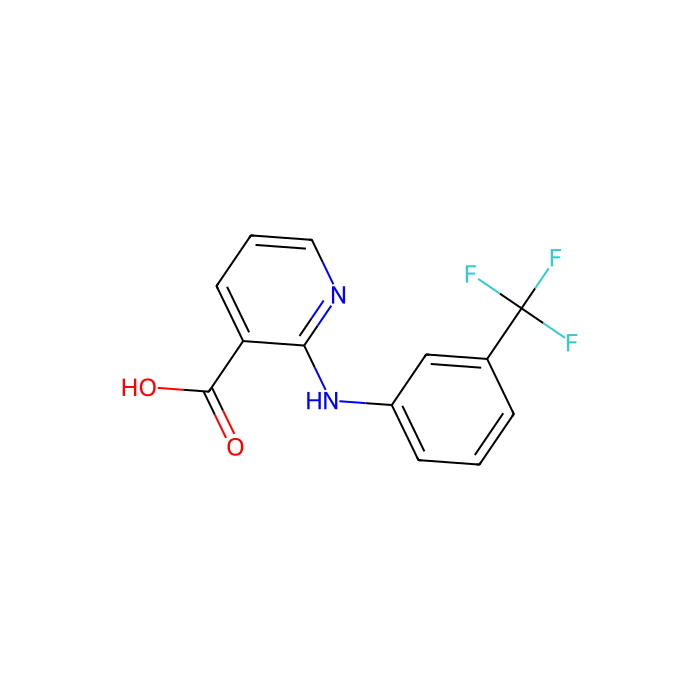
Niflumic acid is an inhibitor of cyclooxygenase-2 used for joint and muscular pain.
In vitro
Niflumic acid inhibits Ca2+-activated Cl- channels with inhibition constant of 17 mM. Niflumic acid also inhibits ICl(Ca) elicited by bath application of Ca2+ to oocytes permeabilized using the Ca2+ ionophore A23187, demonstrating that the inhibition of ICl(Ca) is due to a direct interaction with the Cl- channel, rather than by interference with Ca2+ entry through voltage-dependent Ca2+ channels. Niflumic acid blocks Ca2+-activated non-selective cation channels in inside-out patches from the basolateral membrane of rat exocrine pancreatic cells with IC50 of 50 μM. Niflumic acid dose-dependently and reversibly activates large conductance calcium-activated K+ (KCa) channels. Niflumic acid produces a concentration-dependent inhibition of spontaneous transient inward current (STIC, calcium-activated chloride current) amplitude. Niflumic acid inhibits noradrenaline- and caffeine-evoked IO(Ca) with an ICM50 of 6.6 μM, i.e.is less potent against evoked currents compared to spontaneous currents. Niflumic acid voltage-dependently inhibits spontaneous transient inward current (STIC) amplitude with IC50 of 2.3 μM and 1.1 μM at -50 and +50 mV respectively. Niflumic acid inhibits not only IL-13-induced goblet cell hyperplasia but also airway hyperresponsiveness and eosinophilic infiltration. Niflumic suppresses the eotaxin levels in bronchoalveolar lavage fluids and overexpression of the MUC5AC gene, a marker of goblet cell hyperplasia, in the lung after IL-13 instillation. Niflumic acid suppresses JAK2 activation, STAT6 activation, and eotaxin expression in epithelial cells.
In vivo
Cell Data
cell lines:
Concentrations:
Incubation Time:
Powder Purity:≥99%
| Activity Type | Activity Value -log(M) | Mechanism of Action | Activity Reference | Publications (PubMed IDs) |
|---|
| Activity Type | Activity Value -log(M) | Mechanism of Action | Activity Reference | Publications (PubMed IDs) |
|---|
| Activity Type | Activity Value -log(M) | Mechanism of Action | Activity Reference | Publications (PubMed IDs) |
|---|
| Activity Type | Activity Value -log(M) | Mechanism of Action | Activity Reference | Publications (PubMed IDs) |
|---|
Find and download the COA for your product by matching the lot number on the packaging.
| Lot Number | Certificate Type | Datum | Artikel |
|---|---|---|---|
 C2315448 | Certificate of Analysis | Sep 28, 2026 | N409062 |
| Löslichkeit | Solubility (25°C) In vitro DMSO: 66 mg/mL warmed with 50ºC Water: bath (197.54 mM); Ethanol: 20 mg/mL warmed with 50ºC Water: bath (59.86 mM); Water: Insoluble; |
|---|---|
| Schmelzpunkt (°C) | 203-204 °C |
H315:Causes skin irritation
H319:Causes serious eye irritation
H335:May cause respiratory irritation
H301:Toxic if swallowed
H413:May cause long lasting harmful effects to aquatic life
H302:Harmful if swallowed
H312:Harmful in contact with skin
H332:Harmful if inhaled
P261:Avoid breathing dust/fume/gas/mist/vapors/spray.
P305+P351+P338:IF IN EYES: Rinse cautiously with water for several minutes. Remove contact lenses if present and easy to do - continue rinsing.
P273:Avoid release to the environment.
P280:Wear protective gloves/protective clothing/eye protection/face protection.
P302+P352:IF ON SKIN: wash with plenty of water.
P321:Specific treatment (see ... on this label).
P405:Store locked up.
P501:Dispose of contents/container to an approved waste disposal plant.
P264:Wash hands [and …] thoroughly after handling.
P271:Use only outdoors or in a well-ventilated area.
P270:Do not eat, drink or smoke when using this product.
P304+P340:IF INHALED: Remove person to fresh air and keep comfortable for breathing.
P403+P233:Store in a well-ventilated place. Keep container tightly closed.
P362+P364:Take off contaminated clothing and wash it before reuse.
P330:Rinse mouth.
P264+P265:Wash hands [and …] thoroughly after handling. Do not touch eyes.
P301+P316:IF SWALLOWED: Get emergency medical help immediately.
P301+P317:IF SWALLOWED: Get medical help.
P317:Get emergency medical help.
P337+P317:If eye irritation persists: Get medical help.
P332+P317:If skin irritation occurs: Get medical help.
P319:Get medical help if you feel unwell.
Unser Leitfaden zur Qualitätsauswahl behandelt Reinheit, Stabilisatorstatus und Anwendungseignung für alle Varianten in unserem Katalog.
Moligand™ Qualitätsleitfaden ansehen →