GRADE & PURITYMoligand™?Moligand™ — Aladdin's line of ligands and bioactive small molecules. Use for receptor, pathway, and binding studies needing defined small-molecule tools.10 mM in DMSO
Moligand™, 10 mM in DMSO Moligand™ for sensitive chromatographic and analytical workflows requiring minimal baseline interference.
🌡
Storage & shipping
Protected from light,Argon charged,Store at -80°C Ships Dry ice packs + Cold packs Check lot-specific COA for exact specifications.
📋
Quality documents
SDS, COA, datasheet, and spec sheet available for download. Lot-specific COA accessible via lot number lookup.
📚
Literature proof
Cited in 0 peer-reviewed publications across chromatography, organic synthesis, and cross-coupling reactions.
Übersicht
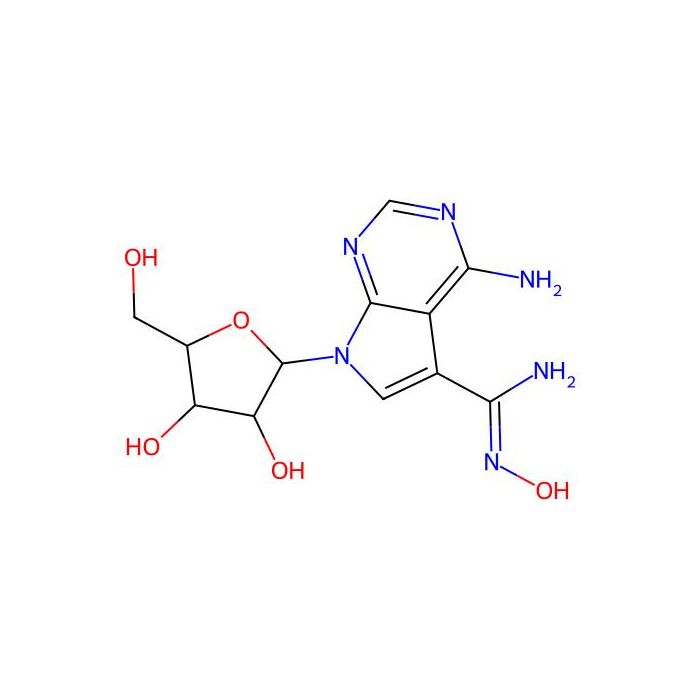
NSC 107512 is a potent inhibitor of cyclin-dependent kinase 9 ( CDK9 ). NSC 107512 is a class of sangivamycin-like molecules (SLM). NSC 107512 inhibits growth and induces apoptosis of multiple myeloma tumors.
Specifications
Spezifikationen & Reinheit
Moligand™, 10 mM in DMSO
Storage
Protected from light,Argon charged,Store at -80°C
Verschickt in
Dry ice packs + Cold packs
Dieses Produkt erfordert Kühlkettenversand. Grundversand und andere Economy-Optionen sind nicht verfügbar.
Note
Moligand™
Namen und Kennungen
Isomere SMILES
C1=C(C2=C(N=CN=C2N1C3C(C(C(O3)CO)O)O)N)/C(=N/O)/N
PubChem CID
5369182
Molekulargewicht
324.29
Documentation
📋 Safety Data Sheet (SDS)
Comprehensive hazard, handling, storage, and regulatory compliance document.
Zertifikate (CoA, COO, BSE/TSE und Analyse-Diagramm)
C of A & Other Certificates(BSE/TSE, COO):
Analytical Chart:
Lösungsrechner
Molarity Calculator
Determine the necessary mass, volume, or concentration for preparing a solution.
Dilution Calculator
Determine the dilution needed to prepare a stock solution.
Reconstitution Calculator
Bewertungen
Kundenbewertungen
Application Protocols
No validated application protocols are provided for this specific item in the Product Data.
General example workflow for screening compounds:
Stock solution: Prepare at 10–50 mM in anhydrous DMSO. Store single-use aliquots at –80°C, protected from light (per Product Data), under inert gas.
Plate preparation: Thaw on ice or at 4°C, brief vortex, spin down, and dispense into assay plates using acoustic or tip-based transfer. Keep exposure to ambient light minimal; use amber plates or covers.
Assay execution: Include vehicle controls matched for DMSO content across all wells; run a short solubility/precipitation check upon dilution.
Data quality: Implement duplicate or triplicate wells, Z′-factor assessment, and orthogonal counterscreens to flag interference liabilities.
Documentation:
Record lot number, preparation date, and storage history for each stock aliquot to support reproducibility and data integrity.
Biological Roles
Item-specific (from Product Data):
No biological mechanism, pathway, or target annotation is specified for this item.
General context for NSC-designated small molecules:
NSC registry compounds span diverse chemotypes and were historically assessed in anticancer-relevant panels; however, any specific mode of action for NSC 107512 is not provided here and should not be inferred without data.
In modern discovery, such compounds may serve as chemical probes or starting points for SAR once a reproducible, target-relevant phenotype is observed (general practice).
Practical recommendations (general):
Establish a clear MoA hypothesis through orthogonal assays (biochemical vs cell-based) and target engagement techniques (e.g., CETSA/DSF, photoaffinity or CETSA-like approaches if compatible).
Evaluate potential assay interference liabilities (fluorescence/absorbance overlap, redox cycling, aggregation) early, and incorporate vehicle and unrelated-target counterscreens.
Report concentrations as both µM and v/v solvent percentages to facilitate cross-lab reproducibility.
Notes:
No endogenous biological role is claimed or implied. All uses are for research laboratory studies only.
Buffer Applications
This product is a small-molecule library member and not a buffering agent.
Item-specific: No buffer system role is specified for this item.
Practical notes (general):
When formulating assay buffers for small-molecule testing, select established systems (e.g., HEPES pH 7.2–7.6, Tris pH 7.5–8.0, phosphate pH 6.5–7.5) appropriate for your biological target. Maintain consistent ionic strength and include low detergent (0.01–0.05% Tween-20) as needed to mitigate compound aggregation.
Verify compound stability across the assay pH and buffer composition; some chemotypes can hydrolyze or tautomerize depending on pH and nucleophilicity of buffer components.
Green Alternatives
Because this item is a screening small molecule rather than a bulk solvent or reagent, “green alternatives” focus on greener handling of stocks and assay workflows.
Greener solvent considerations (general):
Prefer minimal DMSO percentage in assays (≤0.5–1% v/v) to reduce solvent footprint and biological perturbation.
Where compatible, consider ethanol or aqueous co-solvent blends as alternatives for highly soluble chemotypes.
Use 2-MeTHF or bio-based ethanol for preparative solution-making when appropriate; avoid chlorinated solvents unless necessary.
Operational sustainability:
Prepare higher-concentration master stocks to reduce total solvent volume and shipping weight.
Consolidate plate maps to minimize dead volume; employ low-adsorption tips and resealable foil to extend stock life.
Implement microscale assays (384/1536-well) to decrease reagent consumption and waste.
Waste management:
Segregate organic DMSO waste from aqueous assay waste for optimized disposal.
Use light-protective secondary containment to extend compound viability and reduce disposal due to degradation.
Tradeoffs (general):
Lower-toxicity solvents may reduce solubility margins; validate solubility and assay performance before full deployment.
Pharmaceutical Uses
No pharmaceutical or clinical use is specified or implied for this product.
Item-specific:
Research Use Note: For research use only. Not for human or veterinary use, clinical diagnostics, or therapeutic applications.
General formulation context (if used in preclinical lab studies):
For in vitro and ex vivo experiments, prepare DMSO stocks and dilute into compatible media with strict control of final solvent percentage.
For non-clinical in vivo method development, vehicle systems (e.g., PEG400/saline, Captisol, 0.5% methylcellulose/0.1% Tween-80) are commonly evaluated in research settings; any such use requires local IACUC/ethical approval and is outside the scope of this product listing. No claims are made for suitability in regulated development.
Compliance reminder:
This item carries no pharmacopeial monograph status in the Product Data. For GMP or clinical applications, source appropriately qualified materials and documentation.
Physical Properties
Item-specific (from Product Data):
Appearance: Not specified for this item; refer to CoA/Spec Sheet.
Molecular weight: Not specified for this item; refer to CoA/Spec Sheet.
Literature/computed values (if needed for planning):
Boiling point, melting point, density, refractive index, logP/logD, pKa, and aqueous/organic solubility are not provided here. For this screening compound, consult CoA/Spec Sheet or authoritative databases linked via CAS 22242-89-3 or CID 5369182 (literature). Any values retrieved from external databases should be used as planning estimates only and not treated as product specifications.
Practical notes (general):
For small-molecule screening compounds with unknown solubility, begin with anhydrous DMSO (literature best practice). If insoluble, consider DMF, ethanol, or co-solvent blends for stock preparation, then dilute into assay buffers keeping final organic content ≤1–2% v/v when compatible with the biology.
Hygroscopicity and photolability are unknown for this item; Product Data indicates protection from light and inert gas storage, suggesting precautionary handling to minimize oxidation/hydrolysis during long-term storage (general guidance).
Intended for discovery and screening workflows (e.g., biochemical/biophysical assays, phenotypic screens) where identity and suitability for stock preparation are paramount.
Emphasis on: authenticated identity against registry (e.g., CAS/CID/NSC), appropriate packaging for long-term stability (argon, light protection), and compatibility with plate-based dispensing.
Documentation and traceability:
For assay-critical parameters (exact purity method/level, residual solvents, water content, stabilizers, salt form), refer to the item-specific CoA/Spec Sheet. If you require particular analytical thresholds (e.g., metal content for catalysis or UV-cutoff for chromatography), request batch documentation prior to use.
Practical implications:
Screen compounds often ship as neat solids or film-in-vial for DMSO reconstitution. If UV background, fluorescent impurities, or particulates are critical to your readout, filter reconstituted stocks (0.2 µm PTFE) and verify by analytical LC/UV/MS prior to screening.
For orthogonal confirmation, compare activity with fresh lot or independently sourced material as good screening practice.
Reaction and Applications
This product is positioned as a screening small molecule rather than a synthetic reagent, so classic named-reaction roles are not typically applicable to its use.
Item-specific (from Product Data):
Category: Small molecules and compound libraries; Research use only.
Cell-based/phenotypic assays: pilot potency and cytotoxicity windows, with stringent vehicle controls and precipitation checks.
Profiling/annotation: cheminformatic linkage via NSC/CID to public data; orthogonal counter-screens to flag pan-assay interference (PAINS) or redox/aggregator behaviors (literature best practice).
Practical tips (general):
Include DTT/TCEP considerations: some scaffolds are thiol-reactive; run thiol-dependence controls.
Aggregation control: incorporate low detergent (0.01–0.05% Tween-20) and dynamic light scattering on suspect hits.
Redox/artifact checks: add catalase/HRP or H2O2 detection in redox-cycling-prone assays.
Light sensitivity: Product Data recommends protection from light; use amber vials/plates and minimize exposure during assays.
Reaction Conditions
Conventional reaction-condition guidance is not applicable because this product is offered as a screening small molecule, not as a reagent or catalyst.
Item-specific:
No synthetic or catalytic application data are provided for this item.
General best practices for assay solution preparation:
Stock preparation: Dissolve in anhydrous DMSO at a defined concentration (e.g., 10–50 mM), using vortexing and brief sonication. Filter through 0.2 µm PTFE if particulate is observed.
Working solutions: Dilute into assay buffer to the desired µM concentration, ensuring final organic solvent content is typically ≤1% v/v (optimize per assay).
Light and oxygen control: Prepare and dispense using amberware; minimize headspace and maintain inert atmosphere for long-term aliquots consistent with Product Data.
Stability checks: Confirm no time-dependent precipitation or degradation over the assay window using quick LC/UV or plate-reader pre/post reads (general practice).
Safety and Handling
Item-specific (from Product Data):
Storage: Protected from light, Argon charged, Store at -80°C.
Shipping: Dry ice packs + Cold packs.
GHS/Signal word/H-statements/Pictograms: Not specified for this item; refer to SDS.
General laboratory safety (defer to SDS as authoritative):
Handle within a chemical fume hood or ventilated enclosure. Avoid inhalation of dust/aerosols and skin/eye contact.
PPE: lab coat, safety glasses or goggles, and appropriate chemically resistant gloves (e.g., nitrile); upgrade to double-gloving when preparing concentrated DMSO stocks.
Incompatibilities (general): strong oxidizers/reducers, strong acids/bases, and moisture/air for oxidation-sensitive compounds. Protect from light per Product Data.
First aid (general): rinse skin/eyes with water for ≥15 minutes upon contact; remove contaminated clothing. If inhaled, move to fresh air. If ingested, rinse mouth; do not induce vomiting; seek medical attention. Always consult the SDS for compound-specific guidance.
Spill/accidental release: absorb with inert material, collect in sealed container for hazardous waste disposal. Prevent discharge to drains.
Fire safety: use CO2, dry chemical, or foam as appropriate. Combustion may generate CO/CO2 and unknown toxic fumes; firefighters should wear SCBA.
Waste: dispose of solutions and solids as hazardous chemical waste according to institutional and regulatory requirements.
Solvent Selection
Item-specific (from Product Data):
Specific solubility profile: Not specified for this item; refer to CoA/Spec Sheet.
General guidance for screening compounds:
Primary solvent: anhydrous DMSO is the typical first choice for library compounds due to broad solvating power and assay compatibility at ≤1–2% v/v final.
Secondary solvents/co-solvents: DMF, ethanol, isopropanol, acetonitrile. For water-intolerant chemotypes, prepare a concentrated DMSO stock (e.g., 10–50 mM) and dilute into assay buffer with surfactant (0.01–0.05% Tween-20) to mitigate precipitation (general practice).
Buffer compatibility: match pH and ionic strength of your assay; avoid phosphate with metal-requiring biophysical methods (e.g., ITC with divalent cations).
Small comparison (general):
DMSO: highest solvency; may affect membrane assays at >1%.
Ethanol/IPA: lower polarity; useful for hydrophobic scaffolds; higher volatility.
Acetonitrile: miscible with water; suitable for LC makeups; can denature proteins at higher %.
Practical tips:
Warm gently (room temp to 37°C) and vortex/sonicate to dissolve; avoid prolonged heating or light exposure.
Verify solubility visually and by a quick nephelometry/UV check after dilution to working concentration.
Storage and Reconstitution
Item-specific (from Product Data):
Storage conditions: Protected from light, Argon charged, Store at -80°C.
Shipped in: Dry ice packs + Cold packs.
Reconstitution (general best practice for screening compounds):
Solvent: Use anhydrous DMSO for initial stock preparation unless the CoA/Spec Sheet indicates otherwise. Start with 10–50 mM stock; adjust based on solubility.
Procedure: Equilibrate vial to room temperature in a desiccated, light-protected environment before opening to prevent condensation. Add pre-warmed DMSO, vortex, and briefly sonicate if needed. If undissolved material persists, consider incremental solvent addition or a compatible co-solvent.
Filtration: If necessary, pass solution through a 0.2 µm PTFE syringe filter to remove particulates.
Aliquoting: Dispense single-use aliquots into amber, low-bind microtubes or 96/384-well plates. Backfill headspace with inert gas (argon or nitrogen), seal, and freeze at –80°C.
Stability and handling:
Minimize freeze–thaw cycles; use single-use aliquots. Limit cumulative time at ambient temperature and exposure to light during handling.
For long-term storage, maintain continuous –80°C conditions; re-verify integrity periodically via LC/UV/MS.
Specifications reminder:
Any item-specific solubility, salt form, water content, or stabilizer information is Not specified for this item; refer to CoA/Spec Sheet.
Structure and Identity
Brief overview: NSC 107512 is an NIH/NCI Developmental Therapeutics Program (DTP) registry small molecule entry suitable for screening libraries.
Item-specific (from Product Data):
SKU: N1496915
Product Name: NSC 107512
CAS: 22242-89-3
PubChem CID: 5369182
Grade: Moligand™
InChIKey: Not specified for this item; refer to CoA/Spec Sheet.
SMILES: Not specified for this item; refer to CoA/Spec Sheet.
Molecular formula: Not specified for this item; refer to CoA/Spec Sheet.
Molecular weight: Not specified for this item; refer to CoA/Spec Sheet.
Literature/registry context (general):
NSC numbers uniquely identify small molecules within the NCI DTP collection. Mapping to PubChem CID facilitates access to third-party structural records (literature).
Structural features (descriptive, contingent on structure availability):
2D structure, ring systems, and functional groups are not provided in the Product Data. Consult the CoA/Spec Sheet or the cited registry identifiers for the definitive 2D/3D representation (literature).
Synthetic Utility
This listing is for a screening compound rather than a general-purpose synthetic reagent, and item-specific functional group information is not provided.
Item-specific:
Structural/reactive functional groups: Not specified for this item; refer to CoA/Spec Sheet.
General considerations:
If structure is confirmed from registry data (literature), synthetic derivatization and SAR exploration may be pursued by medicinal chemists; however, this falls outside the scope of this catalog entry.
For route-scouting or analog synthesis, consult primary literature associated with the CAS (22242-89-3) or CID (5369182) to identify scalable syntheses, protecting-group strategies, and stability liabilities (literature).
Practical notes for chemists (general):
Prior to any chemistry, verify salt form and hydration state; convert to a free base/acid if necessary for consistent stoichiometry.
Record NMR/LC-MS of the working lot to anchor SAR data. Where relevant, check for atropisomerism/tautomerism that could influence bioassay results.
Target Specificity
No target, pathway, or protein specificity is provided for this item.
Item-specific:
Target/epitope/clone/isotype: Not applicable; this is a small molecule, not an antibody or biologic.
General recommendation:
Determine target specificity empirically via orthogonal assays (biochemical potency vs. cell-based efficacy), ligand-binding biophysics (SPR/MST/ITC), chemoproteomics, or genetic validation (knockdown/knockout/rescue). Incorporate broad counter-screens to uncover off-target activity.
Need help choosing the grade?
Our grade selection guide covers purity, stabilizer status, and application suitability for all variants in our catalog.
Wir verwenden Cookies, um die ordnungsgemäße Funktion der Website sicherzustellen und, soweit zulässig, Ihr Nutzererlebnis zu verbessern. Sie können Ihre Einstellungen jederzeit unter „Einstellungen“ verwalten. Weitere Informationen finden Sie in unserer Cookie-Richtlinie.
Shall we send you a message when we have discounts available?
Remind me later
Thank you! Please check your email inbox to confirm.
Products are supplied to verified businesses, institutions, and qualified professionals for research and development use only. Not for use in humans, animals, diagnosis, or therapy.