GRADE & PURITYMoligand™?Moligand™ — Aladdin's line of ligands and bioactive small molecules. Use for receptor, pathway, and binding studies needing defined small-molecule tools.≥98%(HPLC)
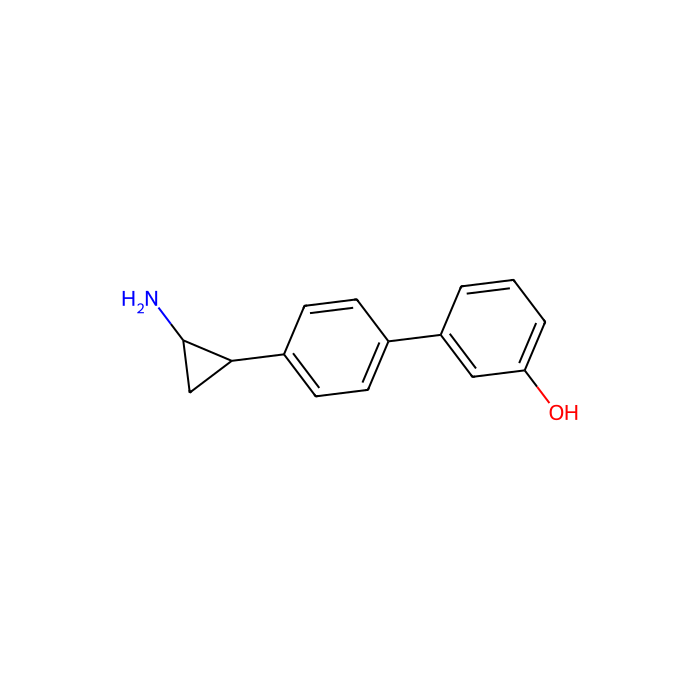
Potent LSD1 inhibitor (IC50= 20 nM). Exhibits some selectivity for LSD1 over MAO-B and MAO-A (IC50values are 0.72 and 1.38 μM, respectively). Inhibits herpes simplex virus (HSV) immediate early gene expression and viral yieldin vitro. Suppresses HSV prima
Storage
Store at -20°C
Verschickt in
Ice chest + Ice pads
Dieses Produkt erfordert Kühlkettenversand. Grundversand und andere Economy-Optionen sind nicht verfügbar.
This compound belongs to the class of organic compounds known as biphenyls and derivatives. These are organic compounds containing to benzene rings linked together by a C-C bond.
External Descriptors
Not available
1. Djoumbou Feunang Y, Eisner R, Knox C, Chepelev L, Hastings J, Owen G, Fahy E, Steinbeck C, Subramanian S, Bolton E, Greiner R, and Wishart DS. ClassyFire: Automated Chemical Classification With A Comprehensive, Computable Taxonomy. Journal of Cheminformatics, 2016, 8:61.
Solvent:DMSO, Max Conc. mg/mL: 22.53, Max Conc. mM: 100; Solvent:ethanol, Max Conc. mg/mL: 22.53, Max Conc. mM: 100; Solvent:1eq. HCl, Max Conc. mg/mL: 4.51, Max Conc. mM: 20
Molekulargewicht
225.280 g/mol
XLogP3
2.500
Hydrogen Bond Donor Count
2
Hydrogen Bond Acceptor Count
2
Rotatable Bond Count
2
Exact Mass
225.115 Da
Monoisotopic Mass
225.115 Da
Topological Polar Surface Area
46.300 Ų
Heavy Atom Count
17
Formal Charge
0
Complexity
260.000
Isotope Atom Count
0
Defined Atom Stereocenter Count
2
Undefined Atom Stereocenter Count
0
Defined Bond Stereocenter Count
0
Undefined Bond Stereocenter Count
0
The total count of all stereochemical bonds
0
Covalently-Bonded Unit Count
1
Lösungsrechner
Molarity Calculator
Determine the necessary mass, volume, or concentration for preparing a solution.
Dilution Calculator
Determine the dilution needed to prepare a stock solution.
Reconstitution Calculator
Bewertungen
Kundenbewertungen
Application Protocols
Only application details provided in the Product Data may be listed as item-specific. None are provided for this item.
Item-specific
Tested applications, recommended working concentrations/dilutions, and controls: Not specified for this item; refer to CoA/Spec Sheet.
General good practice for small-molecule probes (non-item-specific)
Prepare a concentrated DMSO stock (e.g., 10–50 mM) once solubility is confirmed; aliquot to minimize freeze–thaw.
Include vehicle-only controls and a reference compound (if available) in every assay plate.
Establish a serial dilution curve (10–12 points) spanning at least 3 logs of concentration; quantify potency with appropriate models (e.g., four-parameter logistic fit).
Verify compound integrity before and after assays by LC–MS.
For cell assays, confirm that the final DMSO ≤0.5–1% v/v is tolerated by your system.
Biological Roles
Context from literature (not product specification): OG-L002 is widely reported as a small-molecule epigenetic probe that inhibits the lysine-specific demethylase KDM1A/LSD1, an FAD-dependent amine oxidase family enzyme involved in demethylating mono- and dimethylated H3K4. By modulating LSD1 activity, OG-L002 has been used to probe chromatin state, transcriptional programs, and differentiation pathways in various model systems. Always corroborate target engagement and off-target profiles experimentally in your system.
Biochemistry-focused considerations (general)
Mechanistic class (literature): Reversible inhibition of LSD1 with selectivity over MAO isoforms has been described for OG-L002. Cellular activity is typically assessed via changes in histone methyl marks and expression of lineage markers.
Pathways: Impacts on gene regulation networks, including those controlled by CoREST and nuclear hormone receptor complexes, are often evaluated when using LSD1 inhibitors as probes.
Assay readouts: Western blot/ELISA of histone marks, RT-qPCR/RNA-seq for transcriptional changes, and phenotypic readouts (e.g., neurite outgrowth, differentiation markers) are common in research.
Important caveats
The above roles are summarized from the scientific literature and are not item-specific guarantees. Do not infer therapeutic suitability. For accurate potency/selectivity in your system, perform de novo biochemical IC50 and cellular EC50 determinations with appropriate controls.
Buffer Applications
This product is not a buffering agent. It does not form a defined buffer system with a target pH range. Therefore, classic buffer recipes (e.g., phosphate, Tris, HEPES) do not apply.
Practical notes for assay buffers (general guidance)
When preparing biochemical or cell-based assays, maintain constant vehicle % (e.g., DMSO 0.1–1%) across all wells including controls.
Use protein stabilizers (e.g., BSA 0.01–0.1%) if nonspecific adsorption of hydrophobic ligands is suspected.
Consider surfactants at low levels (e.g., 0.01% Tween-20) to mitigate colloid formation, after verifying no assay interference.
Maintain appropriate ionic strength and pH for the target enzyme/protein and confirm ligand stability at that pH via LC–MS.
Green Alternatives
Because OG-L002 is a discrete bioactive small molecule rather than a commodity solvent or reagent, “green substitution” is generally not applicable in the conventional sense.
Practical green chemistry considerations for use (general)
Minimize solvent volumes: Prepare concentrated DMSO stocks (e.g., 10–50 mM) to reduce solvent consumption across screening cascades.
Right-size aliquots: Aliquot into small vials to prevent repeated thawing and disposal of partially used material.
Aqueous compatibility: Where feasible, shift to buffered aqueous working solutions with minimal DMSO (≤0.5% v/v) while maintaining solubility and assay integrity.
Waste management: Segregate halogenated vs non-halogenated organic waste streams; avoid unnecessary mixed waste that is harder to treat.
Comparison note
Replacing OG-L002 with a different compound to achieve “greener” performance would change biological activity and is not a like-for-like substitution. Sustainability gains are better achieved via solvent and workflow optimization rather than altering the probe identity.
Pharmaceutical Uses
This catalog item is supplied strictly for research use only and is not intended for human or veterinary use.
Formulation/CMC context (general, non-clinical)
In preclinical research settings, small-molecule probes like OG-L002 are often formulated as DMSO stock solutions for in vitro work and, when applicable, dispersed in aqueous vehicles (e.g., saline with co-solvent or cyclodextrin) for exploratory in vivo pharmacology. Such uses require institution-specific approvals and are outside the scope of this catalog listing.
There is no stated pharmacopoeial status (e.g., USP/EP) or excipient role for this item. Any such attributes are Not specified for this item; refer to CoA/Spec Sheet.
Manufacturing and handling considerations
If conducting nonclinical studies, document salt form, counterions, and residual solvent to ensure dose accuracy and reproducibility.
Implement light/moisture protection and minimize freeze–thaw cycles to maintain integrity across study lots.
No therapeutic claims are made or implied. For any regulated use, obtain appropriate regulatory-grade material and documentation.
Physical Properties
Item-specific specifications are not provided in the Product Data. Do not treat the following as product specifications; use them only as general/literature guidance and verify on the CoA/SDS before use.
Item-specific (from Product Data)
Appearance: Not specified for this item; refer to CoA/Spec Sheet.
Molecular weight: Not specified for this item; refer to CoA/Spec Sheet.
General/literature-based expectations for OG-L002–type small molecules
Physical state: Typically supplied as a solid (free base or salt) in discovery libraries (literature/general).
Solubility: Frequently soluble in polar aprotic solvents (e.g., DMSO, DMF) and sparingly soluble in water unless supplied as a salt (literature/general). Always confirm experimentally.
pKa/logP: Many epigenetic probes are weak bases (pKa ~6–10) with moderate cLogP (2–4) to balance cell permeability (literature/general, not specific to this item).
UV absorbance: Aromatic scaffolds often exhibit strong UV absorption (254–300 nm), useful for HPLC detection (literature/general).
Not provided for this item (use CoA/SDS):
Melting point, boiling point, density, refractive index, water/peroxide content, residual metals, UV cutoff. These are Not specified for this item; refer to CoA/Spec Sheet.
Quality and Grades
Item-specific (from Product Data)
Grade/Purity: Moligand™
What Moligand™ typically denotes (general guidance)
Moligand-grade compounds are intended for ligand discovery, target identification, and screening workflows where consistent identity and fitness-for-purpose handling are prioritized. Typical features of such offerings include:
Verified chemical identity by orthogonal methods (e.g., NMR, LC–MS) and catalog-level documentation.
Packaging and shipping designed to preserve integrity (here: cold chain with ice pads; storage at −20 °C).
Lot-specific analytical details supplied on the Certificate of Analysis (CoA) and/or Specification Sheet.
What is and is not specified for this item
The Product Data provided here do not list an assay purity value, residual solvent profile, water content, metals, counterion content, or UV cutoff. For any of these parameters, use: Not specified for this item; refer to CoA/Spec Sheet.
If your application is HPLC/HTS screening or biochemical assays, confirm on the CoA that the lot meets your required thresholds (e.g., purity by HPLC/UPLC, identity confirmation, and any stabilizers or salt forms).
Implications for use
For reproducible results in screening, aliquot and minimize freeze–thaw cycles. If performing quantitative biophysics (ITC, SPR), confirm counterion/salt form and water content to enable accurate molarity calculations.
Reaction and Applications
This item is sold as a finished small-molecule research ligand (Moligand™) rather than as a synthetic reagent or building block. It is therefore not typically applied as a reagent in organic transformations.
Most relevant application domain
Chemical biology and screening: Use as a probe candidate in target and pathway studies, biochemical assays, cell-based phenotypic screens, and structure–activity relationship (SAR) comparisons alongside related analogs.
If using in discovery assays (general, not item-specific)
Establish a vehicle control matched to your final DMSO/solvent concentration.
Confirm chemical stability under assay conditions (light, temperature, pH). Run time-course LC–MS to monitor degradation.
Determine solubility limits and avoid supersaturation/colloids; inspect for precipitation after dilution into buffer/media.
Named synthetic reactions (e.g., Grignard, cross-coupling) are not typically relevant to usage of OG-L002 as supplied. For synthetic elaboration or derivatization, consult primary structural literature and ensure IP/freedom-to-operate considerations.
Reaction Conditions
Not applicable. OG-L002 is not supplied as a reagent for chemical transformations, and no item-specific reaction conditions are provided.
If you intend to derivatize or conjugate OG-L002 (general guidance)
Obtain the exact structure/functional groups from the CoA/SDS or literature before planning chemistry.
Assess functional group compatibility and stability (amines, amides, heteroaryl nitrogens) under coupling or protection conditions.
Use anhydrous polar aprotic solvents (e.g., DMF, DMSO, NMP) for amide couplings; control base strength to avoid decomposition of sensitive motifs.
Monitor reactions by LC–MS and purify via preparative HPLC with volatile buffers when necessary.
For typical use as a bioactive probe, no reaction steps are needed; prepare solutions as described under Solvent Selection and Storage & Reconstitution.
Safety and Handling
Authoritative safety information is provided on the product SDS. The following summarizes general good practice for small-molecule discovery ligands.
Item-specific (from Product Data)
GHS Classification / Pictograms / Signal word / H-statements: Not specified for this item; refer to SDS.
Storage: Store at −20 °C.
Shipping: Shipped in an ice chest with ice pads.
Research Use: For research use only.
General laboratory handling (not item-specific; follow your risk assessment)
PPE: Lab coat, safety glasses, and disposable nitrile gloves as a baseline. Upgrade PPE if dusts/aerosols may form.
Engineering controls: Handle powders in a fume hood or ventilated enclosure. Avoid inhalation and skin contact.
Hygiene: Wash hands after handling. Do not eat, drink, or smoke in the work area.
Incompatibilities: Avoid strong oxidizers and strong acids/bases until compatibility is confirmed (general guidance for nitrogen-containing organics).
Thermal stability: Keep cold and dry; avoid repeated warming/cooling that may compromise integrity.
Spill/accident response: Avoid dust generation; collect with inert absorbent, place in chemical waste. For eye/skin contact, rinse with water for at least 15 minutes; seek medical evaluation per SDS.
Waste: Dispose according to institutional and local regulations for organic laboratory chemicals.
Always consult the SDS for OG-L002 before first use and for workplace-specific hazard communication.
Solvent Selection
This product is a small-molecule research ligand rather than a bulk solvent. Nonetheless, solvent choice is critical for preparing assay stock solutions.
General guidance (literature/practice; verify experimentally for your lot)
Primary vehicle for stocks: Dimethyl sulfoxide (DMSO) is commonly used to prepare 10–50 mM stocks for HTS/biochemical assays due to broad solubility and assay compatibility at ≤0.5–1% v/v in final wells.
Alternative vehicles: N,N-dimethylformamide (DMF), ethanol, or aqueous buffers with co-solvent (e.g., 10–20% DMSO) may be used if chemically compatible.
Aqueous solubility enhancers: Adjust pH if a basic center is present (salt formation), or include cyclodextrins/surfactants (e.g., 0.01–0.05% Tween-20) for difficult scaffolds—after confirming no assay interference.
Filtration: Use 0.22 μm PTFE or PES filters to remove particulates when preparing working solutions; avoid adsorption by testing filter/polymer compatibility.
Polarity and miscibility context
Small, heteroatom-rich discovery ligands typically exhibit moderate polarity and partition well into polar aprotic solvents. Always assess for precipitation upon dilution into aqueous buffers.
Quick comparison (general)
DMSO: broad solubility, excellent freeze–thaw stability; may affect some enzymatic readouts at >1%.
Ethanol: volatile, lower solubilizing power; can perturb membranes/cells at ≥0.5–1%.
DMF: strong solvent; consider cytotoxicity and leaching risks; use sparingly in bioassays.
Storage and Reconstitution
Item-specific (from Product Data)
Storage conditions: Store at −20 °C.
Shipping: Ice chest with ice pads to maintain cold chain.
General practices for small-molecule probe handling (non-item-specific; verify with your CoA)
Container and atmosphere: Keep tightly capped in inert containers. Protect from moisture and light as appropriate for aromatic amine/amide scaffolds.
Aliquoting: Upon first opening, divide into single-use aliquots to avoid moisture uptake and repeated freeze–thaw.
Reconstitution vehicle: Commonly reconstituted in anhydrous DMSO to prepare concentrated stock solutions (e.g., 10–50 mM), after verifying solubility for your lot. If aqueous solutions are required, dilute the DMSO stock into buffer while mixing to avoid precipitation.
Working solution stability: Assess stability at intended assay temperature and duration; store working solutions on ice and use the same day unless validated by stability studies.
Freeze–thaw guidance: Minimize cycles; if repeated use is anticipated, prepare multiple small aliquots. Record opening dates and storage history for data integrity.
Any unstated parameters (e.g., exact solubility, salt form, stability in specific buffers) are Not specified for this item; refer to CoA/Spec Sheet.
Structure and Identity
Brief overview: OG-L002 is a cataloged small-molecule research ligand (Moligand grade) commonly used as a chemical probe in discovery workflows. Item-specific identifiers are limited in the provided data; consult CoA/SDS for complete structural details.
Item-specific (from Product Data)
Product Name: OG-L002 (SKU: O288423)
CAS: 1357302-64-7
PubChem CID: 56639570
InChIKey: 71749 (as provided; appears truncated—verify against CoA/SDS)
SMILES: Not specified for this item; refer to CoA/Spec Sheet.
Molecular formula: Not specified for this item; refer to CoA/Spec Sheet.
Molecular weight: Not specified for this item; refer to CoA/Spec Sheet.
Structural features (general, literature context for OG-L002)
OG-L002 is described in literature as a heteroaromatic, polycyclic small molecule featuring multiple tertiary amine/amide and aryl/heteroaryl moieties typical of epigenetic probe scaffolds. Exact atom connectivity must be confirmed from the CoA/SDS or primary literature.
2D depiction in words (general)
Expected to contain one or more fused or linked aromatic rings and at least one basic nitrogen functionality enabling salt formation and DMSO solubility (literature, non-spec for this item). Without an authoritative SMILES/InChI, a definitive textual 2D description cannot be given here. Please consult the official structure on the CoA/SDS prior to structural informatics or inventory registration.
Synthetic Utility
OG-L002 is supplied as a finished, bioactive small molecule for use as a research probe. It is not typically employed as a synthetic reagent or building block in routine organic synthesis.
Nevertheless, for chemists planning to prepare analogs (general considerations)
Probe-like scaffolds with basic nitrogens allow formation of salts for purification and crystallization; salt screening (e.g., HCl, fumarate, mesylate) can be leveraged during route development.
Aromatic/heteroaromatic cores often enable late-stage diversification via cross-couplings (e.g., Suzuki, Buchwald–Hartwig) if appropriate handles are present in precursor intermediates.
For SAR, maintain features linked in literature to target engagement (e.g., amine/amide geometry, heteroatom placement) while modulating lipophilicity and solubility.
Because the exact structure/SMILES are not provided here, do not assume specific transformations without consulting the primary structure and synthetic route from the CoA or literature. For procurement and use as a probe, no synthetic manipulation is required.
Target Specificity
Only information provided in the Product Data may be listed here.
Item-specific
Target, epitope, species reactivity, clone/isotype: Not specified for this item; refer to CoA/Spec Sheet.
Note: While OG-L002 is discussed in literature as an epigenetic probe, no target specificity details are provided in the product listing above; users should consult the CoA or primary references for validated target data relevant to their assays.
Need help choosing the grade?
Our grade selection guide covers purity, stabilizer status, and application suitability for all variants in our catalog.
Wir verwenden Cookies, um die ordnungsgemäße Funktion der Website sicherzustellen und, soweit zulässig, Ihr Nutzererlebnis zu verbessern. Sie können Ihre Einstellungen jederzeit unter „Einstellungen“ verwalten. Weitere Informationen finden Sie in unserer Cookie-Richtlinie.
Shall we send you a message when we have discounts available?
Remind me later
Thank you! Please check your email inbox to confirm.
Products are supplied to verified businesses, institutions, and qualified professionals for research and development use only. Not for use in humans, animals, diagnosis, or therapy.

 K2222591