GRADE & PURITYMoligand™?Moligand™ — Aladdin's line of ligands and bioactive small molecules. Use for receptor, pathway, and binding studies needing defined small-molecule tools.from Olea europaea
Moligand™, from Olea europaea Moligand™ for sensitive chromatographic and analytical workflows requiring minimal baseline interference.
🌡
Storage & shipping
Store at -20°C Ships Ice chest + Ice pads Check lot-specific COA for exact specifications.
📋
Quality documents
SDS, COA, datasheet, and spec sheet available for download. Lot-specific COA accessible via lot number lookup.
📚
Literature proof
Cited in 0 peer-reviewed publications across chromatography, organic synthesis, and cross-coupling reactions.
Übersicht
Description
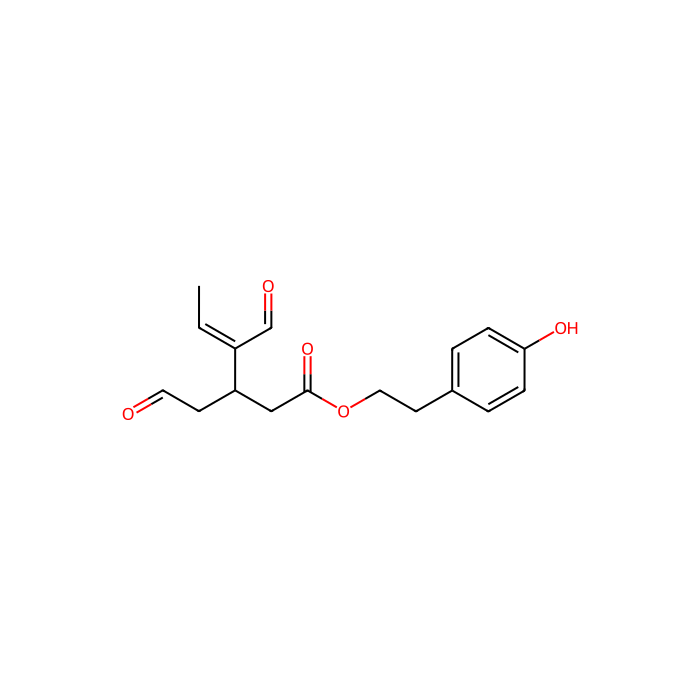
Oleocanthal is a naturally occurring secoiridoid from olive oil, which was shown to exhibit potent anti-inflammatory, anticancer, and neuroprotective activities.
This compound belongs to the class of organic compounds known as tyrosols and derivatives. These are compounds containing a hydroxyethyl group attached to the C4 carbon of a phenol group.
External Descriptors
Not available
1. Djoumbou Feunang Y, Eisner R, Knox C, Chepelev L, Hastings J, Owen G, Fahy E, Steinbeck C, Subramanian S, Bolton E, Greiner R, and Wishart DS. ClassyFire: Automated Chemical Classification With A Comprehensive, Computable Taxonomy. Journal of Cheminformatics, 2016, 8:61.
Zertifikate (CoA, COO, BSE/TSE und Analyse-Diagramm)
C of A & Other Certificates(BSE/TSE, COO):
Analytical Chart:
Chemische und physikalische Eigenschaften
Molekulargewicht
304.340 g/mol
XLogP3
1.500
Hydrogen Bond Donor Count
1
Hydrogen Bond Acceptor Count
5
Rotatable Bond Count
10
Exact Mass
304.131 Da
Monoisotopic Mass
304.131 Da
Topological Polar Surface Area
80.700 Ų
Heavy Atom Count
22
Formal Charge
0
Complexity
394.000
Isotope Atom Count
0
Defined Atom Stereocenter Count
1
Undefined Atom Stereocenter Count
0
Defined Bond Stereocenter Count
1
Undefined Bond Stereocenter Count
0
The total count of all stereochemical bonds
1
Covalently-Bonded Unit Count
1
Lösungsrechner
Molarity Calculator
Determine the necessary mass, volume, or concentration for preparing a solution.
Dilution Calculator
Determine the dilution needed to prepare a stock solution.
Reconstitution Calculator
Bewertungen
Kundenbewertungen
Application Protocols
No item-specific, validated application protocols are provided in the Product Data. The following are general research-use practices for small molecules in screening and analytical workflows; adjust to your assay and consult the CoA/SDS.
Stock solution preparation (general)
Dissolve oleocanthal in anhydrous DMSO to 10–50 mM.
Vortex and, if needed, sonicate briefly to aid dissolution.
Aliquot into amber vials or PCR tubes (single-use) to avoid repeated freeze–thaw.
Assay dilution (general)
Thaw an aliquot on ice; add to pre-equilibrated assay buffer/media to achieve the desired final concentration with ≤0.5–1% DMSO.
Mix gently; use promptly to minimize time-dependent aldehyde reactions.
LC–MS reference standard preparation (general)
Prepare 1–10 mM DMSO or MeCN stock; dilute to 0.1–10 µg/mL in MeCN/H2O (0.1% formic acid) for calibration.
Store working solutions at 4°C (hours to day-scale) and remake frequently to avoid degradation.
Stability checks (recommended)
Run time-course LC–MS at intended assay conditions to confirm absence of significant oxidation or adduct formation.
These practices are offered as general guidance; validate and optimize for your specific system.
Biological Roles
Context (literature/general; no medical claims):
Source and biosynthetic context
Oleocanthal is a native constituent of extra virgin olive oil, belonging to the phenolic secoiridoids that derive from glycosidic precursors in olives. It is typically formed during mechanical processing when endogenous enzymes liberate and transform iridoid glycosides.
Chemical biology behavior
The dialdehydic and α,β-unsaturated aldehyde motifs can form reversible covalent adducts with amines and thiols in biomolecules (e.g., Schiff bases with lysine side chains), a property often explored in biochemical assays for target engagement characterization.
Phenolic functionality can undergo phase II metabolism in biological systems (e.g., glucuronidation, sulfation) in general for phenolic compounds.
Role in plant matrix
Serves as one of the phenolic constituents contributing to organoleptic properties (pungency) of olive oil via TRPA1 activation in sensory assays (literature). This is a chemical biology observation rather than a health claim.
Analytical relevance
Used as a reference analyte for profiling olive oil phenolics by HPLC–DAD/LC–MS methods. Its presence and relative abundance can act as a marker for processing/freshness in analytical chemistry studies.
All points above are provided for biochemical/analytical context only. This product is for research use only and not for human or veterinary use.
Buffer Applications
Oleocanthal is not a buffering reagent. It does not define or stabilize pH ranges and is not typically used to prepare biochemical buffers.
Practical guidance
When dosing oleocanthal into biological buffers for assays, prepare concentrated DMSO stocks and dilute into pre-made buffers (e.g., PBS, HEPES, Tris) immediately before use.
Maintain low final DMSO content (commonly ≤0.5–1% v/v) to preserve assay integrity.
Avoid strongly basic buffers that can promote aldol-type reactions or hydrolysis of the ester linkage.
For buffer formulations and pH control, use established buffering systems (HEPES, MOPS, phosphate, Tris); oleocanthal serves only as an analyte or modulator within those systems.
Green Alternatives
While oleocanthal itself is the compound of interest, greener choices can be made for its handling, purification, and derivatization.
Prefer greener solvents when compatible with stability
Replace DCM/chloroform with ethyl acetate or 2-MeTHF for extractions and chromatography when resolution allows.
Use ethanol or isopropanol in place of methanol where feasible (reduced toxicity), noting potential for acetalization under acid.
Heptane over hexane mixtures to reduce n-hexane exposure.
Example comparison (general, literature-informed)
Solvent | Greener profile | Notes for oleocanthal
--- | --- | ---
Ethyl acetate | Favorable EHS profile, biodegradable | Good solubility, useful for workups and flash; avoid strong acids to limit acetalization.
2-MeTHF | Bio-based, lower peroxide risk than THF | Suitable for extractions; check solubility vs. EtOAc.
EtOH/iPrOH | Safer alcohols | Watch for aldehyde acetal/hemiacetal formation under acid catalysis.
MeCN | Good performance, manageable toxicity | Robust for LC–MS; not "green" but preferable to chlorinated solvents.
Process considerations
Minimize solvent volumes; concentrate under reduced pressure at mild temperatures.
Use inert gas blankets in storage vessels to reduce oxidative waste.
Note: Always balance greenness with the chemical stability of aldehyde/enal functions and performance requirements of your method.
Pharmaceutical Uses
No clinical or therapeutic claims are made for this product. Research use only.
Contextual roles (literature/general)
Reference standard: Employed as an analytical standard for quantifying olive oil phenolics in QC or research settings (e.g., LC–MS assay development).
Probe molecule: Used in early discovery assays to study structure–activity relationships of phenolic secoiridoids and reversible-covalent ligands.
Formulation considerations for research materials
Stock solutions typically prepared in DMSO for high-throughput screening or in ethanol for certain in vitro studies; filter sterilization (0.22 µm) may be employed for cell-based assays after dilution into aqueous media.
No pharmacopeial monograph is referenced for this item in the provided data. Any excipient/designation status is Not specified for this item; refer to CoA/Spec Sheet.
Impurities and stability
Aldehyde-containing compounds may show time-dependent changes in aqueous systems due to hydration, oxidation, or adduct formation. Establish solution stability in your formulation matrix via LC–MS prior to extended studies.
All uses must remain within laboratory research and development contexts.
Physical Properties
Item-specific specs (from Product Data)
Appearance: Not specified for this item; refer to CoA/Spec Sheet.
Molecular formula: Not specified for this item; refer to CoA/Spec Sheet.
Molecular weight: Not specified for this item; refer to CoA/Spec Sheet.
Literature/general properties (for context; not item-specific specifications)
Physical state: Typically obtained as an oil/low-melting solid at ambient temperature (literature).
Solubility: Sparingly soluble in water; soluble in polar aprotic and organic solvents (e.g., DMSO, DMF, acetone, ethyl acetate, methanol/ethanol) (literature).
UV/Vis: Phenolic chromophore and α,β-unsaturated aldehyde can absorb in the near-UV; exact cutoff/ε values are system-dependent (literature).
Acid-base: Contains a phenolic OH (weakly acidic; pKa typically ~9–10 for phenols, literature-general) and two aldehydes (non-ionizable under neutral conditions).
Partitioning: Expected moderate hydrophobicity due to aromatic and aliphatic regions, mitigated by polar functions (literature-general). Quantitative logP for this specific item is not specified.
Not provided for this item; refer to CoA/Spec Sheet
Boiling point, melting point, density, refractive index, vapor pressure, precise solubility values, logP/logD, pKa, UV cutoff.
Note: Values above labeled as literature/general are provided for scientific context only and should not be treated as specifications for this catalog item. Always verify experimental conditions and consult the CoA/SDS for precise property data when planning workups or analyses.
Quality and Grades
Item-specific grade (from Product Data)
Grade/Purity: Moligand™
What Moligand™ typically implies (general context)
Moligand™ indicates inclusion in a small-molecule/compound library suitable for ligand discovery, screening, or probe development. Such offerings are commonly provided with defined identity confirmation (e.g., NMR/HRMS) appropriate for research screening.
Emphasis is typically on structural integrity and suitability for high-throughput screening stock preparation (e.g., DMSO solubility assessment) rather than chromatographic solvent grades.
Documentation
CoA/Spec Sheet: Consult for item-specific identity tests (e.g., NMR, MS, HPLC), purity format (area % vs. weight %), and any residual solvent data. If purity is not listed here, treat as Not specified for this item; refer to CoA/Spec Sheet.
Stabilizers/antioxidants
Not specified for this item; refer to CoA/Spec Sheet. Given aldehydic susceptibility to oxidation, some users employ inert-atmosphere storage or add-on oxygen/moisture control during handling.
Practical guidance for screening use
Prepare single-use DMSO aliquots to avoid repeated freeze–thaw cycles.
Verify purity and identity by in-house LC–MS prior to primary screens when your assay is sensitive to aldehyde/adduct formation.
Note: Where precise item-specific thresholds (e.g., metal limits, UV cutoff) are required, rely on the CoA/SDS; no such specifications are provided in the Product Data.
Reaction and Applications
As a multifunctional natural product, oleocanthal is used in:
Screening and probe discovery (per Category: small molecules/compound libraries)
Deployed as a reference ligand or chemotype for biochemical and cell-based assays. Aldehyde/enal motifs may form reversible adducts with nucleophilic residues (e.g., lysine ε-NH2, cysteine thiols) under assay conditions (literature-general), which can be leveraged in covalent-fragment or reversible-covalent screening paradigms.
Synthetic transformations (literature/general)
Imine/oxime/hydrazone formation: Condensation of aldehydes with primary amines, hydroxylamine, or hydrazines for derivatization or analytical tagging.
Acetal/hemiacetal protection: Acid-catalyzed protection of aldehydes with diols or alcohols to enhance handling stability during multistep synthesis.
Selective reduction: NaBH4 or catalytic hydrogenation to convert the α,β-unsaturated aldehyde to allylic/aliphatic alcohols; careful control needed to avoid over-reduction of both aldehydes.
Michael-type additions: Nucleophiles may add to the enal system under base or Lewis acid catalysis.
Hydrolysis/transesterification: The internal ester can be hydrolyzed under acidic/basic conditions to access the tyrosol-derived alcohol and the corresponding acid/aldehyde fragment.
Practical tips
Work under inert atmosphere when prolonged solution-phase operations are required.
Use mild bases and low temperatures to limit self-condensation of aldehydes.
For analytics, add 0.1% acid to LC–MS mobile phases to reduce on-column adduct formation and tailing.
Reaction Conditions
General literature-guided conditions for common transformations of aldehyde/enal/phenolic ester substrates like oleocanthal (guidance only; optimize per lab):
Imine/oxime formation
Reagents: Primary amines or hydroxylamine·HCl; base such as pyridine or NaOAc when using hydroxylamine.
Solvent: MeOH, EtOH, or MeCN; molecular sieves can accelerate.
Conditions: RT to 40°C, 1–4 h (amines) or 2–12 h (hydroxylamine). Monitor by TLC/LC–MS.
Acetal/hemiacetal protection of aldehydes
Reagents: Ethylene glycol or diols; catalytic p-TsOH or CSA.
Solvent: Toluene, acetone, or MeCN; Dean–Stark for water removal when applicable.
Conditions: RT to reflux; carefully avoid over-acidic conditions that risk ester hydrolysis.
Selective reduction
1,2-Reduction: NaBH4 (0–25°C) in MeOH/EtOH; quench promptly to limit over-reduction.
Global reduction/hydrogenation: H2 (1–3 bar) with Pd/C in EtOAc/EtOH at RT–40°C; can reduce C=C and C=O; monitor selectivity.
Michael additions to the enal
Nucleophiles: Thiols, malonates, enolates.
Catalysis: Base (DBU, tertiary amines) or Lewis acids; inert atmosphere recommended.
Solvent: Polar aprotic (DMF, DMSO) or MeCN; 0–25°C to manage side reactions.
Ester hydrolysis/transesterification
Basic hydrolysis: Aqueous K2CO3/MeOH or NaOH/MeOH–H2O at 0–25°C; brief times to avoid aldehyde degradation.
Acidic methanolysis: Cat. HCl in MeOH at 0–25°C; monitor closely.
Note: The above are literature-style guidelines for multifunctional aldehyde substrates and should be validated experimentally for oleocanthal.
Safety and Handling
Item-specific hazard information (from Product Data)
Signal word: Not specified; refer to SDS.
H-statements: Not specified; refer to SDS.
GHS classification: Not specified; refer to SDS.
Pictograms: Not specified; refer to SDS.
General safety guidance (literature/practice; not a substitute for SDS)
Likely hazards: Phenolic and aldehydic functionalities can cause irritation to skin, eyes, and respiratory tract. Avoid inhalation of dust/aerosols and contact with skin/eyes.
PPE: Use lab coat, chemical-resistant gloves (e.g., nitrile), and safety goggles. Handle within a chemical fume hood.
Storage: Per Product Data, store at −20°C. Protect from light and moisture. Minimize headspace oxygen to limit oxidative degradation of aldehyde/enal functions.
Incompatibilities: Strong oxidizers, strong bases (can promote aldol/self-condensation or hydrolysis), strong acids (ester hydrolysis), and nucleophiles (amines, hydrazines) that may form adducts/Schiff bases with aldehydes.
Stability considerations: Aldehydes can undergo oxidation to acids and polymerization/condensation under basic conditions; phenolic moieties may oxidize. Work under inert atmosphere when feasible for long manipulations.
First-aid overview (consult SDS for authoritative instructions)
Skin/eye contact: Rinse with plenty of water for at least 15 minutes; remove contaminated clothing; seek medical attention if irritation persists.
Inhalation: Move to fresh air; seek medical advice if symptoms occur.
Ingestion: Rinse mouth; do not induce vomiting; seek medical attention.
Always consult and follow the product’s SDS and your institution’s EHS policies.
Solvent Selection
Oleocanthal is a moderately polar, multifunctional organic molecule (phenol, ester, dialdehyde, α,β-unsaturated system). Solvent choice should balance solubility with chemical stability of aldehyde/enal groups.
Nonpolar media: Soluble to varying extents in chlorinated solvents (DCM, chloroform) and moderately in toluene/MTBE depending on sample history.
Typical use scenarios
Screening stocks: DMSO at 10–50 mM; dilute into assay buffers just prior to use, keeping final DMSO ≤0.5–1% v/v as assay permits.
Purification/handling: Ethyl acetate/hexanes or ethyl acetate/heptane systems for normal-phase work; MeOH or MeCN with 0.1% acid (e.g., formic) for LC–MS.
Stability considerations in solution
Avoid strong bases and nucleophilic amines in solvent systems to limit Schiff base formation.
Minimize water and oxygen to slow oxidation of aldehydes; use freshly dried solvents for synthesis/analytics.
Quick comparison (general)
DMSO: Maximal solubility; may engage in minor nucleophilic pathways only under forcing conditions.
Ethanol/MeOH: Good solubility; can participate in acetal/hemiacetal equilibria under acid catalysis—avoid for stability studies.
Ethyl acetate: Good handling solvent; relatively benign; suitable for workups and flash chromatography.
Storage and Reconstitution
Item-specific instructions (from Product Data)
Storage Conditions: Store at −20°C.
Shipped In: Ice chest + ice pads.
Additional best practices (general guidance for aldehyde-rich small molecules)
Protect from light and moisture; use amber vials with PTFE-lined caps.
Purge headspace with inert gas (N2/Ar) after each use to mitigate oxidation.
Keep containers tightly closed; minimize time at ambient temperature.
Reconstitution/stock preparation (general)
Solvents: DMSO is recommended for concentrated stocks; ethanol or acetonitrile are alternative solvents depending on application.
Concentration: 10–50 mM stocks are typical for screening; filter (0.22 µm) after dilution into aqueous media if sterility is required.
Aliquoting: Prepare single-use aliquots to avoid repeated freeze–thaw cycles.
Stability and shelf-life
Not specified for this item; refer to CoA/Spec Sheet. Because aldehydes can oxidize or form adducts, verify solution stability over your intended timeframe by LC–MS.
Disposal
Treat as organic chemical waste; follow institutional and local regulations.
Always refer to the CoA and SDS for authoritative storage constraints and handling precautions beyond the information provided here.
Structure and Identity
Brief overview: Oleocanthal is a phenolic secoiridoid natural product from extra virgin olive oil, commonly studied as a small-molecule probe/ligand in screening libraries.
Item-specific (Product Data)
SKU: O477630
Product Name: Oleocanthal
CAS: 289030-99-5
Grade/Purity: Moligand™
Storage: Store at −20°C (as provided)
Shipped in: Ice chest + ice pads (as provided)
InChIKey (as provided): 385082
SMILES: Not specified for this item; refer to CoA/Spec Sheet.
Molecular formula: Not specified for this item; refer to CoA/Spec Sheet.
Molecular weight: Not specified for this item; refer to CoA/Spec Sheet.
Literature/common identifiers (for scientific context; not item-specific)
Structural features (descriptive, literature-based)
Contains a para-hydroxyphenethyl moiety (phenolic OH + benzylic ethylene linker)
Secoiridoid fragment bearing an enal functionality and an additional aldehyde (dialdehydic motif)
Internal ester linkage connecting the phenolic alcohol (tyrosol-like unit) to the iridoid-derived fragment
Configurational/stereochemical element reported at the secoiridoid center in natural material
2D structure in words (literature): A p-hydroxyphenyl ring bearing a –CH2–CH2–O–(C=O)– linkage to an iridoid-derived chain that contains one conjugated aldehyde (α,β-unsaturated) and one additional aldehyde, giving a dialdehydic, phenolic ester architecture.
Synthetic Utility
Oleocanthal is a multifunctional scaffold offering several orthogonal handles for derivatization and SAR exploration (literature/general):
Functional group handles
Two aldehydes: Enable selective formation of imines/oximes/hydrazones; reductive amination; acetal protection; selective or global reductions.
α,β-Unsaturated system: Supports conjugate additions (Michael) and hydrogenation/isomerization chemistry.
Phenolic OH: Site for etherification or acylation; conjugation to reporter tags; modulation of polarity.
Internal ester: Hydrolysis or transesterification to reconfigure the scaffold (e.g., generating tyrosol derivatives or modified iridoid fragments).
Retrosynthetic perspectives
Disconnection through the ester bond reverts to a phenethyl phenol component (tyrosol-like) and an iridoid-derived dialdehydic acid fragment.
Aldehyde manipulations allow access to alcohols, acids, and protected derivatives to stabilize the molecule for downstream steps.
Applications in method development
Testbed for chemoselective reduction protocols (e.g., 1,2- vs 1,4-reduction of enals), and for evaluating mild acetalization conditions on sensitive substrates.
Useful for benchmarking LC–MS ionization/tailing behavior of multifunctional phenolic aldehydes.
Practical notes
Control pH and exclude nucleophilic amines unless targeted for condensation.
Protect aldehydes during prolonged steps to prevent side reactions; deprotect under mild conditions to regenerate the native framework.
Target Specificity
Not applicable. This product is a small-molecule reagent, not an antibody or biologic. No antigen/epitope, clone, isotype, or species reactivity information applies.
For biochemical studies, any protein interactions or selectivity profiles would be assay- and condition-dependent and are not specified for this catalog item. Consult primary literature for target engagement reports if relevant to your project.
Need help choosing the grade?
Our grade selection guide covers purity, stabilizer status, and application suitability for all variants in our catalog.
Wir verwenden Cookies, um die ordnungsgemäße Funktion der Website sicherzustellen und, soweit zulässig, Ihr Nutzererlebnis zu verbessern. Sie können Ihre Einstellungen jederzeit unter „Einstellungen“ verwalten. Weitere Informationen finden Sie in unserer Cookie-Richtlinie.
Shall we send you a message when we have discounts available?
Remind me later
Thank you! Please check your email inbox to confirm.
Products are supplied to verified businesses, institutions, and qualified professionals for research and development use only. Not for use in humans, animals, diagnosis, or therapy.