PACAP (1-27) (human - Moligand™, 10mM in Water , Agonist of PAC 1 receptor;Agonist of VPAC 1 receptor;Agonist of VPAC 2 receptor, CAS No.127317-03-7, Agonist of PAC 1 receptor;Agonist of VPAC 1 receptor;Agonist of VPAC 2 receptor

CAS: 127317-03-7 Cat. No.: P421125 Summenformel: C142H224N40O39S Molekulargewicht: 3147.68 PubChem CID: 44134520
Zu bestellen verfügbar
QUALITÄT & REINHEIT Moligand™ ? Moligand™ — Aladdin's line of ligands and bioactive small molecules. Use for receptor, pathway, and binding studies needing defined small-molecule tools. 10mM in Water
Synonyms
PACAP 1-27|PACAP (1-27), human, ovine, rat|Histidylseryl-alpha-aspartylglycylisoleucylphenylalanylthreonyl-alpha-aspartylseryltyrosylserylarginyltyrosylarginyllysylglutaminylmethionylalanylvalyllysyllysyltyrosylleucylalanylalanylvalylleucinamide
Storage
Protected from light,Store at -80°C
Shipped In
Dry ice packs + Cold packs
★
Größe
Deutschland (EU)
USA*
Preis
Menge
1ml
P421125-1ml
Auf Bestellung · 8–12 Wochen

178,67€

209,91€
Speichern 31,24 € (14.88%)
Enter a quantity for the sizes you want to add.

Spezifikationen

Synonyme
PACAP 1-27 | PACAP (1-27), human, ovine, rat | Histidylseryl-alpha-aspartylglycylisoleucylphenylalanylthreonyl-alpha-aspartylseryltyrosylserylarginyltyrosylarginyllysylglutaminylmethionylalanylvalyllysyllysyltyrosylleucylalanylalanylvalylleucinamide
Spezifikationen & Reinheit
Moligand™, 10mM in Water
Biochemische und physiologische Mechanismen
Potent PACAP receptor antagonist (IC 50 = 7.45 nM). Stimulates adenylate cyclase more potently than VIP . High binging affinity in lung. Active in vitro and in vivo .
Storage
Protected from light,Store at -80°C
Verschickt in
Dry ice packs + Cold packs
Dieses Produkt erfordert Kühlkettenversand. Grundversand und andere Economy-Optionen sind nicht verfügbar.
Note
Moligand™
Aktionsart
AGONIST
Mechanismus der Wirkung
Agonist of PAC 1 receptor;Agonist of VPAC 1 receptor;Agonist of VPAC 2 receptor
Namen und Kennungen
SMILES
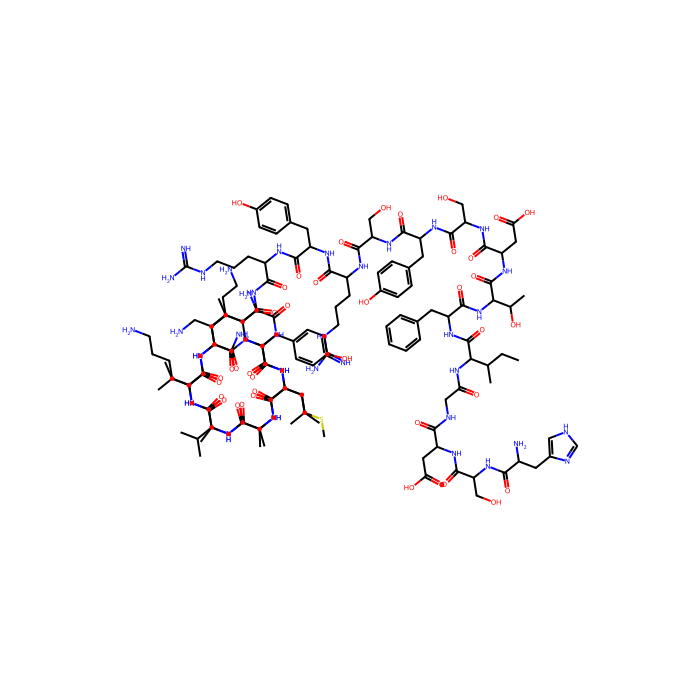
CCC(C)C(C(=O)NC(CC1=CC=CC=C1)C(=O)NC(C(C)O)C(=O)NC(CC(=O)O)C(=O)NC(CO)C(=O)NC(CC2=CC=C(C=C2)O)C(=O)NC(CO)C(=O)NC(CCCNC(=N)N)C(=O)NC(CC3=CC=C(C=C3)O)C(=O)NC(CCCNC(=N)N)C(=O)NC(CCCCN)C(=O)NC(CCC(=O)N)C(=O)NC(CCSC)C(=O)NC(C)C(=O)NC(C(C)C)C(=O)NC(CCCCN)C(=O)NC(CCCCN)C(=O)NC(CC4=CC=C(C=C4)O)C(=O)NC(CC(C)C)C(=O)NC(C)C(=O)NC(C)C(=O)NC(C(C)C)C(=O)NC(CC(C)C)C(=O)N)NC(=O)CNC(=O)C(CC(=O)O)NC(=O)C(CO)NC(=O)C(CC5=CNC=N5)N
IUPAC Name
4-[[2-[[1-[[1-[[1-[[1-[[1-[[1-[[1-[[1-[[1-[[1-[[6-amino-1-[[5-amino-1-[[1-[[1-[[1-[[6-amino-1-[[6-amino-1-[[1-[[1-[[1-[[1-[[1-[(1-amino-4-methyl-1-oxopentan-2-yl)amino]-3-methyl-1-oxobutan-2-yl]amino]-1-oxopropan-2-yl]amino]-1-oxopropan-2-yl]amino]-4-methyl-1-oxopentan-2-yl]amino]-3-(4-hydroxyphenyl)-1-oxopropan-2-yl]amino]-1-oxohexan-2-yl]amino]-1-oxohexan-2-yl]amino]-3-methyl-1-oxobutan-2-yl]amino]-1-oxopropan-2-yl]amino]-4-methylsulfanyl-1-oxobutan-2-yl]amino]-1,5-dioxopentan-2-yl]amino]-1-oxohexan-2-yl]amino]-5-carbamimidamido-1-oxopentan-2-yl]amino]-3-(4-hydroxyphenyl)-1-oxopropan-2-yl]amino]-5-carbamimidamido-1-oxopentan-2-yl]amino]-3-hydroxy-1-oxopropan-2-yl]amino]-3-(4-hydroxyphenyl)-1-oxopropan-2-yl]amino]-3-hydroxy-1-oxopropan-2-yl]amino]-3-carboxy-1-oxopropan-2-yl]amino]-3-hydroxy-1-oxobutan-2-yl]amino]-1-oxo-3-phenylpropan-2-yl]amino]-3-methyl-1-oxopentan-2-yl]amino]-2-oxoethyl]amino]-3-[[2-[[2-amino-3-(1H-imidazol-4-yl)propanoyl]amino]-3-hydroxypropanoyl]amino]-4-oxobutanoic acid
InChIKey
RZGBUJXSKLDAFE-UHFFFAOYSA-N
InChI
1S/C142H224N40O39S/c1-16-75(10)113(179-108(191)66-156-120(201)102(63-109(192)193)173-135(216)104(67-183)176-119(200)88(146)62-84-65-153-70-157-84)139(220)174-101(58-80-28-18-17-19-29-80)133(214)182-114(79(14)186)140(221)175-103(64-110(194)195)132(213)178-106(69-185)136(217)172-100(61-83-39-45-87(189)46-40-83)131(212)177-105(68-184)134(215)164-93(34-27-54-155-142(151)152)126(207)170-98(59-81-35-41-85(187)42-36-81)129(210)163-92(33-26-53-154-141(149)150)124(205)161-89(30-20-23-50-143)122(203)165-94(47-48-107(147)190)127(208)166-95(49-55-222-15)121(202)159-78(13)118(199)180-111(73(6)7)137(218)167-91(32-22-25-52-145)123(204)162-90(31-21-24-51-144)125(206)171-99(60-82-37-43-86(188)44-38-82)130(211)169-97(57-72(4)5)128(209)160-76(11)116(197)158-77(12)117(198)181-112(74(8)9)138(219)168-96(115(148)196)56-71(2)3/h17-19,28-29,35-46,65,70-79,88-106,111-114,183-189H,16,20-27,30-34,47-64,66-69,143-146H2,1-15H3,(H2,147,190)(H2,148,196)(H,153,157)(H,156,201)(H,158,197)(H,159,202)(H,160,209)(H,161,205)(H,162,204)(H,163,210)(H,164,215)(H,165,203)(H,166,208)(H,167,218)(H,168,219)(H,169,211)(H,170,207)(H,171,206)(H,172,217)(H,173,216)(H,174,220)(H,175,221)(H,176,200)(H,177,212)(H,178,213)(H,179,191)(H,180,199)(H,181,198)(H,182,214)(H,192,193)(H,194,195)(H4,149,150,154)(H4,151,152,155)
Isomere SMILES
CCC(C)C(C(=O)NC(CC1=CC=CC=C1)C(=O)NC(C(C)O)C(=O)NC(CC(=O)O)C(=O)NC(CO)C(=O)NC(CC2=CC=C(C=C2)O)C(=O)NC(CO)C(=O)NC(CCCNC(=N)N)C(=O)NC(CC3=CC=C(C=C3)O)C(=O)NC(CCCNC(=N)N)C(=O)NC(CCCCN)C(=O)NC(CCC(=O)N)C(=O)NC(CCSC)C(=O)NC(C)C(=O)NC(C(C)C)C(=O)NC(CCCCN)C(=O)NC(CCCCN)C(=O)NC(CC4=CC=C(C=C4)O)C(=O)NC(CC(C)C)C(=O)NC(C)C(=O)NC(C)C(=O)NC(C(C)C)C(=O)NC(CC(C)C)C(=O)N)NC(=O)CNC(=O)C(CC(=O)O)NC(=O)C(CO)NC(=O)C(CC5=CNC=N5)N
PubChem CID
44134520
Molekulargewicht
3147.68

Erweiterte Daten

Zugehörige Ziele (menschlich)
VIPR2 Tchem Vasoactive intestinal polypeptide receptor 2 (0 Activities)
Activity TypeActivity Value -log(M)Mechanism of ActionActivity ReferencePublications (PubMed IDs)
VIPR1 Tchem Vasoactive intestinal polypeptide receptor 1 (0 Activities)
Activity TypeActivity Value -log(M)Mechanism of ActionActivity ReferencePublications (PubMed IDs)
ADCYAP1R1 Tchem Pituitary adenylate cyclase-activating polypeptide type I receptor (0 Activities)
Activity TypeActivity Value -log(M)Mechanism of ActionActivity ReferencePublications (PubMed IDs)
Zertifikate (CoA, COO, BSE/TSE und Analyse-Diagramm)
C of A & Other Certificates(BSE/TSE, COO):
Analytical Chart:
Chemische und physikalische Eigenschaften
Empfindlichkeitlight sensitive
Lösungsrechner
Bewertungen

Kundenbewertungen

Benötigen Sie Hilfe bei der Auswahl der Qualität?

Unser Leitfaden zur Qualitätsauswahl behandelt Reinheit, Stabilisatorstatus und Anwendungseignung für alle Varianten in unserem Katalog.

Moligand™ Qualitätsleitfaden ansehen →

Dürfen wir Sie über Rabattaktionen informieren?

Später erinnern

Vielen Dank! Bitte überprüfen Sie Ihren E-Mail-Posteingang, um zu bestätigen.

Hoppla! Benachrichtigungen sind deaktiviert.