≥99.95% metals basis for sensitive chromatographic and analytical workflows requiring minimal baseline interference.
🌡
Storage & shipping
Protected from light,Room temperature,Argon charged Ships Normal Check lot-specific COA for exact specifications.
📋
Quality documents
SDS, COA, datasheet, and spec sheet available for download. Lot-specific COA accessible via lot number lookup.
📚
Literature proof
Cited in 22 peer-reviewed publications across chromatography, organic synthesis, and cross-coupling reactions.
Übersicht
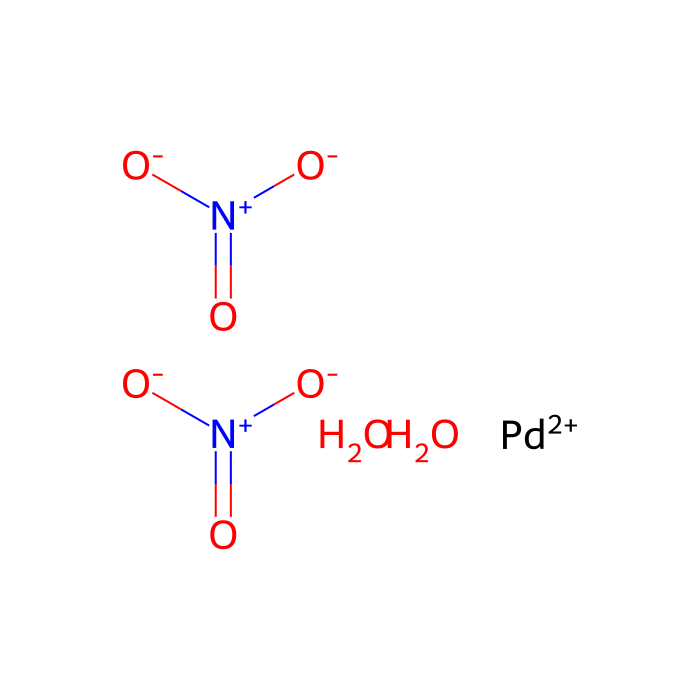
Palladium(II) nitrate dihydrate is a highly reactive compound that is commonly used in catalytic reactions such as the hydrogenation of organic molecules, dehydrogenation of alkanes, and oxidation of alcohols. It is also used in the electrodeposition of palladium on surfaces and as a palladium source in the fabrication of palladium-containing materials. It is also employed in the fabrication of low-cost solid-state hydrogen storage devices made of three-dimensional (3D) reduced graphene oxide (rGO) and expanded graphite (EG)nanocomposite (NC) decorated with Pd nanoparticles (NPs).
Application:
Palladium(II) nitrate dehydrate is used as a reactant for: Doping activated carbon for catalysis; Catalytic use of hydroxyapatite (HAP) supported Pd nanoclusters in the hydrolysis of ammonia-borane; It′s used as catalyst for: Selective hydrogenation of 1-heptyne and napthalene; In highly porous coordination polymer MIL-101 support. ; It may also be used as a reactant for: Preparation of platinum-palladium/carbon alloy nanocatalysts for methanol-tolerant oxygen reduction reaction in fuel cells; Synthesis of Cu-Pd alloy thin films on Ti substrates by co-electrodeposition of Pd and Cu from nitrate-base electrolytic baths; Preparation of palladium catalyst supported on vertically aligned multi-walled carbon nanotubes for microwave-assisted Heck reactions of p-iodonitrobenzene with styrene and Et acrylate; Preparation of di-phenyl sulfide-modified Pd/TiO2 catalysts for acetylene hydrogenation.
Transition metal nitrate - Inorganic oxide - Inorganic salt
Beschreibung
This compound belongs to the class of inorganic compounds known as transition metal nitrates. These are inorganic compounds in which the largest oxoanion is nitrate, and in which the heaviest atom not in an oxoanion is a transition metal.
External Descriptors
Not available
1. Djoumbou Feunang Y, Eisner R, Knox C, Chepelev L, Hastings J, Owen G, Fahy E, Steinbeck C, Subramanian S, Bolton E, Greiner R, and Wishart DS. ClassyFire: Automated Chemical Classification With A Comprehensive, Computable Taxonomy. Journal of Cheminformatics, 2016, 8:61.
Wir verwenden Cookies, um die ordnungsgemäße Funktion der Website sicherzustellen und, soweit zulässig, Ihr Nutzererlebnis zu verbessern. Sie können Ihre Einstellungen jederzeit unter „Einstellungen“ verwalten. Weitere Informationen finden Sie in unserer Cookie-Richtlinie.
Shall we send you a message when we have discounts available?
Remind me later
Thank you! Please check your email inbox to confirm.
Products are supplied to verified businesses, institutions, and qualified professionals for research and development use only. Not for use in humans, animals, diagnosis, or therapy.

 E2626513