QUALITÄT & REINHEITMoligand™?Moligand™ — Aladdin's line of ligands and bioactive small molecules. Use for receptor, pathway, and binding studies needing defined small-molecule tools.≥98%(HPLC)
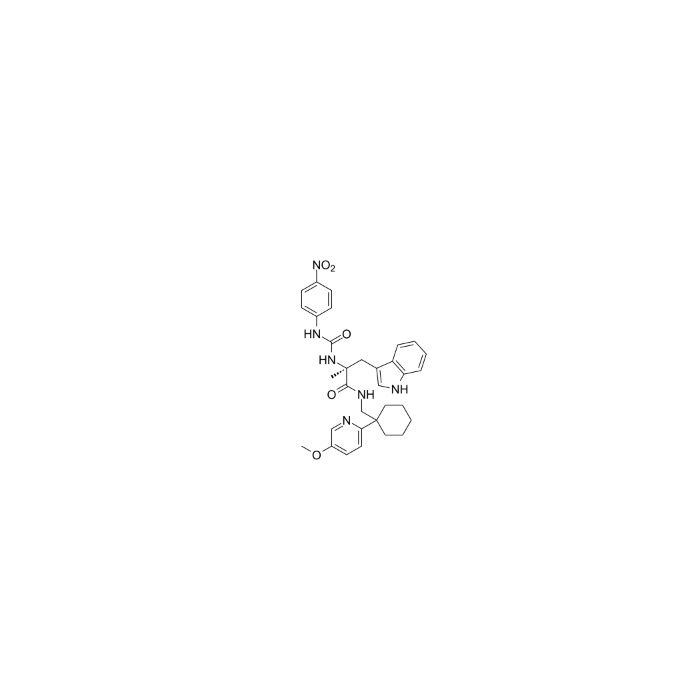
PD176252 is a potent antagonist of neuromedin-B preferring (BB1) and gastrin-releasing peptide-preferring (BB2) receptor with Kis of 0.17 nM and 1 nM for human BB1 and BB2 receptors, and 0.66 nM, 16 nM for Rat BB1 and BB2 receptors, respectively; PD176252 is also an agonist of N-Formyl peptide receptor1/2 (FPR1/FPR2), with EC50s of 0.31 and 0.66 μM in HL-60 cells.
Spezifikationen
Spezifikationen & Reinheit
Moligand™, ≥98%(HPLC)
Biochemische und physiologische Mechanismen
Non-peptide gastrin-releasing peptide receptor (GRP-R, BB2) and neuromedin B receptor (NMB-R, BB1) antagonist (Kivalues are 0.17 and 1.0 nM for BB1and BB2respectively). Inhibits proliferation of rat C6 glioma cells (IC50= 2μM) and inhibits NCI-H1299 xenograft proliferation in nude mice (IC50= 5μM).
Storage
Store at 2-8°C,Argon charged
Verschickt in
Wet ice
Dieses Produkt erfordert Kühlkettenversand. Grundversand und andere Economy-Optionen sind nicht verfügbar.
Note
Moligand™
Aktionsart
ANTAGONIST
Mechanismus der Wirkung
Antagonist of BB 1 receptor;Antagonist of BB 2 receptor
This compound belongs to the class of organic compounds known as n-carbamoyl-alpha amino acids and derivatives. These are compounds containing an alpha amino acid (or a derivative thereof) which bears an carbamoyl group at its terminal nitrogen atom.
External Descriptors
Not available
1. Djoumbou Feunang Y, Eisner R, Knox C, Chepelev L, Hastings J, Owen G, Fahy E, Steinbeck C, Subramanian S, Bolton E, Greiner R, and Wishart DS. ClassyFire: Automated Chemical Classification With A Comprehensive, Computable Taxonomy. Journal of Cheminformatics, 2016, 8:61.
Zertifikate (CoA, COO, BSE/TSE und Analyse-Diagramm)
C of A & Other Certificates(BSE/TSE, COO):
Analytical Chart:
Chemische und physikalische Eigenschaften
Löslichkeit
Solvent:DMSO, Max Conc. mg/mL: 58.47, Max Conc. mM: 100
Molekulargewicht
584.7
XLogP3
5.200
Hydrogen Bond Donor Count
4
Hydrogen Bond Acceptor Count
6
Rotatable Bond Count
9
Exact Mass
584.275 Da
Monoisotopic Mass
584.275 Da
Topological Polar Surface Area
154.000 Ų
Heavy Atom Count
43
Formal Charge
0
Complexity
962.000
Isotope Atom Count
0
Defined Atom Stereocenter Count
1
Undefined Atom Stereocenter Count
0
Defined Bond Stereocenter Count
0
Undefined Bond Stereocenter Count
0
The total count of all stereochemical bonds
0
Covalently-Bonded Unit Count
1
Sicherheit und Gefahren (GHS)
Sicherheitshinweise
P264:Wash hands [and …] thoroughly after handling.
Lösungsrechner
Molarity Calculator
Determine the necessary mass, volume, or concentration for preparing a solution.
Dilution Calculator
Determine the dilution needed to prepare a stock solution.
Reconstitution Calculator
Bewertungen
Kundenbewertungen
Häufig gestellte Fragen
What is the purity of this product, and how is it determined?
This product is supplied at ≥98% purity, determined by HPLC. Lot-specific values are stated on the Certificate of Analysis.
What is Moligand??
Moligand? is one of Aladdin Scientific's premium product lines, formulated for high-purity applications across multiple workflows. Compared to standard grades in the same workflow, Moligand? products typically offer tighter specifications, more rigorous QC, and stronger lot-to-lot consistency.
How should this product be stored?
Store at 2–8 °C under argon. It is supplied under an argon blanket; reseal under inert gas after each use.
How is this product shipped?
This product ships chilled on wet ice. Unpack on arrival and transfer it to the storage condition stated above.
What are the CAS number, molecular formula and molecular weight?
The CAS Number is 204067-01-6, the molecular formula is C32H36N6O5, and the molecular weight is 584.67 g/mol. InChIKey NNFUWNLENRUDHR-HKBQPEDESA-N.
What documentation is provided?
Available product documentation, including Certificates of Analysis (COA), Safety Data Sheets (SDS), and specification sheets, is shown in the product document area. Document availability and access follow the current site policy.
Benötigen Sie Hilfe bei der Auswahl der Qualität?
Unser Leitfaden zur Qualitätsauswahl behandelt Reinheit, Stabilisatorstatus und Anwendungseignung für alle Varianten in unserem Katalog.
Wir verwenden Cookies, um die ordnungsgemäße Funktion der Website sicherzustellen und, soweit zulässig, Ihr Nutzererlebnis zu verbessern. Sie können Ihre Einstellungen jederzeit unter „Einstellungen“ verwalten. Weitere Informationen finden Sie in unserer Cookie-Richtlinie.
Dürfen wir Sie über Rabattaktionen informieren?
Später erinnern
Vielen Dank! Bitte überprüfen Sie Ihren E-Mail-Posteingang, um zu bestätigen.
Products are supplied to verified businesses, institutions, and qualified professionals for research and development use only. Not for use in humans, animals, diagnosis, or therapy.