QUALITÄT & REINHEITMoligand™?Moligand™ — Aladdin's line of ligands and bioactive small molecules. Use for receptor, pathway, and binding studies needing defined small-molecule tools.10 mM in DMSO
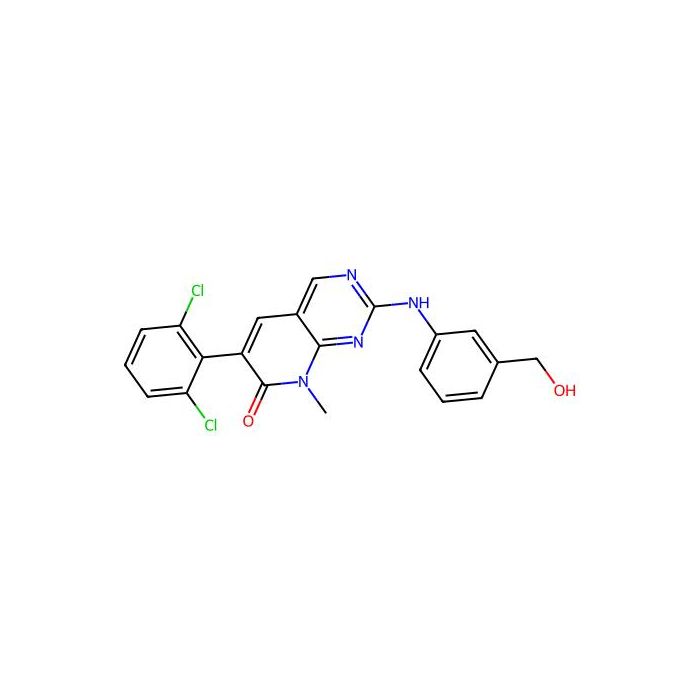
PD166326 is a pyridopyrimidine-type inhibitor of receptor tyrosine kinases , with IC 50 s of 6 nM and 8 nM for Src and Abl , respectively. PD166326 exhibits antileukemic activity .
Spezifikationen
Spezifikationen & Reinheit
Moligand™, 10 mM in DMSO
Storage
Protected from light,Argon charged,Store at -80°C
Verschickt in
Dry ice packs + Cold packs
Dieses Produkt erfordert Kühlkettenversand. Grundversand und andere Economy-Optionen sind nicht verfügbar.
Zertifikate (CoA, COO, BSE/TSE und Analyse-Diagramm)
C of A & Other Certificates(BSE/TSE, COO):
Analytical Chart:
Lösungsrechner
Molarity Calculator
Determine the necessary mass, volume, or concentration for preparing a solution.
Dilution Calculator
Determine the dilution needed to prepare a stock solution.
Reconstitution Calculator
Bewertungen
Kundenbewertungen
Application Protocols
No item-specific tested applications, recommended concentrations, or assay protocols are provided in the Product Data for PD166326.
General guidance (non-item-specific):
Stock preparation: Dissolve in anhydrous DMSO to prepare a concentrated master stock; vortex and, if needed, sonicate briefly. Sterile-filter into low-bind tubes if using in cell culture.
Aliquoting: Dispense single-use aliquots to avoid freeze–thaw cycles; store at -80°C, protected from light, under inert gas as specified.
Use in assays: Thaw quickly, keep on ice, and dilute into pre-warmed buffers or media to the desired final concentration while maintaining constant solvent percentage across controls.
Controls: Include vehicle-only controls and, where possible, orthogonal tool compounds.
For any validated internal SOPs or QC acceptance criteria, adhere to your institutional procedures. For product-specific recommendations, refer to the lot CoA or contact Technical Support.
Class: PD166326 is widely cited as a potent ATP-competitive inhibitor used to probe tyrosine kinase signaling, frequently associated with Src family kinases and Abl-class kinases in biochemical and cellular studies. It serves as a reference ligand to interrogate phosphorylation cascades, feedback regulation, and resistance mechanisms in kinase networks.
Mechanistic features: Typical kinase probes of this class occupy the ATP-binding site, form one or more hinge hydrogen bonds, and exploit hydrophobic back pockets; some display type I or type I½ binding modes depending on DFG conformation (literature).
Utility in systems biology: Enables acute, reversible suppression of specific phosphorylation events, facilitating mapping of upstream/downstream nodes, quantification of pathway robustness, and validation of chemoproteomic hits.
Selectivity considerations: Reported selectivity profiles vary across assay formats (biochemical vs cellular) and are concentration-dependent. Off-target interactions can manifest at higher concentrations; therefore, orthogonal confirmation (e.g., genetic knockdown/knockout, distinct chemotypes) is recommended (literature best practice).
Assay contexts: Commonly used in in vitro kinase assays, thermal shift/DSF, CETSA, phospho-western/ELISA readouts, and chemical proteomics. For cell work, permeability and efflux can influence apparent potency; time-course and washout studies help deconvolute kinetics.
Note: No item-specific biological potency/selectivity data are provided here. For your study design, consult primary literature and validate in your exact assay conditions. This product is for research use only.
Buffer Applications
This product is a small-molecule probe rather than a buffering agent.
Typical use: Dissolution into biological assay buffers (e.g., HEPES, Tris, PBS) from a DMSO stock for biochemical or cell-based studies (general practice; non-item-specific).
pH buffering capacity: Not applicable—PD166326 is not used as a buffer component. Select buffer systems based on your biological target and assay readout.
Practical tips: Maintain consistent final organic cosolvent percentage across all wells/tubes; pre-equilibrate compound with protein targets when necessary; include solvent-only controls to account for DMSO effects.
Item-specific buffer compatibility data are Not specified for this item; refer to CoA/Spec Sheet and SDS for any restrictions.
Green Alternatives
While PD166326 itself is the analyte of interest, greener choices can be made around solvents and workflows used with this compound (general guidance; non-item-specific):
Stock solutions: Prefer aqueous-compatible systems to minimize DMSO where biologically tolerated. For example, titrate the minimum DMSO needed for solubility, then dilute into buffer to ≤0.1–0.5% DMSO in assays.
Alternative solvents: Ethanol or PEG400:water mixtures may dissolve some kinase inhibitors at useful concentrations, offering reduced toxicity/volatility compared to DMF/NMP; verify target tolerance experimentally.
Miniaturization: Use low-dead-volume plates and acoustic dispensing to reduce solvent consumption and waste.
Energy and stability: Adhere to the specified -80°C, argon, light-protection storage to extend shelf life, reducing the need for repeated synthesis/purchasing and associated environmental burden.
Illustrative comparison (general):
DMSO: High solvency; common in screening; moderate environmental impact; hygroscopic; facilitates plastic leaching—control exposure.
Ethanol: Renewable routes possible; lower toxicity; limited solvency for many heteroaromatics; higher assay variability in some systems.
PEG400: Low volatility; good solvency in mixtures; viscosity complicates dispensing; potential assay interference.
Waste considerations:
Segregate halogenated and non-halogenated organic waste.
Minimize DMF/NMP use; substitute with DMSO/EtOH/acetonitrile where feasible.
Rinse glassware promptly to avoid polymerized residues and reduce solvent usage.
Pharmaceutical Uses
This product is offered strictly for research use and is not intended for human or veterinary use, diagnostic procedures, or as an API.
General formulation context (non-item-specific):
Small-molecule kinase probes are sometimes formulated as DMSO concentrates for in vitro studies, then diluted into aqueous media immediately prior to use.
For in vivo preclinical research (if applicable under your institutional approvals), solubilization vehicles often include mixtures such as PEG400/ethanol/saline or Captisol; however, no item-specific guidance is provided here and such use must follow institutional policies and SDS directions.
Regulatory/compendial status:
No pharmacopeial monograph or excipient designation is indicated. Any GMP suitability, residual solvent limits, or elemental impurity controls are Not specified for this item; refer to CoA/Spec Sheet.
Manufacturing note:
If you require a specific salt form, particle size, or custom formulation for research, contact us for possible custom services. Absent such customization, handle as a laboratory research chemical only.
Physical Properties
Item-specific physicochemical specifications are not provided in the Product Data.
Appearance: Not specified for this item; refer to CoA/Spec Sheet.
Molecular weight: Not specified for this item; refer to CoA/Spec Sheet.
Molecular formula: Not specified for this item; refer to CoA/Spec Sheet.
Melting point, boiling point, density, refractive index: Not specified for this item; refer to CoA/Spec Sheet.
Aqueous/organic solubility: Not specified for this item; refer to CoA/Spec Sheet.
LogP/logD, pKa: Not specified for this item; refer to CoA/Spec Sheet.
General literature guidance (non-item-specific):
Many ATP-competitive kinase inhibitors of this class are sparingly soluble in water but dissolve well in polar aprotic solvents (e.g., DMSO) and mixed aqueous cosolvent systems (literature).
They may exhibit moderate basicity due to ring nitrogens; salt formation can improve solubility and handling (literature).
Practical notes:
Prepare small trial solutions to assess solubility in your chosen solvent system before scale-up.
For analytical characterization (HPLC/LC–MS), start with DMSO stocks diluted into aqueous mobile phase with organic modifier; filter if needed to remove particulates.
Always rely on the lot-specific CoA for any property required for regulated or quantitative work.
Quality and Grades
Grade/Purity: Moligand™ (per Product Data).
About Moligand™ grade:
Moligand™ denotes a research-use screening/probe quality tailored for chemical biology and medicinal chemistry workflows. Typical expectations for this grade include identity confirmation (e.g., NMR/HRMS/LC–MS) and assay-ready performance; however, specific test items (purity threshold, residual solvents, water content, salts, counterions) are lot-dependent.
Item-specific numeric specifications (e.g., purity %, residual metals, water or peroxide content, UV cutoff) are Not specified for this item; refer to CoA/Spec Sheet.
What this means for your work:
Suitable for target identification, enzyme/cell-based screening, and mechanism-of-action studies where high chemical identity and stability are essential. If ultra-low UV background or trace-metal specifications are required (e.g., for trace analysis), confirm with the lot CoA.
Stabilization: No stabilizer is listed in the Product Data. If your application is moisture- or oxygen-sensitive, maintain the supplied argon headspace and minimize headspace exchanges.
Analytical verification: We recommend verifying identity/purity on receipt using your internal methods (e.g., LC–MS purity by area, 1H NMR) when the project requires chain-of-custody documentation.
Documentation:
For exact assay data, chromatographic purity, counterion/salt form, and any polymorph information, consult the lot-specific CoA and SDS.
Reaction and Applications
This product is supplied as a finalized small-molecule probe and is not principally intended as a synthetic reagent.
Research applications (general, literature):
Chemical biology: Tool compound for modulating intracellular signaling in biochemical and cell-based assays to interrogate phosphorylation-dependent pathways (literature, non-item-specific).
Target engagement studies: Used in binding/competition assays (e.g., thermal shift, CETSA, kinobeads) to assess kinase engagement and selectivity profiles (literature).
SAR benchmarking: Serves as a reference control in structure–activity relationship campaigns targeting tyrosine kinases (literature).
Not typically applicable:
It is not commonly used as a coupling partner, catalyst, or reagent in organic synthesis. For synthetic transformations, consult building-block or reagent sections of our catalog.
Practical guidance:
Prepare concentrated DMSO stocks, aliquot to minimize freeze–thaw, and dilute freshly into assay media.
Confirm assay compatibility and solvent tolerance for your biological system. Include proper negative and solvent controls.
For precise recommended assay concentrations and protocols, consult primary literature and optimize empirically for your system. Item-specific application data are Not specified for this item; refer to CoA/Spec Sheet.
Reaction Conditions
Not primarily applicable: PD166326 is a final small-molecule probe and is not intended as a reagent for chemical transformations.
General analytical/handling conditions (non-item-specific):
Solution preparation: Commonly dissolved in anhydrous DMSO to prepare concentrated stocks (e.g., 10–50 mM), then diluted into assay buffers immediately before use. Optimize concentration based on your system; this is literature guidance and not an item specification.
Stability considerations: Protect from light and moisture; avoid extended exposure in aqueous media at elevated temperature. Follow the Product Data storage conditions strictly (argon, -80°C).
Chromatography: Reverse-phase HPLC/UPLC with water–acetonitrile (0.1% formic acid or ammonium salts for MS compatibility) is often suitable for purity checks; gradient and detection wavelengths should be optimized empirically.
If you are seeking reaction-condition guidance for synthesizing analogs, please consult medicinal chemistry literature specific to PD166326 or contact us regarding precursor availability.
Safety and Handling
GHS classification, signal word, pictograms, and H-statements: Not specified for this item; refer to the SDS for authoritative safety information.
General hazard profile (class-based, literature): Small-molecule kinase inhibitors are typically handled as hazardous laboratory chemicals. Avoid inhalation, ingestion, and skin or eye contact. Some may cause irritation or sensitization upon exposure.
Safe handling practices:
Engineering controls: Use in a certified chemical fume hood or biosafety cabinet (as appropriate to your workflow) to control dust/aerosol.
PPE: Wear lab coat, nitrile gloves (double-gloving for DMSO handling is recommended), and safety glasses or splash goggles.
Avoid generating dust; handle solids gently. When making DMSO stocks, cap promptly to minimize vapors/aerosols.
Incompatibilities: Strong oxidizers and strong acids/bases may cause degradation; avoid prolonged exposure to moisture, heat, and light. Follow the specified inert-atmosphere and light-protection requirements for this item.
First aid (general): In case of skin contact, wash with soap and water; for eye exposure, rinse with water for several minutes and seek medical attention; if inhaled, move to fresh air; if ingested, seek medical attention. Consult SDS for full instructions.
Spill/cleanup: Avoid raising dust; absorb solutions with inert material. Dispose of waste according to institutional and local regulations.
Storage and transport:
Storage: Protected from light, Argon charged, Store at -80°C (per Product Data).
Item-specific solubility data are not provided. The following guidance is general and literature-based for kinase-inhibitor-like small molecules similar to PD166326.
Primary stock solvent (typical): DMSO is the prevailing choice due to strong solubilizing power for heteroaromatic inhibitors and compatibility with biochemical assays.
Secondary solvents: DMF or NMP can dissolve challenging solids but are less favored for biological assays; if used, prepare concentrated stocks and dilute into aqueous buffers immediately before use.
Aqueous compatibility: For working solutions, dilute DMSO stocks into assay buffers (e.g., HEPES- or Tris-based) maintaining final DMSO ≤0.1–1% v/v as tolerated by the system (literature, non-item-specific). Include nonionic surfactant (e.g., 0.01–0.05% Tween-20) if adsorption to plastics is observed.
Cosolvent systems: For higher working concentrations, consider DMSO:H2O or DMSO:buffer with 10–40% acetonitrile or ethanol, verifying target and cell tolerance experimentally.
Avoid: Strong acids/bases that may degrade heteroaromatic scaffolds; prolonged exposure to aqueous solutions at elevated temperature or light.
Ethanol/IPA: Greener, lower solvency; limited for many kinase inhibitors.
Acetonitrile: Good miscibility; volatile; assay tolerance varies.
Always perform a small solubility screen and filtration check prior to large assays. For definitive solubility limits of this lot, refer to the CoA.
Storage and Reconstitution
Storage conditions (per Product Data): Protected from light, Argon charged, Store at -80°C. Maintain original container tightly closed; minimize headspace exposure by purging with inert gas after each use if re-sealing.
Shipping (per Product Data): Dry ice packs + Cold packs. Maintain cold chain upon receipt; do not leave at ambient temperature for extended periods.
Solvent: Anhydrous DMSO is typically preferred for kinase-inhibitor probes. Item-specific solubility is Not specified for this item; refer to CoA/Spec Sheet.
Procedure: Allow vial to equilibrate to low temperature but open only after brief warming to reduce condensation. Weigh quickly, dissolve in dry solvent, and gently vortex. If particulates persist, brief sonication or warming to room temperature may help; avoid prolonged heating or light exposure.
Aliquoting: Prepare single-use aliquots in low-bind tubes; flush headspace with argon or nitrogen; label with concentration and date.
Stability: Long-term stability at -80°C under inert gas and protected from light is generally best practice. Working solutions in aqueous buffers should be prepared fresh and used promptly.
Disposal: Dispose of unused solutions and contaminated materials as organic chemical waste per institutional and local regulations.
Research use only: Not for diagnostic or therapeutic use.
Structure and Identity
Item: PD166326 (SKU: P1495120), a research-use small-molecule probe from our Moligand™ collection.
CAS: 185039-91-2; PubChem CID: 447700.
Molecular formula: Not specified for this item; refer to CoA/Spec Sheet.
Molecular weight: Not specified for this item; refer to CoA/Spec Sheet.
SMILES: Not specified for this item; refer to CoA/Spec Sheet.
InChIKey: Not specified for this item; refer to CoA/Spec Sheet.
Structural features (general, literature): PD166326 is widely cited as a heteroaromatic, ATP-competitive tyrosine kinase inhibitor scaffold containing fused nitrogen-rich rings and appended aryl/heteroaryl substituents designed for hinge-binding and solvation-pocket occupancy. It is typically neutral to weakly basic, with at least one ring nitrogen that can engage in H-bonding to kinase hinge residues (literature, non-item-specific).
2D structure description (general): A rigid, polyaromatic framework with one or more diaza/aza-heterocycles connected to substituted phenyl/heteroaryl groups through amide/amine/biaryl linkages (literature, non-item-specific).
Notes:
Exact stereochemistry and tautomeric preferences: Not specified for this item; refer to CoA/Spec Sheet.
For definitive identifiers used in registration, please consult the product’s CoA/SDS and your institutional compound registry.
Synthetic Utility
PD166326 is supplied as a finished research probe and is not typically employed as a synthetic reagent or building block.
Functional group reactivity: Without disclosing a definitive structure in this listing, no actionable reagent behavior (e.g., nucleophile/electrophile roles) can be assigned for use in transformations. Item-specific reactive handle information is Not specified for this item; refer to CoA/Spec Sheet.
Synthetic relevance (general): Literature routes to kinase inhibitors of this class commonly involve heteroaryl coupling, selective amination, and heterocycle formation (e.g., cyclocondensation) but PD166326 itself is usually an endpoint, not a synthon.
Use in method development: The compound may be used as a test analyte for chromatographic method development (e.g., reversed-phase LC, stability-indicating assays) due to its heteroaromatic features, but this is an analytical, not a synthetic, role.
If you need structurally related building blocks, consult our heteroaryl halides, boronates, amines, and amide-coupling reagents elsewhere in the catalog.
Target Specificity
Item-specific target data (e.g., primary target, Kd/IC50 values, off-target profile, species reactivity) are Not specified for this item; refer to CoA/Spec Sheet and supporting documentation.
Note: While PD166326 is widely discussed in the literature as a kinase inhibitor tool compound, this section only reports product-specific validated information. Please consult peer-reviewed sources for exploratory use and confirm activity in your assay system.
Benötigen Sie Hilfe bei der Auswahl der Qualität?
Unser Leitfaden zur Qualitätsauswahl behandelt Reinheit, Stabilisatorstatus und Anwendungseignung für alle Varianten in unserem Katalog.
Wir verwenden Cookies, um die ordnungsgemäße Funktion der Website sicherzustellen und, soweit zulässig, Ihr Nutzererlebnis zu verbessern. Sie können Ihre Einstellungen jederzeit unter „Einstellungen“ verwalten. Weitere Informationen finden Sie in unserer Cookie-Richtlinie.
Dürfen wir Sie über Rabattaktionen informieren?
Später erinnern
Vielen Dank! Bitte überprüfen Sie Ihren E-Mail-Posteingang, um zu bestätigen.
Products are supplied to verified businesses, institutions, and qualified professionals for research and development use only. Not for use in humans, animals, diagnosis, or therapy.