
Determine the necessary mass, volume, or concentration for preparing a solution.
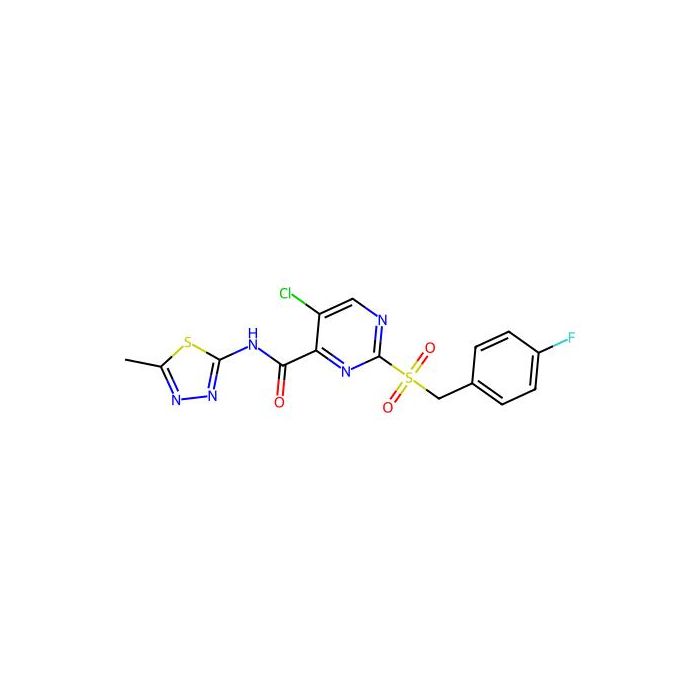
PK11007 - ≥99% , CAS No.874146-69-7
Zu bestellen verfügbar
GRADE & PURITY ≥99%
Storage
Store at -20°C
Shipped In
Ice chest + Ice pads
≥99% for sensitive chromatographic and analytical workflows requiring minimal baseline interference.
Store at -20°C Ships Ice chest + Ice pads Check lot-specific COA for exact specifications.
SDS, COA, datasheet, and spec sheet available for download. Lot-specific COA accessible via lot number lookup.
Cited in 0 peer-reviewed publications across chromatography, organic synthesis, and cross-coupling reactions.
PK11007 is a mild thiol alkylator with anticancer activity. PK11007 stabilizes p53 via selective alkylation of two surface-exposed cysteines without compromising its DNA binding activity. PK11007 induces mutant p53 cancer cell death by increasing reactive oxygen species (ROS) levels.
In Vitro
PK11007 (0-120 µM; 24 hours; four p53 wild-type cell lines and fours p53 mutant cell lines) treatment results in a large viability reduction in mutant p53 cell lines MKN1 (V143A), HUH-7 (Y220C), NUGC-3 (Y220C), and SW480 (R273H/P309S) at concentrations ranging from 15 to 30 µM. PK11007 induces mainly caspase-independent cell death. PK11007 (0-60 µM; 3 hours or 6 hours; NUGC-4, NUGC-3, MKN1, HUH-6, and HUH-7 cancer cells) treatment up-regulates protein levels of the p53 target genes p21, MDM2, and PUMA in a mostly concentration-dependent manner in NUGC-3 (p53-Y220C), HUH-7 (p53-Y220C) and MKN1 (p53-V143A) cells, suggesting partial restoration of transcriptional activity to destabilized p53 mutants. PK11007 also increases p53 activity in HUH-6 and NUGC-4 cells, as indicated by the increase of MDM2, PUMA, and p21 protein levels. PK11007 (15-20 µM; 4.5 hours or 6 hours; MKN1, HUH-7, NUGC-3, HUH-6 cells) treatment increases transcription of p53 target genes in three mutant p53 cell lines after 6-h treatment. PUMA and p21 mRNA levels are up-regulated by a factor of 2 upon treatment of NUGC-3, MKN, and HUH-7 cells, as well as NOXA for the latter two. MDM2 levels are halved in MKN1 and NUGC-3 cells. PK11007 viability reduction is potentiated by glutathione depletion. To test whether PK11007 also increases ROS levels, NUGC-3, NUGC-4, HUH-6, HUH-7, and MKN1 cells with PK11007 are incubated for 2 h. There are elevated ROS levels in all cell lines after 2 h. In the mutant p53 cells MKN1, HUH-7, and NUGC-3, however, the ROS increase is higher at 60 µM PK11007 than in NUGC-4 and HUH-6 cells, suggesting that the higher PK11007 sensitivity of the mutant p53 cell lines is mediated by a stronger ROS induction. Basal and PK11007-induced ROS levels in MKN1 cells are at least twofold higher than in other cell lines. PK11007 inhibits cell proliferation, induces apoptosis and alters genes involved in cell death are all consistent with the ability of PK11007 to reactivate mutant p53. MCE has not independently confirmed the accuracy of these methods. They are for reference only. Cell Viability AssayCell Line: p53 wild-type cell lines (WI-38, HUH-6, NUGC-4, SJSA-1) and p53 mutant cell lines (HUH-7, NUGC-3, SW480, MKN1) Concentration: 0 μM, 20 μM, 40 μM, 60 µM, 80 µM, 100 µM and 120 µM Incubation Time: 24 hours Result: There was a large viability reduction in mutant p53 cell lines MKN1 (V143A), HUH-7 (Y220C), NUGC-3 (Y220C), and SW480 (R273H/P309S) and in p53 WT cell line SJSA-1 at concentrations ranging from 15 to 30 µM. The p53 WT cancer cell lines HUH-6, NUGC-4 and WI-38 were less sensitive with reduced cell viability only at high concentrations of compound (60 and 120 µM). Western Blot AnalysisCell Line: NUGC-4, NUGC-3, MKN1, HUH-6, and HUH-7 cancer cells Concentration: 0 μM, 15 μM, 30 μM, 60 µM Incubation Time: 3 hours or 6 hours Result: Up-regulated protein levels of the p53 target genes p21, MDM2, and PUMA in a mostly concentration-dependent manner in NUGC-3 (p53-Y220C), HUH-7 (p53-Y220C) and MKN1 (p53-V143A) cells. Also increased p53 activity in HUH-6 and NUGC-4 cells, as indicated by the increase of MDM2, PUMA, and p21 protein levels. RT-PCRCell Line: MKN1, HUH-7, NUGC-3, HUH-6 cells Concentration: 15 μM, 20 μM Incubation Time: 4.5 hours or 6 hours Result: Increased transcription of p53 target genes in three mutant p53 cell lines after 6-h treatment. PUMA and p21 mRNA levels were up-regulated by a factor of 2 upon treatment of NUGC-3, MKN, and HUH-7 cells, as well as NOXA for the latter two. MDM2 levels were halved in MKN1 and NUGC-3 cells.
Form:Solid
| Kanonisches Lächeln | CC1=NN=C(S1)NC(=O)C2=NC(=NC=C2Cl)S(=O)(=O)CC3=CC=C(C=C3)F |
|---|---|
| IUPAC Name | 5-chloro-2-[(4-fluorophenyl)methylsulfonyl]-N-(5-methyl-1,3,4-thiadiazol-2-yl)pyrimidine-4-carboxamide |
| InChIKey | IVZQUWCWXYFPOQ-UHFFFAOYSA-N |
| INCHI | 1S/C15H11ClFN5O3S2/c1-8-21-22-14(26-8)20-13(23)12-11(16)6-18-15(19-12)27(24,25)7-9-2-4-10(17)5-3-9/h2-6H,7H2,1H3,(H,20,22,23) |
| Isomere SMILES | CC1=NN=C(S1)NC(=O)C2=NC(=NC=C2Cl)S(=O)(=O)CC3=CC=C(C=C3)F |
| PubChem CID | 16446482 |
| Molekulargewicht | 427.9 |
Comprehensive hazard, handling, storage, and regulatory compliance document.
Download SDS →Lot-specific quality data. Enter your lot number to retrieve the exact COA.
Look up COA →Full quality attributes and acceptance criteria for this grade.
View spec sheet →Taxonomy Tree
| Kingdom | Organic compounds |
|---|---|
| Superclass | Organoheterocyclic compounds |
| Klasse | Diazines |
| Subclass | Pyrimidines and pyrimidine derivatives |
| Intermediate Tree Nodes | Pyrimidinecarboxylic acids and derivatives |
| Direct Parent | Pyrimidinecarboxamides |
| Alternative Parents | Halopyrimidines Fluorobenzenes N-acyl amines Vinylogous halides Thiadiazoles Sulfones Secondary ketimines Heteroaromatic compounds Vinyl fluorides Vinyl chlorides Sulfenyl compounds Propargyl-type 1,3-dipolar organic compounds Fluoroalkenes Chloroalkenes Carboxylic acid amides Azacyclic compounds Organopnictogen compounds Organooxygen compounds Organofluorides Organochlorides Organic oxides Hydrocarbon derivatives |
| Molecular Framework | Aromatic heteromonocyclic compounds |
| Substituents | Pyrimidinecarboxamide - Halopyrimidine - Halobenzene - Fluorobenzene - Benzenoid - N-acyl-amine - Monocyclic benzene moiety - Heteroaromatic compound - Vinylogous halide - Thiadiazole - Sulfonyl - Sulfone - Secondary ketimine - Azole - Carboxamide group - Azacycle - Fluoroalkene - Chloroalkene - Haloalkene - Organic 1,3-dipolar compound - Propargyl-type 1,3-dipolar organic compound - Sulfenyl compound - Vinyl halide - Vinyl fluoride - Vinyl chloride - Carboxylic acid derivative - Organic nitrogen compound - Organic oxygen compound - Organopnictogen compound - Organic oxide - Hydrocarbon derivative - Organosulfur compound - Organooxygen compound - Organonitrogen compound - Organofluoride - Organochloride - Organohalogen compound - Aromatic heteromonocyclic compound |
| Beschreibung | This compound belongs to the class of organic compounds known as pyrimidinecarboxamides. These are compounds containing a pyrimidine ring which bears a carboxamide. |
| External Descriptors | Not available |
| Löslichkeit | DMSO : 250 mg/mL (584.30 mM; Need ultrasonic) |
|---|---|
| Molekulargewicht | 427.900 g/mol |
| XLogP3 | 2.300 |
| Hydrogen Bond Donor Count | 1 |
| Hydrogen Bond Acceptor Count | 9 |
| Rotatable Bond Count | 5 |
| Exact Mass | 426.998 Da |
| Monoisotopic Mass | 426.998 Da |
| Topological Polar Surface Area | 151.000 Ų |
| Heavy Atom Count | 27 |
| Formal Charge | 0 |
| Complexity | 629.000 |
| Isotope Atom Count | 0 |
| Defined Atom Stereocenter Count | 0 |
| Undefined Atom Stereocenter Count | 0 |
| Defined Bond Stereocenter Count | 0 |
| Undefined Bond Stereocenter Count | 0 |
| The total count of all stereochemical bonds | 0 |
| Covalently-Bonded Unit Count | 1 |