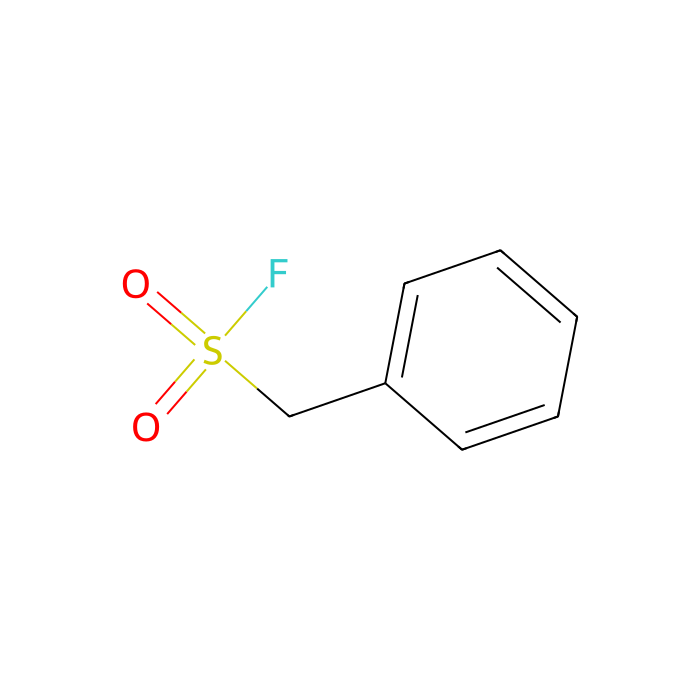
PMSF - 10mM in DMSO , CAS No.329-98-6

CAS: 329-98-6 Cat. No.: P408676 Summenformel: C7H7FO2S Molekulargewicht: 174.19 Beilstein Registry Number: 2088311 EG-Nummer: 206-350-2
Zu bestellen verfügbar
GRADE & PURITY 10mM in DMSO
Synonyms
Phenylmethylsulfonyl Fluoride, Benzylsulfonyl fluoride | phenylmethanesulfonyl fluoride
Storage
Store at -80°C
Shipped In
Dry ice packs + Cold packs
★
Size
Deutschland (EU)
USA*
Price
Qty
1ml
P408676-1ml
—
2 Auf Lager
17,27€
Enter a quantity for the sizes you want to add.
🧪
Why this grade

10mM in DMSO for sensitive chromatographic and analytical workflows requiring minimal baseline interference.

🌡

Storage & shipping

Store at -80°C Ships Dry ice packs + Cold packs Check lot-specific COA for exact specifications.

📋

Quality documents

SDS, COA, datasheet, and spec sheet available for download. Lot-specific COA accessible via lot number lookup.

📚

Literature proof

Cited in 87 peer-reviewed publications across chromatography, organic synthesis, and cross-coupling reactions.

Übersicht

Information

PMSF PMSF (Phenylmethylsulfonyl Fluoride, Benzylsulfonyl fluoride) is an irreversible serine/cysteine protease inhibitor.
In vitro

Although human trypsin is less susceptible to inhibition by PMSF, PMSF rapidly inactivates purified chymotrypsin from human pancreas. PMSF also rapidly inhibits acetylcholinesterase from human red cells. As an inhibitor of phosphatidylinositol-specific phospholipase C, PMSF treatment at 2 mM almost completely inhibits carbachol-stimulated inositol incorporation into phosphatidylinositol (PI) of longitudinal smooth muscle of guinea pig ileum, while it has no effect on potassium-stimulated inositol incorporation. In contrast to its specific inhibition of carbachol-stimulated phosphoinositide turnover, PMSF produces a transient inhibition of contraction by both carbachol and potassium. PMSF has been shown to inhibit the addition of ethanolamine phosphate to glycosylphosphatidylinositol (GPI) intermediates in Trypanosoma brucei. PMSF also inhibits the acylation of the inositol residue of GPI intermediates in bloodstream form T. brucei. PMSF inhibits ethanolamine phosphate addition and inositol acylation for procyclic forms of T. brucei but not for mammalian HeLa cells. PMSF is the more reactive inactivator of mouse acetylcholinesterase (AChE), as the 8-fold higher BSF concentration is necessary to achieve even a 6-fold slower inactivation than that using PMSF.

In vivo

Intraperitoneal injection of PMSF produces dose-dependent analgesia in Sprague-Dawley rats. PMSF significantly enhances the analgesic effect of beta-endorphin (END) in rats. Mice receiving i.p. injections of PMSF exhibit cannabinoid effects that include antinociception, hypothermia and immobility with ED50 of 86 mg/kg, 224 mg/kg and 206 mg/kg, respectively. Pretreatment with an inactive dose of PMSF (30 mg/kg) enhances the effects of anandamide on tail-flick response (antinociception), spontaneous activity and mobility by 5-, 10- and 8-fold, respectively. Administration of PMSF 12 hours prior to PSP causes complete protection in organophosphorus ester-induced delayed neuropathy (OPIDN) in hens, but PMSF administered 4 hours after PSP potentiates its neurotoxic effects. Pretreatment with PMSF (30 mg/kg, i.p.) prior to an injection of 1 or 10 mg/kg 3H-anandamide results 5 minutes later in enhanced brain levels of anandamide compared to those obtained with 3H-anandamide plus vehicle injection. Pretreatment with PMSF inhibits tri-ortho-cresyl phosphate (TOCP)-induced neurofilament (NF) degradation, and protects hens against the development of organophosphate-induced delayed neuropathy (OPIDN). Administration of PMSF enhances the characteristic cannabimimetic effects of Δ(9)-tetrahydrocannabinol (THC) or anandamide (AEA) in ICR mice, by inhibiting the enzyme fatty acid amide hydrolase.
Cell Data

cell lines:

Concentrations:

Incubation Time:

Powder Purity:≥98%

Specifications

Synonyme
Phenylmethylsulfonyl Fluoride, Benzylsulfonyl fluoride | phenylmethanesulfonyl fluoride
Spezifikationen & Reinheit
10mM in DMSO
Biochemische und physiologische Mechanismen
PMSF (Phenylmethylsulfonyl Fluoride, Benzylsulfonyl fluoride) is an irreversible serine/cysteine protease inhibitor.
Storage
Store at -80°C
Verschickt in
Dry ice packs + Cold packs
Dieses Produkt erfordert Kühlkettenversand. Grundversand und andere Economy-Optionen sind nicht verfügbar.
Aktionsart
INHIBITOR
Namen und Kennungen
Isomere SMILES
C1=CC=C(C=C1)CS(=O)(=O)F
WGK Deutschland
3
RTECS
XT8040000
UN-Nummer
2928
Molekulargewicht
174.19
Beilstein
2088311
Reaxy-Rn
2088311
Reaxys-RN_link_address
https://www.reaxys.com/reaxys/secured/hopinto.do?context=S&query=IDE.XRN=2088311&ln=

Documentation

📋 Safety Data Sheet (SDS)

Comprehensive hazard, handling, storage, and regulatory compliance document.

Download SDS →

✅ Certificate of Analysis (COA)

Lot-specific quality data. Enter your lot number to retrieve the exact COA.

Look up COA →

📊 Datasheet

Quick-reference summary of product specifications and applications.

View datasheet →

🔬 Specification Sheet

Full quality attributes and acceptance criteria for this grade.

View spec sheet →

Advanced Data

Zertifikate (CoA, COO, BSE/TSE und Analyse-Diagramm)
C of A & Other Certificates(BSE/TSE, COO):
Analytical Chart:

Find and download the COA for your product by matching the lot number on the packaging.

1 results found

Lot NumberCertificate TypeDatumArtikel
K2407003Certificate of AnalysisSep 03, 2026 P408676
Chemische und physikalische Eigenschaften
LöslichkeitSolubility (25°C) In vitro DMSO: 100 mg/mL (124.53 mM);    
Siedepunkt (°C)85°C/0.3mmHg
Schmelzpunkt (°C)92-95°C
FAQs und Artikel
Cross-linking ChIP-Seq (X-ChIP-Seq) protocol
Chromatin preparation from tissues for chromatin immunoprecipitation (ChIP)
Surfactant-Free Nuclear Protein Extraction Protocol
Protease Inhibitors
Buffer Additives to Prevent Protein Precipitation
How to Optimize Buffer Components for Ni-Agarose Beads
Three Main Differences Between AEBSF and PMSF Protease Inhibitors
How to Choose the Best Protein Purification Technique
FAQ on Molecular Interaction Assays
His-Tag Protein Purification: Common Troubleshooting Questions and Practical Solutions
RNA Pull-Down Standard Operating Procedure (SOP)
DNA Pull-Down Standard Operating Procedure (SOP)
OSF/ASF Dual-Channel Toolbox: Divergent Reactions of Four-Membered Ring Sulfonyl Fluorides, Condition “Knobs,” and Selection Navigation
Protein Tags Demystified: Classification, Properties, and Suitable Experimental Applications
Proteinase K: Frequently Asked Questions
Angiotensin-Converting Enzyme (ACE): A Review of Molecular Features, Catalytic Functions, and Research and Translational Applications
Research Applications of Pancreatin: An Overview
Review of Chymotrypsin: Enzymological Properties, Catalytic Mechanism, and Research Applications
Review of Collagenase: Enzymological Features, Type Systems, and Research Applications
Clostridial Proteases: Classification, Molecular Mechanisms, and Research Applications
Furin: A Review of Its Structural Features, Substrate Recognition, and Research Applications
Roles of the Carboxypeptidase Family in Protein C-Terminal Processing and Experimental Analysis
SuFEx and Sulfonyl Fluorides: From S(VI)–F Click Ligation Reactions to Covalent Tools in Chemical Biology
Coupling Mechanisms Between Terminal Reducing-Power Allocation in Photosynthetic Electron Transport and Metabolic Demand
What Is Synthetic Biology? The Industrialization Pathway from Upstream Reagent Toolchains to Biomanufacturing Applications
Catalytic Mechanisms, Classification Characteristics, and Experimental Applications of Serine Endopeptidases
Catalytic Mechanisms, Substrate Selectivity, and Metabolic Functions of Amide Hydrolases
Citations of This Product
Lösungsrechner
Bewertungen

Kundenbewertungen

Häufig gestellte Fragen

How should this product be stored?
Store at ?80 °C. Ultra-low temperature storage is required to maintain the specified shelf life.
How is this product shipped?
This product ships frozen with dry ice and cold packs. Unpack on arrival and transfer it to the storage condition stated above; handle dry ice with insulated gloves in a ventilated area.
What are the CAS number, molecular formula and molecular weight?
The CAS Number is 329-98-6, the molecular formula is C7H7FO2S, and the molecular weight is 174.19 g/mol.
What documentation is provided?
Available product documentation, including Certificates of Analysis (COA), Safety Data Sheets (SDS), and specification sheets, is shown in the product document area. Document availability and access follow the current site policy.

Shall we send you a message when we have discounts available?

Remind me later

Thank you! Please check your email inbox to confirm.

Oops! Notifications are disabled.