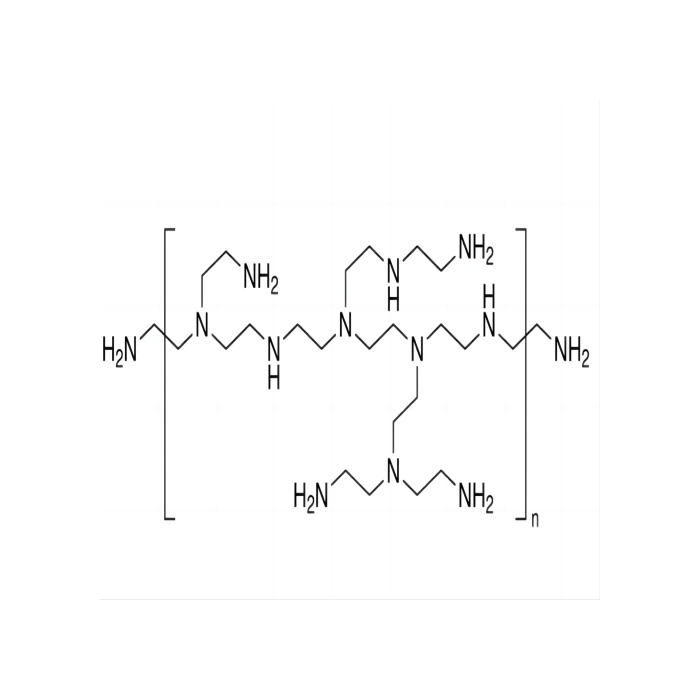
Poly(ethyleneimine) solution(PEI) - average Mw ~2,000 by LS, average Mn ~1,800 by GPC, 50 wt. % in H2O, used for Poly(ethyleneimine) solution can be used for surface modification of cation exchange resins. The modified resins exhibited improved selectivit

CAS: 9002-98-6 Cat. No.: P434395 Summenformel: H(NHCH2CH2)nNH2 EG-Nummer: 618-346-1
Zu bestellen verfügbar
GRADE & PURITY average Mw ~2,000 by LS, average Mn ~1,800 by GPC, 50 wt. % in H2O
Synonyms
PEI
Storage
Room temperature,Argon charged,Desiccated
Shipped In
Normal
★
Size
Deutschland (EU)
USA*
Price
Qty
5ml
P434395-5ml
—
2 Auf Lager
104,04€
100ml
P434395-100ml
—
1 Auf Lager
173,46€
250ml
P434395-250ml
Auf Bestellung · 8–12 Wochen
268,91€
Enter a quantity for the sizes you want to add.
🧪
Why this grade

average Mw ~2,000 by LS, average Mn ~1,800 by GPC, 50 wt. % in H2O for sensitive chromatographic and analytical workflows requiring minimal baseline interference.

🌡

Storage & shipping

Room temperature,Argon charged,Desiccated Ships Normal Check lot-specific COA for exact specifications.

📋

Quality documents

SDS, COA, datasheet, and spec sheet available for download. Lot-specific COA accessible via lot number lookup.

📚

Literature proof

Cited in 2261 peer-reviewed publications across chromatography, organic synthesis, and cross-coupling reactions.

Übersicht

Poly(ethyleneimine) (PEI) is a positivelycharged polymeric amine with a linear or branched structure. It has chelating properties with a variety of metal ions. It is highlysoluble in water and behaves as an effective base in aqueous solutions. Due toits superior physicochemical properties, it is widely used in the field ofbiomedicine, water purification, bioimaging, gene delivery, and self-healingmaterials.

Specifications

Synonyme
PEI
Spezifikationen & Reinheit
average Mw ~2,000 by LS, average Mn ~1,800 by GPC, 50 wt. % in H2O
Anmeldung
Poly(ethyleneimine) solution can be used for surface modification of cation exchange resins. The modified resins exhibited improved selectivity towards transition elements. Due to repulsion effects within the cationic layer, the selectivity for alkaline i
Storage
Room temperature,Argon charged,Desiccated
Verschickt in
Normal
Namen und Kennungen
Pubchem Sid
Pubchem Sid Url
https://pubchem.ncbi.nlm.nih.gov/substance/528774806
Kanonisches Lächeln
C1CN1
IUPAC Name
aziridine
InChIKey
NOWKCMXCCJGMRR-UHFFFAOYSA-N
INCHI
1S/C2H5N/c1-2-3-1/h3H,1-2H2
Isomere SMILES
C1CN1
WGK Deutschland
2
RTECS
TQ7917000
Alternative CAS-Nummer
106899-94-9
UN-Nummer
3082
Verpackungsgruppe
III
Reaxy-Rn
102380
Reaxys-RN_link_address
https://www.reaxys.com/reaxys/secured/hopinto.do?context=S&query=IDE.XRN=102380&ln=

Documentation

📋 Safety Data Sheet (SDS)

Comprehensive hazard, handling, storage, and regulatory compliance document.

Download SDS →

✅ Certificate of Analysis (COA)

Lot-specific quality data. Enter your lot number to retrieve the exact COA.

Look up COA →

📊 Datasheet

Quick-reference summary of product specifications and applications.

View datasheet →

🔬 Specification Sheet

Full quality attributes and acceptance criteria for this grade.

View spec sheet →

Advanced Data

Taxonomic Classification

Taxonomy Tree

KingdomOrganic compounds
SuperclassOrganoheterocyclic compounds
KlasseAziridines
SubclassNot available
Intermediate Tree Nodes Not available
Direct ParentAziridines
Alternative Parents Dialkylamines  Azacyclic compounds  Organopnictogen compounds  Hydrocarbon derivatives  
Molecular FrameworkAliphatic heteromonocyclic compounds
Substituents Azacycle - Secondary amine - Secondary aliphatic amine - Aziridine - Organic nitrogen compound - Organopnictogen compound - Hydrocarbon derivative - Organonitrogen compound - Amine - Aliphatic heteromonocyclic compound
BeschreibungThis compound belongs to the class of organic compounds known as aziridines. These are organic compounds containing a saturated three-member heterocycle with one amino group and two methylene groups.
External Descriptors azacycloalkane - saturated organic heteromonocyclic parent - aziridines
3D-Struktur
Interaktives chemisches Strukturmodell


Wirkungsmechanismen
Zertifikate (CoA, COO, BSE/TSE und Analyse-Diagramm)
C of A & Other Certificates(BSE/TSE, COO):
Analytical Chart:

Find and download the COA for your product by matching the lot number on the packaging.

10 results found

Lot NumberCertificate TypeDatumArtikel
D2603206Certificate of AnalysisMar 28, 2026 P434395
D2603215Certificate of AnalysisMar 28, 2026 P434395
D2603244Certificate of AnalysisMar 28, 2026 P434395
K2414305Certificate of AnalysisNov 08, 2024 P434395
K2414329Certificate of AnalysisNov 08, 2024 P434395
E2423400Certificate of AnalysisMay 16, 2024 P434395
E2423413Certificate of AnalysisMay 16, 2024 P434395
E2423414Certificate of AnalysisMay 16, 2024 P434395
E2423415Certificate of AnalysisMay 16, 2024 P434395
E2423416Certificate of AnalysisMay 16, 2024 P434395
Chemische und physikalische Eigenschaften
Brechungsindex1.5290
Siedepunkt (°C)100 °C
Schmelzpunkt (°C)-10 °C
Molekulargewicht43.070 g/mol
XLogP3-0.400
Hydrogen Bond Donor Count1
Hydrogen Bond Acceptor Count1
Rotatable Bond Count0
Exact Mass43.0422 Da
Monoisotopic Mass43.0422 Da
Topological Polar Surface Area21.900 Ų
Heavy Atom Count3
Formal Charge0
Complexity10.300
Isotope Atom Count0
Defined Atom Stereocenter Count0
Undefined Atom Stereocenter Count0
Defined Bond Stereocenter Count0
Undefined Bond Stereocenter Count0
The total count of all stereochemical bonds0
Covalently-Bonded Unit Count1
FAQs und Artikel
Non-viral Vectors for Gene Transfection: Polyethyleneimine
Differences Between Transformation and Transfection
Nucleic Acid and Nuclease Decontamination in Biopharmaceutical Manufacturing and Molecular Testing Workflows
Materials Can “Switch”: How Smart Polymers Respond to Temperature, pH, and Light (with Experimental Selection Tips & Product Navigation)
Understanding Hydrophilic Polymers in Aqueous Systems: Hydration Mechanisms, Structural Knobs, and Task-Oriented Selection Guide (Including Tables 1–3)
Biomedical Polymer Insights: Role-Based Task Map, Six Key Material Levers, and a Risk-Driven Evidence Chain (including the Product Navigation Guide and Product Tables 1–3)
dsDNase-Mediated Hydrolysis of Double-Stranded DNA: Enzymatic Characteristics, Methodological Strategies, and Bioanalytical Applications
Research Value of Polyelectrolyte Multilayers: Layer-by-Layer Design of Interfacial Composition, Mass Transport, and Function
What Are Polyamines? Structural Features, Classification and Representative Compounds, Applications, and Synthetic Strategies
Signal Transduction Mechanism of Graphene Biosensors: From Molecular Recognition to Electrical/Optical Signal Readout and Materials Selection
Key Variable in the Long-Term Stability of Waterborne Pigment Concentrates: How Dispersant Molecular Weight Distribution (MWD) Affects Pigment Dispersion, Surface Adsorption-Layer Formation, and Storage Stability
Dispersants, Anti-Redeposition Agents, and Scale-Control Materials in Household Cleaning Formulations: Mechanisms of Action, Selection Logic, and Representative Products
Citations of This Product
Lösungsrechner
Bewertungen

Kundenbewertungen

Dürfen wir Sie über Rabattaktionen informieren?

Später erinnern

Vielen Dank! Bitte überprüfen Sie Ihren E-Mail-Posteingang, um zu bestätigen.

Hoppla! Benachrichtigungen sind deaktiviert.