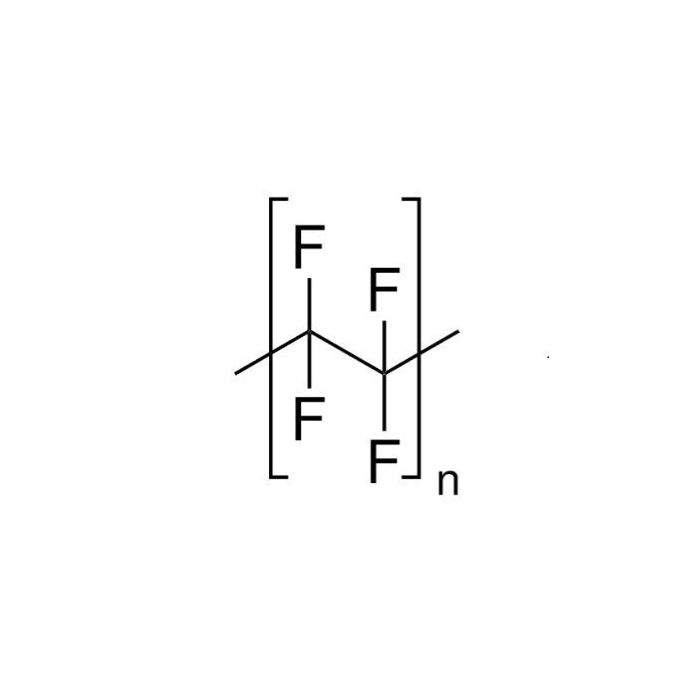
Poly(tetrafluoroethylene)(PTFE) - powder,>40 μm particle size, used for Polytetrafluoroethylene (PTFE) can be used as a precursor to manufacture supercapacitors. various applications , CAS No.9002-84-0

CAS: 9002-84-0 Cat. No.: P434337 Summenformel: (C2F4)n EG-Nummer: 618-337-2 PubChem CID: 8301
Zu bestellen verfügbar
QUALITÄT & REINHEIT powder,>40 μm particle size
Synonyms
PTFE sheet, 6.35mm (0.25in) thick|Tetrafluorethylene|Tetrafluorethene|Tetrafluoraethylen|Tetrafluoroethylene, inhibited [UN1081] [Flammable gas]|1,1,2,2-tetrakis(fluoranyl)ethene|PTFE rod, 6.35mm (0.25in) dia|TEFLON|Tetrafluoraethen|Ethene, tetrafluoro-|perfluorethylen|TETRAFLUOROETHYLENE [IARC]|1,1,2,2-tetrafluoroethene|TETRAFLUOROETHYLENE|PTFE sheet, 3.18mm (0.125in) thick|Tetrafluoroethylene monomer|Tetrafluoroethyl methyl ether|Perfluoroethene|Ethene, 1,1,2,2-tetrafluoro-|Ethylene, tetrafluoro-|TETRAFLUOROETHYLENE [MI]|Perfluorethen (Geman)|Perfluoroethylene|tetrafluorethylen|tetrafluoro ethene|TETRAFLUOROETHYLENE [HSDB]|Fluoroplast 4|TETRAFLUOROETHYLENE (IARC)|Tetrafluoroethene|UN 1081 (Salt/Mix)|Tetrafluorethylene telomer (Salt/Mix)|MS-122 (Salt/Mix)|tetrafluorethen|Perfluoraethylen|Tetrafluoroethylene, inhibited
Storage
Room temperature,Desiccated
Shipped In
Normal
★
Größe
Deutschland (EU)
USA*
Preis
Menge
100g
P434337-100g
Auf Bestellung · 8–12 Wochen
43,30€
500g
P434337-500g
Auf Bestellung · 8–12 Wochen
156,11€
Enter a quantity for the sizes you want to add.

Übersicht

Polytetrafluoroethylene (PTFE) is a stable fluoropolymer widely used in coatings, heat shields, supercapacitors, lubricants, bearings, and clinical applications.
Features and Benefits

Chemically and biologically inert; recyclable; resistant to enzyme and microbial degradation; extremely low friction coefficient; insulating and dielectric properties.

Spezifikationen

Synonyme
PTFE sheet, 6.35mm (0.25in) thick | Tetrafluorethylene | Tetrafluorethene | Tetrafluoraethylen | Tetrafluoroethylene, inhibited [UN1081] [Flammable gas] | 1,1,2,2-tetrakis(fluoranyl)ethene | PTFE rod, 6.35mm (0.25in) dia | TEFLON | Tetrafluoraethen | Ethene, tetrafluoro- | perfluorethylen | TETRAFLUOROETHYLENE [IARC] | 1,1,2,2-tetrafluor Show more
Spezifikationen & Reinheit
powder,>40 μm particle size
Anmeldung
Polytetrafluoroethylene (PTFE) can be used as a precursor to manufacture supercapacitors.
Storage
Room temperature,Desiccated
Verschickt in
Normal
Namen und Kennungen
SMILES
F\C(F)=C(\F)F
IUPAC Name
1,1,2,2-tetrafluoroethene
InChIKey
BFKJFAAPBSQJPD-UHFFFAOYSA-N
InChI
1S/C2F4/c3-1(4)2(5)6
Isomere SMILES
C(=C(F)F)(F)F
PubChem CID
8301

Erweiterte Daten

Taxonomic Classification

Taxonomy Tree

KingdomOrganic compounds
SuperclassOrganohalogen compounds
KlasseVinyl halides
SubclassVinyl fluorides
Intermediate Tree Nodes Not available
Direct ParentVinyl fluorides
Alternative Parents Fluoroalkenes  Organofluorides  Hydrocarbon derivatives  
Molecular FrameworkAliphatic acyclic compounds
Substituents Fluoroalkene - Haloalkene - Vinyl fluoride - Hydrocarbon derivative - Organofluoride - Aliphatic acyclic compound
BeschreibungThis compound belongs to the class of organic compounds known as vinyl fluorides. These are vinyl halides in which a fluorine atom is bonded to an sp2-hybridised carbon atom.
External Descriptors fluorocarbon
3D-Struktur
Interaktives chemisches Strukturmodell


Wirkungsmechanismen
Zertifikate (CoA, COO, BSE/TSE und Analyse-Diagramm)
C of A & Other Certificates(BSE/TSE, COO):
Analytical Chart:

Find and download the COA for your product by matching the lot number on the packaging.

3 results found

Lot NumberCertificate TypeDatumArtikel
H2614632H2614632Certificate of AnalysisJul 31, 2026 P434337
H2614635H2614635Certificate of AnalysisJul 31, 2026 P434337
H2614638H2614638Certificate of AnalysisJul 31, 2026 P434337
Chemische und physikalische Eigenschaften
Molekulargewicht100.01
XLogP31.300
Hydrogen Bond Donor Count0
Hydrogen Bond Acceptor Count4
Rotatable Bond Count0
Exact Mass99.9936 Da
Monoisotopic Mass99.9936 Da
Topological Polar Surface Area0.000 Ų
Heavy Atom Count6
Formal Charge0
Complexity55.600
Isotope Atom Count0
Defined Atom Stereocenter Count0
Undefined Atom Stereocenter Count0
Defined Bond Stereocenter Count0
Undefined Bond Stereocenter Count0
The total count of all stereochemical bonds0
Covalently-Bonded Unit Count1
FAQs und Artikel
How to Choose a Hydrogen Evolution (HER) Catalyst: Kinetic Barriers in Water Electrolysis, AWE/PEM/AEM Pathways, and a Materials-Family Roadmap (with a Product Map)
Panorama Guide to Lithium-Ion Battery Electrode Materials: Working Principles, Materials Map, and Selection Navigation (incl. Tables 1–4)
A Panorama Guide to Synthetic Resins: Definitions & Polymerization Mechanisms, Classification Frameworks, Common Resins and Applications, Packaging Codes, and a Selection Roadmap (Tables 1–3)
Optical & Optoelectronic Materials Selection Guide:Positioning materials, key metrics, and validation paths along “Generation → Guiding → Control → Readout” (with product navigation and Tables 1–4)
Biomedical Polymer Insights: Role-Based Task Map, Six Key Material Levers, and a Risk-Driven Evidence Chain (including the Product Navigation Guide and Product Tables 1–3)
uide to Hydrophobic Polymers and Hydrophobic Surfaces: Wetting Models, Evaluation Metrics, and Task-Oriented Material Selection (including Tables 1–3)
How Matting Agents in Coatings Build Low-Gloss Coating Surfaces: Mechanisms, Formulation Trade-Offs, and Product Selection
Why Fluorocarbon Resins Are Weatherable: Structural Stability, Low Surface Energy, and Coating Film Appearance Retention
Guide to Selecting Polyurethane Coating Systems: Application Analysis for Wood, Flooring, Plastics, Automotive, and Industrial Protection
PVDF, FEVE and Functional Fluororesins: System Differences and Application Selection in Fluorocarbon Coatings
Fluorocarbon Resin Coating Formulation Design: Resin Selection, Supporting Systems, and Key Application Control Points
Comprehensive Performance Analysis of Polyurethane Coating Films: Soft/Hard Segment Structure, Microphase Separation, Crosslinking and Curing, and Selection of Representative Chemicals
When Should You Choose Silicone Resin? Selection Comparison with Epoxy, Acrylic, Polyurethane, Fluororesin, and Other Coating Resins
Applications and Selection of Polyester Resins in Industrial Coatings: Powder, Coil, Baking, Packaging, and Metal Coating Scenarios
Applicability Boundaries, Failure Risks, and Alternative System Selection for Chlorinated Rubber Resin in Coatings
Resin Polarity in Coating Formulations: From Molecular Structure to Dissolution, Compatibility, Interfacial Interactions, and Formulation Design
Solid Supports in Packed Gas Chromatography Columns: Definition, Mechanisms of Action, Classification, and Selection
Citations of This Product
Lösungsrechner
Bewertungen

Kundenbewertungen

Dürfen wir Sie über Rabattaktionen informieren?

Später erinnern

Vielen Dank! Bitte überprüfen Sie Ihren E-Mail-Posteingang, um zu bestätigen.

Hoppla! Benachrichtigungen sind deaktiviert.