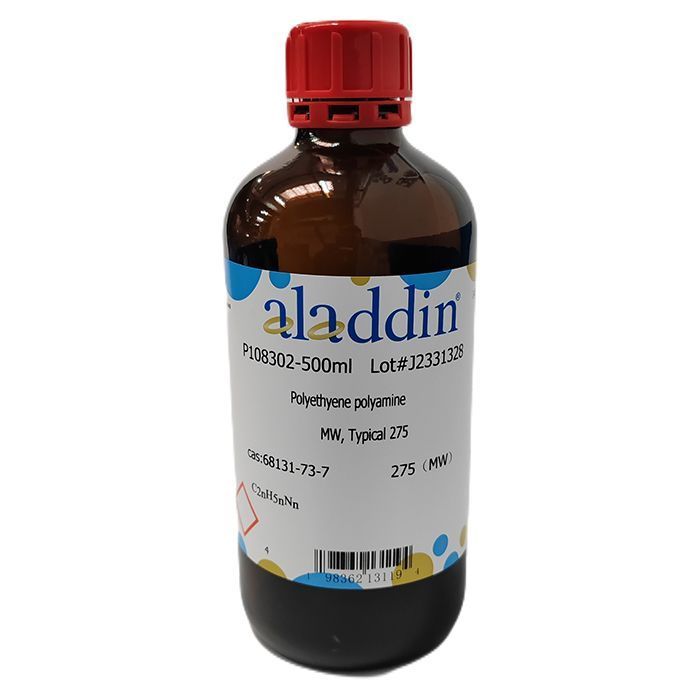
MW, Typical 275 für empfindliche chromatographische und analytische Workflows, die minimale Basislinieninterferenzen erfordern.
🌡
Lagerung & Versand
Room temperature Versand FedEx DG Service. Genaue Spezifikationen finden Sie im chargenspezifischen COA.
📋
Qualitätsdokumente
SDS, COA, Datenblatt und Spezifikationsblatt stehen zum Download bereit. Chargenspezifische COA über Chargennummernsuche abrufbar.
📚
Literaturbeleg
In 5 peer-reviewten Publikationen zu Chromatographie, organischer Synthese und Kreuzkupplungsreaktionen zitiert.
Übersicht
Polyethyene polyamine is an economical, complex mixture of linear, branched and cyclic ethylene amines. Polyethyene polyamine offers more flexibility versus DETA,TETA, and TEPA type materials. It is recommended for epoxy coal tar systems, patch kits,two-pack adhesives, and other applications where color is not a limitation. In adhesives,Polyethyene polyamine yields much higher peel strength than DETA or TETA at comparable gel times and lower cost.This amine curing agent is hygroscopic and may pick up moisture and carbon dioxide from the atmosphere. Aliphatic polyamines are low viscosity, economical, fast reacting curing agents, imparting high chemical and solvent resistance and improved physical properties to the applied system. When cured under ambient conditions epoxy-polyamine coatings reach maximum physical properties in about four days, and maximum chemical resistance in seven days. These times can be accelerated by heat treatment. In epoxy coatings, aliphatic polyamines are generally used at or near stoichiometric concentration. Major concerns of aliphatic polyamines include their high volatility, toxicity, tendency to blush during cure and inconvenient mix ratios which must be weighed very accurately. Blush can be reduced through the use of higher molecular weight amines and application under low humidity conditions. See the Dow technical bulletin entitled, Aliphatic polyamines can be modified to form a variety of other curatives, including polyamides, polyamine-adducts, amidoamines, ketimines and Mannich bases. ? Adhesives ? Casting and Tooling ? Civil Engineering ? Composites ? Marine and Protective Coatings ? Potting and Encapsulation
Determine the necessary mass, volume, or concentration for preparing a solution.
Dilution Calculator
Determine the dilution needed to prepare a stock solution.
Reconstitution Calculator
Bewertungen
Kundenbewertungen
Application Protocols
No vendor-tested bioassay protocols are provided for this reagent. Below are general, non-item-specific examples for research planning. Adjust based on your lot’s CoA (amine value, viscosity) and your substrate.
Epoxy curing stoichiometry (literature/general):
Obtain AHEW from CoA or calculate from amine value. 2) Determine epoxide equivalent weight (EEW) of resin. 3) Parts by weight of PEPA = (AHEW / EEW) × 100. 4) Mix under dry N2, allow induction time, de-gas, cure per schedule.
Metal scavenging test (literature/general):
Prepare 0.01–0.1 M PEPA in water (pH ~9). 2) Spike with 10–100 ppm metal ion (Cu2+/Ni2+). 3) Stir 15–30 min; monitor residual metal by ICP-OES. 4) Strip with 1–2 M HCl; neutralize effluent appropriately.
Reductive amination on solid support (literature/general):
React carbonyl-functional resin with PEPA in MeOH/toluene with 3 Å sieves, rt–50 °C, 2–16 h. 2) Wash; 3) Reduce with NaBH3CN in MeOH/AcOH; 4) Wash and characterize loading by elemental analysis.
Amide coupling to diacyl chloride (literature/general):
Cool 0–5 °C in DCM; 2) Add diacyl chloride slowly to PEPA solution; 3) Maintain pH/basicity with additional base if needed; 4) Quench cautiously; 5) Work up.
Item-specific validated protocols/dilutions: Not specified for this item; refer to CoA/Spec Sheet.
Biological Roles
This product is a synthetic mixture of polyamines intended for laboratory research and chemical processing; it is not a biological metabolite.
Literature/general context:
Polyamines in biology (putrescine, spermidine, spermine) are ubiquitous cations that bind nucleic acids and modulate translation, ion channels, and cell growth. While chemically related (aliphatic amines spaced by methylenes), polyethylene polyamines like PEPA are not endogenous and exhibit different physicochemical and toxicological profiles.
Biopolymer interactions: Cationic amines can condense DNA/RNA electrostatically; synthetic polyamines are sometimes explored as nonviral transfection aids or as components of antimicrobial coatings in research settings, but this specific product is for research use only and not intended for biological administration.
Metal sequestration: Multidentate amines can chelate Fe/Cu/Zn, impacting redox chemistry in vitro. This is exploited in biochemical sample prep (e.g., metal scavenging prior to enzyme assays) on a research basis.
Caveats:
Mixture composition affects charge density and binding; empirical optimization is required for biochemical uses.
Protein incompatibilities may arise due to strong basicity and potential denaturation at high pH.
Item-specific biological data (cytotoxicity, LD50, biocompatibility): Not specified for this item; refer to SDS and primary literature. For research use only.
Buffer Applications
Polyethylene polyamine is not a standardized buffering reagent and is rarely used to prepare defined pH buffers.
Literature/general guidance:
Acid–base properties: Multiple amine sites confer a series of overlapping pKa values (primary ~10–11; secondary ~9–10). While this provides broad basic capacity, it yields poor buffer plateaus compared to dedicated buffers (Tris, HEPES, phosphate).
Potential uses: As a strong base or titratable component to adjust pH upward in aqueous systems; to generate polyamine salts (e.g., sulfate, chloride) for particular formulations or to modulate ionic strength.
Cautions: Rapid CO2 absorption can lower apparent pH via carbamate formation; strong interactions with proteins/DNA can perturb biological assays; corrosive to glassware coatings and certain plastics if concentrated and hot.
If a buffer is required, choose a conventional buffering system (e.g., Tris pKa 8.1, HEPES pKa 7.5, phosphate pKa2 7.2) and reserve polyethylene polyamine for roles such as chelation, scavenging, or crosslinking in separate steps.
Item-specific buffer recipes or pKa data: Not specified for this item; refer to CoA/Spec Sheet if provided.
Green Alternatives
Assessing greener choices depends on the target function (curing, chelation, CO2 capture). Polyethylene polyamines have benefits (high functionality, low VOC vs small amines) but also concerns (corrosivity, aquatic toxicity, nitrosamine potential with nitrosating agents).
Comparison (literature/general):
PEPA vs small amines (e.g., ethylenediamine, DETA):
PEI offers even higher functionality but with higher cytotoxicity and challenging waste treatment; PEPA may be easier to handle and dispose of in some contexts.
Solvent choices: favor water/ethanol where chemistry permits; use 2-MeTHF/CPME over chlorinated solvents for extractions or nonaqueous processing.
Greener practice tips:
Optimize stoichiometry via amine value/AHEW to minimize excess.
Implement closed transfer to reduce worker exposure and emissions.
Use aqueous systems for chelation where possible; recover metals via pH swing.
Establish nitrite-free conditions to avoid nitrosamine formation.
Item-specific eco/tox data: Not specified for this item; refer to SDS and local regulations.
Pharmaceutical Uses
No medical or clinical claims are made for this product. It is supplied strictly for research and laboratory use.
Formulation and manufacturing context (literature/general):
Crosslinker/curing component in device adhesives and coatings used in manufacturing environments (e.g., epoxy-based assembly aids). Selection depends on AHEW and viscosity.
Polymer functionalization: Introduction of cationic sites to excipient polymers (e.g., cellulose, dextran) for ion-exchange or mucoadhesive properties in research-scale development.
API processing aids: As an acid scavenger or nucleophilic catalyst in certain synthetic steps during small-molecule API manufacturing (under GMP, alternative grades/specs would be required).
Metal scavenging: Removal of residual catalyst metals from process streams or intermediates.
Regulatory considerations:
Pharmacopoeial monographs: none specific to polyethylene polyamine mixtures (literature/general). Any use in regulated environments requires qualification and impurity profiling.
Extractables/leachables: High basicity can extract species from certain plastics; conduct compatibility studies with contact materials.
Item-specific pharmacopeial status, residual solvents, bioburden/endotoxin: Not specified for this item; refer to CoA/Spec Sheet and quality agreement if pursuing regulated applications.
Physical Properties
Item-specific specifications are not provided. See CoA/Spec Sheet for any certified values for this lot.
Literature/general characteristics for polyethylene polyamine mixtures:
Physical state/appearance: typically viscous, hygroscopic liquids; colorless to pale yellow to amber depending on cut and impurities (literature/general).
Boiling behavior: broad, component-dependent. Representative pure components: DETA bp ~206 °C; TETA bp ~277 °C; TEPA bp ~340 °C at 1 atm (literature). Mixtures exhibit wide boiling ranges and may be distilled under reduced pressure.
Melting point: not meaningful for mixtures; many remain liquid at ambient temperatures (literature/general).
Density (20–25 °C): commonly ~0.95–1.00 g/mL depending on composition (literature/general).
Viscosity: increases sharply with average chain length; may be >100 mPa·s for higher oligomer cuts (literature/general).
Solubility: miscible with water, alcohols, and many polar aprotic solvents (e.g., DMF, DMSO); limited solubility in nonpolar hydrocarbons (literature/general).
Hydrogen-bonding: strong donor/acceptor; readily forms salts with mineral and organic acids (literature/general).
Hygroscopic/CO2 uptake: absorbs moisture and CO2 from air forming ammonium/carbamate species, which can alter apparent mass and basicity (literature/general).
Item-specific data not listed above: Not specified for this item; refer to CoA/Spec Sheet.
Quality and Grades
Grade/purity: Not specified for this item; refer to CoA/Spec Sheet.
Context for polyethylene polyamine quality metrics (literature/general):
Amine value / total amine: Often reported as mg KOH/g or eq/kg; correlates with average functionality and molecular weight distribution. Useful for stoichiometry in curing or salt formation.
Active hydrogen equivalent weight (AHEW): Calculated from amine value and functionality; critical for epoxy curing calculations.
Color (Gardner/APHA): Indicates oxidation/by-product levels; important for coatings/adhesives applications.
Water content: Karl Fischer moisture influences reactivity, acid scavenging capacity, and CO2 uptake behavior. Item-specific value: Not specified for this item; refer to CoA/Spec Sheet.
Residual chloride/metal content: May be relevant for catalysis or electronics-related uses. Not specified for this item; refer to CoA/Spec Sheet.
UV absorbance (for HPLC uses): Typically not a chromatographic solvent; low relevance.
Stabilizers/inhibitors: Not specified for this item; refer to CoA/Spec Sheet. Many polyamine mixtures are shipped without stabilizers but benefit from dry, oxygen-limited storage to minimize color development.
What this means practically:
For precision applications (e.g., epoxy stoichiometry, chelation capacity), request and use the lot-specific CoA values (amine value, water content, viscosity, AHEW) to calculate charges.
For synthetic transformations, test-scale to account for batch-to-batch distribution differences inherent to mixture CAS 68131-73-7.
Reaction and Applications
Polyethylene polyamine (PEPA) serves as a versatile, high-functionality base/nucleophile and chelating scaffold.
Research and industrial applications (literature/general):
Epoxy/oxirane curing agent: Primary/secondary amines open epoxides rapidly, affording crosslinked thermosets; cure rate and network density are tunable via average functionality (AHEW-driven stoichiometry).
Acylation/Urea/Amide formation: Reacts with acyl chlorides/anhydrides/activated esters to give polyamides and ureas; useful for polymer and surface functionalization.
Isocyanate reactions: Fast addition to isocyanates forming ureas; exploited in polyurethane chain extension or crosslinking.
Imine/Schiff base formation: Condensation with aldehydes/ketones; subsequent reduction yields secondary/tertiary amines; also employed for temporary protection or resin conjugation.
Chelation/complexation: Multiple donor nitrogens bind transition metals (Cu, Ni, Co, Fe) for separations, catalysis, or scavenging; precursor to immobilized chelating resins.
CO2 capture: Forms carbamates/bicarbonates in aqueous or supported media; relevant to screening studies for direct air capture (lab-scale research only).
Corrosion inhibition: Adsorbs on steel/copper surfaces; forms protective films in water treatment formulations (research/formulation context).
Practical tips (literature/general):
Dry and degas prior to moisture/CO2-sensitive steps; store under inert gas to maintain capacity.
Control exotherms when adding to epoxides, acyl chlorides, or isocyanates; add slowly, cool if needed.
For step-growth polymerizations, use titrated amine value to compute stoichiometry; monitor conversion by acid number/epoxide equivalent titration.
Metal complex workups: acidify to strip metals; basify to regenerate free amine.
Reaction Conditions
Guidance below reflects literature/general practice. Optimize per substrate and refer to primary sources.
Epoxide curing: Neat or in DMF/MEA diluents; 0.8–1.1 amine-H equivalents per epoxide equivalent. Typical cure: 25–60 °C (pot life control), post-cure 80–120 °C for 1–4 h. Exothermic—meter addition and provide cooling for bulk mixes.
Acylation to amides: Solvent DCM/THF/DMF, base scavenging by excess PEPA or external base (e.g., Et3N). Temperature 0–25 °C initial, then to rt; couple via acyl chloride/anhydride or EDC/NHS-activated esters. Monitor by IR (amide C=O) or titration.
Isocyanate to ureas: Dry DCM/THF to control gelation; add isocyanate slowly at 0–25 °C; allow to cure to rt–60 °C as needed.
Imine formation/reductive amination: Carbonyl + PEPA in toluene/MeOH with molecular sieves; 20–60 °C. Reduce with NaBH3CN or H2/Pd under controlled conditions.
Metal chelation: Aqueous pH 8–11 improves loading for many divalent metals; strip with mineral acid (pH <2); complexation times 5–60 min with stirring.
CO2 absorption (screening): 20–40 °C gas uptake in aqueous/alcoholic solutions; desorb under N2/heat 80–120 °C (closed systems with proper relief only).
Notes:
Remove water/CO2 (vacuum, inert sweep) for moisture-sensitive couplings.
Viscosity may require gentle heating (30–50 °C) for transfer.
Expected yields vary widely with substrate; small-scale optimization recommended.
Item-specific conditions or catalytic data: Not specified for this item; refer to CoA/Spec Sheet.
Safety and Handling
Item-specific GHS classification and statements: Not specified for this item; refer to SDS.
General safety profile for aliphatic polyethylene polyamines (literature/general):
Hazards: typically corrosive/causes severe skin burns and eye damage; harmful if inhaled or swallowed; may cause respiratory irritation; can be sensitizing in some cases; harmful to aquatic life. Vapors are low due to low volatility but can be irritating.
Reactivity: strong bases and nucleophiles; react exothermically with acids, acylating agents (acyl chlorides, anhydrides), epoxides, isocyanates, carbonyls (imine formation), and oxidizers. Absorb CO2 from air to form carbamates; may form salts/solids on exposure.
Incompatibilities: strong oxidizers, acid chlorides/anhydrides, nitrosating agents (risk of nitrosamine formation), reactive halides, isocyanates, and epoxides unless controlled.
PPE: chemical-resistant gloves (e.g., nitrile), lab coat, closed goggles/face shield; use in a fume hood. For bulk handling, consider butyl/laminate gloves and splash protection.
First aid (overview; consult SDS): skin—immediately remove contaminated clothing, rinse with water ≥15 min; eyes—rinse with water ≥15 min and seek medical attention; inhalation—fresh air, monitor breathing; ingestion—rinse mouth, do not induce vomiting, seek medical attention.
Spill response: contain with inert absorbent; neutralize cautiously with dilute acid if appropriate; avoid release to environment; ventilate area.
Fire: low flammability but combustible; use CO2, dry chemical, or foam. Thermal decomposition may emit NOx.
Storage conditions (item-specific): Room temperature (per Product Data). Keep tightly closed, under dry air or inert gas if possible to limit moisture/CO2 uptake. Shipping: FedEx DG Service (per Product Data). Always defer to the product’s SDS for authoritative guidance.
Solvent Selection
This product is a reactive polyfunctional amine, not primarily used as a solvent. However, choosing compatible media is critical for handling and reactions.
General solvent compatibility (literature/general):
Water: Miscible; forms ammonium salts with acids; high basicity can shift equilibria. CO2 from air can alter apparent pH via carbamate formation.
Polar protic (MeOH, EtOH): Miscible; may participate in H-bonding; suitable for salt formation and metal chelation studies.
Polar aprotic (DMF, DMSO, NMP, acetonitrile): Good solubility; useful for nucleophilic reactions, polymer functionalization, and homogeneous catalysis studies.
Ethers (THF/2-MeTHF/CPME): Moderate solubility; ensure low peroxide content of solvent to avoid side reactions.
Hydrocarbons (hexanes, toluene): Limited solubility, especially for higher oligomers; toluene/xylene can dissolve to some extent at elevated temperatures.
Selection tips:
For epoxy curing, neat or in reactive diluents; otherwise use low-water polar aprotics (e.g., DMF) to moderate viscosity.
For acylation/urea formation, choose anhydrous aprotic solvents (DCM, THF, DMF) and exclude moisture/CO2.
For metal complexation, water/alcohols can be advantageous; buffer ionic strength to control speciation.
Dielectric constants, pKa, and logP are mixture-dependent; exact values are not item-specific and vary with composition (consult CoA if available).
Storage and Reconstitution
Storage conditions (item-specific): Room temperature (per Product Data). Shipments are via FedEx DG Service.
General handling and storage recommendations (literature/general):
Container: Store in tightly closed, corrosion-resistant containers (lined steel or HDPE). Purge headspace with dry nitrogen if possible to limit moisture and CO2 uptake.
Environment: Dry area, away from acids, oxidizers, isocyanates, acyl halides, and nitrosating agents. Protect from direct sunlight/heat to minimize color development.
Shelf life: Mixture can slowly oxidize/darken; check amine value and color periodically for critical applications. Item-specific shelf life: Not specified for this item; refer to CoA/Spec Sheet.
Reconstitution: Not applicable; product is typically supplied as a neat liquid. If warming is needed to reduce viscosity, use a controlled bath (30–40 °C) and mix thoroughly before use.
In-use practices: Minimize air exposure; recap promptly; use dry syringes/pumps. For precision work, pre-dry under vacuum at ambient temperature and backfill with inert gas.
Disposal: Neutralize cautiously and dispose of according to local regulations. Avoid release to the environment.
For definitive storage stability, impurity limits, and packaging materials, consult the lot-specific CoA and the product SDS.
Structure and Identity
Polyethylene polyamine (often abbreviated PEPA) is a technical mixture of linear and branched aliphatic polyamines derived from ethylene dichloride–ammonia chemistry.
CAS: 68131-73-7 (mixture entry for polyethylene polyamines)
2D description: A flexible chain of ethylene linkers (–CH2–CH2–) interrupted by amine nitrogens. Molecules range from small oligomers to higher oligomers; several terminal –NH2 groups with internal –NH– linkages enable polyfunctionality.
Identity note: Because CAS 68131-73-7 covers a mixture, a single discrete structure, exact formula, and exact molecular weight cannot be assigned. Consult the Certificate of Analysis for this lot’s amine value, average molecular weight (if provided), and composition distribution.
Synthetic Utility
Functional group toolkit:
Nucleophilicity: Primary/secondary amines add to electrophiles—epoxides (β-attack), isocyanates (urea formation), activated esters/acyl halides (amides), sulfonyl chlorides (sulfonamides), and alkyl halides (alkylation; control overpolyalkylation via protection or stoichiometry).
Basicity: Effective base for neutralizations, salt-breaks, and phase-transfer facilitation (as transient ammonium salts).
Ligand/chelator: Multidentate binding to transition metals; precursors to immobilized ligands on silica/polymers.
Condensation: Imine/Schiff base formation with aldehydes/ketones; reductive amination sequences; formation of macrocycles via high-dilution techniques with diacyl/diisocyanate partners.
Strategic advantages (literature/general):
Polyfunctionality enables crosslinking and network formation; one reagent can create dense grafting on surfaces or polymers.
Tunability: By selecting PEPA cuts (DETA-rich vs TEPA/PEHA-rich), balance reactivity vs viscosity and cure speed.
Practical considerations:
Determine amine value/AHEW from CoA to compute stoichiometry for amide/epoxy forming reactions.
Use protecting groups (Boc, Cbz) when selective mono-functionalization is required; alternatively, exploit differential reactivity (primary > secondary > tertiary).
For metal scavenging, load on a solid support (e.g., chloromethyl polystyrene) to create reusable chelating resins.
Item-specific reactivity parameters (e.g., exact AHEW, water content): Not specified for this item; refer to CoA/Spec Sheet.
Target Specificity
Not applicable. This product is a chemical reagent (polyamine mixture), not a biological targeting reagent or antibody. No antigen/epitope, species reactivity, clone, or isotype information applies.
Item-specific targeting data: Not specified for this item; refer to CoA/Spec Sheet.
Wir verwenden Cookies, um die ordnungsgemäße Funktion der Website sicherzustellen und, soweit zulässig, Ihr Nutzererlebnis zu verbessern. Sie können Ihre Einstellungen jederzeit unter „Einstellungen“ verwalten. Weitere Informationen finden Sie in unserer Cookie-Richtlinie.
Dürfen wir Sie über Rabattaktionen informieren?
Später erinnern
Vielen Dank! Bitte überprüfen Sie Ihren E-Mail-Posteingang, um zu bestätigen.
Products are supplied to verified businesses, institutions, and qualified professionals for research and development use only. Not for use in humans, animals, diagnosis, or therapy.

 E2322637