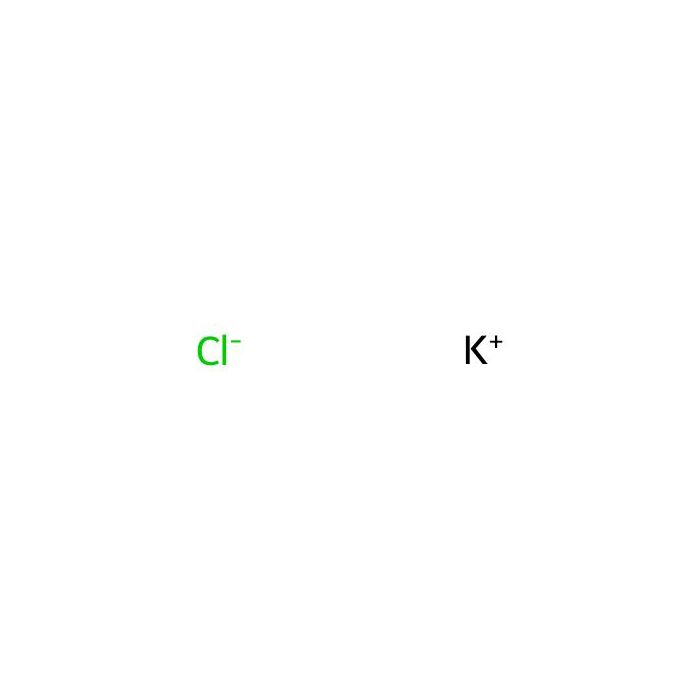
Potassium chloride solution - ~3 M in H2O,Sterile , CAS No.7447-40-7

CAS: 7447-40-7 Cat. No.: K743067 Summenformel: KCl Molekulargewicht: 74.55 EG-Nummer: 231-211-8
Zu bestellen verfügbar
GRADE & PURITY ~3 M in H2O,Sterile
Storage
Room temperature
Shipped In
Normal
★
Size
Deutschland (EU)
USA*
Price
Qty
250ml
K743067-250ml
1 Auf Lager
1 Auf Lager

15,53€

18,14€
Speichern 2,60 € (14.35%)
Enter a quantity for the sizes you want to add.
🧪
Why this grade

~3 M in H2O,Sterile for sensitive chromatographic and analytical workflows requiring minimal baseline interference.

🌡

Storage & shipping

Room temperature Ships Normal Check lot-specific COA for exact specifications.

📋

Quality documents

SDS, COA, datasheet, and spec sheet available for download. Lot-specific COA accessible via lot number lookup.

📚

Literature proof

Cited in 3194 peer-reviewed publications across chromatography, organic synthesis, and cross-coupling reactions.

Specifications

Spezifikationen & Reinheit
~3 M in H2O,Sterile
Stabilität und Lagerung
Store at room temperature for up to 1 year.
Storage
Room temperature
Verschickt in
Normal
Namen und Kennungen
Kanonisches Lächeln
[Cl-].[K+]
IUPAC Name
potassium;chloride
InChIKey
WCUXLLCKKVVCTQ-UHFFFAOYSA-M
INCHI
1S/ClH.K/h1H;/q;+1/p-1
Isomere SMILES
[Cl-].[K+]
WGK Deutschland
1
Molekulargewicht
74.55

Documentation

📋 Safety Data Sheet (SDS)

Comprehensive hazard, handling, storage, and regulatory compliance document.

Download SDS →

✅ Certificate of Analysis (COA)

Lot-specific quality data. Enter your lot number to retrieve the exact COA.

Look up COA →

📊 Datasheet

Quick-reference summary of product specifications and applications.

View datasheet →

🔬 Specification Sheet

Full quality attributes and acceptance criteria for this grade.

View spec sheet →

Advanced Data

Taxonomic Classification

Taxonomy Tree

KingdomInorganic compounds
SuperclassMixed metal/non-metal compounds
KlasseAlkali metal salts
SubclassAlkali metal chlorides
Intermediate Tree Nodes Not available
Direct ParentAlkali metal chlorides
Alternative Parents Inorganic chloride salts  
Molecular FrameworkNot available
Substituents Alkali metal chloride - Inorganic chloride salt - Inorganic salt
BeschreibungThis compound belongs to the class of inorganic compounds known as alkali metal chlorides. These are inorganic compounds in which the largest halogen atom is Chlorine, and the heaviest metal atom is an alkali metal.
External Descriptors potassium salt - inorganic chloride
3D-Struktur
Interaktives chemisches Strukturmodell


Zertifikate (CoA, COO, BSE/TSE und Analyse-Diagramm)
C of A & Other Certificates(BSE/TSE, COO):
Analytical Chart:

Find and download the COA for your product by matching the lot number on the packaging.

3 results found

Lot NumberCertificate TypeDatumArtikel
H2620070Certificate of AnalysisAug 26, 2026 K743067
D2618001Certificate of AnalysisApr 27, 2026 K743067
F2506753Certificate of AnalysisJun 11, 2025 K743067
Chemische und physikalische Eigenschaften
Siedepunkt (°C)1413 °C/1013 hPa
Schmelzpunkt (°C)770 °C (lit.)
FAQs und Artikel
Common Types of Buffer Solutions
How to Optimize Buffer Components for Ni-Agarose Beads
Salting-In and Salting-Out: “Salt” Strategies in Protein Purification
Differences Between Transformation and Transfection
Eight Common Lysis Buffers
FAQ on Molecular Interaction Assays
Mag-Fluo-4 AM Magnesium/Calcium Ion Fluorescent Probe: Properties, Experimental Use, and Aladdin Metal Ion Fluorescent Probe Selection Guide
How to Choose a Hydrogen Evolution (HER) Catalyst: Kinetic Barriers in Water Electrolysis, AWE/PEM/AEM Pathways, and a Materials-Family Roadmap (with a Product Map)
Electrophoretic Mobility Shift Assay (EMSA) Standard Operating Procedure (SOP)
Installing a Redox Switch on Biomolecules: Principles, Conjugation Essentials, and an Application Guide for ATTO MB2 NHS ester
A Review of Ten Commonly Used Techniques for Detection, Quantification, and Interaction Analysis in Nucleic Acid Research
Selection of Common Research Salts: A Task Map for Alkali Metal Salts & Alkaline Earth Metal Salts (with Product Tables 1–6)
Perovskite PV/PeLED Precursor Guide: Selecting Metal Halide Salts, Key Conditions, and Reproducible Performance (including Product Tables 1–4 and a Selection Navigation Guide)
Recent Progress in Types, Mechanisms, and Food Applications of In Vitro Digestion Models
Methodological essentials for mineralization visualization: Alizarin Red S staining vs. Von Kossa silver staining
EMSA PAGE Precast Gels: Principle Alignment, Performance Advantages, and Application Scenarios
Selection Strategy for PBS, TBS, PBST, and TBST Washing Systems in IHC
From Structure to Rheology: How Carbomer Forms Gel Structures and Enables Thickening, Suspension, and Auxiliary Emulsion Stabilization
Practical Guide to TSA Tyramide Signal Amplification: How to Select Reagents, Optimize the Workflow, and Reduce Background When Detection Signals Are Weak for Low-Abundance Targets
Signal Transduction Mechanism of Graphene Biosensors: From Molecular Recognition to Electrical/Optical Signal Readout and Materials Selection
Inflammasomes: Core Signaling Platforms and Targeted Research in Immunoinflammation
Citations of This Product
Lösungsrechner
Bewertungen

Kundenbewertungen

Shall we send you a message when we have discounts available?

Remind me later

Thank you! Please check your email inbox to confirm.

Oops! Notifications are disabled.