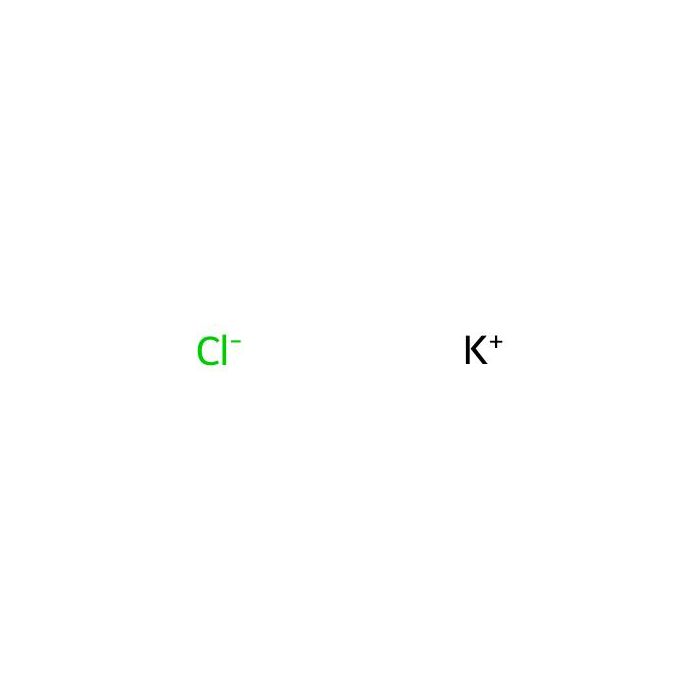
Potassium chloride solution - sterile-filtered, BioReagent, for cell culture, 0.075 M , CAS No.7447-40-7

CAS: 7447-40-7 Cat. No.: P755699 Summenformel: KCl Molekulargewicht: 74.55 EG-Nummer: 231-211-8
Zu bestellen verfügbar
QUALITÄT & REINHEIT Sterile-filtered ? Sterile-filtered — passed through a 0.2µm filter to remove microorganisms. Use as a ready aseptic solution for culture and sensitive applications. BioReagent ? BioReagent grade — tested suitable for life-science and molecular-biology use. Use for cell culture, assays, and biochemical work needing biological compatibility. for Cell culture ? Cell-culture grade — low endotoxin and contaminants to support viable cell growth. Use in mammalian/other cell culture media and supplements. 0.075 M
Storage
Room temperature
Shipped In
Normal
★
Größe
Deutschland (EU)
USA*
Preis
Menge
100ml
P755699-100ml
Auf Bestellung · 8–12 Wochen
32,89€
Enter a quantity for the sizes you want to add.

Übersicht

Potassium chloride solution is a hypotonic solution used to enlarge cells for the adequate spreading of metaphase chromosomes for karyotyping.
Application:
Potassium chloride solution has been used as a hypotonic solution for resuspension of isolated pellet during the control fluorescence in situ hybridization slide preparation protocol.

Spezifikationen

Spezifikationen & Reinheit
sterile-filtered, BioReagent, for cell culture, 0.075 M
Storage
Room temperature
Verschickt in
Normal
Note
BioReagent, für die Zellkultur, Steril gefiltert
Namen und Kennungen
SMILES
[Cl-].[K+]
IUPAC Name
potassium;chloride
InChIKey
WCUXLLCKKVVCTQ-UHFFFAOYSA-M
InChI
1S/ClH.K/h1H;/q;+1/p-1
Isomere SMILES
[Cl-].[K+]
WGK Deutschland
1
Molekulargewicht
74.55

Erweiterte Daten

Taxonomic Classification

Taxonomy Tree

KingdomInorganic compounds
SuperclassMixed metal/non-metal compounds
KlasseAlkali metal salts
SubclassAlkali metal chlorides
Intermediate Tree Nodes Not available
Direct ParentAlkali metal chlorides
Alternative Parents Inorganic chloride salts  
Molecular FrameworkNot available
Substituents Alkali metal chloride - Inorganic chloride salt - Inorganic salt
BeschreibungThis compound belongs to the class of inorganic compounds known as alkali metal chlorides. These are inorganic compounds in which the largest halogen atom is Chlorine, and the heaviest metal atom is an alkali metal.
External Descriptors potassium salt - inorganic chloride
3D-Struktur
Interaktives chemisches Strukturmodell


Zertifikate (CoA, COO, BSE/TSE und Analyse-Diagramm)
C of A & Other Certificates(BSE/TSE, COO):
Analytical Chart:
Chemische und physikalische Eigenschaften
Siedepunkt (°C)1413 °C/1013 hPa
Schmelzpunkt (°C)770 °C (lit.)
Molekulargewicht74.55
XLogP3
Hydrogen Bond Donor Count0
Hydrogen Bond Acceptor Count1
Rotatable Bond Count0
Exact Mass73.9326 Da
Monoisotopic Mass73.9326 Da
Topological Polar Surface Area0.000 Ų
Heavy Atom Count2
Formal Charge0
Complexity2.000
Isotope Atom Count0
Defined Atom Stereocenter Count0
Undefined Atom Stereocenter Count0
Defined Bond Stereocenter Count0
Undefined Bond Stereocenter Count0
The total count of all stereochemical bonds0
Covalently-Bonded Unit Count2
Sicherheit und Gefahren (GHS)
Signal
Warning
Gefahrenhinweise

H303:May be harmful if swallowed

Sicherheitshinweise

P312:Call a POISON CENTER or doctor/... if you feel unwell.

WGK Deutschland
1
FAQs und Artikel
Sterile-Filtered
For Cell Culture
Common Types of Buffer Solutions
How to Optimize Buffer Components for Ni-Agarose Beads
Salting-In and Salting-Out: “Salt” Strategies in Protein Purification
Differences Between Transformation and Transfection
Eight Common Lysis Buffers
FAQ on Molecular Interaction Assays
Mag-Fluo-4 AM Magnesium/Calcium Ion Fluorescent Probe: Properties, Experimental Use, and Aladdin Metal Ion Fluorescent Probe Selection Guide
How to Choose a Hydrogen Evolution (HER) Catalyst: Kinetic Barriers in Water Electrolysis, AWE/PEM/AEM Pathways, and a Materials-Family Roadmap (with a Product Map)
Electrophoretic Mobility Shift Assay (EMSA) Standard Operating Procedure (SOP)
Installing a Redox Switch on Biomolecules: Principles, Conjugation Essentials, and an Application Guide for ATTO MB2 NHS ester
A Review of Ten Commonly Used Techniques for Detection, Quantification, and Interaction Analysis in Nucleic Acid Research
Selection of Common Research Salts: A Task Map for Alkali Metal Salts & Alkaline Earth Metal Salts (with Product Tables 1–6)
Perovskite PV/PeLED Precursor Guide: Selecting Metal Halide Salts, Key Conditions, and Reproducible Performance (including Product Tables 1–4 and a Selection Navigation Guide)
Recent Progress in Types, Mechanisms, and Food Applications of In Vitro Digestion Models
Methodological essentials for mineralization visualization: Alizarin Red S staining vs. Von Kossa silver staining
EMSA PAGE Precast Gels: Principle Alignment, Performance Advantages, and Application Scenarios
Selection Strategy for PBS, TBS, PBST, and TBST Washing Systems in IHC
From Structure to Rheology: How Carbomer Forms Gel Structures and Enables Thickening, Suspension, and Auxiliary Emulsion Stabilization
Practical Guide to TSA Tyramide Signal Amplification: How to Select Reagents, Optimize the Workflow, and Reduce Background When Detection Signals Are Weak for Low-Abundance Targets
Signal Transduction Mechanism of Graphene Biosensors: From Molecular Recognition to Electrical/Optical Signal Readout and Materials Selection
Inflammasomes: Core Signaling Platforms and Targeted Research in Immunoinflammation
Citations of This Product
Lösungsrechner
Bewertungen

Kundenbewertungen

Häufig gestellte Fragen

How should this product be stored?
Store at room temperature.
What does sterile-filtered mean?
sterile-filtered indicates that the material has been processed and tested for specialty industrial processing. Specifications focus on the impurities that affect performance in that application — for example, metal content for electronics, particle size for batteries, refractive index for optics, or moisture content for moisture-sensitive processes.
What does BioReagent mean?
BioReagent indicates that the product has been processed and tested for biological and biochemical applications. Specifications may include endotoxin limits, microbial controls, sterility, low DNase/RNase/protease activity, and verified biological activity where relevant.
How is this product shipped?
This product ships under standard ambient conditions. No temperature-controlled packaging is required.
What are the CAS number, molecular formula and molecular weight?
The CAS Number is 7447-40-7, the molecular formula is KCl, and the molecular weight is 74.55 g/mol. InChIKey WCUXLLCKKVVCTQ-UHFFFAOYSA-M.
What documentation is provided?
Available product documentation, including Certificates of Analysis (COA), Safety Data Sheets (SDS), and specification sheets, is shown in the product document area. Document availability and access follow the current site policy.

Dürfen wir Sie über Rabattaktionen informieren?

Später erinnern

Vielen Dank! Bitte überprüfen Sie Ihren E-Mail-Posteingang, um zu bestätigen.

Hoppla! Benachrichtigungen sind deaktiviert.