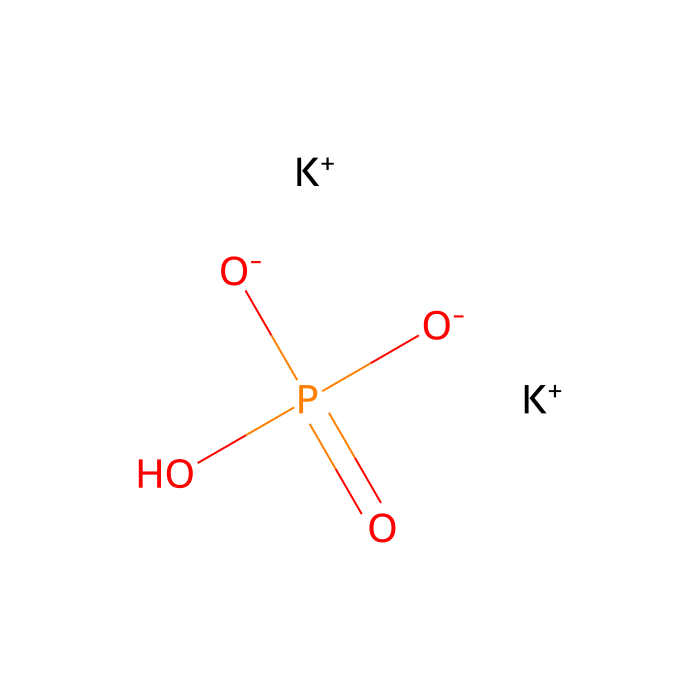
Potassium phosphate dibasic anhydrous - PrimorTrace™, ≥99.99% metals basis , CAS No.7758-11-4

CAS: 7758-11-4 Cat. No.: P112218 Summenformel: K2HPO4 Molekulargewicht: 174.18 EG-Nummer: 231-834-5
Zu bestellen verfügbar
GRADE & PURITY PrimorTrace™ ? PrimorTrace™ — Aladdin's trace-metal-analysis line with ultra-low metal background. Use for ICP/AAS trace-metal work where contamination must be minimal. ≥99.99% metals basis
Synonyms
Dipotassium hydrogen orthophosphate | DI-POTASSIUM HYDROGEN ORTHOPHOSPHATE | dipotassium;hydrogen phosphate | EC 231-834-5 | POTASSIUM PHOSPHATE DIBASIC [WHO-DD] | CHEBI:131527 | DIBASIC POTASSIUM PHOSPHATE COMPONENT OF POTASSIUM PHOSPHATES | Potassium ph
Storage
Desiccated,Room temperature
Shipped In
Normal
★
Size
Deutschland (EU)
USA*
Price
Qty
25g
P112218-25g
Auf Bestellung · 8–12 Wochen
17,27€
100g
P112218-100g
—
3 Auf Lager
53,71€
500g
P112218-500g
—
1 Auf Lager
176,93€
Enter a quantity for the sizes you want to add.
🧪
Why this grade

PrimorTrace™, ≥99.99% metals basis PrimorTrace™ for sensitive chromatographic and analytical workflows requiring minimal baseline interference.

🌡

Storage & shipping

Desiccated,Room temperature Ships Normal Check lot-specific COA for exact specifications.

📋

Quality documents

SDS, COA, datasheet, and spec sheet available for download. Lot-specific COA accessible via lot number lookup.

📚

Literature proof

Cited in 327 peer-reviewed publications across chromatography, organic synthesis, and cross-coupling reactions.

Übersicht

Potassium phosphate dibasic is a useful biological buffer having a pH in the range of 8.5-9.6. Potassium phosphate is present in various forms: monobasic (KH2PO4), dibasic (KH2PO4), and tribasic (K3PO4). Potassium phosphate buffers are widely employed in equilibrium dialysis, high performance liquid chromatography (HPLC) and affinity capillary electrophoresis studies.

Specifications

Synonyme
Dipotassium hydrogen orthophosphate | DI-POTASSIUM HYDROGEN ORTHOPHOSPHATE | dipotassium;hydrogen phosphate | EC 231-834-5 | POTASSIUM PHOSPHATE DIBASIC [WHO-DD] | CHEBI:131527 | DIBASIC POTASSIUM PHOSPHATE COMPONENT OF POTASSIUM PHOSPHATES | Potassium ph
Spezifikationen & Reinheit
PrimorTrace™, ≥99.99% metals basis
Storage
Desiccated,Room temperature
Verschickt in
Normal
Note
PrimorTrace™
Reinheit
≥99.99% metals basis
Namen und Kennungen
Pubchem Sid
Kanonisches Lächeln
OP(=O)([O-])[O-].[K+].[K+]
IUPAC Name
dipotassium;hydrogen phosphate
InChIKey
ZPWVASYFFYYZEW-UHFFFAOYSA-L
INCHI
1S/2K.H3O4P/c;;1-5(2,3)4/h;;(H3,1,2,3,4)/q2*+1;/p-2
Isomere SMILES
OP(=O)([O-])[O-].[K+].[K+]
Molekulargewicht
174.18
Reaxy-Rn
11343458
Reaxys-RN_link_address
https://www.reaxys.com/reaxys/secured/hopinto.do?context=S&query=IDE.XRN=11343458&ln=

Documentation

📋 Safety Data Sheet (SDS)

Comprehensive hazard, handling, storage, and regulatory compliance document.

Download SDS →

✅ Certificate of Analysis (COA)

Lot-specific quality data. Enter your lot number to retrieve the exact COA.

Look up COA →

📊 Datasheet

Quick-reference summary of product specifications and applications.

View datasheet →

🔬 Specification Sheet

Full quality attributes and acceptance criteria for this grade.

View spec sheet →

Advanced Data

Taxonomic Classification

Taxonomy Tree

KingdomInorganic compounds
SuperclassMixed metal/non-metal compounds
KlasseAlkali metal oxoanionic compounds
SubclassAlkali metal phosphates
Intermediate Tree Nodes Not available
Direct ParentAlkali metal phosphates
Alternative Parents Inorganic salts  Inorganic oxides  
Molecular FrameworkNot available
Substituents Alkali metal phosphate - Inorganic oxide - Inorganic salt
BeschreibungThis compound belongs to the class of inorganic compounds known as alkali metal phosphates. These are inorganic compounds in which the largest oxoanion is phosphate, and in which the heaviest atom not in an oxoanion is an alkali metal.
External Descriptors organic molecular entity
3D-Struktur
Interaktives chemisches Strukturmodell


Wirkungsmechanismen
Zertifikate (CoA, COO, BSE/TSE und Analyse-Diagramm)
C of A & Other Certificates(BSE/TSE, COO):
Analytical Chart:

Find and download the COA for your product by matching the lot number on the packaging.

14 results found

Lot NumberCertificate TypeDatumArtikel
H2611406Certificate of AnalysisJul 10, 2026 P112218
H2611407Certificate of AnalysisJul 10, 2026 P112218
J2513520Certificate of AnalysisSep 25, 2025 P112218
J2513699Certificate of AnalysisSep 25, 2025 P112218
J2513701Certificate of AnalysisSep 25, 2025 P112218
I2423504Certificate of AnalysisSep 04, 2024 P112218
I2423505Certificate of AnalysisSep 04, 2024 P112218
I2423506Certificate of AnalysisSep 04, 2024 P112218
F2210571Certificate of AnalysisJun 14, 2022 P112218
A2423080Certificate of AnalysisMay 25, 2022 P112218
D2307391Certificate of AnalysisMay 25, 2022 P112218
F2223373Certificate of AnalysisMay 25, 2022 P112218
F2223377Certificate of AnalysisMay 25, 2022 P112218
F2223378Certificate of AnalysisMay 25, 2022 P112218
Chemische und physikalische Eigenschaften
LöslichkeitSoluble in water. Slightly soluble in alcohol.
EmpfindlichkeitHygroscopic;Moisture sensitive
Schmelzpunkt (°C)340℃
Molekulargewicht174.176 g/mol
XLogP3
Hydrogen Bond Donor Count1
Hydrogen Bond Acceptor Count4
Rotatable Bond Count0
Exact Mass173.889 Da
Monoisotopic Mass173.889 Da
Topological Polar Surface Area83.400 Ų
Heavy Atom Count7
Formal Charge0
Complexity46.500
Isotope Atom Count0
Defined Atom Stereocenter Count0
Undefined Atom Stereocenter Count0
Defined Bond Stereocenter Count0
Undefined Bond Stereocenter Count0
The total count of all stereochemical bonds0
Covalently-Bonded Unit Count3
FAQs und Artikel
How should laboratory strains be preserved?
Operational Guide for Fluorescent Labeling of Antibodies Using AF594 NHS Ester
General Principles of Antibody Labeling with NHS-Activated Esters, F/P Calculation, and Troubleshooting Guide
How to Choose a Hydrogen Evolution (HER) Catalyst: Kinetic Barriers in Water Electrolysis, AWE/PEM/AEM Pathways, and a Materials-Family Roadmap (with a Product Map)
Installing a Redox Switch on Biomolecules: Principles, Conjugation Essentials, and an Application Guide for ATTO MB2 NHS ester
A Review of Ten Commonly Used Techniques for Detection, Quantification, and Interaction Analysis in Nucleic Acid Research
Selection of Common Research Salts: A Task Map for Alkali Metal Salts & Alkaline Earth Metal Salts (with Product Tables 1–6)
From “Reduction First, Then Acylation” to “Direct Amidation”: An Unconventional Route to Amide Bond Formation from Nitro and Nitroso Substrates with α-Keto Carboxylic Acids
The Methodological Value of TCFH: Advantages in Challenging Amidation and the Switching Logic of Carboxylic Acid Activation Pathways
What Is Synthetic Biology? The Industrialization Pathway from Upstream Reagent Toolchains to Biomanufacturing Applications
Design Logic of Fluorinated 3,3-Disubstituted Oxetane Building Blocks: Structural Construction and Modulation of Amine Basicity, Lipophilicity, and Metabolic Stability
Citations of This Product
Lösungsrechner
Bewertungen

Kundenbewertungen

Need help choosing the grade?

Our grade selection guide covers purity, stabilizer status, and application suitability for all variants in our catalog.

View PrimorTrace™ grade guide →

Shall we send you a message when we have discounts available?

Remind me later

Thank you! Please check your email inbox to confirm.

Oops! Notifications are disabled.