GRADE & PURITYMoligand™?Moligand™ — Aladdin's line of ligands and bioactive small molecules. Use for receptor, pathway, and binding studies needing defined small-molecule tools.10 mM in DMSO
Moligand™, 10 mM in DMSO Moligand™ for sensitive chromatographic and analytical workflows requiring minimal baseline interference.
🌡
Storage & shipping
Desiccated,Store at -80°C Ships Dry ice packs + Cold packs Check lot-specific COA for exact specifications.
📋
Quality documents
SDS, COA, datasheet, and spec sheet available for download. Lot-specific COA accessible via lot number lookup.
📚
Literature proof
Cited in 0 peer-reviewed publications across chromatography, organic synthesis, and cross-coupling reactions.
Übersicht
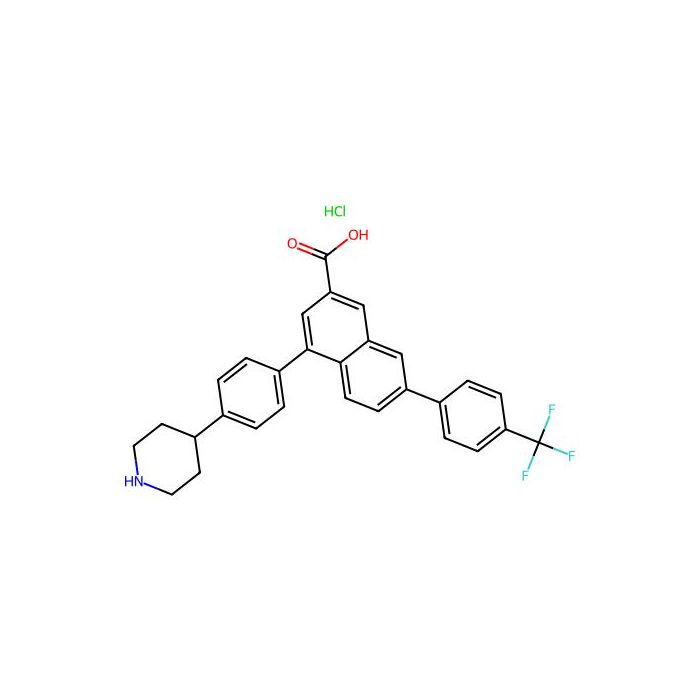
PPTN hydrochloride is a potent, high-affinity, competitive and highly selective P2Y14 receptor antagonist with a K B value of 434 pM. PPTN hydrochloride exhibits no agonist or antagonist effect at the P2Y1, P2Y2, P2Y4, P2Y6, P2Y11, P2Y12, or P2Y13 receptors. Anti-inflammatory and anti-immune activity.
Specifications
Spezifikationen & Reinheit
Moligand™, 10 mM in DMSO
Storage
Desiccated,Store at -80°C
Verschickt in
Dry ice packs + Cold packs
Dieses Produkt erfordert Kühlkettenversand. Grundversand und andere Economy-Optionen sind nicht verfügbar.
Zertifikate (CoA, COO, BSE/TSE und Analyse-Diagramm)
C of A & Other Certificates(BSE/TSE, COO):
Analytical Chart:
Lösungsrechner
Molarity Calculator
Determine the necessary mass, volume, or concentration for preparing a solution.
Dilution Calculator
Determine the dilution needed to prepare a stock solution.
Reconstitution Calculator
Bewertungen
Kundenbewertungen
Application Protocols
No validated or recommended protocols are provided for PPTN hydrochloride in the Product Data.
General guidance for small-molecule screening materials
Prepare concentrated DMSO stock solutions (e.g., 10–50 mM) where soluble; sterile-filter if required for cell-based work.
Store as single-use aliquots at –80°C to minimize freeze–thaw cycles. Thaw on ice and keep exposure to ambient moisture brief.
In assays, control final vehicle percentage (commonly ≤0.1–1% DMSO) and include vehicle-only controls.
Confirm absence of precipitation post-dilution using visual inspection or light-scattering where feasible.
Documentation
Record exact concentrations, lot number, solvent, and dilution scheme in your ELN. Attach CoA/Spec Sheet to protocol records.
Any application-specific conditions (WB, IF, enzyme panels, etc.) must be developed and qualified by the end user.
Biological Roles
No target annotation or biological function is provided for PPTN hydrochloride in the Product Data. The points below offer general best practices for evaluating small molecules as research probes; they are not claims about this item’s activity.
Determine putative targets using a combination of primary phenotypic assays and orthogonal binding/engagement methods (e.g., CETSA, DSF, SPR, ITC), if applicable to your system.
Profile selectivity across related target families to understand off-target liabilities and build a structure–activity relationship (SAR) map.
Assess chemical liabilities (reactivity, redox cycling, aggregation) using control assays (e.g., detergent-sensitive readouts, colloidal aggregator counterscreens).
ADME considerations (general, not item-specific)
Solubility, permeability, and microsomal stability should be measured empirically for tool qualification. Hydrochloride salts can aid aqueous handling but do not alone predict permeability.
Data stewardship
Record exact identifiers (CAS 1992047-65-0; CID 121513852; SKU P1494424) and lot information so biological data can be traced to the correct material specification.
Research-use only
This product is supplied strictly for research use only. No clinical, diagnostic, or therapeutic applications are implied or supported.
Buffer Applications
PPTN hydrochloride is a small-molecule research ligand and is not itself a buffering agent. Therefore, standard buffer system recipes (e.g., phosphate, HEPES, Tris) do not apply directly to this product.
Practical considerations (general)
When formulating assays, dissolve the compound in an appropriate vehicle (commonly DMSO) and dilute into your chosen buffer system while maintaining acceptable final organic content and pH.
Select buffers that maintain the protonation state compatible with the hydrochloride salt (usually mildly acidic to neutral pH for stability), unless your biology requires otherwise.
Verify solubility and absence of precipitation upon dilution into buffer, especially at higher test concentrations.
Green Alternatives
Green chemistry aspects focus on solvent choices and handling, since no synthetic use or process chemistry is defined for this item.
Solvent considerations (general guidance)
Prefer water or aqueous buffers whenever compound solubility and assay design allow; this minimizes VOC use and waste.
If an organic vehicle is required, ethanol can be a greener alternative to methanol or halogenated solvents for some applications, subject to assay compatibility.
DMSO is widely used for screening libraries; while not “green” per se, it offers high solvency that can reduce total solvent volumes and re-dosing.
Comparison (informative, not item-specific)
Water/buffer: lowest environmental impact; constrained by compound solubility and stability.
Ethanol: bio-based routes available; good safety profile; may impact certain bioassays.
Methanol: higher toxicity; use only if necessary for solubility.
Halogenated solvents: generally avoid for stock preparation; reserve for analytical sample prep if absolutely needed and permitted by your method.
Operational practices
Use microscale preparations and plate-based miniaturization to reduce solvent consumption.
Consolidate storage in aliquots to minimize waste from degraded stock solutions.
Waste management
Segregate aqueous and organic waste; select the least hazardous workable solvent for rinses and dilutions.
Because compound-specific process routes are not part of this product’s use case, no greener synthetic alternatives are proposed.
Pharmaceutical Uses
No pharmacopeial status, excipient role, or formulation use is provided for PPTN hydrochloride. This product is supplied strictly for laboratory research.
Not for human or veterinary use
Do not use in diagnostic, therapeutic, or clinical applications.
Informative notes (general, not item-specific claims)
Small-molecule hydrochloride salts are common in pharmaceutical development due to improved aqueous solubility and solid-state stability versus free bases; however, no development context is provided for this item.
If used in preclinical research, ensure materials are documented with lot-specific CoA and handled under appropriate QA practices for nonclinical studies.
Any implication of clinical performance, dosage, or therapeutic effect is outside the scope of this catalog entry and is not supported.
Physical Properties
Item-specific specifications are not disclosed for this catalog entry. Where values are absent, consult the CoA/Spec Sheet. The following notes provide general, literature-based expectations for small-molecule hydrochloride salts; they are NOT product specifications for this SKU.
Item-specific values
Appearance: Not specified for this item; refer to CoA/Spec Sheet.
Melting point (MP): Not specified for this item; refer to CoA/Spec Sheet.
Boiling point (BP): Not applicable to salts in practice (decompose) unless otherwise stated; specific value not provided.
Density/Refractive index: Not specified for this item; refer to CoA/Spec Sheet.
Solubility: Not specified for this item; refer to CoA/Spec Sheet.
LogP/pKa: Not specified for this item; refer to CoA/Spec Sheet.
General/literature guidance (not item-specific)
Hydrochloride salts of basic small molecules are often more water-soluble than their corresponding free bases. Typical practice is to prepare DMSO stocks (e.g., 10–50 mM) followed by aqueous dilution (buffer, saline, or culture media) as solubility permits.
Many HCl salts exhibit a sharp melting point associated with a defined crystalline form; however, polymorphism and hydrates can alter MP ranges.
Thermal behavior for organic salts may show decomposition before boiling under ambient pressure; TGA/DSC are preferred for thermal profiling.
Hygroscopicity is common for hydrochloride salts; handling under low humidity helps maintain accurate massing and concentration.
Practical tip
For quantitative work, confirm solubility and extinction coefficients experimentally for your exact lot, as these are compound-specific and not supplied here.
Quality and Grades
Item-specific grade
Moligand™ grade: Provided as part of a curated small-molecule/compound library suitable for ligand discovery, screening, and chemical biology workflows. This denotes an emphasis on identity confirmation and fitness for research probing of molecular targets. Specific numeric specifications (purity %, residual solvents, assay methods) are not listed here—refer to the CoA/Spec Sheet.
What Moligand™ generally implies (informative, not item-specific specifications)
Identity verification: Typically supported by analytical techniques such as NMR, LC-MS/HRMS, and/or HPLC. Exact test suite for this item: Not specified; see CoA.
Suitability for screening: Packaged to facilitate preparation of DMSO stocks and plate-based assays; stability guidance provided under Storage.
Documentation: CoA/Spec Sheet should include structure, batch-level purity, and recommended handling.
Stabilizers/additives
None are specified in the Product Data. If stabilizers or form-specific notes (hydrate/solvate/polymorph) apply to your lot, they will appear on the CoA/Spec Sheet.
Practical guidance
On receipt, verify the catalog identifiers (CAS 1992047-65-0, CID 121513852, SKU P1494424) match your records. For HTS or SAR work, capture lot-specific purity and identity data from the CoA into your ELN/LIMS.
If low-UV or LC-MS cleanliness is critical, review the CoA chromatograms to ensure compatibility with your analytical methods.
Reaction and Applications
This catalog item is provided as a research ligand candidate rather than a synthetic reagent, and no manufacturer application notes are supplied. As such, its use is typically in biochemical or cellular screening rather than as a stoichiometric reagent in synthesis.
Typical research uses for Moligand™ small molecules (general guidance)
Assay tool compound: Evaluate binding/phenotypic responses, generate preliminary SAR, or serve as a reference control in screening cascades.
Chemical biology probes (early-stage): Explore pathway modulation in vitro; confirm target engagement using orthogonal assays (e.g., thermal shift, CETSA, SPR), where appropriate.
Method development: Assess LC-MS/MS response factors, retention behavior, or interference profiles in analytical method validation.
Not typically applicable
Named organic reactions (e.g., cross-coupling, condensation) are generally irrelevant to end-use handling of finished library compounds unless you intend to derivatize the scaffold. No such derivatization guidance is provided for this item.
Practical tips
Prepare fresh DMSO stocks and minimize freeze–thaw cycles to preserve integrity.
Where target specificity is unknown or proprietary, implement broad selectivity counterscreens (e.g., off-target panels) to contextualize activity.
Include appropriate vehicle controls and, if available, orthogonal chemical controls to benchmark potency and efficacy.
Note: Any quantitative performance claims (Ki, IC50, EC50) must be derived from your own assays or literature for this exact compound; none are provided here.
Reaction Conditions
Reaction-condition guidance is not applicable to this product’s intended use. PPTN hydrochloride is sold as a research ligand candidate, not as a reagent for performing chemical transformations.
If you plan to use the compound in a chemical transformation (general advice)
Acquire the full structural information and convert to the appropriate form (e.g., free base) before planning reactions.
Verify stability under planned conditions (base, heat, oxidants/reductants). Perform small-scale scouting with analytical monitoring (LC-MS/HPLC).
No item-specific reaction temperatures, catalysts, or yields are provided. Refer to the CoA/Spec Sheet for any stability notes.
Safety and Handling
Safety data specific to PPTN hydrochloride are not provided in the Product Data. Always refer to the product SDS for authoritative information.
GHS information (item-specific)
Signal word: Not specified for this item; refer to SDS.
Hazard statements (H-codes): Not specified for this item; refer to SDS.
GHS classification/pictograms: Not specified for this item; refer to SDS.
General laboratory precautions for small-molecule hydrochloride salts (not item-specific)
PPE: Lab coat, safety glasses, and appropriate chemically resistant gloves (e.g., nitrile). Avoid inhalation of dust and contact with skin/eyes.
Engineering controls: Handle powders in a fume hood or ventilated enclosure. Use antistatic tools to minimize airborne particulates.
Incompatibilities: Strong bases (may liberate free base), strong oxidizers, and moisture (hygroscopic uptake can alter composition). Avoid generating aerosols.
First aid (overview): If inhaled—move to fresh air; if on skin—wash with water/soap; if in eyes—rinse cautiously with water for several minutes; if ingested—rinse mouth. Seek medical attention as needed. Follow SDS instructions.
Spill response: Gently cover with damp disposable towels or absorbent to minimize dust; collect for disposal in a sealed container. Decontaminate surfaces with appropriate solvent or detergent solution.
Waste disposal: Dispose according to institutional and local regulations for organic laboratory chemicals; avoid drain disposal.
Special notes
Hydrochloride salts can be hygroscopic; maintain desiccation to preserve mass accuracy and composition. Use secondary containment for cold-chain storage (-80°C) to avoid condensation during retrieval.
Solvent Selection
Because detailed solubility data for PPTN hydrochloride are not provided, choose solvents using standard practices for small-molecule hydrochloride salts used in screening.
Primary stock preparation (general best practice)
DMSO is the default for discovery libraries due to broad solubilizing power, compatibility with microplates, and assay workflows. Begin with 10–50 mM stocks when feasible; filter if necessary.
If DMSO is undesirable, consider water or aqueous buffers (e.g., PBS, HEPES) when the salt form confers sufficient solubility. Verify pH to maintain the protonated form.
Co-solvent strategies
For aqueous assays, dilute DMSO stocks to ≤0.1–1% v/v DMSO in the final well, as dictated by assay tolerance.
For less soluble salts, test DMF, methanol, or ethanol as alternatives. Avoid strong bases that could deprotonate the cation and reduce solubility.
Polarity/miscibility (general)
Hydrochloride salts tend to favor polar, protic, or highly polar aprotic solvents. Nonpolar media (e.g., hexanes, toluene) are usually unsuitable unless converting to a free-base form.
Practical comparisons (general)
DMSO vs water: DMSO offers higher likelihood of dissolving both ionic and lipophilic scaffolds; water is optimal for biocompatibility but may require modest organic cosolvent.
Methanol/ethanol: often effective but can interfere with certain assays; confirm compatibility.
Verification
Empirically determine solubility for your lot and protocol; document concentration, vehicle, and pH in the ELN. Consult the CoA/Spec Sheet for any item-specific solvent notes.
Storage and Reconstitution
Item-specific storage and shipping (from Product Data)
Storage conditions: Desiccated, Store at –80°C.
Shipped in: Dry ice packs + Cold packs.
Handling guidance
Maintain the material desiccated to limit moisture uptake, which can alter mass and concentration. Use a dry box or quickly handle at ambient humidity with tight resealing.
Upon receipt, allow the package to equilibrate to room temperature in secondary containment before opening to minimize condensation.
Reconstitution (general best practice for library compounds)
Dissolve in anhydrous DMSO to prepare a concentrated stock (e.g., 10–50 mM) if solubility permits. If aqueous use is required, dilute the DMSO stock into buffer while monitoring for precipitation.
Filter sterilize (0.22 µm) only if necessary for cell-based assays and if the compound is not adsorptive/unstable to the membrane; perform a small test.
Aliquoting and stability
Prepare single-use aliquots to avoid repeated freeze–thaw. Store aliquots at –80°C in tightly sealed, low-bind vials.
Track storage history and visually inspect for discoloration or solids before use. If instability is suspected, confirm integrity by LC-MS/HPLC prior to critical experiments.
Expiry and specifications
No item-specific shelf-life or reconstitution limits are provided; consult the CoA/Spec Sheet and follow institutional best practices for compound management.
Research use note
For research use only.
Structure and Identity
Brief overview: PPTN hydrochloride (SKU P1494424) is supplied as a research-use small-molecule hydrochloride salt within Aladdin’s Moligand screening collection.
Item-specific identifiers (from Product Data)
Product name: PPTN hydrochloride
SKU: P1494424
CAS: 1992047-65-0
PubChem CID: 121513852
Grade: Moligand™
Molecular formula: Not specified for this item; refer to CoA/Spec Sheet.
Molecular weight: Not specified for this item; refer to CoA/Spec Sheet.
SMILES: Not specified for this item; refer to CoA/Spec Sheet.
InChIKey: Not specified for this item; refer to CoA/Spec Sheet.
Structural features (general notes)
As a hydrochloride salt, the active base is protonated at a basic site (commonly an amine or heteroaromatic nitrogen) with chloride as counterion. This often improves aqueous solubility and solid-state stability relative to the free base.
Without a disclosed structure, specific functional groups, ring systems, and stereochemistry cannot be detailed for this catalog entry. Refer to the CoA/Spec Sheet for definitive structural descriptors.
2D structure description (general guidance)
Hydrochloride salts are typically represented as the protonated cation paired with Cl−. If you have the free-base SMILES, a salt representation commonly appends “.[Cl-]” after the cationic form. For this item, consult the provided structural file(s) on the CoA/Spec Sheet before building in silico models or registering to ELNs.
Synthetic Utility
This catalog item is offered as a finished small-molecule hydrochloride salt for screening and research probing; it is not positioned as a synthetic building block. Without a disclosed structure, meaningful retrosynthetic or functional-group–based guidance cannot be provided.
Not typically applicable
No functional-group reactivity, protecting-group strategy, or named-reaction guidance is offered for this item.
If derivatization is intended (general guidance)
Obtain the full structure and analytical package (CoA/Spec Sheet). Confirm availability of the free base for coupling or modification, as salt forms may require neutralization.
Establish compatibility of any planned transformations with the compound’s heteroatom and salt content; consider counterion exchange if needed.
For routine use, treat this material as a probe candidate rather than a synthetic intermediate.
Target Specificity
No target, pathway, or selectivity data are provided for PPTN hydrochloride in the Product Data.
Item-specific details
Target/Pathway: Not specified for this item; refer to CoA/Spec Sheet or internal project notes.
Species reactivity / panel coverage: Not specified for this item; refer to CoA/Spec Sheet.
Assay context (biochemical, cellular, phenotypic): Not specified for this item; refer to CoA/Spec Sheet.
For any study claiming target engagement, document the assays, controls, and lot identifiers to ensure reproducibility.
Need help choosing the grade?
Our grade selection guide covers purity, stabilizer status, and application suitability for all variants in our catalog.
Wir verwenden Cookies, um die ordnungsgemäße Funktion der Website sicherzustellen und, soweit zulässig, Ihr Nutzererlebnis zu verbessern. Sie können Ihre Einstellungen jederzeit unter „Einstellungen“ verwalten. Weitere Informationen finden Sie in unserer Cookie-Richtlinie.
Shall we send you a message when we have discounts available?
Remind me later
Thank you! Please check your email inbox to confirm.
Products are supplied to verified businesses, institutions, and qualified professionals for research and development use only. Not for use in humans, animals, diagnosis, or therapy.