QUALITÄT & REINHEITMoligand™?Moligand™ — Aladdin's line of ligands and bioactive small molecules. Use for receptor, pathway, and binding studies needing defined small-molecule tools.10 mM in DMSO
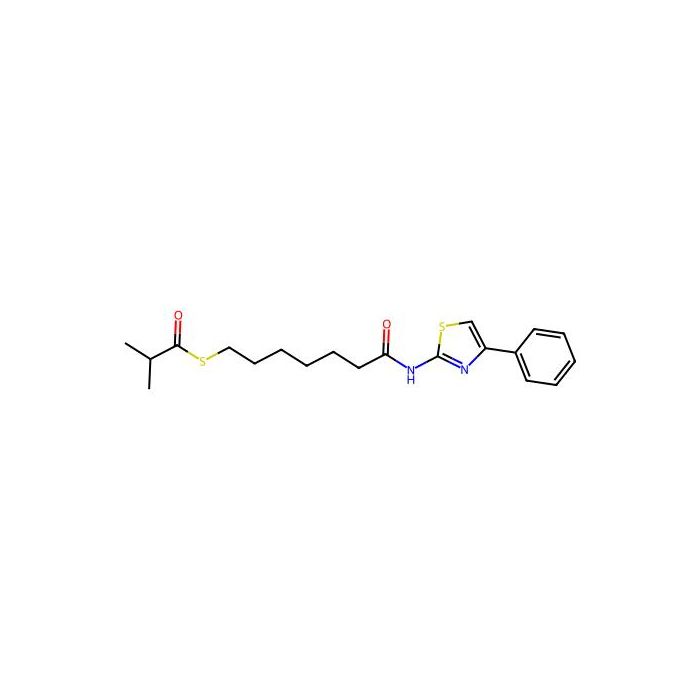
PTACH (NCH-51) is a potent HDAC inhibitor with IC 50 s of 48 nM, 32 nM, and 41 nM for HDAC1 , HDAC4 , and HDAC6 , respectively. PTACH exerts potent growth inhibition against various cancer cells (EC 50 s of 1.1-9.1 μM) .
Spezifikationen
Spezifikationen & Reinheit
Moligand™, 10 mM in DMSO
Storage
Store at -80°C
Verschickt in
Dry ice packs + Cold packs
Dieses Produkt erfordert Kühlkettenversand. Grundversand und andere Economy-Optionen sind nicht verfügbar.
Determine the necessary mass, volume, or concentration for preparing a solution.
Dilution Calculator
Determine the dilution needed to prepare a stock solution.
Reconstitution Calculator
Bewertungen
Kundenbewertungen
Application Protocols
Item-specific validated applications and conditions: Not specified for this item.
General protocols for small-molecule screening (not item-specific)
Biochemical enzyme assay: Prepare 10 mM DMSO stock; dose to final 0.5% DMSO, incubate with enzyme and substrate under optimized conditions; include vehicle and positive controls.
Thermal shift (DSF): Mix protein with dye and serial dilutions of compound in low-salt buffer with 1–2% DMSO; record Tm shifts and assess aggregation controls.
SPR binding: Prepare matched-buffer DMSO stocks; perform solvent correction; screen at multi-concentration series with reference subtraction.
Note: Tailor concentrations and conditions to your specific targets; validate solubility and stability prior to runs.
Biological Roles
Item-specific biological role: Not specified for this item; refer to CoA/Spec Sheet and literature for CAS 848354-66-5.
General context for small-molecule ligands (not item-specific)
Small molecules may act as binders, inhibitors, activators, or chemical probes in cellular or biochemical pathways. The precise role depends on structure and target engagement, which are not provided here.
Prior to biological testing, determine or request the complete structure and any known bioactivity annotations to ensure appropriate hazard assessments and assay design.
Research use limitation
For research use only. Not for human or veterinary applications, clinical diagnostics, or household use.
Buffer Applications
Applicability
PTACH is a small-molecule library member rather than a buffering agent. It is not typically used to prepare or control buffer pH.
Practical note
If assayed in aqueous buffers, ensure compatibility of the compound with the buffer components (salts, detergents, reducing agents). Optimize co-solvent content (commonly 0.1–1% DMSO) to maintain solubility during dilutions.
Green Alternatives
Applicability
Without structural and solvent-use context, green alternatives can only be discussed at the level of handling and formulation practices rather than replacement reagents.
Greener handling practices for small-molecule libraries (general)
Use minimal DMSO volumes consistent with assay needs; consider aqueous-first dilutions where feasible.
Replace chlorinated solvents during cleanup/workup with ethyl acetate or 2-MeTHF when compatible (general suggestion; verify compound stability).
Where heating is needed for dissolution, prefer closed-vial block heaters to reduce emissions; avoid open hotplates.
Solvent comparison (general guidance; not item-specific)
DMSO vs DMF: DMSO favored for biocompatibility and lower volatility; DMF has higher toxicity concerns.
ACN vs MeOH/EtOH: ACN is MS-friendly but has higher environmental burden; MeOH/EtOH are greener but may affect assay readouts.
Waste minimization
Plate at high concentration stocks to reduce shipping/handling volume. Consolidate mother plates and use acoustic dispensing to cut solvent waste.
Pharmaceutical Uses
Item-specific pharmacopeial/excipient status: Not specified for this item; no pharmacopeial monograph indicated.
Context
As a Moligand™ small-molecule library compound, PTACH is intended for research screening and discovery workflows. It is not supplied for drug product manufacturing or as a GMP excipient.
Formulation notes for research only (not for human use)
Prepare DMSO stock solutions under low-moisture conditions. If evaluating in preclinical research assays, document vehicle composition, dose solution stability, and any observed precipitation or adsorption to plastics.
Physical Properties
Item-specific properties (from Product Data)
Appearance: Not specified for this item; refer to CoA/Spec Sheet.
Molecular weight: Not specified for this item; refer to CoA/Spec Sheet.
Literature/computed values
Boiling point, melting point, density, refractive index, logP, pKa, UV cutoffs: Not available for this item; consult the CoA/SDS or primary literature for CAS 848354-66-5 if needed.
Solubility guidance (general best practices for screening compounds; not item-specific)
Initial solvent: Anhydrous DMSO is typically used for small-molecule libraries at 10–50 mM stock; confirm compatibility once structure/functional groups are known.
Alternative solvents: DMF, ethanol, methanol, acetonitrile, or aqueous buffers with co-solvent can be explored by small-scale solubility tests (serial dilution, visual inspection, nephelometry).
Notes on hygroscopicity and stability
Without specific data, assume potential sensitivity to moisture, oxygen, and light. Work quickly at ambient temperature and return to −80°C storage to minimize degradation.
Quality and Grades
Item-specific grade (from Product Data)
Grade/Purity: Moligand™.
What Moligand™ typically implies (general explanation; not a specification)
Intended for research screening of molecular interactions (e.g., binding, SAR exploration, chemical biology). Such collections generally emphasize confirmed identity and consistent lot-to-lot performance for library use.
Typical QC elements for library compounds may include structure confirmation (e.g., NMR/HRMS), purity checks (e.g., HPLC/UPLC), and documentation via CoA. Specific acceptance criteria are not provided here.
Explicit non-provided specifications (do not infer)
Water content, residual solvents, metal content, stabilizers, counter-ions/salt form, and UV absorbance characteristics: Not specified for this item; refer to CoA/Spec Sheet.
Practical guidance
For plate-based screening, pre-test solubility and stability in the chosen assay buffer and DMSO concentration. Record lot and plate maps. If using for biophysical assays (SPR/ITC/DSF), filter stocks (0.2 μm PTFE) when compatible, and quantify concentration by weight and, if possible, by UV/LC.
Reaction and Applications
Item-specific reaction behavior: Not specified for this item; structural details are required to discuss reactivity.
Research applications (general to Moligand™ small molecules; not item-specific)
Ligand discovery and screening: Use in biochemical or biophysical assays (e.g., enzyme inhibition, binding displacement, thermal shift) to identify hits.
Cellular probe evaluation: Preliminary assessment of permeability, cytotoxicity windows, and target engagement using non-clinical research assays.
Analytical reference: Use as an internal or external standard if structurally suitable and characterized in-house.
Practical tips
Prepare replicate stocks and include vehicle controls. Track freeze–thaw cycles to reduce variability.
Assess compound aggregation (detergent controls, DLS) and redox activity (PAINS assays) when screening to reduce false positives.
If proceeding to chemistry optimization, request or determine full structural data to enable SAR and derivatization strategies.
Reaction Conditions
Item-specific reaction conditions and yields: Not specified for this item; refer to primary literature for CAS 848354-66-5 if applicable.
General guidance for handling in assay preparation (not synthetic chemistry)
Stock preparation: 10–50 mM in dry DMSO; vortex and, if necessary, sonicate briefly. Filter through 0.2 μm PTFE if compatible.
Dilution: Add DMSO stock to buffer as the final step while vortexing to avoid local supersaturation; typical final DMSO 0.1–1%.
Stability checks: Reassess after 24–72 h at assay temperature for precipitation, discoloration, or chromatographic degradation.
Safety and Handling
GHS information (from Product Data)
Signal word: Not specified for this item; refer to SDS.
H-statements: Not specified for this item; refer to SDS.
GHS classification: Not specified for this item; refer to SDS.
Pictograms: Not specified for this item; refer to SDS.
General laboratory precautions (not item-specific; follow institutional EHS requirements)
PPE: Lab coat, nitrile gloves, safety glasses. Use a certified chemical fume hood to avoid inhalation exposure during weighing or preparation.
Avoid contact with skin, eyes, and clothing; prevent ingestion and inhalation. Wash hands thoroughly after handling.
Storage incompatibilities: Until structural class is verified, segregate from strong oxidizers, strong acids/bases, and reducing agents. Keep container tightly closed under dry, inert conditions at −80°C as specified.
First-aid overview (consult SDS for definitive instructions)
Inhalation: Move to fresh air; seek medical attention if symptoms persist.
Skin/eye contact: Rinse with water for at least 15 minutes; remove contaminated clothing; obtain medical advice.
Ingestion: Rinse mouth; do not induce vomiting; seek medical attention.
Special risks
Unknown sensitization or toxicity profile. Minimize aerosol generation, avoid open handling, and label all intermediate vials/plates used in screening.
Solvent Selection
Item-specific solubility: Not specified for this item; refer to CoA/Spec Sheet.
General strategy for small-molecule library members (not item-specific)
Primary solvent: Anhydrous DMSO (≥99.9%) for 10–50 mM stocks; store at −20 to −80°C in tightly sealed, low-bind vials.
Screening dilutions: Into assay buffer with final DMSO 0.1–1% v/v; confirm assay tolerance to DMSO.
Alternative organic solvents: DMF, acetonitrile, methanol, ethanol can be used for intermediate dilutions; evaluate stability and potential assay interference (e.g., ACN in MS workflows; MeOH/EtOH for biochemical assays).
Aqueous compatibility: If ionizable functionalities are known (not provided here), adjust pH to enhance solubility; consider co-solvent systems or cyclodextrin inclusion where appropriate.
Selection tips
If the compound is hydrophobic (visual cues: rapid precipitation upon aqueous dilution), increase DMSO carryover or use gentle heating/sonication.
For sensitive assays (fluorescence), use high-purity, low-fluorescence solvents and verify compound autofluorescence independently.
Storage and Reconstitution
Item-specific storage and shipping (from Product Data)
Storage conditions: Store at −80°C.
Shipped in: Dry ice packs + Cold packs.
Reconstitution guidance (general; not item-specific)
Allow vials to equilibrate to room temperature in a desiccator before opening to prevent moisture condensation.
Prepare concentrated stocks in anhydrous DMSO. Record concentration, solvent, date, and number of freeze–thaw cycles.
Aliquot into inert, low-bind vials or plates to minimize freeze–thaw. Backfill headspace with dry nitrogen or argon where possible.
For aqueous working solutions, dilute immediately before use; avoid long-term storage in water-containing media unless stability is verified.
Stability notes
Protect from light if chromophores are suspected; use amber vials as a precaution.
If precipitation occurs after thawing, gently warm (≤40°C) and vortex/sonicate briefly; do not overheat. Discard if persistent insolubility or discoloration is observed.
Documentation
Retain CoA/Spec Sheet and SDS with the stored material. Track lot numbers in all experiments. For research use only.
Structure and Identity
Item-specific identifiers (from Product Data)
CAS: 848354-66-5
Product name: PTACH (Moligand™)
SKU: P1495987
InChIKey: Not specified for this item; refer to CoA/Spec Sheet.
SMILES: Not specified for this item; refer to CoA/Spec Sheet.
Molecular formula: Not specified for this item; refer to CoA/Spec Sheet.
Molecular weight: Not specified for this item; refer to CoA/Spec Sheet.
PubChem CID: 11395181 (identifier only; consult literature/SDS for structure details).
Structural features
2D/3D structure description: Not specified for this item; refer to CoA/Spec Sheet.
Functional groups, ring systems, stereochemistry: Not specified for this item; refer to CoA/Spec Sheet.
Notes
PTACH is listed within a small-molecule/compound library (Moligand™). Without a disclosed structure, treat as an unknown small molecule for handling and solution preparation. Always verify identity via the supplied CoA/SDS prior to experimental use.
Synthetic Utility
Applicability
Synthetic transformations and functional-group reactivity cannot be discussed without the disclosed structure. No claims are made regarding building-block utility for PTACH.
General note
If structural information is obtained, assess handles for diversification (e.g., halides for cross-coupling, amines/acids for amide formation). Consider late-stage functionalization strategies only after confirming stability and purity.
Target Specificity
Item-specific target(s), epitope(s), or binding profile: Not specified for this item; refer to CoA/Spec Sheet and literature for any known bioactivity associated with CAS 848354-66-5.
Guidance
For screening use, include orthogonal assays to confirm any apparent activity and to exclude assay interference or colloidal aggregation.
Benötigen Sie Hilfe bei der Auswahl der Qualität?
Unser Leitfaden zur Qualitätsauswahl behandelt Reinheit, Stabilisatorstatus und Anwendungseignung für alle Varianten in unserem Katalog.
Wir verwenden Cookies, um die ordnungsgemäße Funktion der Website sicherzustellen und, soweit zulässig, Ihr Nutzererlebnis zu verbessern. Sie können Ihre Einstellungen jederzeit unter „Einstellungen“ verwalten. Weitere Informationen finden Sie in unserer Cookie-Richtlinie.
Dürfen wir Sie über Rabattaktionen informieren?
Später erinnern
Vielen Dank! Bitte überprüfen Sie Ihren E-Mail-Posteingang, um zu bestätigen.
Products are supplied to verified businesses, institutions, and qualified professionals for research and development use only. Not for use in humans, animals, diagnosis, or therapy.