GRADE & PURITYRecombinant?Recombinant — produced via recombinant expression for defined sequence and consistency. Use for reproducible, animal-free proteins of known origin.ExactAb™?ExactAb™ — Aladdin's antibody line emphasizing precision and validated quality. Use for reliable, specificity-validated antibody applications.Validated?Validated grade — performance confirmed in defined applications before release. Use when you want documented assurance the reagent works as stated.0.9 mg/mL
Voltage-gated chloride channel. Chloride channels have several functions including the regulation of cell volume; membrane potential stabilization, signal transduction and transepithelial transport.
Wirtsspezies
Kaninchen
Spezifität
CLCN2
Immunogen
A synthetic peptide derived from human CLCN2
Positive Kontrolle
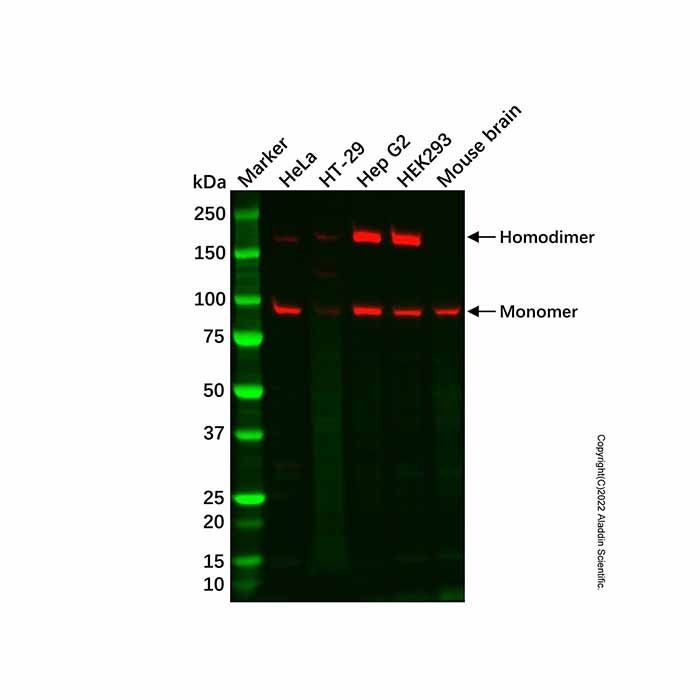
WB: Mouse brain, HeLa, HT-29, Hep G2 and HEK293 lysates.
Konjugation
Unconjugated
Note
ExactAb™, Recombinant, Validated
Lichterketten-Typ
kappa
SDS-PAGE
150 kDa
Verfahren zur Reinigung
Protein A purified
Konzentration
0.9 mg/mL
Product Line
Biologische Produkte
Lagerung und Versand
Form
Liquid
Storage
Store at -20°C,Avoid repeated freezing and thawing
Verschickt in
Ice chest + Ice pads
Stabilität und Lagerung
Store at 4°C short term (1-2 weeks). Store at -20°C long term (24 months). Upon receipt, it is recommended to aliquot. Avoid freeze/thaw cycle.
Anwendung
Anwendung
Dilution info
WB
1/1000
Documentation
📋 Safety Data Sheet (SDS)
Comprehensive hazard, handling, storage, and regulatory compliance document.
Determine the necessary mass, volume, or concentration for preparing a solution.
Dilution Calculator
Determine the dilution needed to prepare a stock solution.
Reconstitution Calculator
Bewertungen
Kundenbewertungen
Application Protocols
Manufacturer applications: Not specified for this item; refer to CoA/Spec Sheet.
Because no tested applications or dilutions are provided for SKU Ab096752, users should consult the CoA for validated uses and optimize conditions empirically in their own system. General practices (non-product-specific) include:
Prepare aliquots to avoid freeze–thaw cycles; mix gently by inversion.
Include appropriate positive and negative controls for each assay.
Titrate antibody concentration across a reasonable range to establish optimal signal-to-noise. Do not infer any recommended dilution from this listing.
Biological Roles
Target overview (General biology; not product specification)
ClC‑2 (CLCN2) is a voltage‑gated chloride channel of the CLC family. It contributes to setting resting membrane potential, cell volume regulation, and transepithelial chloride transport.
ClC‑2 exhibits inwardly rectifying chloride currents, activated under hyperpolarization, cell swelling, or acidic extracellular pH (literature).
Research relevance
Widely studied in epithelia (e.g., intestine, airway), neurons, and glia for roles in chloride homeostasis and barrier function.
Investigations commonly examine expression regulation, post‑translational modulation, and interactions with accessory proteins (e.g., glutamate transporters or scaffolding proteins) that influence membrane localization.
Use of anti‑ClC‑2 antibodies
Supports mapping of tissue distribution and subcellular localization by immunoassays.
Facilitates interrogation of signaling pathways affecting chloride transport and cellular osmoregulation.
Note: No medical or clinical claims are made. This antibody is for research use only.
Buffer Applications
Not applicable. This product is an antibody reagent, not a buffering agent. For best performance, use the supplied buffer or a recommended storage/dilution buffer as indicated in the CoA/Spec Sheet (e.g., PBS or TBS with optional carrier protein and mild detergent when compatible).
Green Alternatives
Not directly applicable. Environmental considerations for antibodies focus on buffer selection, preservative choice, and packaging rather than solvent replacement.
General greener practices (General guidance)
Use phosphate or Tris buffers prepared with high‑purity water; minimize hazardous preservatives where feasible and compliant with stability needs.
Implement micro-aliquoting to reduce waste from degraded material.
Choose energy-efficient cold storage (−20°C as specified) and consolidated shipments when practical to reduce cold‑chain footprint.
Pharmaceutical Uses
Not applicable. This product is supplied strictly for research use only and is not intended for use as a drug, diagnostic, or excipient in pharmaceutical formulations. No pharmacopeial status is claimed. For any regulated applications, obtain explicit documentation and regulatory clearance independently.
Physical Properties
Item-specific physical data
Appearance: Not specified for this item; refer to CoA/Spec Sheet.
Concentration, buffer composition, pH: Not specified for this item; refer to CoA/Spec Sheet.
Molecular weight: Not specified for this item; refer to CoA/Spec Sheet.
Literature/general values for antibodies (for context; not specifications)
Typical IgG MW ~150 kDa; Fab ~50 kDa; Fc ~50 kDa.
Proteins are generally water-soluble in isotonic buffers (e.g., PBS, TBS) and insoluble in most organic solvents.
Isoelectric point (pI) varies widely by sequence; many IgGs fall between pI ~6–9 (literature).
Practical notes (General guidance)
Avoid surface adsorption by using low-protein-binding plastics and including carrier protein or mild detergents only if compatible with your downstream application.
Refrain from vigorous vortexing or foaming, which can denature proteins.
Quality and Grades
Item-specific quality descriptors
Recombinant: Produced by engineered expression systems to deliver defined sequence and batch-to-batch consistency.
ExactAb™: Brand designation indicating sequence-defined, reproducible recombinant antibody format (general meaning; consult product CoA for specifics such as isotype and species reactivity).
Validated: The listing indicates validation has been performed; exact methods/applications are not specified here—refer to CoA/Spec Sheet for validation details.
What these mean in practice (General guidance)
Recombinant antibodies typically exhibit higher lot-to-lot reproducibility versus hybridoma-derived counterparts, facilitating consistent assay performance.
Validation commonly includes assessment of specificity and performance in one or more applications (e.g., WB, IF, IHC); however, this item’s validated applications are not specified here.
If stabilizers/preservatives are present (e.g., BSA, glycerol, azide), they can affect enzyme conjugations or live-cell compatibility; consult the CoA for exact composition.
Documentation
For certificate of analysis (CoA), sequence/isotype, and application data, contact Aladdin Scientific or review the product page’s downloadable documents.
Reaction and Applications
This section is not typically applicable to antibodies in the sense of small‑molecule reaction chemistry. However, antibodies enable biochemical applications via antigen recognition.
Item-specific applications: Not specified for this item; refer to CoA/Spec Sheet.
General application contexts for anti‑ClC‑2 antibodies (General knowledge)
Detection/quantification of ClC‑2 in cell/tissue lysates or fixed specimens by common immunoassays (e.g., Western blot, immunofluorescence, immunohistochemistry), if validated for those uses.
Immunoprecipitation or pulldown of ClC‑2 to study protein interactions and channel regulation, contingent on antibody affinity and epitope accessibility.
Practical tips (General guidance)
Confirm species reactivity and epitope accessibility relative to your sample preparation (denatured vs native).
Optimize blocking and detergents to balance specificity and membrane protein solubilization when targeting ion channels like ClC‑2.
Reaction Conditions
Not applicable to chemical reactions. For immunoassay workflows (general guidance; not product-specific):
Sample preparation for membrane proteins like ClC‑2 often benefits from optimized detergents (e.g., mild nonionic detergents) to maintain epitope integrity while solubilizing membranes.
Incubation conditions (temperature, time) should be titrated empirically for best signal-to-noise. Always verify compatibility with the antibody’s validated applications as per CoA. No specific conditions are provided for this item.
Safety and Handling
GHS classification and hazards (Item-specific)
Signal word: Not specified for this item; refer to SDS.
H‑Statements: Not specified for this item; refer to SDS.
Pictograms: Not specified for this item; refer to SDS.
General laboratory safety for protein antibodies (General guidance)
Handle using standard PPE: lab coat, safety glasses, and disposable nitrile gloves.
Avoid inhalation of aerosols; work on ice for prolonged manipulations to reduce degradation.
If the product contains preservatives (e.g., sodium azide or ProClin), consult the SDS for specific hazard and disposal instructions. Do not assume presence—check CoA/SDS.
First aid overview (General guidance; defer to SDS)
Skin/eye contact: Rinse with water for several minutes; remove contaminated clothing. Seek medical advice if irritation persists.
Ingestion/inhalation: Rinse mouth, move to fresh air; seek medical attention as needed.
Special risks
Biological origin but recombinant and intended for research use only; not from human subjects unless specified. Follow institutional biosafety procedures.
Avoid repeated freeze–thaw cycles to prevent aggregation and loss of activity.
Solvent Selection
Not typically applicable. As a recombinant antibody, the relevant medium is an aqueous buffer rather than an organic solvent. Use the supplied buffer or a compatible physiological buffer (e.g., PBS or TBS) as indicated in the CoA. For conjugation or formulation changes, perform gentle buffer exchange (e.g., spin desalting) into a composition compatible with your downstream chemistry.
Storage and Reconstitution
Item-specific storage
Store at −20°C.
Avoid repeated freezing and thawing.
Shipped in an ice chest with ice pads (cold chain maintained).
Reconstitution and handling
Reconstitution volume, buffer, and concentration: Not specified for this item; refer to CoA/Spec Sheet.
General guidance (not product-specific): If provided lyophilized, reconstitute with sterile, antibody-grade water or buffer as directed in the CoA, then equilibrate into storage buffer if needed. If provided in liquid form, keep on ice during handling and aliquot promptly.
Mixing: Gently invert; avoid vigorous vortexing and foaming.
Aliquoting: Dispense into single-use portions to minimize freeze–thaw exposure; store tightly sealed to prevent evaporation/contamination.
Stability notes
Working dilutions are best prepared fresh and kept on ice during use. For longer storage, consult the CoA for recommended stabilizers and temperatures.
Research Use Note: For research use only.
Structure and Identity
This product is a recombinant research antibody directed against the chloride channel protein ClC-2 (gene: CLCN2).
Item-specific identifiers (Product Data)
SKU: Ab096752
Product name: Recombinant ClC-2 Antibody
Grade/Purity: Recombinant, ExactAb™, Validated
CAS, CID, InChIKey, SMILES: Not applicable for antibodies; not specified for this item.
Molecular composition (Item-specific)
Molecular formula: Not specified for this item; refer to CoA/Spec Sheet.
Molecular weight: Not specified for this item; refer to CoA/Spec Sheet. (Antibodies commonly range ~150 kDa for IgG, literature.)
Structural features (General antibody knowledge)
Typical IgG antibodies are Y‑shaped glycoproteins comprising two heavy chains and two light chains linked by disulfide bonds, with variable domains forming the antigen-binding sites.
Recombinant production implies the sequence is defined and expressed in a controlled system; ExactAb™ branding suggests sequence-controlled reproducibility (general description; see Quality & Grades).
Synthetic Utility
Not applicable in the context of organic synthesis. As a recombinant antibody, its utility lies in specific antigen recognition rather than chemical transformation.
General laboratory utility (General guidance)
Target capture and enrichment of ClC‑2 from complex lysates (e.g., immunoprecipitation) when the antibody’s epitope is accessible.
Analytical detection in immunoassays to quantify or localize ClC‑2 expression across experimental conditions.
Target Specificity
Item-specific details (from Product Data)
Target: ClC‑2 (chloride channel protein 2; gene symbol CLCN2)
Antibody type/clone/isotype/species reactivity: Not specified for this item; refer to CoA/Spec Sheet.
Epitope: Not specified for this item; refer to CoA/Spec Sheet.
Häufig gestellte Fragen
What does ExactAb? mean?
ExactAb? indicates the product has been validated for use in rigorous antibody validation workflows. Validation may include positive/negative control samples, signal-to-noise testing, and protocol-specific QC. Lot-specific test data is published on the Certificate of Analysis where available.
What does Recombinant mean?
Recombinant is a defined analytical purity tier suitable for workflows requiring a specific validated property. It specifies a minimum assay percentage, controlled limits on common impurities (water, heavy metals, residue on ignition), and lot-to-lot consistency. Recombinant is one of several purity tiers — choose based on the sensitivity and regulatory requirements of your method.
How should this product be stored?
Store at ?20 °C. Avoid repeated freeze–thaw cycles. Aliquot into single-use volumes before freezing.
How is this product shipped?
This product ships in an insulated container with ice pads. Unpack on arrival and transfer it to the storage condition stated above.
What documentation is provided?
Available product documentation, including Certificates of Analysis (COA), Safety Data Sheets (SDS), and specification sheets, is shown in the product document area. Document availability and access follow the current site policy.
Which species reactivity has this antibody been validated against?
Validated reactivity is listed on the PDP and on each lot's datasheet. We validate against the most commonly tested species for the target (Recombinant ClC-2 Antibody); cross-reactivity in untested species may exist but is not guaranteed. Contact technical support for specific species inquiries.
Need help choosing the grade?
Our grade selection guide covers purity, stabilizer status, and application suitability for all variants in our catalog.
Wir verwenden Cookies, um die ordnungsgemäße Funktion der Website sicherzustellen und, soweit zulässig, Ihr Nutzererlebnis zu verbessern. Sie können Ihre Einstellungen jederzeit unter „Einstellungen“ verwalten. Weitere Informationen finden Sie in unserer Cookie-Richtlinie.
Dürfen wir Sie über Rabattaktionen informieren?
Später erinnern
Vielen Dank! Bitte überprüfen Sie Ihren E-Mail-Posteingang, um zu bestätigen.
Products are supplied to verified businesses, institutions, and qualified professionals for research and development use only. Not for use in humans, animals, diagnosis, or therapy.

 ZJ24F1215784