QUALITÄT & REINHEITRecombinant?Recombinant — produced via recombinant expression for defined sequence and consistency. Use for reproducible, animal-free proteins of known origin.ExactAb™?ExactAb™ — Aladdin's antibody line emphasizing precision and validated quality. Use for reliable, specificity-validated antibody applications.Validated?Validated grade — performance confirmed in defined applications before release. Use when you want documented assurance the reagent works as stated.0.5 mg/mL
ExactAb™, Validated, Recombinant, 0.5 mg/mL ExactAb™,Recombinant,Validated für empfindliche chromatographische und analytische Workflows, die minimale Basislinieninterferenzen erfordern.
🌡
Lagerung & Versand
Store at -20°C,Avoid repeated freezing and thawing Versand Ice chest + Ice pads. Genaue Spezifikationen finden Sie im chargenspezifischen COA.
📋
Qualitätsdokumente
SDS, COA, Datenblatt und Spezifikationsblatt stehen zum Download bereit. Chargenspezifische COA über Chargennummernsuche abrufbar.
📚
Literaturbeleg
In 0 peer-reviewten Publikationen zu Chromatographie, organischer Synthese und Kreuzkupplungsreaktionen zitiert.
Übersicht
Rabbit anti Human DOK1 Antibody, Recombinant, could be used for WB and so on.
Application:
WB: 1/500 - 1/1000
Protein Function
DOK proteins are enzymatically inert adaptor or scaffolding proteins. They provide a docking platform for the assembly of multimolecular signaling complexes. DOK1 appears to be a negative regulator of the insulin signaling pathway. Modulates integrin activation by competing with talin for the same binding site on ITGB3.
Post-translational
Constitutively tyrosine-phosphorylated. Phosphorylated on tyrosine residues by the insulin receptor kinase. Results in the negative regulation of the insulin signaling pathway.
Spezifikationen
Product Name
Recombinant DOK1 Antibody - Primärer Antikörper, specific to DOK1, Rabbit IgG
A synthetic peptide derived from human DOK1 (AA 430-481)
Positive Kontrolle
WB: K562, Jurkat, NIH/3T3 and C6 cell lysates.
Konjugation
Unconjugated
Note
ExactAb™, Recombinant, Validated
Isotyp
Rabbit IgG
Lichterketten-Typ
kappa
SDS-PAGE
150 kDa
Verfahren zur Reinigung
Protein A purified
Konzentration
0.5 mg/mL
Product Line
Biologische Produkte
Lagerung und Versand
Form
Liquid
Storage
Store at -20°C,Avoid repeated freezing and thawing
Verschickt in
Ice chest + Ice pads
Stabilität und Lagerung
Store at 4°C short term (1-2 weeks). Store at -20°C long term (24 months). Upon receipt, it is recommended to aliquot. Avoid freeze/thaw cycle.
Bilder
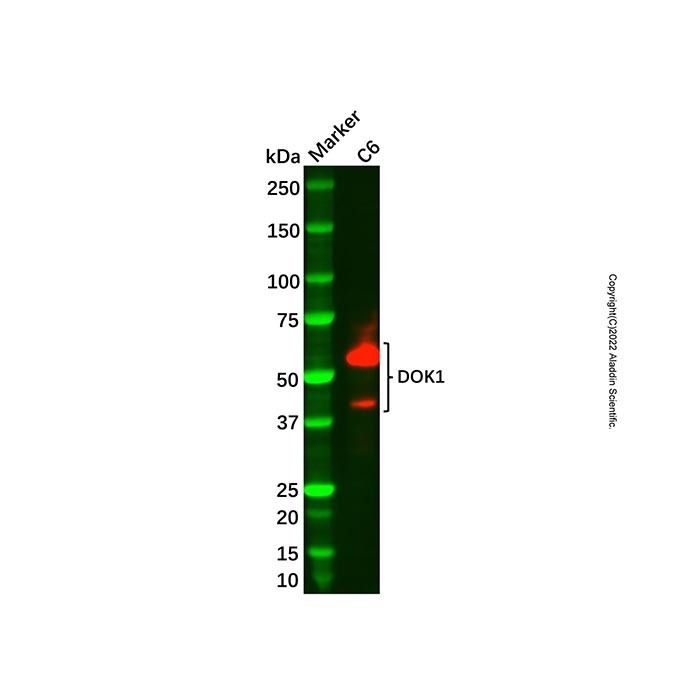
Recombinant DOK1 Antibody (Ab100293) - Western Blot All lanes: Recombinant DOK1 Antibody (Ab100293) at 1/1000 dilution Samples: Lysates at 20 µg per lane Secondary: Goat Anti-Rabbit IgG H&L (HRP) (Ab170144) at 1/20000 dilution Predicted band size: 52 kDa Observed band size: 44, 58 kDa Exposure time: 21.5 s
Recombinant DOK1 Antibody (Ab100293) - Western Blot All lanes: Recombinant DOK1 Antibody (Ab100293) at 1/1000 dilution Samples: Lysates at 10 µg per lane Secondary: Goat Anti-Rabbit IgG H&L (HRP) (Ab170144) at 1/20000 dilution Predicted band size: 52 kDa Observed band size: 44, 58 kDa Exposure time: 3.0 s
Anwendung
Anwendung
Dilution info
WB
1/500-1/1000
Dokumentation
📋 Sicherheitsdatenblatt (SDS)
Umfassendes Dokument zu Gefahren, Handhabung, Lagerung und Einhaltung regulatorischer Vorschriften.
Determine the necessary mass, volume, or concentration for preparing a solution.
Dilution Calculator
Determine the dilution needed to prepare a stock solution.
Reconstitution Calculator
Bewertungen
Kundenbewertungen
Application Protocols
Application-specific protocols, tested applications, and recommended dilutions are not specified for this item; refer to CoA/Spec Sheet and SDS.
Notes
As with all research antibodies, end-users should optimize assay conditions (antibody dilution, incubation time/temperature, blocking, retrieval) in their system and include appropriate positive/negative controls.
Biological Roles
Target overview: DOK1 (Docking protein 1) is an adaptor/scaffold protein involved in tyrosine kinase signaling (literature/general). It contains a pleckstrin homology (PH) domain and a phosphotyrosine-binding (PTB) domain, enabling membrane localization and interaction with phosphorylated receptors and signaling intermediates.
Signal attenuation: DOK1 recruits negative regulators such as RasGAP to activated receptor complexes, dampening RAS–MAPK signaling.
Tyrosine kinase pathways: Interfaces with Src family kinases and ABL family kinases; can be phosphorylated on multiple tyrosines, creating docking sites for SH2 domain-containing proteins.
Hematopoietic signaling: Participates in immune cell receptor pathways and cytokine receptor signaling, modulating thresholds for activation.
Subcellular localization: Predominantly cytosolic but translocates to the plasma membrane upon stimulation via its PH domain.
PTMs: Undergoes tyrosine phosphorylation and other modifications that tune binding affinities and function.
Research implications
DOK1 serves as a readout of pathway activation and as a node for dissecting adaptor-mediated negative feedback. Antibody-based detection enables analysis of expression levels, phosphorylation status (when using modification-specific antibodies), and interaction networks via IP/Co-IP.
Note
This product’s exact epitope, species reactivity, and affinity are not specified; refer to CoA/Spec Sheet for item-specific target details.
Buffer Applications
While this product is an antibody rather than a buffer, its performance depends critically on buffer systems used in immunoassays.
Common buffer systems (literature/general)
PBS (pH 7.2–7.4): Standard for dilution, washing, and storage; maintains isotonic conditions and protein stability.
TBS (pH 7.4–8.0): Alternative to PBS that can reduce background in some phospho-protein assays; compatible with most detection chemistries.
Blocking buffers: 1–5% BSA, casein, or serum in PBS/TBS to suppress nonspecific binding; detergent (0.05% Tween-20) often added for washes.
Antigen retrieval (IHC): Citrate buffer pH 6.0 or Tris-EDTA pH 9.0 used for heat-induced epitope retrieval; conditions require empirical optimization for DOK1.
Practical tips
Maintain consistent pH and ionic strength across steps to minimize conformational changes and nonspecific interactions.
For ELISA/WB, include a mild non-ionic detergent in wash buffers to lower background.
Item-specific note
Supplied buffer, stabilizers, and preservative content for Ab100293 are not specified; consult the CoA/Spec Sheet before selecting complementary buffers or making dilutions.
Green Alternatives
Sustainability for antibody-based workflows focuses on buffer choices, waste minimization, and cold-chain efficiency rather than solvent substitution.
Greener practice suggestions (literature/general)
Buffer systems: Prefer phosphate- or Tris-based aqueous buffers at neutral pH. Avoid unnecessary organic cosolvents; use minimal volumes when conjugation chemistry requires them.
Preservatives: If sodium azide is not required (e.g., for live-cell applications), select azide-free formulations to reduce toxic waste; filter-sterilize and store cold to maintain sterility.
Cryoprotection: Use glycerol at 30–50% for working aliquots stored at −20 °C to avoid repeated freeze–thaw, reducing waste from activity loss.
Packaging: Consolidate orders and choose right-size packaging to reduce cold-chain materials. Reuse/recycle ice packs and foam where facility policies allow.
Tradeoffs
Azide-free or BSA-free formulations enhance compatibility with live cells or downstream MS, but may reduce shelf stability; compensate with stricter aseptic technique and cold storage.
Concentrated stocks reduce packaging and shipping burden but require accurate dilution and may increase adsorption losses without carrier protein.
Note
Exact formulation of this SKU is not specified; refer to CoA/Spec Sheet to tailor green practices to the provided buffer and excipients.
Pharmaceutical Uses
This product is designated For research use only and is not intended for human or veterinary use, diagnostics, or therapeutic applications.
Research-grade antibodies may be supplied in PBS or other isotonic buffers with stabilizers (e.g., glycerol, BSA) and/or preservatives (e.g., sodium azide). Such excipients are selected to maintain stability, reduce aggregation, and preserve sterility during laboratory storage and handling.
Manufacturing context
No pharmacopeial monograph or GMP status is claimed for this SKU. It is not qualified as an excipient for pharmaceutical manufacturing.
Item-specific note
Exact formulation, preservatives, and stabilizers for Ab100293 are not specified for this item; refer to CoA/Spec Sheet.
Physical Properties
Item-specific physical properties
Concentration, buffer composition, and excipients: Not specified for this item; refer to CoA/Spec Sheet.
pH of supplied solution: Not specified for this item; refer to CoA/Spec Sheet.
Extinction coefficient and A280 conversion: Not specified for this item; refer to CoA/Spec Sheet.
Appearance: Not specified for this item.
General properties of recombinant antibodies (literature/general)
Typical molecular mass: IgG-format antibodies are ~150 kDa; Fab fragments ~50 kDa; scFv ~25–30 kDa. Exact for this item is not specified.
Solubility: Readily soluble in aqueous buffered saline (e.g., PBS, TBS); precipitates outside physiological pH/ionic strength or upon repeated freeze–thaw.
Isoelectric point (pI): Commonly pI ~7–9 for human IgG; actual pI depends on sequence and is not specified for this item.
Stability: Enhanced by neutral pH buffers, moderate salt (100–300 mM), carrier proteins (e.g., BSA) and cryoprotectants (e.g., 10–50% glycerol) for frozen storage (general guidance; not item-specific).
Proteins denature upon exposure to high temperatures, extreme pH, surface adsorption, or proteases. Avoid vigorous vortexing and excessive shear.
Important
Where exact numerical values are required for method development or QC, use the product’s CoA/Spec Sheet and SDS. Do not treat the above as item specifications.
Recombinant: Produced from a defined expression system from a characterized sequence, improving lot-to-lot consistency versus hybridoma-derived antibodies.
ExactAb™: Aladdin Scientific line indicating rigorous design and manufacturing controls for research-grade antibodies. Typical expectations include sequence-defined production, standardized purification, and QC checkpoints. Specific QC metrics for this SKU are not specified; refer to CoA/Spec Sheet.
Validated: Indicates the antibody has undergone internal suitability checks against intended research applications. Exact tested applications, species reactivity, and validation data are not specified for this item; consult the datasheet for details.
Implications for use
Recombinant manufacturing reduces drift in affinity and specificity across lots, aiding reproducibility in quantitative assays.
Validation status supports use in common immunoassays; nonetheless, end-users should verify performance in their own system and run appropriate controls.
What is not stated (item-specific)
Purity percentage, aggregate content, endotoxin level, residual host-cell proteins/DNA, and preservative/excipient profile: Not specified for this item; refer to CoA/Spec Sheet.
Isotype, clonality (mono/polyclonal), and host species: Not specified for this item; refer to CoA/Spec Sheet.
Reaction and Applications
As a research antibody, this product is intended for immunoassay-based applications rather than chemical reactions.
Typical research applications (literature/general)
Western blot (WB): Detection of DOK1 in denatured lysates following SDS-PAGE; performance depends on epitope exposure and antibody format.
Immunoprecipitation (IP)/Co-IP: Enrichment of DOK1 and associated complexes from cell lysates for downstream analysis (e.g., MS, WB).
Immunofluorescence (IF)/Immunocytochemistry (ICC): Cellular localization studies of DOK1; fixation/permeabilization conditions should preserve epitopes.
Immunohistochemistry (IHC): Tissue-level detection; antigen retrieval and blocking must be optimized.
ELISA: Quantitative detection when configured as capture or detection reagent; requires matched pair validation.
Assay design notes (general)
Antigen considerations: DOK1 isoforms, PTMs, and cell-type-specific expression may affect epitope availability. Validate specificity with siRNA/CRISPR knockdown or overexpression controls where possible.
Controls: Include positive biological controls known to express DOK1 and negative controls lacking expression; use isotype controls and no-primary controls to assess background.
Important
This listing does not specify validated applications, species reactivity, or recommended dilutions for SKU Ab100293. Consult the datasheet and verify conditions in your system.
Reaction Conditions
Chemical reaction conditions are not applicable; however, typical incubation conditions for immunoassays using anti-DOK1 antibodies are provided as general guidance (literature/general). These are not validated for this SKU and must be optimized by the user.
General incubation parameters
Western blot: Primary incubation 1–16 h at 4–25 °C in TBST or PBST with 1–5% BSA or milk; antibody dilution is assay- and titer-dependent.
Immunofluorescence/ICC: 0.5–2 h at room temperature or overnight at 4 °C in blocking buffer after appropriate fixation (e.g., PFA) and permeabilization (e.g., Triton X-100 0.1%).
Immunohistochemistry: Heat-induced epitope retrieval in citrate pH 6.0 or Tris-EDTA pH 9.0; primary incubation 1 h RT or overnight 4 °C.
Immunoprecipitation: 1–4 h antibody–lysate binding at 4 °C with gentle rotation, followed by capture with protein A/G resin; high-salt and detergent conditions adjusted to preserve DOK1 complexes.
Controls and verification
Include isotype and no-primary controls to benchmark background.
Validate specificity with genetic controls (knockdown/knockout) or overexpression where feasible.
Item-specific note
Recommended dilutions, tested species, and verified applications for Ab100293 are not specified; refer to CoA/Spec Sheet.
Safety and Handling
Hazard classification
GHS classification, signal word, and pictograms: Not specified for this item; refer to SDS.
Antibodies are generally considered non-hazardous biological reagents; however, formulations may contain preservatives (e.g., sodium azide) that carry acute toxicity and aquatic hazard statements (literature/general). Always check the SDS for the supplied lot.
PPE and safe handling (general laboratory best practice)
Wear lab coat, safety glasses, and disposable nitrile gloves.
Avoid aerosol generation; handle in a clean area to prevent contamination.
Do not pipette by mouth; avoid skin or eye contact. Wash thoroughly after handling.
Storage incompatibilities and precautions
Avoid repeated freeze–thaw cycles as specified in Product Data; aliquot upon first thaw to maintain integrity.
If sodium azide is present (not specified for this item), avoid contact with heavy metals and acids; azide can form explosive metal azides in plumbing.
Protect from microbial contamination; use sterile tips and containers.
First-aid overview (general)
Skin/eye contact: Rinse with water for at least 15 minutes; remove contaminated clothing. Seek medical attention if irritation persists.
Ingestion/inhalation: Rinse mouth, move to fresh air. Seek medical advice if unwell.
Authoritative source
For definitive hazard, transport, and disposal guidance, consult the product SDS and institutional biosafety policies.
Solvent Selection
This product is an aqueous biological reagent (antibody). Organic solvent selection is typically not applicable.
Practical guidance (literature/general)
Compatible media: Physiological buffers such as PBS (pH ~7.2–7.4) or TBS (pH ~7.4–8.0). Maintain ionic strength to preserve solubility and binding.
Avoid: Strong oxidants, chaotropes, or high percentages of organic solvents that denature proteins. If coupling or labeling requires organic cosolvent, keep below denaturing thresholds and validate empirically.
Small comparison (general)
PBS vs TBS: PBS is widely used and compatible with most HRP/AP detection systems; TBS may reduce background in some phospho-protein applications due to phosphate interactions (case-dependent). Choice should be guided by assay design and target biology.
Note
Exact supplied buffer composition for this SKU is not specified; refer to CoA/Spec Sheet before combining with other reagents.
Storage and Reconstitution
Item-specific instructions (from Product Data)
Storage conditions: Store at −20 °C. Avoid repeated freezing and thawing.
Shipping: Shipped in an ice chest with ice pads to maintain the cold chain.
General best practices (literature/general)
Upon receipt: If frozen, thaw gently on ice. Mix by slow inversion; avoid vigorous vortexing.
Aliquoting: Immediately aliquot into single-use volumes to prevent freeze–thaw cycles. Use low-protein-binding tubes to minimize adsorption losses.
Working stocks: For frequent use, consider adding sterile glycerol to 30–50% v/v and store at −20 °C to keep solutions unfrozen and reduce freeze–thaw (only if compatible with intended applications and the supplied buffer; check CoA/Spec Sheet).
Short-term storage: 2–8 °C for days to a few weeks may be acceptable if preservative is present and sterility is maintained; confirm with the datasheet.
Reconstitution: If provided lyophilized (not specified for this item), reconstitute with sterile, antibody-grade water or buffer as directed on the CoA/Spec Sheet; allow to equilibrate to room temperature before gently mixing and then return to recommended storage.
Stability caveats
Avoid microbial contamination and protease exposure. Protect from prolonged ambient temperatures.
For definitive, lot-specific instructions, defer to the CoA/Spec Sheet.
Structure and Identity
Recombinant DOK1 Antibody (SKU: Ab100293) is a recombinant research antibody targeting the adaptor protein DOK1 (Docking protein 1), provided under Aladdin Scientific’s ExactAb™ line.
Item-specific identifiers
Molecular formula: Not specified for this item; refer to CoA/Spec Sheet.
Molecular weight: Not specified for this item; refer to CoA/Spec Sheet.
SMILES: Not applicable for proteins; not specified for this item.
InChIKey: Not applicable for proteins; not specified for this item.
CAS/CID: Not specified for this item; refer to CoA/Spec Sheet.
General structural description (literature/general)
Antibody class: Recombinant immunoglobulin-based binder. If an IgG format, typical architecture is a Y-shaped heterotetramer with two heavy and two light chains stabilized by inter- and intra-chain disulfides; Fc glycosylation is common in mammalian-expressed products.
Functional domains: Variable domains (VH/VL) mediate antigen recognition through CDRs; constant regions (CH/CL) determine isotype and Fc interactions (if present).
Target: DOK1 is a cytosolic scaffolding/adaptor protein with PH and PTB domains that localize it to membranes and enable binding to phosphotyrosine motifs on receptor tyrosine kinases and signaling proteins (literature/general).
2D description in words: The antibody comprises modular immunoglobulin domains arranged to form two antigen-binding sites at the tips of the Fab arms and an Fc stem (for IgG-like formats). Epitope recognition is paratope-dependent and sequence-specific to DOK1.
Notes
Exact isotype, host, clonality, and sequence are not specified for this item; refer to CoA/Spec Sheet.
Synthetic Utility
Not typically applicable. Antibodies are not reagents for small-molecule synthesis.
Related laboratory utility (literature/general)
Affinity capture: Antibodies can be immobilized on solid supports (e.g., protein A/G or covalent coupling to agarose) to purify target proteins or complexes from cell lysates for biochemical characterization.
Analytical workflows: Serve as selective recognition elements in immunoassays that complement mass spectrometry, CRISPR perturbation studies, or kinase assays to map signaling networks involving DOK1.
Item-specific note
No immobilization chemistry, coupling conditions, or conjugation format is specified for Ab100293; consult the CoA/Spec Sheet if such features are provided for this item.
Target Specificity
Item-specific details are not provided in the Product Data.
Antigen/epitope: Not specified for this item; refer to CoA/Spec Sheet.
Species reactivity: Not specified for this item; refer to CoA/Spec Sheet.
Clonality, isotype, and host: Not specified for this item; refer to CoA/Spec Sheet.
Cross-reactivity: Not specified for this item; refer to CoA/Spec Sheet.
General note (literature/general)
DOK1 is an adaptor protein found in many mammalian systems; epitope choice (linear vs conformational) and sequence conservation will dictate cross-species reactivity. Please consult the datasheet for the exact specificity profile of SKU Ab100293.
Häufig gestellte Fragen
What does ExactAb? mean?
ExactAb? indicates the product has been validated for use in rigorous antibody validation workflows. Validation may include positive/negative control samples, signal-to-noise testing, and protocol-specific QC. Lot-specific test data is published on the Certificate of Analysis where available.
What does Recombinant mean?
Recombinant is a defined analytical purity tier suitable for workflows requiring a specific validated property. It specifies a minimum assay percentage, controlled limits on common impurities (water, heavy metals, residue on ignition), and lot-to-lot consistency. Recombinant is one of several purity tiers — choose based on the sensitivity and regulatory requirements of your method.
How should this product be stored?
Store at ?20 °C. Avoid repeated freeze–thaw cycles. Aliquot into single-use volumes before freezing.
How is this product shipped?
This product ships in an insulated container with ice pads. Unpack on arrival and transfer it to the storage condition stated above.
What documentation is provided?
Available product documentation, including Certificates of Analysis (COA), Safety Data Sheets (SDS), and specification sheets, is shown in the product document area. Document availability and access follow the current site policy.
Which species reactivity has this antibody been validated against?
Validated reactivity is listed on the PDP and on each lot's datasheet. We validate against the most commonly tested species for the target (Recombinant DOK1 Antibody); cross-reactivity in untested species may exist but is not guaranteed. Contact technical support for specific species inquiries.
Benötigen Sie Hilfe bei der Auswahl der Qualität?
Unser Leitfaden zur Qualitätsauswahl behandelt Reinheit, Stabilisatorstatus und Anwendungseignung für alle Varianten in unserem Katalog.
Wir verwenden Cookies, um die ordnungsgemäße Funktion der Website sicherzustellen und, soweit zulässig, Ihr Nutzererlebnis zu verbessern. Sie können Ihre Einstellungen jederzeit unter „Einstellungen“ verwalten. Weitere Informationen finden Sie in unserer Cookie-Richtlinie.
Dürfen wir Sie über Rabattaktionen informieren?
Später erinnern
Vielen Dank! Bitte überprüfen Sie Ihren E-Mail-Posteingang, um zu bestätigen.
Products are supplied to verified businesses, institutions, and qualified professionals for research and development use only. Not for use in humans, animals, diagnosis, or therapy.

 ZJ24F0809175