QUALITÄT & REINHEITRecombinant?Recombinant — produced via recombinant expression for defined sequence and consistency. Use for reproducible, animal-free proteins of known origin.ExactAb™?ExactAb™ — Aladdin's antibody line emphasizing precision and validated quality. Use for reliable, specificity-validated antibody applications.Validated?Validated grade — performance confirmed in defined applications before release. Use when you want documented assurance the reagent works as stated.0.5 mg/mL
Rabbit anti Human eIF2A Antibody, Recombinant, could be used for WB and ICC/IF. Application: WB: 1/500 – 1/1000 ICC/IF: 1/50 – 1/200 Protein Function Functions in the early steps of protein synthesis of a small number of specific mRNAs. Acts by directing the binding of methionyl-tRNAi to 40S ribosomal subunits. In contrast to the eIF-2 complex, it binds methionyl-tRNAi to 40 S subunits in a codon-dependent manner, whereas the eIF-2 complex binds methionyl-tRNAi to 40 S subunits in a GTP-dependent manner. May act by impiging the expression of specific proteins.
Spezifikationen
Product Name
Recombinant eIF2A Antibody - Primärer Antikörper, specific to EIF2A, Rabbit IgG
Store at -20°C,Avoid repeated freezing and thawing
Verschickt in
Ice chest + Ice pads
Stabilität und Lagerung
Store at 4°C short term (1-2 weeks). Store at -20°C long term (24 months). Upon receipt, it is recommended to aliquot. Avoid freeze/thaw cycle.
Bilder
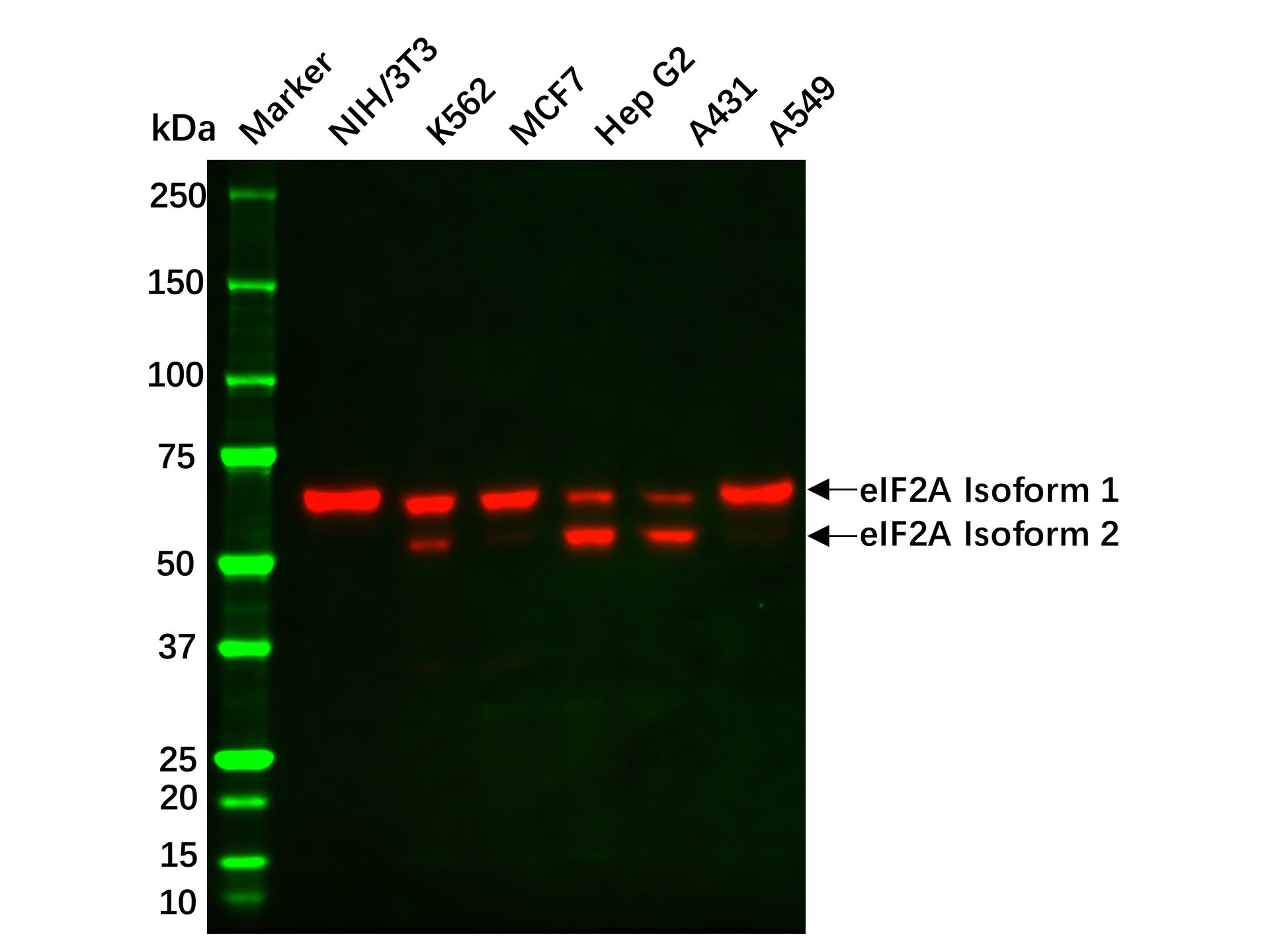
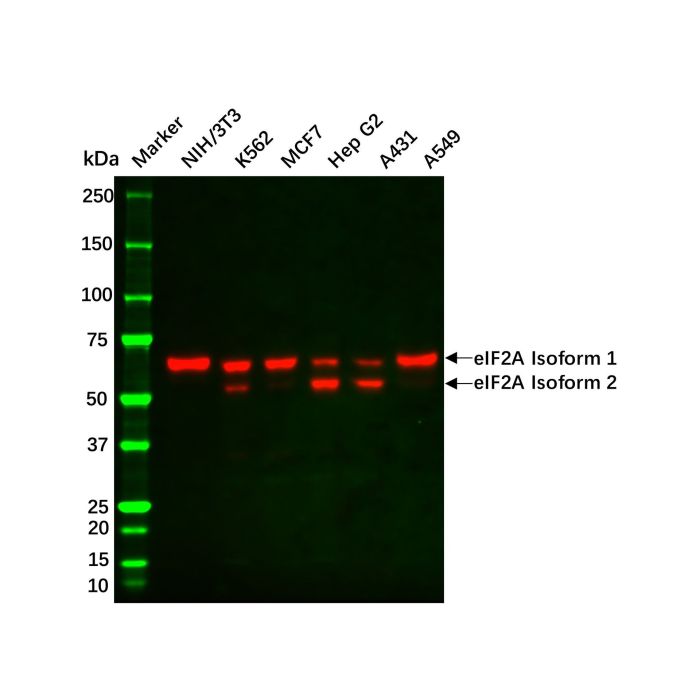
Recombinant eIF2A Antibody (Ab101265) - Western Blot All lanes: Recombinant eIF2A Antibody (Ab101265) at 1/1000 dilution Samples: Lysates at 20 µg per lane Secondary: Goat Anti-Rabbit IgG H&L (HRP) (Ab170144) at 1/20000 dilution
Predicted band size: 65 kDa Observed band size: 65&55 kDa Exposure time: 1.7 s
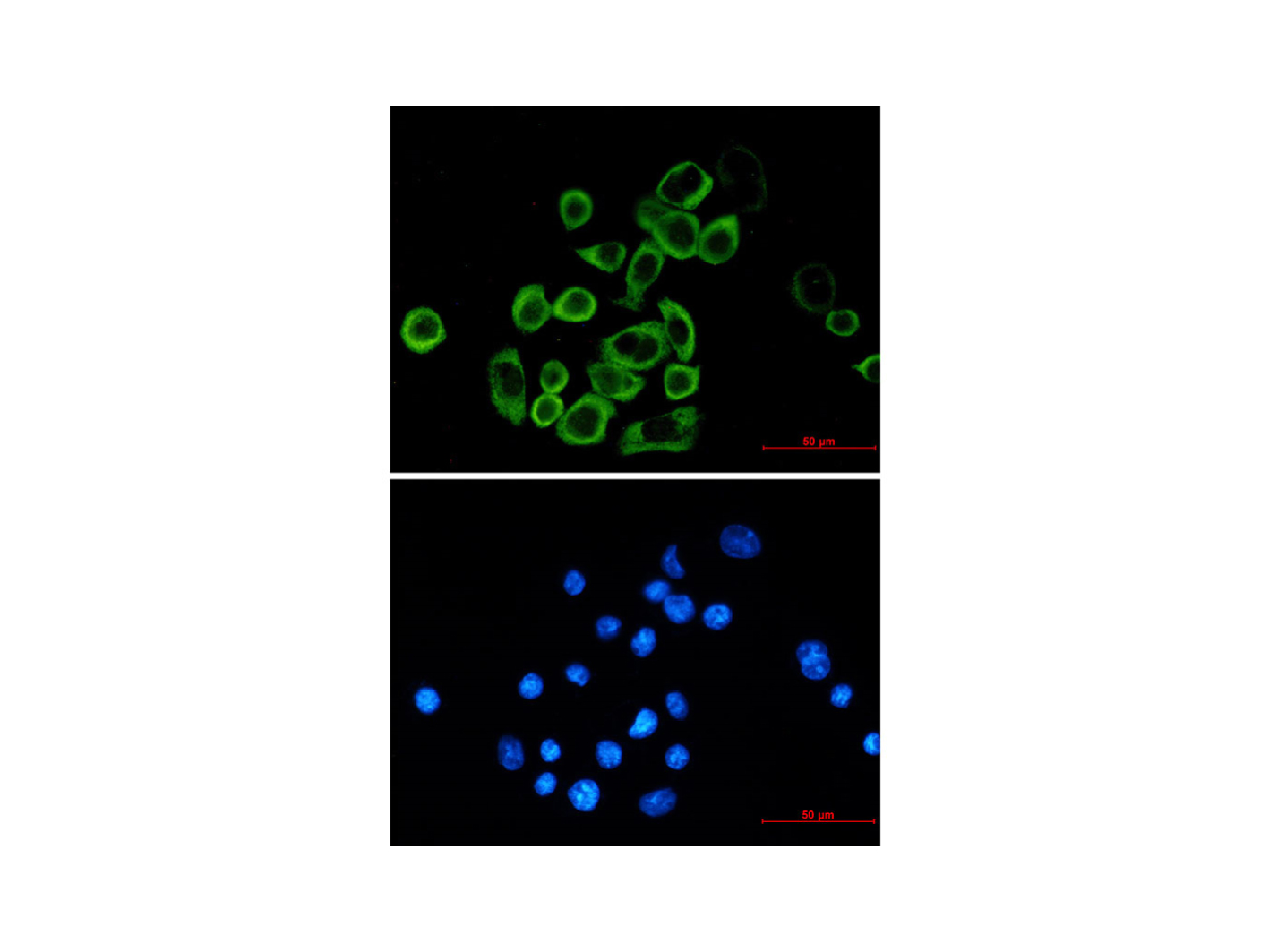
Recombinant eIF2A Antibody (Ab101265) - IF Immunocytochemistry analysis of eIF2A (green) in MCF7 using Recombinant eIF2A Antibody (Ab101265) and cells were counterstained with DAPI (blue).
Determine the necessary mass, volume, or concentration for preparing a solution.
Dilution Calculator
Determine the dilution needed to prepare a stock solution.
Reconstitution Calculator
Bewertungen
Kundenbewertungen
Application Protocols
Tested applications and recommended dilutions for this SKU: Not specified for this item; refer to CoA/Spec Sheet.
General guidance (literature/practice):
Western blot (WB): Validate on lysates known to express eIF2A; include loading controls and molecular weight markers. Optimize blocking reagent and primary/secondary incubation times.
Immunofluorescence (IF) / Immunohistochemistry (IHC): Titrate antibody, optimize fixation (paraformaldehyde vs. methanol) and, for IHC, antigen retrieval conditions. Include isotype and no-primary controls.
Immunoprecipitation (IP): Determine optimal antibody:lysate ratio; choose Protein A or G beads to match antibody isotype (not specified here). Include IgG control IP.
Data quality: Establish standard curves or use internal references for semi-quantitative comparisons; document exposure times and imaging settings for reproducibility.
Biological Roles
Target overview (literature/general):
eIF2A (eukaryotic translation initiation factor 2A) is a translation factor distinct from the heterotrimeric eIF2 complex. eIF2A has been implicated in specialized, context-dependent initiation pathways, including initiation at non-AUG codons and re-initiation events under certain stress or viral contexts. It can coordinate with factors such as eIF5B and contributes to the assembly of 80S ribosomes on particular mRNAs.
While eIF2 (via its α-subunit phosphorylation) governs global translation attenuation during stress, eIF2A is reported to support selective translation programs, potentially influencing proteostasis, stress responses, and viral translation strategies (literature).
Research utility of anti-eIF2A antibodies (general):
Detection and quantification of eIF2A protein levels across cell lines and tissues.
Subcellular localization studies via IF/IHC to examine cytoplasmic versus stress granule-associated pools.
Co-immunoprecipitation to probe eIF2A-interacting proteins and assembly into initiation complexes.
Note: Species reactivity, epitope/region, and cross-reactivity for this specific SKU are not specified; consult the CoA/Spec Sheet for item-specific details and validation data.
Buffer Applications
Not a buffering reagent. This is a recombinant antibody supplied in an aqueous medium. It does not serve as a pH buffer component.
Practical handling (general):
Maintain the antibody in neutral pH buffers (e.g., PBS, TBS) compatible with your downstream assay. Avoid extreme pH which can denature immunoglobulins.
For conjugation or special assays, perform buffer exchange into amine-free or metal-chelator-free buffers as required, using desalting columns or dialysis. Item-specific buffer composition is not specified; refer to CoA/Spec Sheet.
Green Alternatives
Not directly applicable to an aqueous antibody reagent. However, greener laboratory practices can still be considered:
General recommendations (literature):
Minimize single-use plastics by employing reusable racks and validated washing protocols where appropriate.
Favor phosphate- or Tris-based buffers prepared with ultrapure water and avoid unnecessary organic cosolvents or azide where biosafety permits.
Optimize assay conditions to reduce antibody consumption per experiment, thereby lowering upstream resource use.
Consolidate cold-chain shipments when possible; this item ships cold (ice chest + ice pads per product data).
Pharmaceutical Uses
This product is designated for research use only and is not intended for diagnostic or therapeutic applications.
General formulation context (literature):
In bioprocess development, research-grade antibodies may be used as analytical reagents for in-process monitoring, target quantitation, or immunocapture in non-clinical settings. They are not manufactured under cGMP for clinical use.
Excipients commonly found in research antibody formulations include PBS, glycerol, sugars, proteins (e.g., BSA), and preservatives (e.g., sodium azide); for this item, exact formulation is not specified. Refer to CoA/Spec Sheet.
Physical Properties
Antibody physical constants (item-specific): Not specified for this item; refer to CoA/Spec Sheet.
Appearance: Not specified for this item; refer to CoA/Spec Sheet.
Concentration, buffer composition, and preservatives: Not specified for this item; refer to CoA/Spec Sheet.
General properties (literature/general):
Recombinant IgG-class antibodies typically have an approximate molecular mass of ~150 kDa (literature) and are supplied in aqueous buffer (commonly PBS) with stabilizers such as glycerol, BSA, and/or azide; exact formulation for this item is not specified.
Solubility: Readily soluble in common physiological buffers (e.g., PBS) (literature). Denatured by extremes of pH, heat, and repeated freeze–thaw.
Stability: Enhanced by storage at subzero temperatures with cryoprotectant and by avoiding proteases and microbial contamination (literature).
Interpretation and implications (general/literature):
Recombinant: Produced in a defined expression system from a known sequence, providing high lot-to-lot consistency, animal-origin control, and reduced background versus hybridoma-derived counterparts.
ExactAb™: Branding that typically denotes sequence-defined, engineered, and quality-controlled antibody production. It often implies traceable sequence, reproducibility, and stable supply. For the exact definition and any sequence disclosure for this SKU, refer to CoA/Spec Sheet.
Validated: Indicates performance has been confirmed in one or more research applications by the manufacturer. Specific tested applications, dilutions, and validation data are not specified here; refer to CoA/Spec Sheet.
What is not specified for this item:
Clone ID, isotype/subclass, host species, antigen affinity, endotoxin level, and formulation are not specified; refer to CoA/Spec Sheet for exact values and acceptance criteria.
Practical note:
For regulated workflows and quantitative studies, request the latest CoA, lot-specific validation report, and sequence/isotype details to ensure assay compatibility (e.g., Fc-binding of secondaries, species cross-reactivity).
Reaction and Applications
Not a chemical reagent for synthetic transformations; therefore, classical organic reactions, catalysts, and conditions do not apply.
Research application context (general/literature):
Anti-eIF2A antibodies are commonly used for immunoassays such as Western blot (WB), immunoprecipitation (IP), immunofluorescence (IF), and immunohistochemistry (IHC) to evaluate eIF2A expression, localization, and pathway modulation in translation initiation research. Specific tested applications, recommended dilutions, and controls for this SKU are not specified; refer to CoA/Spec Sheet.
For quantitative or comparative studies, include appropriate loading controls (WB), isotype controls (IF/IHC/FC), and validation on positive/negative cell lines with known eIF2A status.
For IP, pre-clear lysates, optimize antibody:lysate ratios, and validate bead type (Protein A/G) according to the isotype (not specified here).
Reaction Conditions
Not applicable to chemical reaction conditions. This antibody is employed under biochemical assay conditions.
Assay conditions (general, literature):
Western blot: Typical primary antibody incubations are performed in blocking buffer at 4°C overnight or 1–2 h at room temperature, with antibody concentration optimized empirically.
Immunofluorescence/IHC: Incubation conditions depend on fixation/permeabilization; antigen retrieval may be required for IHC. Optimize dilution and incubation time.
Immunoprecipitation: Commonly 1–10 µg antibody per 0.5–1 mg lysate protein; incubate 1–4 h at 4°C followed by capture with Protein A/G beads. Actual conditions for this SKU are not specified; refer to CoA/Spec Sheet.
Safety and Handling
GHS/SDS information (item-specific): Not specified for this item; refer to SDS.
Signal word, H-statements, pictograms, classification: Not specified for this item; refer to SDS.
General laboratory safety for protein antibodies (literature/best practice):
Handle as a laboratory chemical/biological reagent under BSL-1 practices. Avoid ingestion, inhalation of aerosols, and contact with skin/eyes. Wear appropriate PPE: lab coat, safety glasses, and nitrile gloves.
Avoid repeated freeze–thaw cycles to prevent loss of activity and aggregation. Aliquot upon first thaw.
Incompatibilities: Avoid strong oxidizers, proteases, and microbial contamination. Do not mix with reducing agents or detergents unless compatible with your assay.
First aid (general): In case of skin or eye contact, rinse with water for at least 15 minutes and seek medical attention as needed. If inhaled, move to fresh air. If swallowed, rinse mouth and seek medical advice. Always consult the product SDS for authoritative guidance.
Waste: Dispose of protein solutions and consumables according to institutional biosafety and chemical hygiene policies.
Shipping/storage risks (item-specific): Shipped on cold packs (ice chest + ice pads, per product data). Store at -20°C; avoid repeated freezing and thawing (per product data).
Solvent Selection
Not typically applicable. This product is an aqueous protein reagent (antibody), not a small-molecule solute requiring organic solvent optimization.
General guidance (literature):
Antibodies are normally handled in physiological buffers (e.g., PBS, TBS) at neutral pH. Organic solvents can denature or precipitate antibodies; avoid DMSO, acetone, acetonitrile, and alcohols unless specifically validated for your assay.
If buffer exchange is required (e.g., for conjugation), use desalting columns or dialysis into the target buffer rather than solvent-based methods.
Storage and Reconstitution
Item-specific storage from Product Data:
Store at -20°C.
Avoid repeated freezing and thawing.
Shipped in an ice chest with ice pads.
General handling and reconstitution (literature/practice):
If provided frozen or as a liquid, thaw gently on ice and mix by slow inversion; avoid vigorous vortexing to minimize aggregation. Upon first thaw, aliquot into single-use volumes and refreeze promptly at -20°C or below per your laboratory policy.
If supplied lyophilized (not specified for this item), reconstitute with sterile buffer (e.g., PBS or water) to the desired concentration, allow complete dissolution on ice, then aliquot. Record the final concentration.
Protect from microbial contamination; use sterile, low-protein-binding tubes and tips.
Short-term storage (2–8°C) may be suitable for working aliquots for a few days; for longer-term preservation, store at -20°C or below. Inclusion of cryoprotectants (e.g., glycerol) can improve freeze–thaw stability, but the presence/amount for this item is not specified; refer to CoA/Spec Sheet.
Do not expose to repeated temperature cycling; use chilled racks during setup and keep on ice when possible.
Research Use Only: For research use only; not for diagnostic or therapeutic use.
Structure and Identity
Item-specific structural identifiers (SMILES, InChIKey, molecular formula, exact molecular weight) are not applicable to intact recombinant antibodies and are not provided for this product. Not specified for this item; refer to CoA/Spec Sheet.
General description (literature):
The product is a recombinant antibody directed against eIF2A (eukaryotic translation initiation factor 2A).
Antibodies are Y-shaped glycoproteins composed of two heavy and two light chains with variable regions that confer antigen specificity. Recombinant production provides sequence-defined, lot-to-lot consistent reagents.
Structural features include disulfide-bonded domains (Ig fold), Fc region, and antigen-binding complementarity-determining regions (CDRs). Exact isotype, host, and clone are not specified for this item; refer to CoA/Spec Sheet.
2D/functional description in words (general):
Two identical antigen-binding sites at the tips of Fab arms recognize epitopes on the eIF2A protein; the Fc region enables purification/secondary detection depending on isotype subclass (not specified here).
Synthetic Utility
Not applicable. As a recombinant protein reagent, this antibody is not used as a building block or reagent in chemical synthesis.
Related laboratory utility (general):
Functions as a biological affinity reagent for detection, capture, or localization of eIF2A in complex mixtures or fixed samples.
May serve as a component of immunoassays or pull-down workflows rather than participating in chemical transformations.
Target Specificity
Item-specific details must come from product data.
Epitope/Immunogen, clone, isotype, species reactivity, cross-reactivity, and sequence region: Not specified for this item; refer to CoA/Spec Sheet.
General note:
eIF2A is a cytoplasmic translation factor; antibodies may recognize linear or conformational epitopes depending on design. Verify compatibility with denatured (WB) versus native (IP) conditions using item-specific validation data.
Häufig gestellte Fragen
What does ExactAb? mean?
ExactAb? indicates the product has been validated for use in rigorous antibody validation workflows. Validation may include positive/negative control samples, signal-to-noise testing, and protocol-specific QC. Lot-specific test data is published on the Certificate of Analysis where available.
What does Recombinant mean?
Recombinant is a defined analytical purity tier suitable for workflows requiring a specific validated property. It specifies a minimum assay percentage, controlled limits on common impurities (water, heavy metals, residue on ignition), and lot-to-lot consistency. Recombinant is one of several purity tiers — choose based on the sensitivity and regulatory requirements of your method.
How should this product be stored?
Store at ?20 °C. Avoid repeated freeze–thaw cycles. Aliquot into single-use volumes before freezing.
How is this product shipped?
This product ships in an insulated container with ice pads. Unpack on arrival and transfer it to the storage condition stated above.
What documentation is provided?
Available product documentation, including Certificates of Analysis (COA), Safety Data Sheets (SDS), and specification sheets, is shown in the product document area. Document availability and access follow the current site policy.
Which species reactivity has this antibody been validated against?
Validated reactivity is listed on the PDP and on each lot's datasheet. We validate against the most commonly tested species for the target (Recombinant eIF2A Antibody); cross-reactivity in untested species may exist but is not guaranteed. Contact technical support for specific species inquiries.
Benötigen Sie Hilfe bei der Auswahl der Qualität?
Unser Leitfaden zur Qualitätsauswahl behandelt Reinheit, Stabilisatorstatus und Anwendungseignung für alle Varianten in unserem Katalog.
Wir verwenden Cookies, um die ordnungsgemäße Funktion der Website sicherzustellen und, soweit zulässig, Ihr Nutzererlebnis zu verbessern. Sie können Ihre Einstellungen jederzeit unter „Einstellungen“ verwalten. Weitere Informationen finden Sie in unserer Cookie-Richtlinie.
Dürfen wir Sie über Rabattaktionen informieren?
Später erinnern
Vielen Dank! Bitte überprüfen Sie Ihren E-Mail-Posteingang, um zu bestätigen.
Products are supplied to verified businesses, institutions, and qualified professionals for research and development use only. Not for use in humans, animals, diagnosis, or therapy.

 ZJ24F0404260