Recombinant FGF2 Antibody - Primärer Antikörper, specific to Recognizes natural and recombinant human FGF2, Rabbit IgG

Cat. No.: Ab007066
Zu bestellen verfügbar
GRADE & PURITY Recombinant ? Recombinant — produced via recombinant expression for defined sequence and consistency. Use for reproducible, animal-free proteins of known origin. ExactAb™ ? ExactAb™ — Aladdin's antibody line emphasizing precision and validated quality. Use for reliable, specificity-validated antibody applications. Validated ? Validated grade — performance confirmed in defined applications before release. Use when you want documented assurance the reagent works as stated. High Performance ? High-performance grade with optimized purity and performance characteristics. Use for sensitive analyses where ordinary grades fall short. 0.103 mg/mL
Application
ELISA, IF/ICC, IHC, IP, WB
Host species
Kaninchen
Reactive species
Mensch
Isotype
Rabbit IgG
Clone Number
EP1735
Conjugation
Unconjugated
★
Size
Deutschland (EU)
USA*
Price
Qty
10μl
Ab007066-10μl
—
5 Auf Lager
69,33€
50μl
Ab007066-50μl
—
1 Auf Lager
225,53€
100μl
Ab007066-100μl
—
1 Auf Lager
364,36€
1ml
Ab007066-1ml
Auf Bestellung · 8–12 Wochen
2.950,23€
Enter a quantity for the sizes you want to add.
🧪
Why this grade

ExactAb™, Validated, Recombinant, High performance, 0.103 mg/mL ExactAb™,High Performance,Recombinant,Validated for sensitive chromatographic and analytical workflows requiring minimal baseline interference.

🌡

Storage & shipping

Store at -20°C,Avoid repeated freezing and thawing Ships Ice chest + Ice pads Check lot-specific COA for exact specifications.

📋

Quality documents

SDS, COA, datasheet, and spec sheet available for download. Lot-specific COA accessible via lot number lookup.

📚

Literature proof

Cited in 0 peer-reviewed publications across chromatography, organic synthesis, and cross-coupling reactions.

Übersicht

Rabbit anti Human FGF2 Antibody, Recombinant (EP1735), could be used for WB, IHC, IP and Sandwich ELISA.

Application

IHC: 1/100-1/200

WB: 1/1000 - 1/10000

IF/ICC: 1/200

IP: 1/10 - 1/100

Sandwich ELISA: 1/200

Protein Function

Plays an important role in the regulation of cell survival, cell division, angiogenesis, cell differentiation and cell migration. Functions as potent mitogen in vitro. Can induce angiogenesis (PubMed:23469107).

Specifications

Product Name
Recombinant FGF2 Antibody - Primärer Antikörper, specific to Recognizes natural and recombinant human FGF2, Rabbit IgG
Synonyme
Basic fibroblast growth factor antibody | Basic fibroblast growth factor bFGF antibody | BFGF antibody | FGF 2 antibody | FGF B antibody | FGF-2 antibody | Fgf2 antibody | FGF2 basic antibody | FGF2_HUMAN antibody | FGFB antibody | Fibroblast growth facto
Spezifikationen & Reinheit
ExactAb™, Validated, Recombinant, High performance, 0.103 mg/mL
Wirtsspezies
Kaninchen
Spezifität
Recognizes natural and recombinant human FGF2
Immunogen
Synthetic peptide within Human FGF2 (AA: 100-200).
Positive Kontrolle
WB: HeLa, A549 and HUVEC cell lysates. IHC: Human prostate cancer tissue. IF/ICC: HeLa cells.
Konjugation
Unconjugated
Note
ExactAb™, High Performance, Recombinant, Validated
Isotyp
Rabbit IgG
SDS-PAGE
150 kDa
Verfahren zur Reinigung
Protein A purified
Konzentration
0.103 mg/mL
Lagerung und Versand
Form
Liquid
Storage
Store at -20°C,Avoid repeated freezing and thawing
Verschickt in
Ice chest + Ice pads
Stabilität und Lagerung
Store at 4°C short term (1-2 weeks). Store at -20°C long term (12 months). Upon delivery aliquot. Avoid freeze/thaw cycle.
Bilder

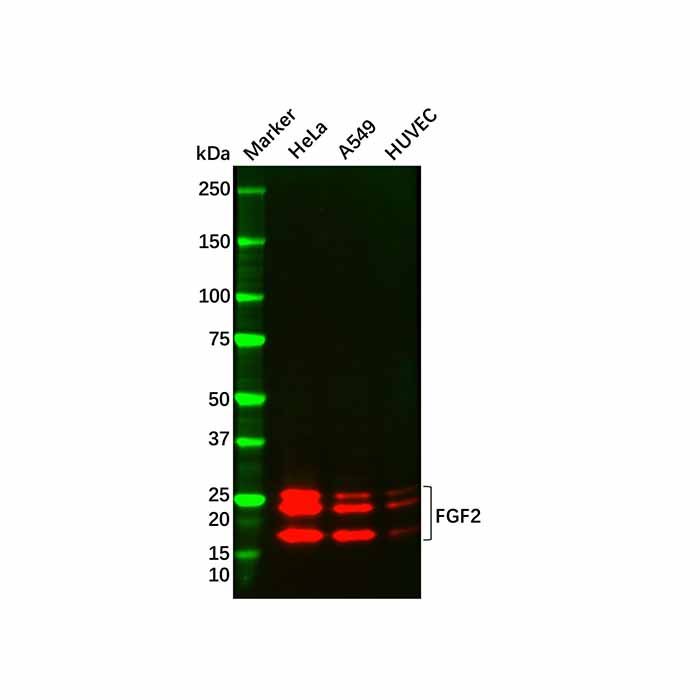
Recombinant FGF2 Antibody (Ab007066) - Western Blot
All lanes: Recombinant FGF2 Antibody (Ab007066) at 1/1000 dilution
Samples: Lysates at 20 µg per lane
Secondary: Goat Anti-Rabbit IgG H&L (HRP) (Ab170144) at 1/20000 dilution

Predicted band size: 18, 20, 22, 24 kDa
Observed band size: 18,2 2, 25 kDa
Exposure time: 8.0 s

Recombinant FGF2 Antibody (Ab007066) - IHC
Immunohistochemistry (Formalin/PFA-fixed paraffin-embedded sections) analysis of human prostate tissue sections labeling FGF2 with purified Recombinant FGF2 Antibody (Ab007066). Heat mediated antigen retrieval was performed.

Recombinant FGF2 Antibody (Ab007066) - IF/ICC
 IF analysis of Recombinant FGF2 Antibody (Ab007066) in HeLa cells. The cells were fixed with 4% PFA for 10 minutes, permeabilized with 0.3% Triton X-100 (I743383) for 10 minutes and then blocked with 5% BSA for 1 hour at room temperature. Cells were stained with Recombinant FGF2 Antibody (Ab007066) at 1/200 dilution in blocking buffer overnight at 4°C, and then incubated with Goat Anti-Rabbit IgG H&L (AF488) (Ab181954) at a dilution of 1/1000 for 1 hour at room temperature in the dark (green). Cells were counterstained with DAPI (D1372407) (blue).
Anwendung
Anwendung
Dilution info
IHC

1/100 - 1/200

WB

1/1000 - 1/10000

IF/ICC

1/200

ELISA

1/200

IP

1/10 - 1/100

Documentation

📋 Safety Data Sheet (SDS)

Comprehensive hazard, handling, storage, and regulatory compliance document.

Download SDS →

✅ Certificate of Analysis (COA)

Lot-specific quality data. Enter your lot number to retrieve the exact COA.

Look up COA →

📊 Datasheet

Quick-reference summary of product specifications and applications.

View datasheet →

🔬 Specification Sheet

Full quality attributes and acceptance criteria for this grade.

View spec sheet →

Advanced Data

Zugehörige Ziele (menschlich)
FGF2 Tchem Fibroblast growth factor 2 (0 Activities)
Activity TypeActivity Value -log(M)Mechanism of ActionActivity ReferencePublications (PubMed IDs)
Wirkungsmechanismen
Zertifikate (CoA, COO, BSE/TSE und Analyse-Diagramm)
C of A & Other Certificates(BSE/TSE, COO):
Analytical Chart:

Find and download the COA for your product by matching the lot number on the packaging.

3 results found

Lot NumberCertificate TypeDatumArtikel
ZJ23F0800911Certificate of AnalysisSep 10, 2026 Ab007066
ZJ23F0800912Certificate of AnalysisSep 10, 2026 Ab007066
ZJ24F0911340Certificate of AnalysisApr 07, 2026 Ab007066
FAQs und Artikel
Immunoprecipitation (IP) lysates and reagents
Immunohistochemical staining protocol for frozen samples (IHC-Fr)
Immunohistochemistry (IHC) staining antigen retrieval protocol
General Immunoprecipitation Protocol
RNA Immunoprecipitation (RIP) Protocol
Immobilized IP Protocol
The Fibroblast Development Factor (FGF) Family
Angiogenic Factors: Molecular Classes, Regulatory Mechanisms, and Experimental as Well as Translational Applications
Key Nodes and Representative Mechanisms in Angiogenic Regulatory Networks: A Structured Review
Ligand Systems, Receptor Activation, and Biological Effects of the FGF Pathway
Lösungsrechner
Bewertungen

Kundenbewertungen

Application Protocols

Tested applications, recommended dilutions, and positive controls for this SKU are Not specified for this item; refer to the CoA/Spec Sheet. The following are general, non-item-specific starting frameworks to aid initial setup—final conditions must be empirically optimized.

  • Western blot (general): Prepare samples under reducing/denaturing conditions; transfer to PVDF or nitrocellulose. Block with 5% BSA or milk in TBS-T. Incubate with primary at an empirically determined dilution, then HRP- or fluorophore-conjugated secondary. Include recombinant FGF2 as a positive control and isotype/no-primary controls for background assessment.
  • ELISA (general): Coat plates with capture antibody (if using this product as capture, confirm epitope and pairing). Block, add standards/samples, then detect with orthogonal anti-FGF2 antibody or labeled secondary. Generate a 4PL standard curve using recombinant FGF2.
  • IF/IHC (general): Optimize fixation (PFA) and antigen retrieval (citrate pH 6 or Tris-EDTA pH 9). Use appropriate secondary antibodies and counterstains. Include tissue known to express FGF2 as a positive control.
  • IP/Co-IP (general): Couple antibody to Protein A/G beads; incubate with lysate under gentle conditions. Wash stringently and elute for analysis by WB or MS.

Important: Do not treat these as validated conditions for Ab007066. Always consult the CoA and perform pilot titrations.

Biological Roles

This tab describes the biology of the target (FGF2) for experimental context. It does not imply therapeutic use.

  • FGF2 overview (literature): Fibroblast growth factor 2 (basic FGF) is a pleiotropic growth factor in the FGF family. It binds FGFR1–4 and heparan sulfate proteoglycans, forming signaling complexes at the cell surface. Alternative translation produces multiple isoforms with distinct localization (low–high molecular weight forms).
  • Key cellular processes (literature):
    • Mitogenic signaling via MAPK/ERK and PI3K/AKT pathways.
    • Regulation of angiogenesis, extracellular matrix remodeling, and wound-healing programs.
    • Stem/progenitor cell maintenance and differentiation context-dependent cues.
    • Neurotrophic support and synaptic plasticity roles in the nervous system.
  • Biochemical features (literature):
    • Strongly heparin-binding; activity and stability are modulated by ionic strength and sulfation patterns of glycosaminoglycans.
    • Secreted and ECM-associated; can be sequestered in basement membranes, released upon tissue remodeling.
  • Experimental implications:
    • Matrix composition (heparin/heparan sulfate) can mask or enhance detection; include competition controls (heparin or recombinant FGF2) to probe specificity.
    • Multiple isoforms may yield bands at distinct apparent molecular weights in Western blot; verify isoform specificity with blocking peptide or orthogonal antibodies when necessary.

Target specificity details for this SKU (clone, epitope, species reactivity) are Not specified for this item; consult the CoA/Spec Sheet to align assay design with the antibody’s validated reactivity profile.

Buffer Applications

Buffers are central to antibody performance. Item-specific formulation is Not specified; use the following general practices and optimize for your assay.

  • Common working buffers:
    • Diluent: PBS or TBS, pH 7.2–7.6; include 0.05% Tween-20 to reduce nonspecific binding in ELISA/WB.
    • Blocking: 1–5% BSA, casein, or serum (species matched to secondary antibody) to minimize background. Avoid blockers containing the antigen or structurally related proteins.
    • Wash: PBS/TBS + 0.05–0.1% Tween-20; increase salt (up to 300–500 mM NaCl) to suppress low-affinity interactions.
    • Storage (short-term): Working dilutions kept on ice during use; discard at end of day to prevent microbial growth unless preservative is present (preservatives for this item are Not specified).
  • IHC-specific notes:
    • Antigen retrieval can unmask FGF2 epitopes; test citrate buffer pH 6.0 vs Tris-EDTA pH 9.0. Optimize temperature/time to preserve tissue morphology.
    • Include heparin (e.g., 5–50 µg/mL) in buffers during incubations if matrix sequestration reduces accessibility; titrate to avoid interference.
  • IF/WB notes:
    • For WB, choose transfer buffer compatible with your membrane (PVDF vs nitrocellulose). For IF, use isotonic buffers to maintain cell/tissue integrity.

Ensure buffer components do not quench detection (e.g., azide inhibits HRP). Item-specific recommendations are Not specified for this item; refer to CoA/Spec Sheet.

Green Alternatives

Although antibodies are not classical solvents or synthetic reagents, sustainability principles still apply to their use and logistics.

  • Storage and shipping footprint:
    • This item ships with ice pads rather than dry ice per product data—reducing CO2 emissions from dry-ice sublimation and minimizing hazardous shipment classifications.
    • Consolidate orders and coordinate delivery to limit repeated cold-chain shipments.
  • Longevity to reduce waste:
    • Prepare small aliquots to avoid freeze–thaw–induced degradation and disposal of compromised material.
    • Use validated, low-binding plastics to minimize losses at low concentrations.
  • Buffer choices (general):
    • Favor readily biodegradable, low-toxicity buffers (PBS/TBS) and avoid azide where not required; if preservation is needed, explore gentler alternatives compatible with your assays (check local EHS guidance). Preservatives for this item are Not specified.
  • Process efficiency:
    • Right-size assays and adopt miniaturized formats (e.g., 96- or 384-well ELISA) to reduce reagent volume and plastic waste.
    • Reuse secondary containers and cold packs when allowed by institutional policy.

Trade-offs: Preservatives (e.g., azide) prolong shelf life but complicate waste handling; glycerol enables −20°C storage without freezing yet increases mass and viscosity. Balance stability versus environmental impact within your QA requirements. Item-specific formulation details are Not specified; consult the CoA before altering storage conditions.

Pharmaceutical Uses

This product is for research use only and is not intended for human or veterinary use, diagnostics, or as a therapeutic.

Relevant non-clinical, laboratory roles in pharmaceutical/bioprocess settings (general):

  • Analytical reagent for process development and QC of recombinant FGF2 (e.g., ligand-binding assays, ELISA for in-process concentration monitoring), provided the antibody’s affinity and specificity are appropriate. Suitability for such assays is Not specified for this item; verify with CoA.
  • Characterization of cell-culture supernatants and conditioned media where FGF2 is produced or supplemented, including stability studies under different buffer/excipient conditions.
  • Reagent in pharmacological mechanism-of-action research models to quantify pathway modulation downstream of FGFR engagement (e.g., measuring FGF2 levels in response to perturbations). No therapeutic or diagnostic claims are implied.
  • Capture/affinity step in research-scale immunoaffinity enrichment prior to LC–MS quantitation of FGF2 or binding-partner mapping, after verifying minimal cross-reactivity.

Compliance and documentation:

  • For regulated workflows, request documentation on recombinant production, lot traceability, and any available QC attributes (purity, residual HCP/DNA, endotoxin) to support risk assessments. These attributes are Not specified for this item; refer to CoA/Spec Sheet.
  • Establish in-house reference standards and bridging studies when changing lots to maintain method comparability.
Physical Properties

Item-specific physicochemical specifications are not provided in the product data. Relevant general properties for recombinant antibodies are summarized for context.

  • Appearance: Not specified for this item; refer to CoA/Spec Sheet.
  • Molecular weight: Not specified for this item; typical full-length IgG ~150 kDa (literature).
  • Isoelectric point (pI): Not specified; antibodies commonly span pI ~6–9 depending on isotype/sequence (literature).
  • Solubility: High solubility in aqueous buffers (PBS, TBS) at neutral pH; avoid extreme pH and high ionic detergents unless validated (general practice).
  • Extinction coefficient (A280): Not specified; protein quantitation typically uses isotype- or sequence-derived ε280 (literature). Use item-specific coefficient if supplied on CoA.
  • Stabilizers/excipients: Not specified for this item; refer to CoA/Spec Sheet.
  • Formulation/buffer: Not specified for this item; refer to CoA/Spec Sheet.
  • Sterility/endotoxin: Not specified for this item; refer to CoA/Spec Sheet.
  • Aggregation state: Not specified; evaluate by SEC or DLS if critical to your application (general guidance).

Handling implications (general): Protein stability is enhanced by neutral pH buffers, low ionic strength to moderate salt (e.g., 150 mM NaCl), addition of carrier protein (e.g., 0.1–1% BSA) or sugar polyols, and by minimizing freeze–thaw. Always verify any additives are compatible with your downstream assay (e.g., avoid BSA/azide for cell-based activity assays).

Quality and Grades

Item-specific quality designations from Product Data: Recombinant, ExactAb™, Validated, High Performance.

  • Recombinant: Produced from a defined sequence in a controlled expression system, enabling lot-to-lot consistency versus animal-derived polyclonals. Benefits include reproducibility, scalability, and reduced batch variability. Sequence and isotype are Not specified for this item; refer to CoA/Spec Sheet.
  • ExactAb™: Branded indication of engineered/recombinant manufacture intended to deliver precise epitope targeting and consistent performance. Functional meaning in your lab: expect minimal drift across lots and compatibility with quantitative workflows when properly validated in-house.
  • Validated: Indicates the manufacturer has performed application-relevant testing. Specific validated applications, host/species reactivity, and performance metrics are Not specified for this item; refer to CoA/Spec Sheet. Users should perform fit-for-purpose validation under their own assay conditions.
  • High Performance: Marketing-grade descriptor implying strong signal-to-noise and robust binding under recommended conditions. Because exact metrics (KD, affinity, WB/IHC/ELISA data) are not provided here, rely on the CoA/datasheet for binding and application details.

What this means for you:

  • Expect reproducible behavior across lots due to recombinant manufacture.
  • Request or consult the CoA for: concentration, purity (SDS-PAGE), residual host-cell proteins/DNA, endotoxin (if using in cell assays), buffer composition, preservative, and any stabilizers.
  • Record lot numbers and retain small aliquots for internal benchmarking to leverage the consistency advantage of recombinant antibodies.
Reaction and Applications

As an affinity reagent, the Recombinant FGF2 Antibody enables selective detection, capture, or modulation of FGF2 (basic FGF) in research workflows rather than serving as a reactant in chemical synthesis.

Common research applications (general guidance):

  • Immunoassays: ELISA (coating or detection), sandwich ELISA with orthogonal anti-FGF2 pairs; verify non-overlapping epitopes when pairing capture/detector antibodies.
  • Blotting: Western blot for FGF2 isoforms; optimize denatured vs native conditions depending on epitope conformation.
  • Immunofluorescence/Immunohistochemistry: Fixation/permeabilization strategy influences epitope accessibility; titrate antibody and adjust antigen retrieval for tissue sections.
  • Immunoprecipitation/Co-IP: Capture endogenous or recombinant FGF2 from lysates; use gentle lysis buffers to preserve interactions if probing complexes.
  • Neutralization/blocking assays: Assess functional blockade of FGF2–FGFR interactions in cell systems; requires careful titration and robust controls. Suitability of this specific item for neutralization is Not specified.

Practical tips:

  • Validate linear range and dynamic window for each matrix (cell lysate, conditioned media, serum-free media) due to variable FGF2 abundance and binding partners (heparan sulfate).
  • Include reagent and matrix controls (isotype control, no-primary, competition with recombinant FGF2) to confirm specificity.
  • FGF2 is heparin-binding; salt and heparin in buffers can modulate apparent binding. Screen ionic strength if signal is low or nonspecific.

Application claims for this specific SKU are Not specified; consult the datasheet/CoA to confirm supported techniques and conditions.

Reaction Conditions

Not directly applicable—this product is an antibody reagent, not a substrate or catalyst in chemical reactions. However, conditions for optimal binding in immunoassays can be considered in lieu of reaction parameters (general guidance):

  • Temperature: Incubations commonly at room temperature (20–25°C) or 4°C overnight to enhance binding specificity. Optimize for your matrix.
  • Time: Primary antibody incubations range from 1–2 h (RT) to 12–18 h (4°C) depending on assay format and antigen abundance.
  • pH/Ionic strength: Near-neutral pH (7.2–7.6) with 100–300 mM NaCl generally balances specificity and solubility. Heparin/heparan sulfate in samples can alter FGF2 availability—consider ionic-strength titrations.
  • Detergents/blockers: 0.05–0.1% Tween-20 in wash buffers to suppress nonspecific binding; protein blockers (BSA, casein) tailored to detection scheme.
  • Expected signal: Highly assay- and matrix-dependent; establish standard curves with recombinant FGF2 and include competition controls to characterize dynamic range.

Item-specific validated conditions (e.g., tested dilutions, matrices, species reactivity, KD) are Not specified for this item; refer to CoA/Spec Sheet. Always run pilot titrations to map the working window in your platform.

Safety and Handling
  • GHS classification, signal word, pictograms, H-statements: Not specified for this item; refer to SDS for authoritative safety information.
  • General hazard profile (proteins, literature/guidance): Recombinant antibodies are typically considered low hazard for laboratory use but may cause irritation or allergic reactions in sensitized individuals. Contains biological material—handle using good microbiological practices.
  • PPE: Laboratory coat, gloves (nitrile), and safety glasses recommended. Use in a clean area designated for protein handling to prevent contamination.
  • First aid (general): If skin contact occurs, wash with soap and water. If eye contact, rinse thoroughly with water for several minutes. If inhaled (aerosols), move to fresh air. If ingested, rinse mouth and seek medical advice. Always follow your institution’s EHS procedures.
  • Handling precautions:
    • Avoid generation of aerosols and splashes; centrifuge briefly before opening vials to collect contents.
    • Use sterile, low-protein-binding tips/tubes if sterility or concentration is critical.
    • Sodium azide (if present in formulation; Not specified for this item) is toxic and may form explosive metal azides in plumbing—dispose of according to SDS.
  • Incompatibilities (general): Avoid strong oxidants, extreme pH (<5 or >9) unless validated, organic solvents, and repeated freeze–thaw cycles.
  • Waste: Dispose according to local regulations for laboratory biological/chemical waste; decontaminate surfaces with appropriate disinfectant.
  • Shipping: Shipped in an ice chest with ice pads per product data. Inspect upon receipt; if warm, place immediately at the recommended storage temperature and assess integrity before use.
Solvent Selection

This product is an aqueous protein reagent, not an organic-solvent solute. “Solvent selection” is best interpreted as choosing appropriate biological buffers and diluents.

  • Primary diluents (general practice):
    • PBS, pH ~7.2–7.4 or TBS, pH ~7.4 for most immunoassays.
    • Additives often used to enhance stability and reduce nonspecific binding: 0.05–0.1% Tween-20 (for wash buffers), 0.1–1% BSA or casein (for blocking/dilution; avoid if interfering with detection), 10–50% glycerol for frozen storage. Additives for this specific item are Not specified; confirm compatibility with your application.
  • Compatibility notes:
    • Avoid strong denaturants (e.g., 6 M guanidine, 8 M urea) unless the assay requires them.
    • For enzyme-conjugate workflows, avoid azide if peroxidase activity is needed (azide inhibits HRP). Preservative content for this item is Not specified.
  • When to choose PBS vs TBS (general):
    • PBS: widely used; may enhance background with phospho-epitopes or phosphate-sensitive interactions.
    • TBS: preferred where phosphate interferes with binding or in alkaline phosphatase detection systems.
  • Low-protein-binding plastics and pre-blocked surfaces help maintain effective concentration at low antibody dilutions.

Bottom line: Select a neutral aqueous buffer matched to your assay chemistry; verify any excipients against your detection scheme. Item-specific formulation and recommended diluents are Not specified for this item; refer to CoA/Spec Sheet.

Storage and Reconstitution
  • Storage conditions (product data): Store at −20°C. Avoid repeated freezing and thawing.
  • Shipping: Shipped in an ice chest with ice pads (product data). Inspect upon receipt and transfer promptly to −20°C.
  • Formulation and concentration: Not specified for this item; refer to CoA/Spec Sheet.
  • Reconstitution: If lyophilized or concentrated stock requires dilution, use sterile, neutral pH buffer (PBS or TBS). Specific reconstitution instructions for this SKU are Not specified; follow CoA guidance.
  • Aliquoting (general best practice):
    • Prepare small, single-use aliquots in low-protein-binding tubes to prevent activity loss from freeze–thaw cycles.
    • For storage at −20°C, consider adding sterile glycerol to achieve 40–50% v/v so the solution remains unfrozen; confirm compatibility with your assays. Do not add glycerol if contraindicated on the CoA.
  • Short-term handling: Keep on ice during use. Avoid prolonged exposure at room temperature.
  • Stability: Exact shelf-life and stability in working buffers are Not specified for this item; refer to CoA/Spec Sheet. If preservative-free, prepare fresh working solutions and discard after use to prevent microbial growth.
  • Compatibility cautions: Remove or exchange out amine-containing buffers (e.g., Tris) and carrier proteins before conjugation chemistries. If sodium azide is present (Not specified), avoid HRP-based detection and follow proper disposal procedures.

Always defer to the product’s CoA/Spec Sheet and SDS for item-specific instructions and safety information.

Structure and Identity

Recombinant FGF2 Antibody is a protein-based affinity reagent that binds fibroblast growth factor 2 (FGF2, basic FGF). As a recombinant immunoglobulin, it consists of immunoglobulin domains stabilized by disulfide bonds. Specific sequence, isotype, and clonality are not provided for this catalog item.

  • Molecular formula: Not applicable to proteins of undefined sequence length; Not specified for this item; refer to CoA/Spec Sheet.
  • Molecular weight: Not specified for this item; refer to CoA/Spec Sheet. Typical IgG is ~150 kDa (literature).
  • SMILES: Not applicable for proteins; Not specified for this item.
  • InChIKey: Not applicable for proteins; Not specified for this item.
  • Structural features (general, literature):
    • Two heavy chains and two light chains (if IgG format), each with variable (V) and constant (C) domains.
    • Antigen-binding fragments (Fabs) confer specificity to FGF2; Fc region mediates effector functions (isotype-dependent).
    • Disulfide bonds link heavy–heavy and heavy–light chains; N-glycosylation may be present depending on expression host.
  • 2D description in words: Y-shaped macromolecule with two identical antigen-binding sites at the tips of flexible Fab arms; a stem (Fc) formed by paired heavy-chain constant domains. Epitope and paratope sequences are not specified for this item.

Notes: Precise amino acid sequence, isotype (e.g., IgG1, IgG2a), clonality (mono-/polyclonal), host species, and recombinant expression system are Not specified for this item; refer to CoA/Spec Sheet.

Synthetic Utility

Not typically applicable. As a protein affinity reagent, the Recombinant FGF2 Antibody is not used as a building block or reagent in classical organic/inorganic synthesis.

Practical redirection:

  • If your goal is to conjugate the antibody (e.g., to enzymes, fluorophores, or solid supports), standard bioconjugation chemistries apply (general guidance):
    • Amine-targeted NHS esters (labels added to lysines); requires pH ~8.3 buffers free of primary amines (avoid Tris).
    • Thiol-targeted maleimides after controlled reduction or 2-iminothiolane derivatization; maintain pH ~6.5–7.5 to preserve site selectivity.
    • Site-directed methods (e.g., Protein A/C–directed Fc conjugation, enzymatic tags) for improved lot-to-lot uniformity.
  • For solid-phase capture, couple to activated agarose or magnetic beads via NHS or epoxy chemistries; test orientation and capacity to maintain FGF2-binding activity.

Note: Conjugation readiness (buffer composition, presence of amines, carrier proteins, or azide) for this specific SKU is Not specified; perform buffer exchange/desalting before derivatization as needed and confirm with the CoA/Spec Sheet.

Target Specificity

Only information explicitly supported by the product data is listed here.

  • Antigen/Target: FGF2 (basic fibroblast growth factor).
  • Epitope: Not specified for this item; refer to CoA/Spec Sheet.
  • Clone/Clonality: Not specified for this item; refer to CoA/Spec Sheet.
  • Isotype: Not specified for this item; refer to CoA/Spec Sheet.
  • Host/Expression system: Recombinant (product data). Specific host system is Not specified.
  • Species reactivity (human/mouse/rat, etc.): Not specified for this item; refer to CoA/Spec Sheet.
  • Cross-reactivity: Not specified for this item; refer to CoA/Spec Sheet.

Notes: For paired-assay designs (e.g., sandwich ELISA), verify that capture and detection antibodies recognize non-overlapping epitopes on FGF2. Always confirm species reactivity and matrix compatibility with the datasheet before use.

Need help choosing the grade?

Our grade selection guide covers purity, stabilizer status, and application suitability for all variants in our catalog.

View Recombinant grade guide → View Validated grade guide → View ExactAb™ grade guide → View High Performance grade guide →

Verwandte Produkte

Goat Anti-Rabbit IgG H&L Antibody - Sekundärantikörper, for ELISA,LF,GICA various applications, from Rabbit, generated in Goat
Goat Anti-Rabbit IgG H&L (AF594) - Sekundärantikörper, IgG
Goat Anti-Rabbit IgG H&L (Biotin) - Sekundärantikörper, IgG
Goat Anti-Rabbit IgG H&L (AF488) - Sekundärantikörper, IgG
Goat Anti-Rabbit IgG H&L (AF405) - Sekundärantikörper, IgG
Donkey Anti-Rabbit IgG H&L (AF647) - Sekundärantikörper, specific to , IgG
Donkey Anti-Rabbit IgG H&L (Biotin) - Sekundärantikörper, IgG
Goat Anti-Rabbit IgG H&L (HRP) - Sekundärantikörper
Goat Anti-Rabbit IgG H&L Antibody - Sekundärantikörper, Goat IgG
Goat Anti-Rabbit IgG H&L (Biotin) - Sekundärantikörper
Goat Anti-Rabbit IgG H&L (Cy5) - Sekundärantikörper
Goat Anti-Rabbit IgG H&L (FITC) - Sekundärantikörper
Goat Anti-Rabbit IgG H&L (TRITC) - Sekundärantikörper
Goat Anti-Rabbit IgG H&L (Biotin) - Sekundärantikörper, Goat IgG
Goat Anti-Rabbit IgG H&L (HRP) - Sekundärantikörper, Goat IgG
Goat Anti-Rabbit IgG H&L (Cy5) - Sekundärantikörper, Goat IgG
Goat Anti-Rabbit IgG H&L (TRITC) - Sekundärantikörper, Goat IgG
Goat Anti-Rabbit IgG H&L (FITC) - Sekundärantikörper, Goat IgG
Goat Anti-Rabbit IgG H&L (PE) - Sekundärantikörper, Goat IgG
Goat Anti-Rabbit IgG H&L (APC) - Sekundärantikörper, Goat IgG
Goat Anti-Rabbit IgG H&L (AF647) - Sekundärantikörper, Goat IgG
Goat Anti-Rabbit IgG H&L (AF405) - Sekundärantikörper, Goat IgG
Goat Anti-Rabbit IgG H&L (AF555) - Sekundärantikörper, Goat IgG
Recombinant FGF2 Antibody - Primärer Antikörper, specific to FGF2, Rabbit IgG
Goat Anti-Rabbit IgG H&L (AF546) - Sekundärantikörper, specific to Rabbit IgG
Goat Anti-Rabbit IgG H&L (AF700) - Sekundärantikörper, specific to Rabbit IgG
Goat Anti-Rabbit IgG H&L (AF488) - Sekundärantikörper
Goat Anti-Rabbit IgG H&L (AF647) (Ready to use) - Sekundärantikörper, specific to Rabbit IgG

Shall we send you a message when we have discounts available?

Remind me later

Thank you! Please check your email inbox to confirm.

Oops! Notifications are disabled.