QUALITÄT & REINHEITAnimal Free?Animal-free — produced without animal-derived components to reduce contamination risk. Use in biomanufacturing and culture avoiding animal-origin material.Carrier Free?Carrier-free — supplied without added carrier protein/stabilizer. Use when carriers (e.g. BSA) would interfere with conjugation or sensitive assays.Bioactive?Bioactive grade — verified to retain biological activity in functional assays. Use when the molecule must be functionally active, not just pure.ActiBioPure™?ActiBioPure™ — Aladdin's premier line for bioactive and recombinant products. Use when both high purity and preserved biological activity are required.Azide Free?Azide-free — without sodium azide preservative. Use in conjugations, cell work, or assays where azide is toxic or inhibitory.High Performance?High-performance grade with optimized purity and performance characteristics. Use for sensitive analyses where ordinary grades fall short.≥95%(SDS-PAGE)
Accession #
P05230
Protein Tag
No tag
Expression system
E. coli
Endotoxin Concentration
<0.1 EU/μg
Bioactivity
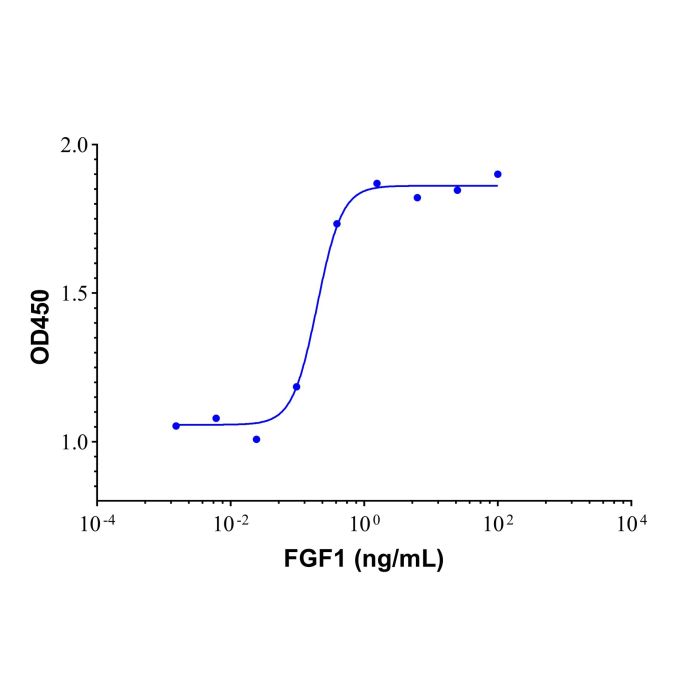
Measured in a cell proliferation assay using BALB/3T3 mouse embryo fibroblasts cell line in the presence of heparin. The ED₅₀ for this effect is typically <0.5ng/mL.
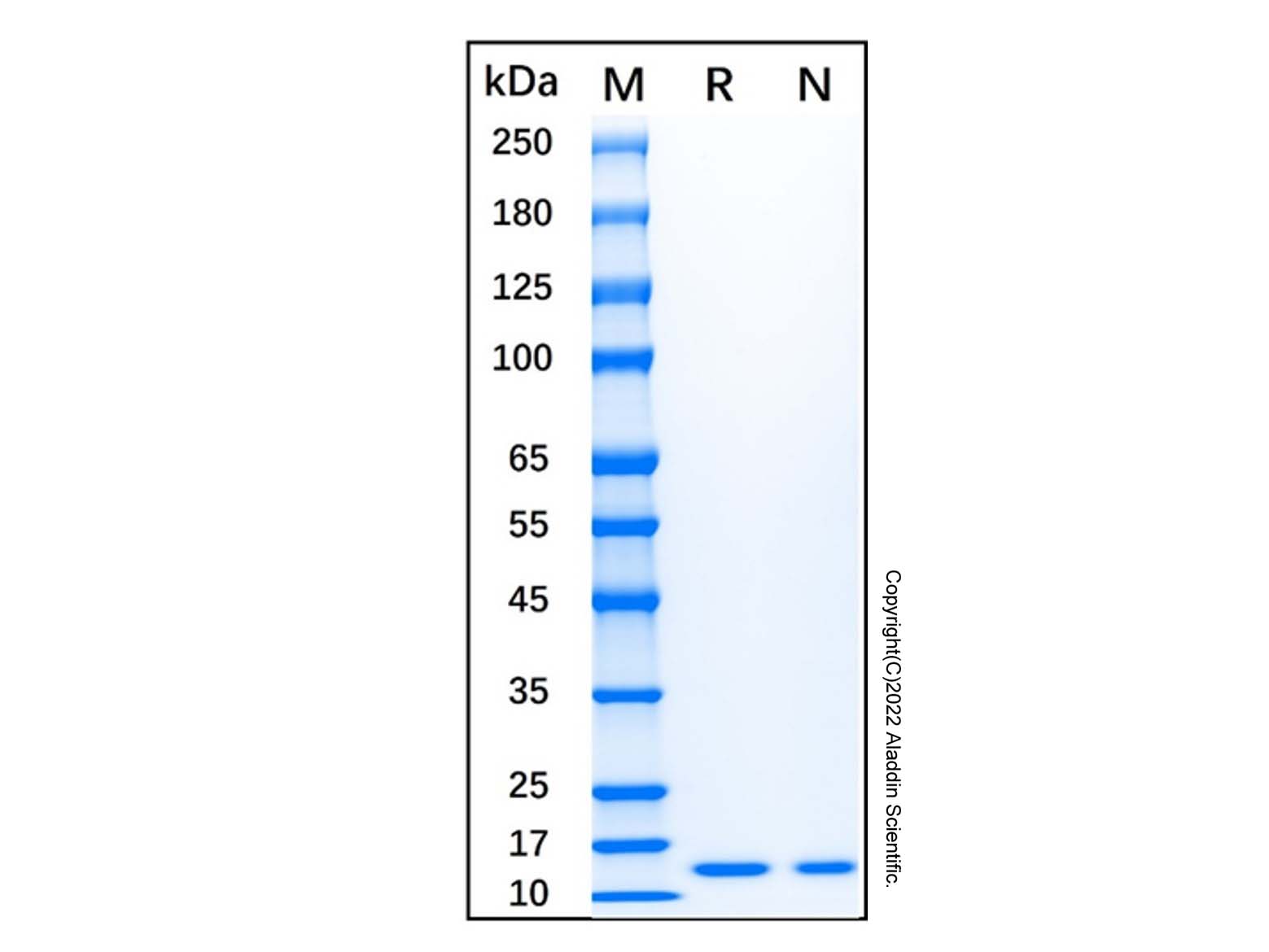
>95% as determined by SDS-PAGE and Coomassie blue staining
Function
The heparin-binding fibroblast growth factors play important roles in the regulation of cell survival, cell division, angiogenesis, cell differentiation and cell migration. They are potent mitogens in vitro.
Sequence similarities
Belongs to the heparin-binding growth factors family.
Cellular localization
Secreted. Cytoplasm. Cytoplasm > cell cortex. Lacks a cleavable signal sequence. Within the cytoplasm, it is transported to the cell membrane and then secreted by a non-classical pathway that requires Cu(2+) ions and S100A13. Secreted in a complex with SYT1.
Spezifikationen
Product Name
Recombinant human FGF1 protein, >95% SDS-PAGE
Synonyme
FGF-1 | HBGF-1 | Heparin-binding growth factor 1
Note
ActiBioPure™, Animal Free, Azide Free, Bioactive, Carrier Free, High Performance
Measured in a cell proliferation assay using BALB/3T3 mouse embryo fibroblasts cell line in the presence of heparin. The ED₅₀ for this effect is typically <0.5ng/mL.
After receiving lyophilized powder protein, centrifuge first, and then r econstitute at 100µg/mL in sterile PBS.
Storage
Store at -20°C
Verschickt in
Ice chest + Ice pads
Stabilität und Lagerung
Stable for 12 months from the date of receipt of the product under proper storage andhandling conditions. Avoid repeated freeze-thaw cycles.
Bilder
Recombinant Human FGF1 Protein (rp145907)-Protein Bioactivity Measured in a cell proliferation assay using BALB/3T3 mouse embryo fibroblasts cell line in the presence of heparin. The ED50 for this effect is typically <0.5ng/mL.
Recombinant Human FGF1 Protein (rp145907)-SDS-PAGE 3μg/lane of Recombinant Human FGF1 was resolved with SDS-PAGE under reducing (R) and non-reducing (N) conditions and visualized by Coomassie® Blue staining, showing a single band at 13.3 kDa.
Erweiterte Daten
Zertifikate (CoA, COO, BSE/TSE und Analyse-Diagramm)
C of A & Other Certificates(BSE/TSE, COO):
Analytical Chart:
Find and download the COA for your product by matching the lot number on the packaging.
Determine the necessary mass, volume, or concentration for preparing a solution.
Dilution Calculator
Determine the dilution needed to prepare a stock solution.
Reconstitution Calculator
Bewertungen
Kundenbewertungen
Application Protocols
Item-specific, tested application details (e.g., cell types, assay formats, recommended concentrations, or positive controls) are not specified for this item; refer to CoA/Spec Sheet.
General planning guidance (non-prescriptive)
Define your assay endpoint (e.g., pERK/pAKT by Western blot or ELISA, cell proliferation) and select an appropriate time course.
Establish a dose–response curve spanning sub-nanomolar to tens of nanomolar ligand levels as appropriate for your model; optimize in the presence/absence of heparin.
Use serum-starvation or defined media to reduce background signaling when measuring acute receptor activation.
Include controls: vehicle, heparin-only, and known FGFR inhibitors where mechanistic validation is desired.
These are general considerations; they are not validated protocols for this SKU.
FGF1 is a prototypical member of the fibroblast growth factor family that acts as a potent, heparan sulfate–dependent agonist of FGFR1–4. Upon binding to FGF receptors and heparan sulfate proteoglycans (HSPGs), FGF1 promotes receptor dimerization and transphosphorylation.
Signaling: Triggers Ras–MAPK/ERK, PI3K–Akt, and PLCγ pathways, driving gene-expression programs associated with cell-cycle entry, survival, cytoskeletal remodeling, and metabolism.
Contextual roles: Functions as a broad-spectrum mitogen in many mesenchymal and epithelial cell types; can influence angiogenic processes in vitro and modulate extracellular matrix interactions through HSPG binding.
Intracrine/nuclear aspects: FGF1 has been reported to translocate to the nucleus under certain conditions via noncanonical pathways, potentially influencing cell cycle and stress responses.
Specificity and modulators: Heparin/heparan sulfate chain length and sulfation pattern strongly affect affinity and signaling output; co-receptors and FGFR splice variants (IIIb/IIIc) shape cellular responses.
Research significance
Widely used as a positive control for FGFR activation, in pathway mapping, phosphoproteomics, and studies of glycosaminoglycan-dependent signaling. Also valued for engineering receptor/ligand variants and evaluating FGFR-targeted tools.
Note: All roles described above are research contexts; no clinical or therapeutic claims are made.
Buffer Applications
This product is a recombinant protein and is not itself a buffering agent.
Practical buffer considerations for use (general guidance; not item-specific specifications)
Reconstitution/dilution is typically performed in physiological aqueous buffers (e.g., PBS or Tris-based) adjusted to neutral pH. Specific buffer composition and recommended excipients for this item are not specified; refer to CoA/Spec Sheet.
To minimize adsorption and preserve activity at low concentrations, many laboratories include carrier proteins (e.g., HSA/BSA) or stabilizers (e.g., trehalose, low levels of nonionic surfactant) when compatible with downstream assays.
Heparin can modulate FGF1–FGFR complex stability; inclusion for certain assays may be beneficial but should be empirically optimized.
If you require defined buffer recipes or validated formulations for this SKU, consult the CoA/Spec Sheet or contact technical support.
Green Alternatives
Green-chemistry framing is not directly applicable to a recombinant protein reagent; however, sustainability and safety considerations can still guide selection and use.
Animal Free production: Reduces reliance on animal-derived raw materials, aligning with ethical sourcing and potentially reducing bioburden variability compared with animal-origin components.
Azide Free: Eliminates sodium azide, a hazardous preservative, improving compatibility with live-cell assays and reducing toxic waste. Note that aseptic handling is required to maintain product integrity.
Carrier Free: Minimizes unnecessary excipients, allowing users to tailor minimal, fit-for-purpose formulations and reduce material use.
Operational greener practices
Prepare small aliquots to minimize waste from freeze–thaw–induced losses.
Use right-sized reaction vessels and low-binding plastics to reduce overage.
Dispose of protein-containing buffers according to local regulations; avoid introducing azide-containing solutions into waste streams.
Pharmaceutical Uses
No therapeutic or clinical use is claimed or supported for this product. For research use only.
Relevant non-clinical/pharmaceutical development contexts (literature/general)
Reference reagent in analytical development: Ligand for establishing and qualifying FGFR-binding assays (e.g., ELISA, SPR/BLI) and downstream phosphorylation readouts used in method development.
Process and formulation development research: Model protein for studying glycosaminoglycan-mediated stabilization, excipient screening, and aggregation/adsorption behaviors in biophysical assays.
Cell-based potency assays: Positive control ligand when developing bioassays for FGFR-targeted biologics.
Item-specific pharmacopeial or compendial status
Not specified for this item; refer to CoA/Spec Sheet for any compendial references if applicable.
Physical Properties
Item-specific properties
Appearance: Not specified for this item; refer to CoA/Spec Sheet.
Extinction coefficient, isoelectric point, solubility, buffer composition: Not specified for this item; refer to CoA/Spec Sheet.
Literature/general values (for context; not item specifications)
Typical apparent MW: ~15–18 kDa by SDS-PAGE for mature human FGF1 constructs, depending on sequence boundaries and tags.
Isoelectric point (pI): Reported acidic-to-neutral range, commonly pI ~5–6 for mature human FGF1 variants, sequence/construct dependent.
Solubility: Readily soluble in physiological aqueous buffers (e.g., PBS, Tris) with added stabilizers or carrier proteins to minimize adsorption and aggregation; heparin can modulate solution behavior. Stability can be salt- and pH-dependent.
Aggregation propensity: As for many growth factors, low-micromolar concentrations and absence of carrier proteins can promote surface adsorption/aggregation; gentle handling and low protein-binding plastics are recommended.
Thermal/processing sensitivity: Bioactivity is conformational; avoid elevated temperatures, vigorous mixing, and repeated freeze–thaw cycles to preserve tertiary structure.
Storage-related property (from Product Data)
Storage temperature: -20°C. Maintain frozen until use; see Storage & Reconstitution tab for handling guidance.
Animal Free: Manufactured without animal-derived components, supporting workflows that avoid adventitious animal contaminants.
Carrier Free: Supplied without carrier proteins (e.g., BSA, HSA). Advantages include precise mass balance and compatibility with sensitive assays; users may add a carrier upon reconstitution to improve stability and minimize adsorption.
Bioactive: Each lot is qualified for functional activity (assay details not specified here); ensures receptor-agonist function consistent with FGF1 biology.
ActiBioPure™: Aladdin Scientific performance designation indicating high activity and purity suitable for demanding research applications. Specific assay metrics are not provided here.
Azide Free: No sodium azide preservative; beneficial for cell-based assays and enzyme systems that are azide-sensitive.
High Performance: Indicates elevated purity and performance characteristics appropriate for advanced research; exact purity percentages or residuals are not specified.
What these grades mean in practice
Bioactivity qualification typically involves a cell-proliferation or receptor-phosphorylation readout for FGFs; consult the CoA/Spec Sheet for the exact assay and unit definition used for this lot.
Carrier-free format allows users to tailor the final buffer (e.g., with HSA/BSA, trehalose, or polysorbates) according to their assay, minimizing background and interference.
Azide-free status requires aseptic handling to avoid microbial contamination after reconstitution.
Not specified for this item; refer to CoA/Spec Sheet
As a bioactive growth factor, FGF1 functions as a ligand in receptor-mediated signaling rather than a reagent in chemical reactions.
Typical research applications (literature/general; not item-specific protocols)
Cell signaling studies: Activation of FGFR1–4 in the presence of heparan sulfate/heparin; analysis of downstream cascades (Ras–MAPK/ERK, PI3K–Akt, PLCγ).
Cell biology: Proliferation and survival assays in fibroblasts, endothelial and epithelial cell models; maintenance of certain stem/progenitor cell phenotypes in defined media when combined with other factors.
Biochemistry/biophysics: Receptor-ligand binding assays, surface plasmon resonance (SPR/BLI) with FGFR ectodomains, thermodynamic studies of heparin-dependent complex formation.
Proteomics and phosphoproteomics: Time-resolved phospho-signaling maps following FGF1 stimulation.
Matrix biology: Studies of HSPG dependence and modulation by glycosaminoglycans.
Practical considerations (general)
Heparin or heparan sulfate enhances receptor binding and signaling complex stability; optimization may be required depending on the cell system.
Adsorption losses can be significant at low nanomolar concentrations; consider low-binding plastics and carrier addition after initial reconstitution if compatible with downstream assays.
Avoid repeated freeze–thaw cycles and vigorous agitation to preserve bioactivity.
Reaction Conditions
Classical chemical reaction conditions do not apply to this recombinant protein. However, for biological assays, conditions that preserve bioactivity are crucial.
General environmental conditions for bioactivity (literature/general; not item-specific protocols)
Temperature: Handle on ice or at 2–8°C during setup; conduct cell stimulations at the physiological temperature appropriate to the model system. Avoid prolonged exposure to elevated temperatures.
Cofactors: Heparin or heparan sulfate often enhances receptor engagement; optimal concentrations are assay-dependent.
Contact materials: Use low-protein-binding plastics; pre-rinse or pre-block contact surfaces when working at low nanomolar to picomolar concentrations.
Freeze–thaw: Minimize cycles by preparing single-use aliquots immediately after initial reconstitution.
Exact concentrations, incubation times, and readouts are not specified for this item; refer to CoA/Spec Sheet or develop empirically based on your assay system.
Safety and Handling
Authoritative safety information should be obtained from the SDS for this product.
Item-specific hazard information
GHS classification, pictograms, signal word, H-statements: Not specified for this item; refer to SDS.
General handling guidance for recombinant proteins (informational; not a substitute for SDS)
PPE: Laboratory coat, gloves, and safety glasses as standard practice when handling protein reagents and buffers.
Exposure controls: Work in a clean area to prevent contamination. Avoid aerosol generation. Use biological safety cabinet if handling in cell culture workflows.
Incompatibilities: Strong oxidants, extremes of pH, and elevated temperatures may denature proteins and reduce bioactivity. Avoid adsorption to untreated glass and certain plastics; consider low-protein-binding consumables.
First-aid overview: In case of skin/eye contact with solutions, rinse with water. If inhaled (aerosols) or ingested, seek medical attention per institutional SOPs. Provide SDS to responders.
Decontamination: Protein solutions can be deactivated by detergents and proteases; dispose of waste following local regulations and biosafety policies.
Microbial considerations: Product is Azide Free; therefore, use sterile technique and store appropriately to prevent microbial growth in aqueous solutions.
Storage & transport precautions
Store at -20°C as specified. Shipments are provided cold (ice chest + ice pads); minimize time at ambient temperature upon receipt.
Solvent Selection
This product is a recombinant protein intended for aqueous biological workflows rather than organic synthesis.
Primary medium: Aqueous buffers (e.g., phosphate or Tris-based) are typically used for reconstitution and dilution. Specific buffer composition for this item is not specified; refer to CoA/Spec Sheet.
Organic solvents: Not applicable for routine use; organic solvents can denature proteins and abolish bioactivity.
Additives: Carrier proteins, sugars, salts, and mild nonionic surfactants are often used in protein formulations to reduce adsorption and aggregation; selection depends on downstream assay requirements.
For selection of working buffer, see Storage & Reconstitution and Biological Roles for considerations around receptor/heparin interactions.
Storage and Reconstitution
Item-specific storage and shipping (from Product Data)
Storage: Store at -20°C.
Shipping: Ice chest + ice pads.
Item-specific formulation/reconstitution details
Reconstitution buffer, final concentration, and excipients: Not specified for this item; refer to CoA/Spec Sheet.
General handling guidance for recombinant proteins (informational)
Upon receipt, promptly transfer to -20°C storage. For long-term storage, consider -80°C if compatible with the formulation and your usage pattern.
After first thaw, prepare small single-use aliquots to avoid repeated freeze–thaw cycles that can reduce bioactivity.
Reconstitute gently with sterile, neutral pH buffer. To minimize adsorption and aggregation, consider adding a compatible carrier protein or stabilizer if allowed by your downstream assay.
Mix by gentle inversion; avoid vigorous vortexing and foaming. Allow complete dissolution on ice.
Use sterile filtration only if necessary and compatible with concentration and recovery; low-binding devices are recommended.
Track freeze–thaw history and working aliquot age; discard if turbidity, precipitation, or loss of activity is observed.
Always consult the CoA/Spec Sheet for any lot-specific instructions or restrictions.
Structure and Identity
Item-specific facts (from Product Data)
Product: Recombinant human FGF1 protein (SKU: rp145907)
Molecular formula: Not specified for this item; refer to CoA/Spec Sheet.
Molecular weight: Not specified for this item; refer to CoA/Spec Sheet.
CAS, CID, SMILES, InChIKey: Not applicable/Not specified for recombinant protein reagents.
Literature/general identity and structural features (for context; not item specifications)
Protein family: Fibroblast Growth Factor (FGF) family; FGF1 is the prototypical acidic FGF.
Typical length/size (literature): Human FGF1 is commonly produced as a nonglycosylated polypeptide of ~140–155 amino acids (monomeric), with an apparent size of ~15–18 kDa by SDS-PAGE depending on construct and tags.
Fold: Canonical beta-trefoil fold formed by 12 β-strands; presents a basic heparin-binding surface patch.
Post-translational features: Recombinant E. coli–derived forms are typically nonglycosylated and without signal peptide; mammalian-expressed variants may carry native modifications. (Literature)
2D/sequence-space description (literature)
Compact, globular cytokine-like growth factor with exposed basic residues enabling heparin/HSPG interaction; lacks transmembrane regions; no enzymatic active site—functions through receptor engagement.
Synthetic Utility
Not typically applicable. This product is a recombinant growth factor used as a biological ligand rather than a synthetic building block or reagent.
Relevant laboratory utility (general)
Biochemical tool: Enables interrogation of FGFR signaling in cells and with purified receptor ectodomains.
Assay development: Serves as a standard agonist for calibrating dose–response curves and dynamic ranges in receptor phosphorylation or reporter assays.
For chemical synthesis guidance, please refer to small-molecule reagents rather than recombinant proteins.
Target Specificity
This section typically documents antigen/epitope and species reactivity for antibodies. It is not directly applicable to a recombinant growth factor.
FGF1 binds FGFR1–FGFR4 extracellular domains and heparan sulfate proteoglycans to form signaling-competent complexes. Receptor splice variants (IIIb/IIIc) and glycosaminoglycan sulfation patterns modulate binding and signaling strength.
No antibody clone, isotype, or epitope information applies to this product.
Häufig gestellte Fragen
What is the purity of this product, and how is it determined?
This product is supplied at ≥95% purity, determined by SDS-PAGE. Lot-specific values are stated on the Certificate of Analysis.
What does Animal Free mean?
Animal Free indicates that the material has been processed and tested for specialty industrial processing. Specifications focus on the impurities that affect performance in that application — for example, metal content for electronics, particle size for batteries, refractive index for optics, or moisture content for moisture-sensitive processes.
How should this product be stored?
Store at ?20 °C. Freezer storage is required to maintain the specified shelf life.
What does Carrier Free mean?
Carrier Free indicates that the material has been processed and tested for specialty industrial processing. Specifications focus on the impurities that affect performance in that application — for example, metal content for electronics, particle size for batteries, refractive index for optics, or moisture content for moisture-sensitive processes.
How is this product shipped?
This product ships in an insulated container with ice pads. Unpack on arrival and transfer it to the storage condition stated above.
What documentation is provided?
Available product documentation, including Certificates of Analysis (COA), Safety Data Sheets (SDS), and specification sheets, is shown in the product document area. Document availability and access follow the current site policy.
Benötigen Sie Hilfe bei der Auswahl der Qualität?
Unser Leitfaden zur Qualitätsauswahl behandelt Reinheit, Stabilisatorstatus und Anwendungseignung für alle Varianten in unserem Katalog.
Wir verwenden Cookies, um die ordnungsgemäße Funktion der Website sicherzustellen und, soweit zulässig, Ihr Nutzererlebnis zu verbessern. Sie können Ihre Einstellungen jederzeit unter „Einstellungen“ verwalten. Weitere Informationen finden Sie in unserer Cookie-Richtlinie.
Dürfen wir Sie über Rabattaktionen informieren?
Später erinnern
Vielen Dank! Bitte überprüfen Sie Ihren E-Mail-Posteingang, um zu bestätigen.
Products are supplied to verified businesses, institutions, and qualified professionals for research and development use only. Not for use in humans, animals, diagnosis, or therapy.

 ZJ23F0400116
