QUALITÄT & REINHEITCarrier Free?Carrier-free — supplied without added carrier protein/stabilizer. Use when carriers (e.g. BSA) would interfere with conjugation or sensitive assays.Azide Free?Azide-free — without sodium azide preservative. Use in conjugations, cell work, or assays where azide is toxic or inhibitory.His Tag?His tag grade — recombinant protein bearing a His tag for affinity purification/detection. Use to purify, immobilize, or detect the tagged protein.≥90%(SDS-PAGE)
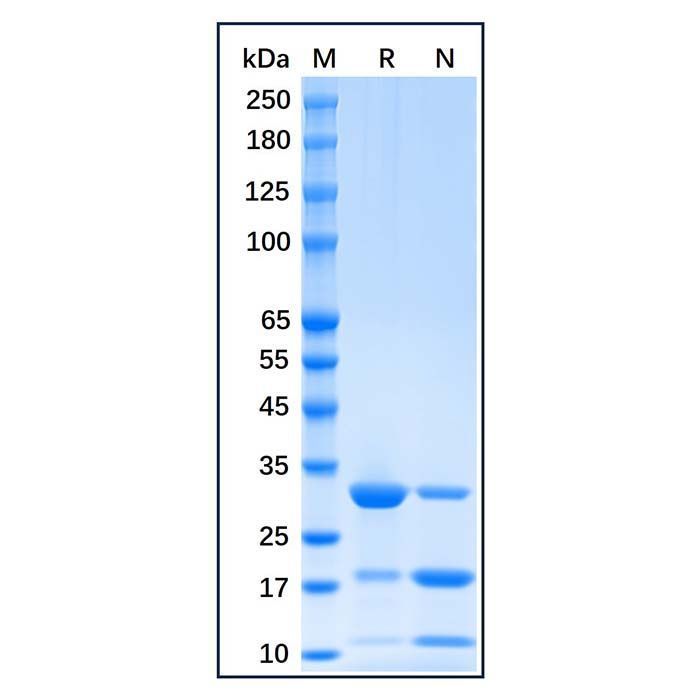
Purity:>85%, by SDS-PAGE visualized with Coomassie® Blue Staining.
Description:
mCherry is a bright red monomeric fluorescent protein created by rounds of directed evolution of DsRed. mCherry matures rapidly, making it possible to see results very soon after transfection or activation of transcription. It is highly photostable and resistant to photobleaching (Shaner et al. 2004). As a result, mCherry is now the most widely used and cited red fluorescent protein. mCherry is bright although tdTomato is the brightest commercially available red fluorescent protein.
Spezifikationen
Product Name
Recombinant mCherry Protein
Synonyme
MCherry fluorescent protein | mCherry protein | mCherry Escherichia coli Recombinant Protein
30.2 kDa, 18.7 kDa and 11.1 kDa, reducing conditions; 30.2 kDa, 18.7 kDa and 11.1 kDa, non-reducing conditions
Molekültyp
Protein
Product Line
Biologische Produkte
Lagerung und Versand
Form
Lyophilized
Rekonstitution
We recommend that this vial be briefly centrifuged prior to opening to bring the contents to the bottom. Reconstitute at 1.0 mg/mL in sterile distilled water. Stock solutions should be apportioned into working aliquots and stored at ≤ -20 °C. Further dilutions should be made in appropriate buffered solutions.
Storage
Store at -20°C,Avoid repeated freezing and thawing
Verschickt in
Ice chest + Ice pads
Stabilität und Lagerung
Store at -20°C for 1 year. Avoid freeze / thaw cycle.
Bilder
Recombinant mCherry protein (rp175918) - SDS-PAGE Recombinant mCherry protein was resolved with SDS-PAGE under reducing (R) and non-reducing (N) conditions and visualized by Coomassie® Blue staining, showing three bands at 30.2 kDa and 18.7 kDa and 11.1 kDa.
Erweiterte Daten
Zertifikate (CoA, COO, BSE/TSE und Analyse-Diagramm)
C of A & Other Certificates(BSE/TSE, COO):
Analytical Chart:
Find and download the COA for your product by matching the lot number on the packaging.
Determine the necessary mass, volume, or concentration for preparing a solution.
Dilution Calculator
Determine the dilution needed to prepare a stock solution.
Reconstitution Calculator
Bewertungen
Kundenbewertungen
Application Protocols
General protocols (illustrative; adjust to your instrument and lot; not item-specific):
Fluorescence calibration curve for a plate reader
Prepare a 2-fold serial dilution series of mCherry in PBS, pH 7.4, spanning the expected dynamic range (e.g., 0.5 nM to 500 nM). Use low-binding plates.
Fit linear region to derive RFU-to-concentration conversion. Verify linearity and photobleaching by repeated reads.
Ni-NTA surface immobilization (His-tag)
Equilibrate Ni-NTA beads in binding buffer (20 mM HEPES, 300 mM NaCl, pH 7.4).
Incubate with mCherry at 4–22°C for 15–60 min with gentle mixing, protected from light.
Wash with binding buffer to remove unbound protein. Elute with 200 mM imidazole if recovery is needed, or proceed to imaging/assay.
NHS-ester labeling (optional conjugation)
Exchange protein into amine-free buffer (e.g., 50 mM HEPES, 150 mM NaCl, pH 7.5) by desalting.
Add NHS-ester reagent at 2–5 molar excess; incubate 30–60 min at room temperature.
Quench with 20 mM Tris or glycine; remove excess dye via desalting. Assess fluorescence and labeling degree.
Microscopy control slides
Spot known concentrations onto poly-L-lysine–coated coverslips; fix gently if needed. Mount in antifade medium and image with RFP filter sets.
Biological Roles
General biological context (literature):
Origin: Engineered from the tetrameric Discosoma sp. DsRed to a monomeric variant with improved maturation and photostability.
Function: Intrinsically fluorescent protein; no cofactor required other than molecular oxygen for post-translational chromophore maturation.
Chromophore maturation: Autocatalytic formation from the polypeptide backbone via cyclization and oxidation steps; maturation half-times are typically tens of minutes at 37°C (method-dependent).
Spectral characteristics: Ex ~587 nm, Em ~610 nm; pKa ~4.5; fluorescence largely stable at physiological pH.
Cellular compatibility: Frequently used as a genetically encoded reporter. As a purified protein, it serves as a calibration standard or immobilized probe; it does not engage in specific cellular pathways unless engineered.
Oligomeric state: Monomeric, reducing propensity for aggregation and perturbation when fused in vivo (design goal of the mFruit series).
Notes for researchers:
Oxygen is required for chromophore maturation; anaerobic expression or storage does not generate chromophore, though already matured protein remains fluorescent until denatured.
Photophysics: Subject to photobleaching and potential reversible dark states; antifade additives (e.g., ROXS systems) can modulate blinking in single-molecule studies.
All points above are literature/general knowledge and not specifications for this particular lot.
Buffer Applications
This product is supplied carrier-free and azide-free, enabling flexible buffer formulation tailored to your application.
HEPES, 20–50 mM, pH 7.2–7.5: Superior pH stability near physiological conditions; low temperature coefficient.
Tris, 20–50 mM, pH 7.4–8.0: Useful for many biochemical assays; note temperature-dependent pKa and potential interactions in enzymology.
Additive options (validate for your use):
Glycerol 10–50% v/v for frozen storage and freeze–thaw protection.
Reductants (e.g., 1–5 mM DTT or 0.5–2 mM TCEP) to maintain reduced cysteines; avoid during Ni-NTA immobilization.
Salt 100–300 mM NaCl to reduce nonspecific interactions and adsorption.
Practical recipes (examples; not item-specific specs):
Imaging buffer: 20 mM HEPES, 150 mM NaCl, pH 7.4; filter-sterilize (0.22 µm) to limit microbial growth.
Storage buffer: 20 mM Tris, 150 mM NaCl, 10–50% glycerol, pH 7.5; aliquot and freeze.
Note: Because this item is azide-free, sterility depends on user handling. If asepsis is required and azide is incompatible, consider sterile filtration and single-use aliquots.
Green Alternatives
As an aqueous protein reagent, environmental considerations focus on buffer composition, preservatives, and waste minimization rather than solvent substitution.
Greener practice options (general):
Aqueous-only systems: Maintain water-based buffers with minimal organic cosolvent. Avoid azide-containing preservatives when not necessary; this item is azide-free by specification.
Biodegradable buffers: Use HEPES or phosphate buffers at minimal effective concentrations. Avoid Tris in large-scale discharges where amine load is regulated.
Energy and cold chain: Consolidate shipments and plan aliquoting to minimize freeze–thaw losses and dry ice/ice pack usage over the product lifetime.
Waste reduction: Prepare small working aliquots to reduce disposal of expired bulk solutions. Use low-binding consumables to reduce loss-driven repeats.
Alternative red FPs (literature; performance trade-offs):
mScarlet: Brighter (higher quantum yield) and fast maturation; emission slightly shorter than some far-reds; may photobleach differently.
mRuby3/mRuby2: High brightness; different photostability and maturation profiles.
mKate2: Farther red-shifted emission; often dimmer in some systems but improved tissue penetration in imaging contexts.
Trade-offs:
Switching fluorophores affects filter sets, FRET pairings, and spectral unmixing. mCherry remains a widely used benchmark standard due to robust maturation and monomeric behavior.
Pharmaceutical Uses
This recombinant fluorescent protein is provided for research use only and is not intended for diagnostic or therapeutic applications.
Assay development and QC: Fluorescent system-suitability standards for plate readers, HPLC with fluorescence detection (FLD) of labeled analytes, or flow cytometry channel verification.
Device and workflow qualification: Calibration of optical paths, filter sets, and detector linearity in process analytical technology (PAT) settings.
Conjugation benchmarking: Reference substrate for evaluating protein-labeling workflows (e.g., site-specific conjugation methods) and assessing drug–antibody conjugate analytics by fluorescence recovery after denaturation.
No pharmacopeial monograph or excipient role is associated with mCherry (literature). Any use in manufacturing must be validated internally and is outside the scope of supplied documentation.
Physical Properties
Item-specific physical constants are not supplied in the Product Data.
Appearance: Not specified for this item; refer to CoA/Spec Sheet.
Molecular weight (item-specific): Not specified for this item; refer to CoA/Spec Sheet.
Protein concentration: Not specified for this item; refer to CoA/Spec Sheet.
Extinction coefficient (item-specific): Not specified for this item; refer to CoA/Spec Sheet.
Literature/general properties of mCherry (for planning only; not specifications):
Excitation maximum: ~587 nm (literature).
Emission maximum: ~610 nm (literature).
Extinction coefficient: ~72,000 M−1·cm−1 at Ex max (literature).
Oligomeric state: monomeric under standard aqueous buffer conditions (engineered).
Buffer solubility: Highly soluble in typical biological buffers (PBS, Tris, HEPES) at neutral pH (general protein behavior).
Notes for use:
Carrier-free proteins may adhere to plastic at low concentrations; use low-binding plastics or add inert protein (e.g., BSA) if compatible with your application.
Fluorescence is sensitive to denaturants and high temperatures; avoid >45–50°C and strong chaotropes unless denaturation is intended.
Carrier Free: Supplied without carrier proteins (e.g., BSA) or stabilizing additives. Advantages include precise mass balance, lower background in assays, and freedom to formulate custom buffers. Implication: greater adsorption losses possible at low ng–µg/mL; consider low-binding plastics or adding an inert carrier in your own formulation if compatible.
Azide Free: Contains no sodium azide. This is compatible with applications sensitive to azide (e.g., HRP-based assays, cell exposure). Note that absence of a preservative increases the importance of aseptic technique and small aliquots to avoid contamination.
His Tag: Affords convenient immobilization on Ni2+/Co2+ matrices, affinity capture in pull-downs, and straightforward anti-His detection. Tag position and length are not specified for this item; consult CoA/Spec Sheet if critical.
What is not specified for this item (consult CoA/Spec Sheet):
Purity by SDS-PAGE/HPLC, endotoxin level, host expression system, buffer composition, concentration, degree of multimer/aggregate, and residual imidazole.
Context for professionals:
For imaging standards or calibration, carrier-free/azide-free material enables direct mass-based preparation of fluorometric standards, conjugations, or encapsulation without interference from carriers or azide.
Reaction and Applications
Manufacturer Applications: Not explicitly provided for this item. The following are common professional uses of recombinant mCherry protein (literature/general):
Fluorescence calibration standards: Prepare defined concentration series to calibrate microscopes, plate readers, flow cytometers, or to interconvert fluorescence units to molecules of equivalent soluble fluorophore (MESF).
Biophysical characterization: Benchmarking photophysics (quantum yield, lifetime), testing filters, dichroics, and emission path alignment for red channels.
FRET studies: mCherry is a common acceptor for teal/cyan donors (e.g., mTFP1) and a donor to far-red acceptors in specialized setups. Validate spectral overlap and instrument filters.
Surface/particle functionalization: His-tag allows oriented immobilization on Ni-NTA/Co-IDA beads, membranes, or patterned surfaces to create fluorescent standards and biosensing interfaces.
Assay development: Positive control for antibody-based detection of His-tagged proteins; test cleavage, unfolding, or proteolysis by monitoring fluorescence loss.
Practical tips:
Work at 4°C for prolonged handling; protect from strong light.
For low-concentration work, pre-block plastics or add an inert protein to reduce adsorption (if compatible).
Verify buffer composition does not include quenchers (e.g., high concentrations of iodide, strong denaturants) during fluorescence measurements.
Reaction Conditions
General aqueous bioconjugation and handling conditions for fluorescent proteins (literature/practice; not item-specific):
NHS-ester labeling (lysines): pH 7.5–8.5 in phosphate or bicarbonate buffer; 4–22°C; 0.5–2 h; protect from light. Quench with Tris or glycine. Avoid primary amine buffers (e.g., Tris) during coupling.
Maleimide labeling (cysteines): pH 6.5–7.5 in phosphate/HEPES; 4–22°C; 0.5–2 h. Maintain thiols reduced with minimal TCEP; avoid excess DTT that can consume maleimide.
His-tag immobilization: Bind in neutral buffer with 200–500 mM NaCl; elute with 150–300 mM imidazole. Avoid strong chelators (EDTA) that strip the resin.
Crosslinking (e.g., EDC/NHS to carboxyls): pH 5.0–6.0 activation, then couple at pH 7.2–7.4; monitor fluorescence to ensure integrity.
Photophysical measurements:
Use excitation near 587 nm and detect emission near 610 nm with bandwidths matched to instrumentation. Calibrate concentration via absorbance using the extinction coefficient appropriate for your construct/lot (item-specific value not provided; verify from CoA/Spec Sheet or determine experimentally).
Yields/efficiencies:
Typical labeling degrees: 1–3 labels per protein (optimize to balance brightness and activity). Excessive labeling can quench fluorescence.
Always validate the exact conditions with small-scale trials, as protein sequence, tag position, and buffer composition influence outcomes.
Safety and Handling
GHS/SDS status for this specific item:
Signal word, hazard statements, pictograms, classification: Not specified for this item; refer to SDS.
General guidance for handling recombinant fluorescent proteins (not a substitute for SDS):
PPE: Laboratory coat, nitrile gloves, and safety glasses as minimum protection.
Inhalation/ingestion/skin contact: Avoid aerosol generation and direct contact. Wash thoroughly after handling. Use biological safety cabinet if aerosol risk exists.
Sensitization: Proteins can, in some cases, act as allergens; minimize exposure, especially to powders/lyophilizates or sprays/aerosols.
Spills: Wipe with absorbent material, then clean with appropriate detergent; dispose according to institutional biosafety procedures.
Incompatibilities: Avoid strong oxidizers, proteases, and extremes of pH that can denature the protein or quench fluorescence. Avoid sodium azide if downstream application involves living cells or heme enzymes (azide is toxic/inhibitory)—this item is azide-free by specification.
Photostability: Protect from prolonged intense illumination to minimize photobleaching.
Freeze–thaw: The Product Data specifies avoiding repeated freeze–thaw cycles. Aliquot on first thaw.
Always consult the SDS and institutional EHS policies for authoritative hazard, first-aid, and disposal information. For research use only; not for diagnostic or therapeutic use.
Solvent Selection
This is a recombinant protein; choice of medium is an aqueous buffer selection rather than an organic solvent selection.
General buffer considerations (literature/practice):
pH: mCherry fluorescence is robust above pH ~5; typical working pH 7.2–7.5 using PBS, HEPES, or Tris buffers.
Ionic strength: 100–200 mM total salt commonly provides stability while maintaining solubility.
Additives: For storage, 10–50% glycerol can improve freeze–thaw stability; 1–5 mM DTT or TCEP may be used to maintain reducing conditions if required by the application (validate compatibility with your assay and metals; avoid reducing agents with Ni2+ resins during immobilization).
Metal affinity contexts: For His-tag binding, use imidazole-free or low-imidazole buffers for loading; elute with 150–300 mM imidazole (general IMAC practice).
Comparison notes (general):
HEPES vs Tris: HEPES offers better pH stability near 7.4 and lower temperature dependence; Tris has significant ΔpKa/ΔT and can interact with some enzymes.
PBS vs low-salt: PBS supports protein stability but may be avoided in downstream steps where phosphate precipitates with divalent cations or interferes with certain chemistries.
Non-aqueous solvents are not recommended; organic cosolvents (>10–20%) can reduce fluorescence and denature the protein.
Storage and Reconstitution
Item-specific storage/shipping from Product Data:
Storage Conditions: Store at -20°C; avoid repeated freezing and thawing.
Shipped In: Ice chest + Ice pads.
General best practices (supplementary guidance; not item-specific specs):
Upon receipt: Immediately transfer to -20°C (short term) or -80°C (long term) as institutional practice dictates. Protect from light.
Aliquoting: Thaw once on ice, mix gently, and make single-use aliquots in sterile, low-binding tubes to prevent freeze–thaw cycles and contamination.
Reconstitution: If provided lyophilized or concentrated, reconstitute/dilute with sterile, filtered buffer (e.g., PBS or HEPES, pH ~7.4). The exact diluent and target concentration should follow your application; no item-specific diluent is specified.
Stabilizers: For storage at -20°C, consider adding 10–50% glycerol to working aliquots to improve stability; avoid carriers unless compatible with your downstream use. This item is carrier-free and azide-free by specification.
Light protection: Store in amber tubes or wrap in foil to minimize photobleaching.
Freeze–thaw guidance: Do not refreeze thawed aliquots. If refreezing is unavoidable, expect potential activity/fluorescence loss.
Any missing composition details (buffer, pH, concentration, tag position) are not specified for this item; refer to CoA/Spec Sheet.
Structure and Identity
Item-specific identifiers (small-molecule style) are generally not applicable to recombinant proteins.
Molecular formula (small-molecule): Not specified for this item; refer to CoA/Spec Sheet.
Molecular weight (item-specific): Not specified for this item; refer to CoA/Spec Sheet.
CAS, CID, InChIKey, SMILES: Not applicable for a recombinant protein; not provided for this item.
Literature/General information about mCherry (for context; not item-specific):
mCherry is a monomeric red fluorescent protein (RFP) engineered from Discosoma sp. DsRed.
Structural features: β-barrel fold (~11 β-strands) encapsulating an internal chromophore formed autocatalytically from the peptide sequence (often the X–Tyr–Gly motif) by cyclization, oxidation, and dehydration.
Chromophore: internally generated; not a covalently attached small-molecule ligand.
His Tag: This item is specified as His-tagged, enabling immobilized metal affinity interactions (Ni2+/Co2+ matrices) and anti-His detection.
2D/3D description in words (general):
The protein forms an oblate barrel with an internal, planar chromophore located near the barrel axis. The His tag is typically appended at the N- or C-terminus (position not specified for this item).
Synthetic Utility
For a recombinant protein, “synthetic utility” maps to biochemical and materials workflows rather than organic synthesis.
Useful functional features:
Intrinsic fluorophore: Serves as a built-in spectroscopic reporter for folding, stability, and surface immobilization studies.
Polyhistidine tag: Enables metal-chelate coordination chemistry for immobilization on Ni-NTA/Co-IDA supports, patterning on surfaces, and purification/capture in complex mixtures.
Primary amines and thiols: Native lysines and any cysteines (sequence-dependent) allow bioconjugation via NHS-esters (lysine) or maleimides/iodoacetamides (cysteine) under mild aqueous conditions.
Applications enabled:
Construction of fluorescent biomaterials and nanostructures by oriented His-tag binding or covalent coupling to polymers/nanoparticles.
Standardization of fluorescence response in biosensors, microfluidic devices, and multiplex platforms.
Protease assays: Engineer cleavage sites; monitor activity via fluorescence loss upon unfolding or degradation.
Considerations:
Maintain native structure to preserve fluorescence; avoid harsh pH, denaturants, and high temperatures unless the application requires denaturation.
For covalent conjugation, confirm that labeling sites do not perturb the chromophore environment; excessive lysine labeling can reduce brightness.
Target Specificity
Not applicable. This product is a recombinant fluorescent protein, not an antibody or affinity reagent with defined antigen specificity.
Relevant notes for usage:
The His tag provides generic affinity to immobilized metal ions (Ni2+/Co2+) but does not confer biological target specificity.
If used as a fusion partner or capture bait, any observed “specificity” arises from the engineered fusion domain, not from mCherry itself.
Häufig gestellte Fragen
What is the purity of this product, and how is it determined?
This product is supplied at ≥90% purity, determined by SDS-PAGE. Lot-specific values are stated on the Certificate of Analysis.
What does Azide Free mean?
Azide Free indicates that the material has been processed and tested for specialty industrial processing. Specifications focus on the impurities that affect performance in that application — for example, metal content for electronics, particle size for batteries, refractive index for optics, or moisture content for moisture-sensitive processes.
What does Carrier Free mean?
Carrier Free indicates that the material has been processed and tested for specialty industrial processing. Specifications focus on the impurities that affect performance in that application — for example, metal content for electronics, particle size for batteries, refractive index for optics, or moisture content for moisture-sensitive processes.
How should this product be stored?
Store at ?20 °C. Avoid repeated freeze–thaw cycles. Aliquot into single-use volumes before freezing.
How is this product shipped?
This product ships in an insulated container with ice pads. Unpack on arrival and transfer it to the storage condition stated above.
What documentation is provided?
Available product documentation, including Certificates of Analysis (COA), Safety Data Sheets (SDS), and specification sheets, is shown in the product document area. Document availability and access follow the current site policy.
Benötigen Sie Hilfe bei der Auswahl der Qualität?
Unser Leitfaden zur Qualitätsauswahl behandelt Reinheit, Stabilisatorstatus und Anwendungseignung für alle Varianten in unserem Katalog.
Wir verwenden Cookies, um die ordnungsgemäße Funktion der Website sicherzustellen und, soweit zulässig, Ihr Nutzererlebnis zu verbessern. Sie können Ihre Einstellungen jederzeit unter „Einstellungen“ verwalten. Weitere Informationen finden Sie in unserer Cookie-Richtlinie.
Dürfen wir Sie über Rabattaktionen informieren?
Später erinnern
Vielen Dank! Bitte überprüfen Sie Ihren E-Mail-Posteingang, um zu bestätigen.
Products are supplied to verified businesses, institutions, and qualified professionals for research and development use only. Not for use in humans, animals, diagnosis, or therapy.

 ZJ23F1101781