Resolvin D1 - Moligand™, ≥95%, A solution in ethanol , Agonist of FPR2/ALX;Agonist of GPR32;Gating inhibitor of TRPA1, CAS No.872993-05-0, Agonist of FPR2/ALX;Agonist of GPR32;Gating inhibitor of TRPA1
Resolvin D1 - Moligand™, ≥95%, A solution in ethanol , Agonist of FPR2/ALX;Agonist of GPR32;Gating inhibitor of TRPA1, CAS No.872993-05-0, Agonist of FPR2/ALX;Agonist of GPR32;Gating inhibitor of TRPA1
GRADE & PURITYMoligand™?Moligand™ — Aladdin's line of ligands and bioactive small molecules. Use for receptor, pathway, and binding studies needing defined small-molecule tools.≥95%A solution in ethanol
Moligand™, ≥95%, A solution in ethanol Moligand™ for sensitive chromatographic and analytical workflows requiring minimal baseline interference.
🌡
Storage & shipping
Protected from light,Store at -80°C Ships Dry ice packs + Cold packs Check lot-specific COA for exact specifications.
📋
Quality documents
SDS, COA, datasheet, and spec sheet available for download. Lot-specific COA accessible via lot number lookup.
📚
Literature proof
Cited in 1 peer-reviewed publications across chromatography, organic synthesis, and cross-coupling reactions.
Übersicht
Resolvin D1 is from a family of potent lipid mediators derived from both eicosapentaenoic acid (EPA) and docosahexaenoic (DHA)(1), it is an anti-inflammatory and promotes the resolution of the inflammatory response back to a non-inflamed state.2 RvD1 is produced physiologically from the sequential oxygenation of DHA by 15- and 5-lipoxygenase. It reduces human polymorphonuclear leukocyte (PMNL) transendothelial migration, the earliest event in acute inflammation, with EC50 values of ~30 nM. It exhibits a dose-dependent reduction in leukocyte infiltration in a murine model of peritonitis with a maximal inhibition of ~35% at a 10-100 ng dose.
Resolvin D1 (RvD1) is supplied as a solution in ethanol. To change the solvent, simply evaporate the ethanol under a gentle stream of nitrogen and immediately add the solvent of choice. It is recommended that this product be stored and handled in an ethanol solution. Resolvins can isomerize and degrade when put into freeze thaw conditions and/or in solvents such as dimethyl formamide or DMSO.
Determine the necessary mass, volume, or concentration for preparing a solution.
Dilution Calculator
Determine the dilution needed to prepare a stock solution.
Reconstitution Calculator
Bewertungen
Kundenbewertungen
Application Protocols
Item-specific, tested application protocols and recommended dilutions: Not specified for this item.
General notes (non-binding guidance):
For cell-based assays, prepare concentrated stocks in ethanol or DMSO; titrate to determine minimal effective concentration while keeping co-solvent low.
For LC–MS/MS standards, prepare gravimetrically in acetonitrile or ethanol, use amber glass vials with PTFE-lined caps, and store at −80 °C.
These are general literature practices and not validated protocols for this specific lot/product. Always optimize for your system.
Biological Roles
Nature and biosynthesis (literature overview):
Resolvin D1 is an endogenously produced specialized pro-resolving mediator (SPM) derived from docosahexaenoic acid (DHA) via sequential oxygenation (e.g., 15-LOX/5-LOX pathways), generating epoxide intermediates subsequently hydrolyzed to the trihydroxylated resolvin structure.
Functional roles (literature; non-clinical):
Modulates resolution-phase biology by influencing neutrophil trafficking, macrophage efferocytosis, and restoration of tissue homeostasis.
Engages specific GPCRs in human systems to transduce pro-resolving signals; downstream readouts often include changes in second messengers and kinase activation in vitro.
Acts at picomolar–nanomolar levels in many cell systems; activities are context-dependent and sensitive to isomeric purity.
Analytical biology:
Quantified in tissues/fluids via targeted lipidomics (LC–MS/MS with stable-isotope internal standards). Chromatographic separation of E/Z and positional isomers is critical for accurate assignment.
Notes and boundaries:
This product is for research use only. No medical, diagnostic, or therapeutic claims are made or implied.
Specific receptor identities, EC50 values, and pathway details vary by system and are not item specifications; consult primary literature for your model system.
Buffer Applications
Resolvin D1 is not a buffering agent and is not used to prepare pH-stable buffer systems.
Practical guidance (general):
When dosing into aqueous buffers, dissolve first in a suitable co-solvent (e.g., ethanol or DMSO), then dilute into the target buffer with vigorous mixing to avoid precipitation and adsorption to plastic.
Inclusion of carrier proteins (e.g., fatty-acid–free BSA at low percentages) can reduce nonspecific binding in certain assays (literature practice).
Item-specific buffer recommendations: Not specified for this item; refer to your assay protocol and CoA/SDS for compatibility.
Green Alternatives
Because Resolvin D1 is the target analyte/ligand rather than a reaction solvent or reagent, “green alternative” considerations focus on handling and solvent choices.
Solvent choice (literature-based suggestions):
Prefer ethanol or water-miscible bio-compatible co-solvents over chlorinated solvents for stock preparation when assay-compatible.
Use LC–MS–grade acetonitrile and water for analytical workflows; minimize volumes via microvial workups.
Comparison highlights (general):
| Use case | Conventional choice | Greener alternative | Trade-offs |
|---|---|---|---|
| Stock solutions | DMSO | Ethanol | Ethanol can affect membrane properties at higher %; ensure final v/v ≤0.1–0.5% for cells. |
| Sample extraction | Dichloromethane | Ethyl acetate/MTBE | Phase behavior differs; may change recovery and isomer integrity. |
| Glassware cleaning | Acetone/hexanes | Ethanol/iso-propanol | Slower drying; ensure no residual water that accelerates oxidation. |
Operational greener practices:
Work at small scale with amber vials to minimize waste.
Inert with nitrogen/argon instead of repeated solvent purges.
Consolidate shipments with other −80 °C items to lower cold-chain impact where possible.
Pharmaceutical Uses
This product is supplied strictly for research use only.
General context (non-clinical, literature):
Resolvin D1 and related SPMs are studied as bioactive lipids in discovery research and may be used as analytical standards or pharmacological tools in preclinical laboratories.
Not an excipient, not compendial, and not approved for human or veterinary use.
Manufacturing/formulation notes (research scale):
For formulation studies in vitro, typical vehicles include ethanol, PEG-containing co-solvents, or lipid carriers; exact compositions are system-dependent and beyond the scope of this product listing.
Item-specific pharmacopeial/compendial status: Not specified for this item; refer to CoA/Spec Sheet.
Physical Properties
Item-specific physical data (from Product Data):
Appearance: Not specified for this item; refer to CoA/Spec Sheet.
Storage/handling conditions (item-specific):
Store at −80 °C, protected from light.
Shipped on dry ice packs + cold packs.
Literature/typical physicochemical properties (for context; not item specification):
State: viscous oil or film at ambient temperature; readily forms thin films on glassware.
Solubility: insoluble in water; soluble in ethanol, methanol, acetonitrile, ethyl acetate, DMSO; highly soluble in nonpolar organic solvents (hexanes, toluene) but risk of oxidation increases in nonpolar, oxygenated environments.
Partitioning: strongly lipophilic; high logP expected for polyunsaturated C22 lipid (exact value varies with ionization state and derivatization).
pKa: carboxylic acid pKa typically ~4–5 (literature) for the free acid; hydroxyls are non-ionizing under neutral conditions.
UV/Vis: conjugated diene/triene chromophores give characteristic UV bands; used for analytical identification (literature). Exact λmax depends on geometry and solvent.
Stability: prone to autoxidation/peroxidation and E/Z isomerization upon exposure to heat, light, and air. Antioxidants (e.g., BHT in trace amounts) and inert atmosphere can improve stability (literature best-practice).
Practical implications:
Prepare and handle solutions at low temperature under inert gas with low light exposure to preserve native isomer distribution.
Moligand™ typically denotes a preparation intended for ligand/receptor and biochemical studies, emphasizing identity, purity, and isomeric integrity suitable for reproducible binding/functional assays.
For lipid mediators, critical quality attributes include: correct double-bond geometry and absolute configuration, low levels of oxidative byproducts (hydroperoxides/epoxides), and accurate content by quantitative assay (e.g., qNMR or LC–MS).
What to expect and verify (best practice):
Certificate of Analysis should specify: structural identity (e.g., LC–MS, HRMS), isomeric purity (E/Z and R/S, where applicable), residual solvents, water content, and assay purity. If not listed, request.
Because SPMs are light/oxygen sensitive, confirm packaging under inert gas and inclusion of light-protective vials.
Item-specific notes:
Purity specification details, stabilizers (if any), and assay methodology: Not specified for this item; refer to CoA/Spec Sheet.
Practical tip:
Upon receipt, document appearance, lot number, and promptly transfer to −80 °C storage in darkness to maintain the Moligand™ quality profile.
Reaction and Applications
Manufacturer Applications (from catalog): Not specified.
Research use note (item-specific): For research use only.
Literature and typical applications (for context; not item specification):
Biochemical research: Resolvin D1 is widely used to probe endogenous resolution pathways of inflammation, including effects on leukocyte trafficking, macrophage efferocytosis, and epithelial barrier function.
Receptor pharmacology: employed in ligand-binding and signaling assays in cells expressing candidate GPCRs; used to define concentration–response relationships and downstream signaling readouts (e.g., Ca2+ flux, ERK phosphorylation).
Analytical chemistry: serves as a reference standard for LC–MS/MS quantitation of endogenous SPMs in lipidomics workflows; often handled alongside deuterated internal standards (literature practice).
In vitro systems: utilized in primary cells and immortalized lines at low nanomolar to low micromolar nominal concentrations; careful solvent control and adsorption minimization are essential.
Use amber glassware; minimize headspace oxygen; include antioxidant only if compatible with your assay.
Verify isomeric integrity by LC–MS/UV before critical experiments.
Reaction Conditions
Classical synthetic “reaction conditions” are generally not applicable because Resolvin D1 is used as a bioactive analyte/ligand rather than a reagent. Nevertheless, for experimental use the following preparation conditions are commonly employed (literature/best practice; not item specification):
Stock preparation:
Dissolve in anhydrous ethanol or DMSO to 0.1–10 mM under inert gas. Use amber vials and minimize headspace. Record solvent lot and water content when possible.
Working solutions:
Dilute into pre-chilled assay buffer immediately before use, targeting final co-solvent ≤0.1–0.5% v/v. Include carrier protein if adsorption is problematic.
Temperature and light:
Keep on ice or at 4 °C during setup; protect from light at all stages to prevent isomerization/oxidation.
Analytical verification:
Verify concentration by UV (where appropriate) and/or LC–MS; monitor for oxidative byproducts.
Storage of solutions:
Short-term (hours to a day) at 4 °C under inert, protected from light; longer-term as frozen single-use aliquots at −80 °C.
Item-specific tested conditions: Not specified for this item; refer to CoA/Spec Sheet.
Safety and Handling
Item-specific hazard data (from Product Data):
GHS Classification: Not specified for this item; refer to SDS.
Signal Word: Not specified for this item; refer to SDS.
Pictograms: Not specified for this item; refer to SDS.
H-Statements: Not specified for this item; refer to SDS.
General safety guidance for polyunsaturated lipid mediators (literature/best practice):
Primary hazards: low acute toxicity expected for many fatty-acid–derived lipids, but treat as a laboratory chemical; may cause skin/eye irritation. Avoid inhalation of aerosols/solvent vapors.
Sensitivity: highly susceptible to oxidation and light-induced degradation; oxidation products may have unknown hazards.
PPE: lab coat, safety glasses or face shield, and appropriate chemical-resistant gloves (e.g., nitrile). Work in a fume hood when preparing organic solutions.
Incompatibilities: strong oxidizers; prolonged exposure to air, light, elevated temperature; bases can promote isomerization; acids can catalyze dehydration or isomerization.
First aid (overview; defer to SDS): rinse eyes/skin with water for ≥15 min upon contact; remove contaminated clothing; if inhaled, move to fresh air; if ingested, rinse mouth—seek medical attention in all cases.
Waste: collect solvent solutions and residues as halogen-free organic waste unless otherwise specified by local regulations; minimize peroxidation by storing waste away from heat/light.
Always consult the product SDS for authoritative hazard and response information.
Solvent Selection
Resolvin D1 is a highly unsaturated, lipophilic small molecule with amphipathic features. Solvent choice should balance solubility, chemical stability, and experimental compatibility.
Polarity and miscibility (general guidance):
Strongly lipophilic; insoluble in water as free acid but dispersible when co-solubilized.
Stock solutions: ethanol or DMSO are common for biochemical assays; final working concentrations often achieved by serial dilution into aqueous buffers containing carrier proteins or surfactants (e.g., 0.1% fatty-acid–free BSA) to minimize adsorption (literature practice).
Stability considerations:
Prefer oxygen-free, dry solvents; degas by argon sparge. Avoid prolonged residence in basic solvents; minimize light exposure.
Quick comparison (literature-based):
Ethanol: miscible with water, easy to remove, acceptable for many bioassays; can extract plastics—use glassware.
DMSO: excellent solvency, small final % v/v tolerated in cells; hygroscopic, can carry oxygen; store aliquots inerted.
Acetonitrile: LC–MS friendly; moderate proticity; use for analytical standards.
Item-specific constraints:
No item-specific solvent restrictions provided; follow your assay requirements and the storage guidance given for this item.
Storage and Reconstitution
Item-specific storage and shipping (from Product Data):
Storage Conditions: Store at −80 °C, protected from light.
Shipped In: Dry ice packs + Cold packs.
Item-specific appearance: Not specified for this item; refer to CoA/Spec Sheet.
Reconstitution guidance (general best practice; not item specification):
Allow vial to equilibrate to −20 °C briefly to minimize condensation, then to 0–4 °C before opening.
Work quickly under dim light; purge vial headspace with argon or nitrogen after each opening.
Prepare single-use aliquots as concentrated solutions (e.g., 0.1–10 mM) in anhydrous ethanol or DMSO using amber glass microvials. Record exact mass and solvent volume for gravimetric accuracy.
Store aliquots at −80 °C in secondary containment with desiccant. Avoid repeated freeze–thaw cycles.
For aqueous applications, dilute immediately before use into pre-chilled buffer; keep final co-solvent low and consider carrier proteins to reduce surface adsorption.
Stability notes:
Highly sensitive to oxygen and light; discard aliquots showing discoloration or unexpected LC–MS peaks indicative of oxidation.
Documentation:
Retain the CoA/Spec Sheet for lot-specific details and follow SDS for safe handling. This product is for research use only.
Structure and Identity
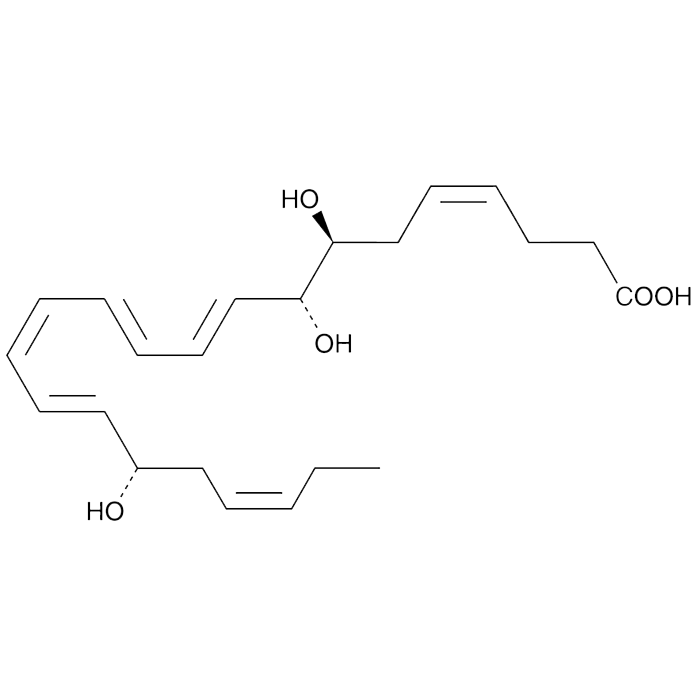
Resolvin D1 is a specialized pro-resolving mediator (SPM) biosynthesized from docosahexaenoic acid (DHA). It is a polyunsaturated, oxygenated lipid with multiple E/Z-configured double bonds and hydroxyl groups.
Item-specific identifiers (from Product Data):
SKU: R341442
Product Name: Resolvin D1
CAS: 872993-05-0
InChIKey: 259212 (as provided)
Grade: Moligand™
Category: 生命科学 (Life Science)
Item-specific molecular data:
Molecular Formula: Not specified for this item; refer to CoA/Spec Sheet.
Molecular Weight: Not specified for this item; refer to CoA/Spec Sheet.
SMILES: Not specified for this item; refer to CoA/Spec Sheet.
Literature/typical identity (for reference only; not item specification):
Core functional groups: three hydroxyls (trihydroxylated), one carboxylic acid (in some forms, methyl esters are used), and six conjugated/non-conjugated double bonds.
Structural features (2D description): a 22‑carbon omega‑3 chain bearing multiple cis/trans double bonds, with hydroxyl substituents at defined stereocenters along the chain and a terminal carboxylate; overall amphipathic yet highly lipophilic.
Notes:
Exact stereochemistry and form (free acid vs. methyl ester) determine the precise SMILES/InChIKey; consult the product CoA for definitive item-specific structure.
Synthetic Utility
Resolvin D1 is a complex, bioactive target molecule rather than a general-purpose synthetic reagent.
General synthetic context (literature):
Total synthesis of Resolvin D1 requires precise installation of multiple E/Z-configured double bonds and stereodefined hydroxyl-bearing stereocenters, often via iterative fragment couplings (e.g., aldol/crotylation) and late-stage selective oxidations.
Protection/deprotection strategies are used to control chemoselectivity; final global deprotection requires conditions that preserve double-bond geometry.
Laboratory handling for derivatization (research practice):
Common derivatizations for analytics include methyl ester formation (diazomethane alternatives recommended for safety), and UV-active or MS-enhancing tags for sensitivity.
Hydrogenation or epoxidation is sometimes employed to confirm double-bond count/positions during structural studies.
As a reagent: not typically used as a building block; its value lies in biological investigation and as a reference standard.
Item-specific synthetic attributes or reactivity: Not specified for this item; consult CoA for any stabilizers or protective groups present.
Target Specificity
Item-specific target information (required source: product data): Not specified for this item.
No antigen/epitope, receptor panel, species reactivity, clone, or isotype data are provided in the Product Data for SKU R341442. Users should consult primary literature for receptor engagement relevant to their model systems, but such details are not specifications of this item.
Häufig gestellte Fragen
What is the purity of this product?
This product is supplied at ≥95% purity (chemical assay). Lot-specific values are stated on the Certificate of Analysis.
What is Moligand??
Moligand? is one of Aladdin Scientific's premium product lines, formulated for high-purity applications across multiple workflows. Compared to standard grades in the same workflow, Moligand? products typically offer tighter specifications, more rigorous QC, and stronger lot-to-lot consistency.
How should this product be stored?
Store at ?80 °C, protected from light. The material is light-sensitive — keep it in its original opaque or amber container.
How is this product shipped?
This product ships frozen with dry ice and cold packs. Unpack on arrival and transfer it to the storage condition stated above; handle dry ice with insulated gloves in a ventilated area.
What are the CAS number, molecular formula and molecular weight?
The CAS Number is 872993-05-0, the molecular formula is C22H32O5, and the molecular weight is 376.5 g/mol. InChIKey OIWTWACQMDFHJG-UHFFFAOYSA-N.
What documentation is provided?
Available product documentation, including Certificates of Analysis (COA), Safety Data Sheets (SDS), and specification sheets, is shown in the product document area. Document availability and access follow the current site policy.
Wir verwenden Cookies, um die ordnungsgemäße Funktion der Website sicherzustellen und, soweit zulässig, Ihr Nutzererlebnis zu verbessern. Sie können Ihre Einstellungen jederzeit unter „Einstellungen“ verwalten. Weitere Informationen finden Sie in unserer Cookie-Richtlinie.
Dürfen wir Sie über Rabattaktionen informieren?
Später erinnern
Vielen Dank! Bitte überprüfen Sie Ihren E-Mail-Posteingang, um zu bestätigen.
Products are supplied to verified businesses, institutions, and qualified professionals for research and development use only. Not for use in humans, animals, diagnosis, or therapy.

 L2515619