Determine the necessary mass, volume, or concentration for preparing a solution.
| Activity Type | Activity Value -log(M) | Mechanism of Action | Activity Reference | Publications (PubMed IDs) |
|---|

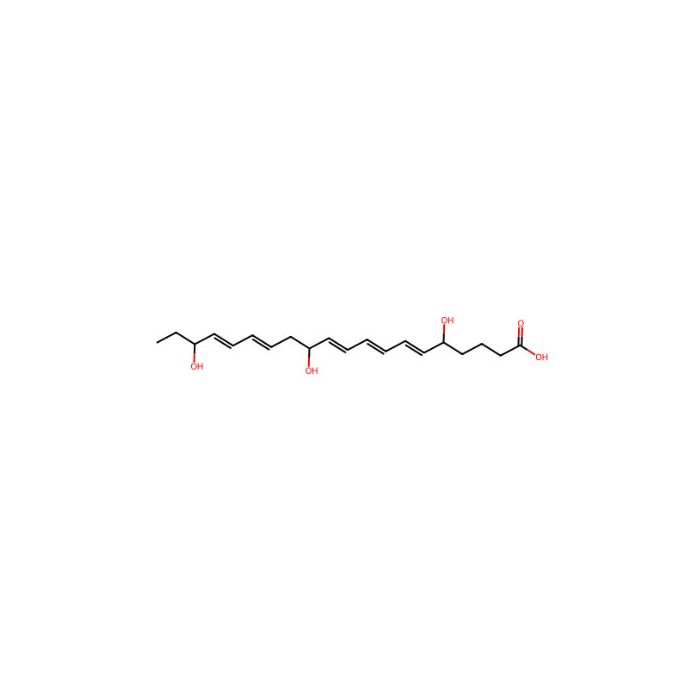
Resolvin E1 (RvE1), a potent endogenous pro-resolving mediator of inflammation, is derived from omega-3 fatty acid eicosapentaenoic acid (EPA). Resolvin E1 is endogenously biosynthesized from EPA in the presence of Aspirin during the spontaneous resolution phase of acute inflammation, where specific cell-cell interactions occur. Resolvin E1 possesses unique counterregulatory actions that inhibit polymorphonuclear leukocyte (PMN) transendothelial migration. Resolvin E1 also acts as a potent inhibitor of leukocyte infiltration, dendritic cell migration, and IL-12 production.
Taxonomy Tree
| Kingdom | Organic compounds |
|---|---|
| Superclass | Lipids and lipid-like molecules |
| Klasse | Fatty Acyls |
| Subclass | Eicosanoids |
| Intermediate Tree Nodes | Not available |
| Direct Parent | Hydroxyeicosapentaenoic acids |
| Alternative Parents | Long-chain fatty acids Hydroxy fatty acids Unsaturated fatty acids Secondary alcohols Polyols Monocarboxylic acids and derivatives Carboxylic acids Organic oxides Hydrocarbon derivatives Carbonyl compounds |
| Molecular Framework | Aliphatic acyclic compounds |
| Substituents | Hydroxyeicosapentaenoic acid - Long-chain fatty acid - Hydroxy fatty acid - Fatty acid - Unsaturated fatty acid - Secondary alcohol - Carboxylic acid derivative - Carboxylic acid - Monocarboxylic acid or derivatives - Polyol - Organic oxide - Organic oxygen compound - Hydrocarbon derivative - Carbonyl group - Organooxygen compound - Alcohol - Aliphatic acyclic compound |
| Beschreibung | This compound belongs to the class of organic compounds known as hydroxyeicosapentaenoic acids. These are eicosanoic acids with an attached hydroxyl group and five CC double bonds. |
| External Descriptors | Hydroxy/hydroperoxyeicosapentaenoic acids |
| Activity Type | Activity Value -log(M) | Mechanism of Action | Activity Reference | Publications (PubMed IDs) |
|---|
Find and download the COA for your product by matching the lot number on the packaging.
| Lot Number | Certificate Type | Datum | Artikel |
|---|---|---|---|
 K2519642 | Certificate of Analysis | Sep 29, 2025 | R613158 |
| Molekulargewicht | 350.4 |
|---|---|
| XLogP3 | 2.400 |
| Hydrogen Bond Donor Count | 4 |
| Hydrogen Bond Acceptor Count | 5 |
| Rotatable Bond Count | 13 |
| Exact Mass | 350.209 Da |
| Monoisotopic Mass | 350.209 Da |
| Topological Polar Surface Area | 98.000 Ų |
| Heavy Atom Count | 25 |
| Formal Charge | 0 |
| Complexity | 488.000 |
| Isotope Atom Count | 0 |
| Defined Atom Stereocenter Count | 3 |
| Undefined Atom Stereocenter Count | 0 |
| Defined Bond Stereocenter Count | 5 |
| Undefined Bond Stereocenter Count | 0 |
| The total count of all stereochemical bonds | 5 |
| Covalently-Bonded Unit Count | 1 |
No tested applications or protocols are provided in the Product Data for this item. The following notes describe only general handling steps and do not constitute a validated protocol for this specific lot.
Item-specific applications
General handling (literature/practice)
Documentation
The following describes literature/general biological roles of Resolvin E1; these are provided to inform research planning and do not constitute medical or clinical claims.
Origin and biosynthesis (literature/general)
Molecular pharmacology (literature/general)
Cellular actions observed in research (literature/general)
Systems biology context (literature/general)
Experimental considerations (literature/general)
Note: The above roles are provided for research context only; no therapeutic or clinical uses are implied.
This product is not a buffer component and is not typically used to control pH. For experimental use, it is dissolved in organic vehicles and then diluted into existing biological buffers.
Practical guidance (literature/general)
Buffer specifications for this item
As a defined bioactive lipid ligand used at low concentrations, Resolvin E1 does not have direct “green” substitutes in the way solvents or bulk reagents do. Nonetheless, greener handling choices can reduce environmental impact.
Minimizing solvent and waste (general)
Vehicle considerations (general)
Storage efficiency (general)
Tradeoffs
Item-specific greener alternative
No pharmacopeial status or excipient role is specified for this item. The following notes refer to research and development contexts only and do not imply clinical use.
Item-specific status
R&D and analytics (literature/general)
Formulation research (literature/general)
Regulatory note
Item-specific physical specifications are not provided in the Product Data for this listing; consult the CoA/Spec Sheet for definitive values. The following are literature/general characteristics for Resolvin E1 to aid handling and method development.
Aggregate physical description (literature/general)
Solubility profile (literature/general)
Stability considerations (literature/general)
Other common physico‑chemical descriptors
Item-specific quality information
About Moligand™ (general description)
What to verify on receipt (practical guidance)
Stabilizers and formulation
Documentation
This compound is primarily a bioactive lipid mediator used as a research standard or ligand, not a general synthetic reagent. Accordingly, its most relevant “applications” are in biochemical, cellular, and analytical contexts rather than as a stoichiometric reactant.
Research applications (literature/general)
Practical notes for use (literature/general)
Not typically applicable
As a research ligand/standard, Resolvin E1 is not generally used in synthetic reactions. The most relevant “conditions” are those for biological assays and analytics. Values below are literature/general guidance and should be optimized per assay; they are not specifications for this item.
Stock solutions (literature/general)
In vitro assay dosing (literature/general)
LC–MS analytics (literature/general)
Stability controls (literature/general)
Yield/performance expectations
GHS classification and hazard statements are not provided in the Product Data for this item. Always consult the product‑specific SDS for authoritative safety information.
Item-specific safety
General laboratory precautions (good practice)
Chemical reactivity and incompatibilities (literature/general)
First‑aid overview (general)
Spills and waste
SDS
Resolvin E1 is a lipophilic, polyhydroxylated long‑chain fatty acid derivative. Solvent choice should balance solubility, stability, and compatibility with the intended bioassay or analytical method.
Polarity and miscibility (literature/general)
Recommended stock preparation (practice)
Compatibility for analytics (literature/general)
Quick comparison (literature/general)
Specifications
Item-specific storage and shipping (from Product Data)
Item-specific appearance
Reconstitution guidance (literature/general)
Handling and stability (literature/general)
Compatibility notes
Specifications
Research Use Note
Resolvin E1 (RvE1) is a specialized pro‑resolving lipid mediator derived biosynthetically from eicosapentaenoic acid (EPA). This item is supplied as a small‑molecule library ligand under Aladdin’s Moligand grade.
Item-specific identifiers (from Product Data)
Structure overview (literature/general)
Notes
Resolvin E1 is typically the target of synthesis rather than a synthetic building block. For chemists interested in its preparation or modification, the following high‑level points summarize literature practices.
Retrosynthetic features (literature/general)
Representative tactics (literature/general)
Derivatizations for research (literature/general)
Utility as a reagent
Target specificity data are not provided in the Product Data for this item.
Item-specific target/receptor details
Note
Unser Leitfaden zur Qualitätsauswahl behandelt Reinheit, Stabilisatorstatus und Anwendungseignung für alle Varianten in unserem Katalog.
Moligand™ Qualitätsleitfaden ansehen →