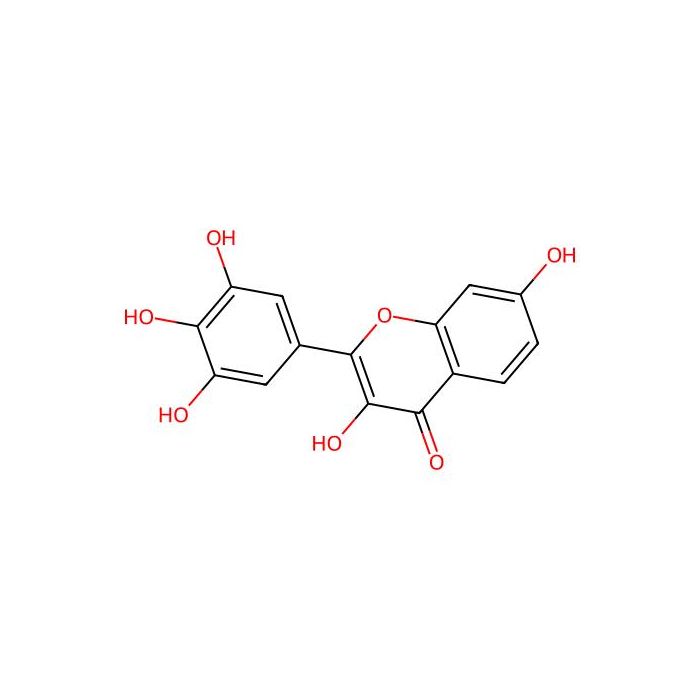
Robinetin (3,3',4',5',7-Pentahydroxyflavone), a naturally occurring flavonoid with remarkable ‘two color’ intrinsic fluorescence properties, has antifungal, antiviral, antibacterial, antimutagenesis, and antioxidant activity. Robinetin also can inhibit lipid peroxidation and protein glycosylation.
In Vitro
Robinetin (0.1-10 μM; 1 h) inhibits HIV integrase cleavage and integration in a dose-dependent manner. Robinetin inhibits the DNA synthesis in Proteus vulgaris , and the RNA synthesis in S. aureus. Robinetin (100-200 or 25 μM; 1 or 72 h) inhibits egg yolk phosphatidylcholine (EYPC) membrane lipid peroxidation and hemoglobin A (HbA) glycosylation with high efficiency. Robinetin exhibits photo-induced excited-state intramolecular proton transfer resulting in ‘two color’ (in ‘blue-violet’ and ‘yellow-green’ regions) fluorescence characteristic of flavonols, the relative contributions between the two colors being strongly modulated by the local environment of the fluorophore. MCE has not independently confirmed the accuracy of these methods. They are for reference only.
Spezifikationen
Spezifikationen & Reinheit
10mM in DMSO
Biochemische und physiologische Mechanismen
Robinetin (3,3',4',5',7-Pentahydroxyflavone), a naturally occurring flavonoid with remarkable ‘two color’ intrinsic fluorescence properties, has antifungal , antiviral , antibacterial , antimutagenesis, and antioxidant activity. Robinetin also can inhibit
Storage
Protected from light,Argon charged,Store at -80°C
Verschickt in
Dry ice packs + Cold packs
Dieses Produkt erfordert Kühlkettenversand. Grundversand und andere Economy-Optionen sind nicht verfügbar.
Namen und Kennungen
Isomere SMILES
C1=CC2=C(C=C1O)OC(=C(C2=O)O)C3=CC(=C(C(=C3)O)O)O
PubChem CID
5281692
Molekulargewicht
302.24
Erweiterte Daten
Zertifikate (CoA, COO, BSE/TSE und Analyse-Diagramm)
Determine the necessary mass, volume, or concentration for preparing a solution.
Dilution Calculator
Determine the dilution needed to prepare a stock solution.
Reconstitution Calculator
Bewertungen
Kundenbewertungen
Application Protocols
No manufacturer-tested application protocols are provided for this item. The following are general, literature-informed examples to aid experimental planning (not validated for this lot):
Preparation of DMSO stock solution (general):
Weigh compound quickly under low light. Dissolve in anhydrous, degassed DMSO to 10–50 mM. Vortex and sonicate briefly if needed. Filter (0.22 µm PTFE) for analytical work. Aliquot under argon, store at −80°C.
Antioxidant assay (DPPH) reference run (general):
Prepare DPPH solution in MeOH (e.g., 100 µM). Dilute robinetin DMSO stock into MeOH to a series of concentrations, keeping DMSO ≤1% v/v. Incubate mixtures in the dark at room temperature 30 min. Measure A517 and calculate % scavenging vs. blank; include a known standard for comparison.
HPLC method development (general):
Column: C18, 100 × 2.1 mm, 1.7–3 µm. Mobile A: water + 0.1% formic acid; Mobile B: acetonitrile. Gradient 5→40% B over 10–15 min at 0.3 mL/min, 30°C. Detect at 254, 280, and 360 nm. For LC–MS, switch to volatile buffers and reduce acid if needed for ESI(−).
Always confirm solubility/stability in your exact matrices and consult the SDS and CoA for product-specific constraints.
Biological Roles
Literature context (not product-specific; no clinical/therapeutic claims):
Source and function: Robinetin is a plant-derived flavonol implicated in defense and signaling, contributing to antioxidative capacity, UV protection, and pigmentation. It has been reported in species such as Robinia spp., consistent with its name.
Chemical biology features:
Redox-active polyphenol capable of radical scavenging and metal chelation; can modulate oxidative chemistry in vitro.
Binds to proteins via hydrogen bonding and π–π interactions; can precipitate proteins at high concentrations (a general trait of polyphenols/tannins).
Exhibits characteristic UV–Vis and fluorescence behaviors arising from its conjugated chromophore, enabling spectroscopic tracking in biochemical assays.
Metabolism and conjugation (general):
In biological systems, polyphenols are often subject to Phase II conjugation (glucuronidation, sulfation, methylation) that alters solubility and reactivity; such transformations are commonly studied in microsomes or cell lysates.
Note: The above summarizes general biochemical roles of flavonols for research design; it does not imply any therapeutic utility.
Buffer Applications
Robinetin is not a buffering reagent and is not typically used to prepare pH buffer systems. In biochemical assays it is introduced as a solute (often from DMSO stocks) into pre-made buffers.
Practical notes (general):
If dissolution in aqueous buffer is required, limited amounts of DMSO or ethanol (≤1–2% v/v) can be used as cosolvent.
Avoid strongly basic buffers unless necessary; if used, work under inert atmosphere and consider including antioxidants to limit oxidative degradation.
Green Alternatives
As a solid flavonol, “green alternatives” primarily concern solvent and process choices rather than replacement of the compound itself.
Greener solvent choices (literature/general):
Prefer ethanol or water/ethanol mixtures (with pH control) over chlorinated solvents for extractions and recrystallizations, when chemically compatible.
For stock solutions, DMSO is often necessary for solubility; where feasible, use bio-based solvents (Cyrene, 2-MeTHF) for synthetic transformations instead of DMF/THF, subject to solubility/reactivity.
Process considerations:
Minimize air/light exposure to reduce waste from degradation.
Employ microscale assays and high-throughput formats to cut solvent use.
Trade-offs:
Ethanol/water systems may require basic pH to dissolve polyphenols, which can accelerate oxidation; inert atmosphere and antioxidants may be needed, offsetting some green benefits.
Comparison snapshot (general):
DMF vs Cyrene: Cyrene can replace DMF in some coupling/acylation steps; however, phenol acylations and glycosylations may show different kinetics/solubilities.
THF vs 2‑MeTHF: 2‑MeTHF offers better renewability and safety; for phenolic protections and Mitsunobu-like steps it can be suitable, but solubility of highly polar flavonols may still necessitate DMSO/DMF cosolvent.
Pharmaceutical Uses
No pharmacopeial or excipient grade information is provided for this item. Robinetin is supplied for research use only.
General, non-clinical context (literature/industry practice):
Analytical reference: Can serve as a reference standard for quality control of botanical extracts containing related flavonols (e.g., chromatographic marker, system suitability, calibration).
Preformulation research: Polyphenols like robinetin are used in excipient compatibility and solubility screening studies (e.g., complexation with cyclodextrins, lipid vehicles) to understand formulation behaviors in vitro.
Note: No medical or therapeutic claims are made. This product is not intended for use in drug products without appropriate qualification and regulatory assessment.
Physical Properties
Item-specific physical specifications (appearance, exact purity, residuals, cutoffs) are not provided. Do not treat literature values below as specifications for this lot.
Literature/compiled properties (for general reference):
Molecular weight: ~302.24 g/mol (literature)
Molecular formula: C15H10O7 (literature)
Physical state: polyphenolic solid (literature description of flavonols)
Solubility: sparingly soluble in water; soluble in polar aprotic solvents such as DMSO and DMF; limited solubility in ethanol/methanol unless warmed or basified (literature, typical for flavonols).
pKa values: multiple phenolic pKa’s typically in the ~6–10 range depending on substitution and medium (literature, general for flavonols); deprotonation markedly increases aqueous solubility.
Partitioning: expected moderate polarity with multiple H-bond donors/acceptors; logP often in the low-to-moderate range for flavonols but highly method-dependent (literature, general guidance).
UV–Vis: flavonols typically exhibit two main absorption bands (Band II ~240–280 nm; Band I ~340–390 nm) associated with the A- and B-ring transitions (literature, general for flavonols). Exact maxima for robinetin should be confirmed experimentally.
Item-specific values not supplied:
Melting point: Not specified for this item; refer to CoA/Spec Sheet.
Boiling point: Not applicable (decomposes); Not specified for this item; refer to CoA/Spec Sheet.
Density, refractive index, water/peroxide/metal limits, UV cutoff: Not specified for this item; refer to CoA/Spec Sheet.
Quality and Grades
Item-specific grade/purity and appearance are not provided in the Product Data. For exact grade definitions (e.g., ≥98%, reference standard grade, screening library grade), consult the Certificate of Analysis (CoA) and Specification Sheet accompanying this lot.
How to interpret common grades (general guidance):
Reference/Analytical standard: Tight ID/assay limits, low related substances; suitable for chromatographic calibration and quantitation in botanical/phytochemical QC.
Research or Screening grade: Fit-for-purpose purity for biochemical screening and SAR; may have broader limits on minor impurities.
HPLC grade (for solvents) and USP/EP grades are not applicable here.
O‑Acylation and O‑alkylation to modulate solubility or protect phenols; selective protection often uses silyl or benzyl groups with strategic order to address differential phenolic acidity.
Glycosylation (Koenigs–Knorr, trichloroacetimidate donors, Mitsunobu-mediated) at 3‑OH or ring phenols to access natural glycosides.
Complexation with metals to form coordination compounds for materials/analytical studies.
Practical tips:
Use anhydrous, oxygen- and light-minimized conditions; include BHT or ascorbate if oxidative darkening is observed in solution (general practice).
For LC–MS: negative ESI typically gives intense [M–H]−; fragmentation often shows retro-Diels–Alder patterns common to flavonoids (literature trend).
Note: No manufacturer-specific application notes were provided; the above are typical literature applications for robinetin and closely related flavonols.
Reaction Conditions
General literature guidance for transformations of polyhydroxy flavonols like robinetin (for planning purposes; verify experimentally):
O‑Acylation/O‑Alkylation:
Typical reagents: Ac2O/pyridine or acid chlorides with base (Et3N, pyridine); alkyl halides with K2CO3/Cs2CO3 in DMF/acetone.
Solvents: Dry DMF, acetone, or MeCN; DMSO for difficult solubility (may require phase-transfer catalysts).
Temperature: 0–25°C for acylation; 25–60°C for alkylation.
Notes: Control stoichiometry and order of addition to manage selectivity across multiple OH groups; monitor by UPLC-DAD.
Glycosylation (installation of O‑glycosides):
Donors: Peracetylated glycosyl bromides (Ag2CO3/AgOTf promotion) or trichloroacetimidates (TMSOTf/BF3·OEt2 activation).
Solvents: Anhydrous DCM, toluene, or 1,2‑dichloroethane; often with molecular sieves.
Temperature: −40 to 0°C to favor desired anomers; gradual warm-up.
Protection/Deprotection:
Silylation: TBSCl/imidazole (DMF) or TMSCl with base; deprotect with TBAF or mild acid as orthogonal handles.
Benzylation: BnBr/K2CO3; hydrogenolysis (Pd/C, H2) for deprotection.
Metal complexation studies:
Conditions: Alcoholic or aqueous/alcoholic media; adjust pH to deprotonate chelating OH’s (pH 6–9), inert atmosphere to limit oxidation; characterize by UV–Vis shifts and HRMS.
Analytical:
LC–MS: ESI(−) favored; mobile phases with 0.1% formic acid or ammonium acetate buffers improve peak shape (optimize for system).
Safety and Handling
Research use: For research use only. Not for human or veterinary use.
GHS/SDS: Item-specific GHS classification, pictograms, signal word, and H-statements are not provided here. Always consult the product SDS for authoritative safety information.
General safety considerations for polyphenolic flavonols (literature/experience-based; not product-specific):
Hazards: May cause skin/eye irritation and respiratory tract irritation as a fine powder. Dust may form combustible mixtures with air; avoid dust clouds and ignition sources.
PPE: Wear lab coat, safety glasses/goggles, and appropriate chemical-resistant gloves (e.g., nitrile). Use in a fume hood to avoid inhalation of dust/aerosols.
Handling: Hygroscopicity can vary; minimize exposure to ambient moisture and air. Given the supplier’s guidance (argon charged; protect from light), handle under inert atmosphere when feasible and limit light exposure.
Incompatibilities: Strong oxidizers; strong bases promote rapid phenolate formation and potential oxidation/discoloration. Transition metals can form complexes and catalyze oxidative degradation.
First aid (summary; defer to SDS):
Inhalation: Move to fresh air; seek medical attention if symptoms persist.
Skin: Wash with soap and water; remove contaminated clothing.
Eyes: Rinse cautiously with water for several minutes; remove contact lenses if present and easy; continue rinsing.
Ingestion: Rinse mouth; seek medical advice.
Spill/Disposal: Avoid dust generation; collect with dampened inert absorbent. Dispose of contents/container according to local regulations and institutional protocols.
Solvent Selection
Robinetin is a polyphenolic solid with limited aqueous solubility but good solubility in polar aprotic media.
Water: Poorly soluble at neutral pH; solubility increases upon basification (formation of phenolates) but may risk oxidation.
DMSO/DMF: Readily soluble; preferred for stock solutions for biochemical screening and analytical work.
Alcohols (MeOH/EtOH): Moderate solubility; warming or minimal base can aid dissolution; protect from air/light.
Acetone/Acetonitrile: Limited-to-moderate solubility depending on water content; DMSO cosolvent often used.
Practical strategies:
Prepare concentrated stocks in dry, degassed DMSO (e.g., 10–50 mM), aliquot, and store at -80°C under inert gas.
For aqueous assays, dilute DMSO stock into buffer to a final DMSO content typically ≤1–2% v/v to avoid assay interference (general practice).
Avoid strong basic aqueous media unless necessary; if used, degas and include antioxidants (e.g., ascorbate) to mitigate oxidation (general tip).
Comparison (general):
DMSO vs ethanol: DMSO offers higher solubility and stability for polyphenols; ethanol is more volatile and may precipitate compound upon aqueous dilution.
DMF can substitute DMSO for some synthetic operations but is less favored for bioassays due to toxicity concerns.
Storage and Reconstitution
Supplied storage guidance (item-specific):
Protect from light.
Argon charged.
Store at −80°C.
Shipped on dry ice packs + cold packs.
Practical recommendations (aligned with the above):
Upon receipt, keep container closed and cold. Allow to equilibrate to room temperature in a desiccator before opening to prevent moisture condensation.
If frequent use is expected, prepare single-use aliquots in anhydrous, degassed DMSO or DMF under inert gas. Backfill vials with argon or nitrogen before re-freezing.
Avoid repeated freeze–thaw cycles; thaw aliquots only once. Maintain samples in amber vials or wrap in foil to minimize light exposure.
For aqueous work, dilute organic stock directly into buffer immediately before use; minimize time in basic or oxygenated media to reduce oxidation.
Item-specific unknowns (consult CoA/Spec Sheet):
Appearance, assay/purity, water content, residual solvents, and exact stabilizers (if any) are Not specified for this item; refer to CoA/Spec Sheet.
Structure and Identity
Robinetin is a polyhydroxylated flavonol (flavone core with a 3-hydroxyl), commonly encountered as a plant secondary metabolite and analytical reference standard.
Item-specific identifiers (from Product Data):
SKU: R656126
CAS: 490-31-3
Category: Small molecules and compound library (非临床研究用)
InChIKey: Not specified for this item; refer to CoA/Spec Sheet.
SMILES: Not specified for this item; refer to CoA/Spec Sheet.
Literature identifiers and composition (informational; not item specifications):
Common name: Robinetin; systematic description: a pentahydroxyflavonol
Molecular formula (literature): C15H10O7
Molecular weight (literature): 302.24 g/mol
Synoptic structure (2D, textual): A 15-carbon flavonol scaffold with a 1,3-benzodioxinone-like conjugated system (chromen-4-one core), bearing phenolic OH at C-3 (C-ring) and on the A/B rings; the B-ring is typically trihydroxylated (3′,4′,5′), while the A/C rings carry 3- and 7-OH (overall five phenolic OH groups). Planar, highly conjugated polyphenol with intramolecular H-bonding potential.
Key structural features (general chemistry):
Functional groups: phenols (×5), conjugated ketone (4-one), aryl–ether linkage within the flavonol backbone.
Aromaticity across two rings with a heteroaromatic chromenone; extended π-system conducive to UV absorption and redox activity.
Multiple hydrogen-bond donors/acceptors; good metal-chelating motifs (3-OH/4-oxo and catechol-like arrays).
Synthetic Utility
Robinetin offers a dense array of phenolic handles on a rigid, conjugated flavonol core, enabling diverse derivatizations.
Functional group leverage (literature/general):
Phenolic O‑acylation/alkylation to tune lipophilicity and protect groups for multistep synthesis.
Selective protection strategies exploiting differential acidity/sterics (e.g., transient silyl protection on more acidic 3‑OH, benzyl protections for orthogonality).
Electrophilic aromatic substitution on suitably activated rings is generally disfavored; instead, transformations proceed via O‑functionalization or via ring-opening of the C‑ring under specialized conditions.
Metal complex formation using the 3‑OH/4‑oxo chelation site and catechol-like sites for materials and catalysis studies.
Access to derivatives:
Glycosides via Koenigs–Knorr, trichloroacetimidate donors, or Mitsunobu to install natural sugar patterns at 3‑OH or ring phenols.
Ether/ester prodrugs (research) to modulate permeability/solubility in chemical biology studies.
Retrosynthetic perspective:
The flavonol core can be assembled via Algar–Flynn–Oyamada oxidation from 2′‑hydroxychalcones or via oxidative cyclization of appropriate chalcones; these routes inform late-stage diversification on the natural scaffold.
Target Specificity
Not applicable. This product is a small-molecule flavonol, not a biological targeting reagent (e.g., antibody, aptamer, inhibitor with defined protein selectivity in this listing). No target specificity data are provided in the Product Data.
Wir verwenden Cookies, um die ordnungsgemäße Funktion der Website sicherzustellen und, soweit zulässig, Ihr Nutzererlebnis zu verbessern. Sie können Ihre Einstellungen jederzeit unter „Einstellungen“ verwalten. Weitere Informationen finden Sie in unserer Cookie-Richtlinie.
Dürfen wir Sie über Rabattaktionen informieren?
Später erinnern
Vielen Dank! Bitte überprüfen Sie Ihren E-Mail-Posteingang, um zu bestätigen.
Products are supplied to verified businesses, institutions, and qualified professionals for research and development use only. Not for use in humans, animals, diagnosis, or therapy.