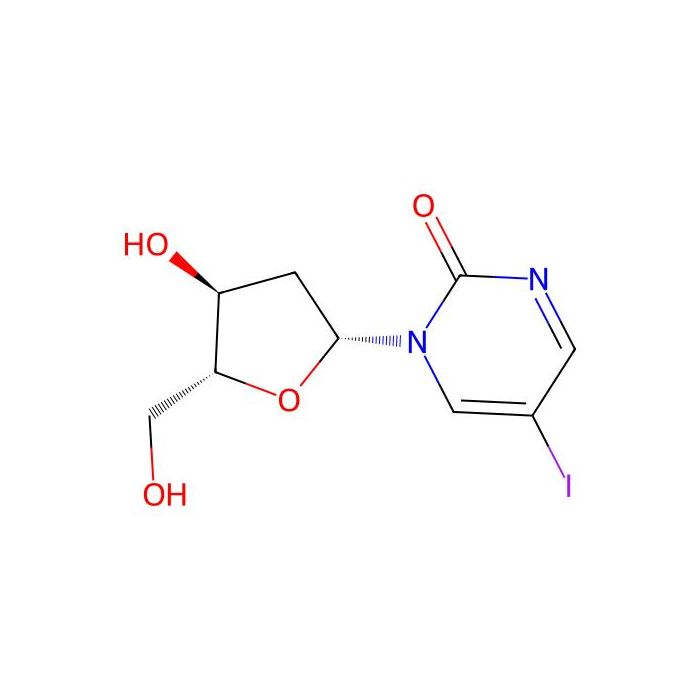
10mM in DMSO for sensitive chromatographic and analytical workflows requiring minimal baseline interference.
🌡
Storage & shipping
Store at -80°C Ships Dry ice packs + Cold packs Check lot-specific COA for exact specifications.
📋
Quality documents
SDS, COA, datasheet, and spec sheet available for download. Lot-specific COA accessible via lot number lookup.
📚
Literature proof
Cited in 0 peer-reviewed publications across chromatography, organic synthesis, and cross-coupling reactions.
Übersicht
Ropidoxuridine (IPdR) is a novel orally available, halogenated thymidine analog and is a potential radiosensitizer for use in human tumors.
In Vitro
Ropidoxuridine is an orally bioavailable pro-drug of IUdR (5-iodo-2'-deoxyuridine). Ropidoxuridine demonstrates strong synergy effects with Alisertib at clinically relevant concentrations. MCE has not independently confirmed the accuracy of these methods. They are for reference only.
In Vivo
In an orthotopic tumor model, Ropidoxuridine (750 mg/kg/day) and Alisertib (30 mg/kg/day) demonstrate strong synergy effects . MCE has not independently confirmed the accuracy of these methods. They are for reference only.
Specifications
Spezifikationen & Reinheit
10mM in DMSO
Biochemische und physiologische Mechanismen
Ropidoxuridine (IPdR) is a novel orally available, halogenated thymidine analog and is a potential radiosensitizer for use in human tumors.
Storage
Store at -80°C
Verschickt in
Dry ice packs + Cold packs
Dieses Produkt erfordert Kühlkettenversand. Grundversand und andere Economy-Optionen sind nicht verfügbar.
Zertifikate (CoA, COO, BSE/TSE und Analyse-Diagramm)
C of A & Other Certificates(BSE/TSE, COO):
Analytical Chart:
Lösungsrechner
Molarity Calculator
Determine the necessary mass, volume, or concentration for preparing a solution.
Dilution Calculator
Determine the dilution needed to prepare a stock solution.
Reconstitution Calculator
Bewertungen
Kundenbewertungen
Application Protocols
Tested/validated applications: Not specified for this item.
Recommended conditions, dilutions, or positive controls: Not specified for this item.
General note: Application parameters are assay- and lab-specific. Consult primary literature and validate conditions locally for your workflow (analytical, biochemical, or synthetic).
Biological Roles
General/literature context (no medical claims)
Ropidoxuridine is an iodinated deoxynucleoside analog of the uracil family. Such analogs can be processed by cellular nucleoside transporters and metabolizing enzymes (e.g., thymidine kinase, uridine phosphorylase) in vitro, generating phosphorylated species relevant to DNA synthesis pathways.
Incorporation potential: iodinated pyrimidines are studied for incorporation into replicating DNA in cell-free or cellular research models, enabling biophysical and analytical interrogation of DNA structure, repair, and radiosensitization mechanisms (research context only).
Spectroscopic/analytical role: the heavy-atom iodine imparts distinctive mass and X-ray scattering characteristics, facilitating detection, quantitation, and structural studies.
Enzymology: as a uracil-base nucleoside analog, it can serve as a substrate, inhibitor, or probe for glycosidic bond–processing enzymes in biochemical assays, allowing kinetic analyses (Km, Vmax) and mechanistic elucidation (literature-driven experimental designs).
Practical notes for bioscience workflows (general)
Prepare freshly in sterile water or DMSO; filter sterilize (0.2 µm) where sterility is required.
Control for cytotoxicity and off-target effects in cell assays by including proper vehicle controls and concentration–response designs; verify compound identity and purity prior to mechanistic studies.
For isotope or halogen tracing, leverage iodine’s isotopic pattern in MS to confirm uptake/metabolite formation.
Buffer Applications
Not a buffering reagent.
Practical guidance (general)
While ropidoxuridine is not used to control pH, it can be dissolved in common biological buffers (e.g., phosphate, HEPES) for research assays if chemically compatible.
Prepare concentrated stock in DMSO or water and dilute into the working buffer; confirm stability at the chosen pH (avoid strong acid/base and prolonged heating).
If precipitation occurs upon dilution, increase dilution rate, adjust temperature slightly, or introduce a small percentage of co-solvent (e.g., 0.1–1% DMSO) compatible with the assay.
Green Alternatives
Context
Ropidoxuridine is a solid reagent rather than a bulk organic solvent. Green-by-design efforts focus on solvent choices, protecting groups, and coupling conditions used around this molecule.
Greener handling and synthesis options (general guidance)
Solvent selection: prefer water, ethanol, or water/DMSO mixtures for dissolution where compatible with the assay. For cross-couplings at C5, consider aqueous micellar catalysis (TPGS-750-M, Savie) or bio-based solvents (2-MeTHF) instead of DMF/DMF–toluene.
Catalysis: employ Pd at ppm levels with robust ligands (e.g., SPhos/XPhos systems) or explore Ni catalysis to reduce precious-metal usage; recover and recycle catalysts when feasible.
Protecting-group economy: minimize protection/deprotection steps on the sugar by using chemoselective coupling conditions; when protection is required, select removable groups under mild, low-waste conditions (e.g., carbonate-based or enzymatic methods).
Workup/waste: aqueous workups with minimal halogenated solvent use; capture iodine-containing wastes separately for appropriate disposal.
Comparison (general)
Traditional approach: DMF or dioxane, stoichiometric bases, elevated temperatures.
Greener alternative: water or EtOH with micellar catalysis, carbonate bases, ambient to moderate temperatures, reduced solvent volumes.
Trade-offs
While greener media can reduce environmental impact, solubility and catalyst turnover may require optimization; analytical baselines can shift with surfactants and bio-based solvents.
Pharmaceutical Uses
Item-specific regulatory/compendial status: Not specified for this item; refer to CoA/Spec Sheet.
Research/formulation context only (no therapeutic claims)
As an iodinated nucleoside analog, ropidoxuridine may be used in pharmaceutical research laboratories as a reference standard, for impurity profiling, or for preformulation studies exploring solubility, stability, and compatibility with excipients.
Useful in analytical method development (HPLC/LC–MS) to establish retention, ionization efficiency, and detection limits for iodinated nucleosides in complex matrices.
Excipient role: none known; this compound is an active small-molecule research reagent rather than a common excipient.
Development considerations (general)
Assess polymorphism, hydrate formation, and solution stability across pH 3–8 under ICH-like stress conditions when designing formulation feasibility studies.
Track potential degradants: deiodination, glycosidic cleavage, and base/sugar modifications under oxidative or acidic/basic stress (analytical development guidance).
Physical Properties
Item-specific values
Melting point, boiling point, density, refractive index, solubility, logP/logD, pKa: Not specified for this item; refer to CoA/Spec Sheet.
General/literature expectations for iodinated deoxynucleosides (informational only)
Physical state: typically a crystalline solid due to extensive hydrogen bonding motifs from the sugar hydroxyls and the lactam base.
Solubility profile: nucleoside analogs commonly exhibit good solubility in polar protic solvents (water, aqueous buffers) and polar aprotic solvents (DMSO, DMF); solubility may improve with gentle warming or pH adjustment toward neutrality. Avoid strong base which can promote glycosidic cleavage.
Acidity/basicity: the pyrimidinone ring presents a weakly acidic N–H and a carbonyl able to engage in H-bonding; overall molecule is neutral at physiological pH (literature, qualitative).
Halogen effect: the 5-iodo substituent increases molecular weight and polarizability, often decreasing aqueous solubility versus the non-halogenated parent but enabling distinctive UV absorbance and reactivity at C5 (literature).
Practical notes (general guidance)
For analytical work, dissolution in high-purity water or DMSO is commonly effective. Filter (0.2 µm) if particulates persist.
Hygroscopicity can be observed for some nucleosides; work rapidly in a dry environment and record mass promptly to ensure accurate preparation of solutions.
Quality and Grades
Item-specific grade/purity: Not specified for this item; refer to CoA/Spec Sheet.
Interpreting grades (general guidance for small-molecule research reagents)
Research grade: suitable for discovery research, screening, method development, and synthetic work. For trace-analytical or regulatory applications, verify impurity profiles with a current CoA.
HPLC or LC–MS suitability (if applicable to a future lot): low non-volatile residue and low UV background are preferred for analytical workflows; confirm with CoA if critical.
Nucleoside-specific considerations: hydration state and counter-ions (if salt forms) can influence assay reproducibility and mass balance. Verify form (free base vs salt), water content (Karl Fischer), and residual solvent profile on the CoA when precision is required.
Stabilizers/additives
None are indicated in the Product Data. If stabilizers or antioxidants are present in a given lot, they will be disclosed on the CoA; assess potential assay interference accordingly.
Documentation
For definitive specifications (assay/purity, identity, residual solvents, water content, appearance), rely on the lot-specific Certificate of Analysis and Specification Sheet.
Reaction and Applications
Research application themes (general; expand-on-manufacturer placeholder)
Reference material for nucleoside metabolism studies (e.g., enzymatic activation by nucleoside kinases and phosphorolysis by nucleoside phosphorylases) in biochemical assays.
Radiobiology and DNA-incorporation research: iodinated pyrimidine nucleosides are studied for incorporation into replicating DNA and for halogen-dependent physicochemical effects on duplex stability (in vitro; no clinical claims).
Analytical standard/control for LC–MS method development involving iodinated nucleosides (optimize ionization, in-source fragmentation, and iodine-specific isotopic signatures).
C5–I provides a handle for cross-coupling (Suzuki–Miyaura, Sonogashira, Stille) to generate C5-aryl/alkynyl derivatives under Pd catalysis with nucleoside-compatible conditions (aqueous DMF/THF, mild base). Protect sugar hydroxyls as needed (TBDMS, acetyl) to achieve chemoselectivity.
Late-stage functionalization on the base (electrophilic substitution at C5 is already achieved by I; further N- or O-functionalization can be tuned via protecting-group strategies).
Practical tips
For biochemical assays, prepare fresh aqueous or DMSO stocks; avoid repeated freeze–thaw of hydrated solids.
For Pd-catalyzed couplings, maintain anhydrous conditions unless using designed aqueous protocols; consider phase-transfer or micellar systems for greener media. Monitor by HPLC-UV at nucleoside wavelengths (literature: strong absorbance ~260–280 nm for pyrimidines).
Reaction Conditions
General conditions for key transformations on iodopyrimidinone nucleosides (literature guidance)
Suzuki–Miyaura coupling (C5–I → C5–Csp2):
Catalyst: Pd2(dba)3 (0.5–2 mol%) with SPhos/XPhos; or Pd(PPh3)4 (1–5 mol%).
Base: K2CO3, Cs2CO3, or K3PO4 (2–3 equiv).
Solvent: DMF/H2O, THF/H2O, or micellar H2O; 25–80 °C; 2–16 h.
Notes: Protect 3′/5′-OH if needed; avoid strong base and high temperatures that risk glycosidic cleavage.
Sonogashira coupling (C5–I → C5–Csp):
Catalyst: Pd(PPh3)2Cl2 (1–3 mol%) + CuI (5–10 mol%).
Base: Et3N or DIPEA; solvent: DMF or MeCN; 20–50 °C; 2–8 h.
Notes: Copper-free variants reduce side reactions; aqueous micellar media are possible.
N-Glycosidic stability:
Avoid strong acids/bases and prolonged heating; maintain neutral to mildly basic conditions for cross-couplings.
Workup and purification
Quench into water, extract if compatible or use reversed-phase chromatography for polar products. Desalt and polish by preparative RP-HPLC when necessary.
Expected outcomes
Iodide is a superb leaving group; C5 cross-couplings generally provide moderate to high yields under optimized conditions on protected nucleosides (literature). Carefully validate on the specific substrate and protection pattern used.
Safety and Handling
GHS/SDS information (item-specific)
Signal Word: Not specified for this item; refer to SDS.
Hazard (H-) Statements: Not specified for this item; refer to SDS.
GHS Classification and Pictograms: Not specified for this item; refer to SDS.
General laboratory precautions (best practice; not a substitute for SDS)
Personal protective equipment: lab coat, safety glasses, and appropriate chemically resistant gloves (e.g., nitrile). Handle powders in a fume hood to avoid inhalation of dust/aerosols.
Avoid contact with skin and eyes. Prevent ingestion and inhalation. Wash thoroughly after handling.
Incompatibilities (general for nucleosides): strong acids/bases and strong oxidizers can degrade the glycosidic linkage or modify the heterocycle. Avoid prolonged elevated temperatures.
Thermal decomposition may produce iodine-containing fumes; ensure adequate ventilation.
First-aid overview (general)
Inhalation: move to fresh air; seek medical attention if symptoms persist.
Skin/eye contact: rinse with water for several minutes; remove contaminated clothing; seek medical attention if irritation persists.
Ingestion: rinse mouth; seek medical attention.
Waste disposal
Dispose of iodine-containing organic waste in accordance with institutional and local regulations. Collect solutions and solids in halogenated-organic waste streams as applicable.
Always consult the product’s SDS for authoritative hazard classification and response measures.
Solvent Selection
Intended use context: small-molecule iodinated deoxynucleoside analog.
Solubility strategy (general/literature guidance)
Primary solvents: water (neutral pH), aqueous buffers (phosphate, HEPES), and polar aprotic solvents (DMSO, DMF) are commonly suitable for nucleosides.
Co-solvent approaches: for concentrated stock solutions, prepare 10–100 mM in DMSO, then dilute into aqueous media while maintaining final DMSO ≤0.1–1% v/v to limit assay interference.
pH effects: avoid strong base (>pH 9) or strong acid (<pH 3) during extended storage or heating to reduce risk of glycosidic cleavage or deiodination (general nucleoside guidance).
Polarity and dielectric context (general)
Highly polar, H-bonding solute. Effective dissolution correlates with solvents of high dielectric constant capable of H-bond donation/acceptance (water, methanol, DMSO).
Practical comparison (general)
Water/buffer: best for biological assays; may have limited solubility ceiling; gentle warming and sonication can help.
DMSO: excellent for high-concentration stocks; miscible with water; monitor hygroscopic uptake.
Methanol/ethanol: may dissolve at modest levels but can complicate bioassays; use primarily for analytical sample prep.
Filtration and sterilization
For cell-based research, prepare through 0.2 µm sterile filters after dissolution in an appropriate sterile solvent. Verify chemical compatibility of filter media (PES or PTFE) with chosen solvent.
Storage and Reconstitution
Storage (item-specific from Product Data)
Store at -80 °C.
Shipped on dry ice packs + cold packs to maintain a low-temperature chain.
Handling and stability (general guidance for nucleoside solids)
Allow the shipping container to equilibrate to room temperature before opening to prevent condensation. Minimize exposure to ambient humidity; promptly re-cap under dry conditions.
For short-term working stocks (days to a week), -20 °C storage in tightly sealed, desiccated containers is commonly used; for long-term stability follow the specified -80 °C storage.
Avoid repeated freeze–thaw cycles. Aliquot the solid or prepared solutions into single-use vials.
Reconstitution (general guidance)
Prepare concentrated stocks in high-purity water or DMSO. Typical research stocks are 10–100 mM depending on solubility and intended use. Filter sterilize (0.2 µm) if sterility is required.
For aqueous solutions, maintain near-neutral pH and store at ≤-20 °C protected from light for short periods; verify stability by HPLC before critical experiments.
Documentation
Because no item-specific solubility or stability constants are provided, confirm concentration by UV/LC–MS where possible and consult the lot-specific CoA/Spec Sheet for any additional storage or handling instructions.
Research Use Only: as stated in Product Data.
Structure and Identity
Item-specific identifiers
CAS: 93265-81-7 (Product Data)
CID: 9840777 (Product Data)
InChIKey: Not specified for this item; refer to CoA/Spec Sheet.
SMILES: Not specified for this item; refer to CoA/Spec Sheet.
Molecular Formula: Not specified for this item; refer to CoA/Spec Sheet.
Molecular Weight: Not specified for this item; refer to CoA/Spec Sheet.
Structural features (general/literature description for ropidoxuridine)
Ropidoxuridine is an iodinated deoxynucleoside analog structurally related to uracil nucleosides.
Typical scaffold: a β-2′-deoxyribofuranose linked via an N-glycosidic bond to a 2(1H)-pyrimidinone base bearing an iodine at the 5-position (5-iodopyrimidinone). The ring system is a six-membered pyrimidine with two nitrogens (positions 1 and 3) and a carbonyl at C2 (lactam tautomer), analogous to the uracil core.
Functional groups: heteroaromatic lactam (pyrimidinone), aryl iodide (C–I at C5 of the base), multiple secondary alcohols on the sugar (2′-deoxy: OH at 3′ and 5′), and an N-glycosidic C1′–N bond.
Stereochemistry (literature, typical for 2′-deoxyribosides): D-configuration at the sugar with defined stereocenters at C1′, C3′, and C4′; β-anomeric linkage at C1′ to the nucleobase.
2D structural description (general/literature)
A five-membered furanose ring (deoxyribose) bearing a primary hydroxymethyl at 5′ and a secondary hydroxyl at 3′; the anomeric C1′ is bonded to the N1 of a substituted pyrimidinone. The pyrimidine ring carries a carbonyl at C2 and an iodine substituent at C5, with typical conjugation across the ring.
Synthetic Utility
Functional group handles (general/literature for iodinated pyrimidine nucleosides)
C5–I on the pyrimidine ring: versatile site for cross-coupling (Suzuki, Sonogashira, Stille, Negishi) to install aryl, vinyl, alkynyl groups, enabling SAR exploration and probe synthesis.
Sugar hydroxyls (3′, 5′): amenable to protection (TBDMS, TBS, acetyl, benzoyl) for selective transformations; 5′-OH can be phosphorylated (e.g., phosphoramidite chemistry) to access nucleotide derivatives.
Lactam (2-pyrimidinone): participates in H-bonding; can be N-alkylated/acylated under controlled conditions, though selectivity vs glycosidic stability must be managed.
Retrosynthetic value
Serves as a platform for constructing libraries of C5-substituted nucleosides while preserving the deoxyribose framework; enables late-stage diversification on a common core.
Suzuki–Miyaura at C5: Pd(0)/phosphine ligand, base (K2CO3, Cs2CO3), aqueous DMF/THF, 25–80 °C; good chemoselectivity with protected sugars.
Sonogashira: Pd/Cu co-catalysis, amine base (Et3N, DIPEA), DMF or mixed aqueous media; access to 5-alkynyl derivatives for click-style elaboration.
Deprotection sequences: fluoride-mediated (for silyl protections) or basic methanolysis (for esters) under mild conditions to preserve the glycosidic bond.
Analytical control
Monitor reactions by HPLC-UV (pyrimidine λmax ca. 260–280 nm, literature) and LC–MS exploiting iodine’s isotopic signature; verify anomeric integrity and minimal sugar epimerization.
Target Specificity
Not an antibody, protein, or targeted biologic; target specificity data (antigen/epitope, species reactivity, clone, isotype) are not applicable.
For biochemical studies, any observed enzyme interactions (e.g., with nucleoside kinases or phosphorylases) should be determined experimentally under defined assay conditions. No item-specific target data are provided in the Product Data.
Wir verwenden Cookies, um die ordnungsgemäße Funktion der Website sicherzustellen und, soweit zulässig, Ihr Nutzererlebnis zu verbessern. Sie können Ihre Einstellungen jederzeit unter „Einstellungen“ verwalten. Weitere Informationen finden Sie in unserer Cookie-Richtlinie.
Shall we send you a message when we have discounts available?
Remind me later
Thank you! Please check your email inbox to confirm.
Products are supplied to verified businesses, institutions, and qualified professionals for research and development use only. Not for use in humans, animals, diagnosis, or therapy.