GRADE & PURITYMoligand™?Moligand™ — Aladdin's line of ligands and bioactive small molecules. Use for receptor, pathway, and binding studies needing defined small-molecule tools.10 mM in DMSO
Moligand™, 10 mM in DMSO Moligand™ for sensitive chromatographic and analytical workflows requiring minimal baseline interference.
🌡
Storage & shipping
Desiccated,Store at -80°C Ships Dry ice packs + Cold packs Check lot-specific COA for exact specifications.
📋
Quality documents
SDS, COA, datasheet, and spec sheet available for download. Lot-specific COA accessible via lot number lookup.
📚
Literature proof
Cited in 0 peer-reviewed publications across chromatography, organic synthesis, and cross-coupling reactions.
Übersicht
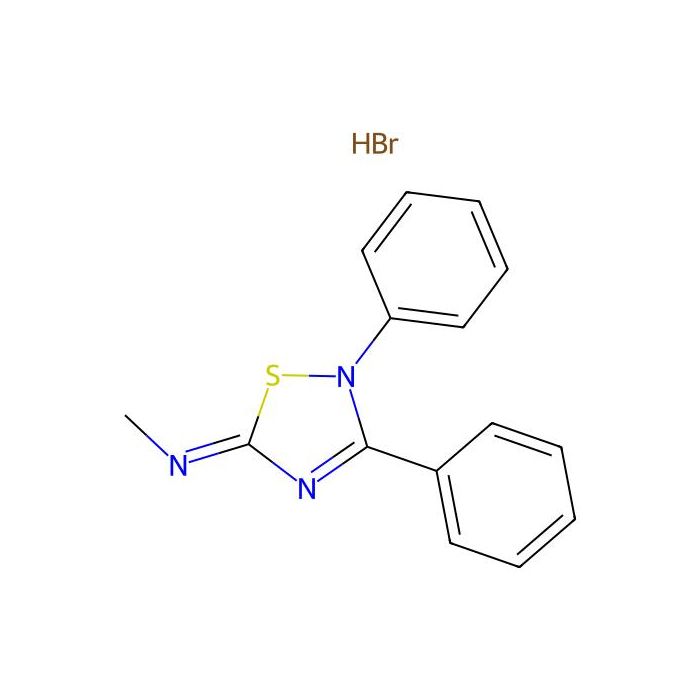
SCH-202676 hydrobromide is an allosteric modulator of G protein-coupled receptors ( GPCRs ) and adenosine receptor ( AR ). SCH-202676 hydrobromide has antiviral activity and inhibits 3CL pro in a time-dependent manner with an IC 50 value of 0.655 μM .
Specifications
Spezifikationen & Reinheit
Moligand™, 10 mM in DMSO
Storage
Desiccated,Store at -80°C
Verschickt in
Dry ice packs + Cold packs
Dieses Produkt erfordert Kühlkettenversand. Grundversand und andere Economy-Optionen sind nicht verfügbar.
Note
Moligand™
Namen und Kennungen
Isomere SMILES
CN=C1N=C(N(S1)C2=CC=CC=C2)C3=CC=CC=C3.Br
PubChem CID
11957689
Molekulargewicht
348.26
Documentation
📋 Safety Data Sheet (SDS)
Comprehensive hazard, handling, storage, and regulatory compliance document.
Zertifikate (CoA, COO, BSE/TSE und Analyse-Diagramm)
C of A & Other Certificates(BSE/TSE, COO):
Analytical Chart:
Lösungsrechner
Molarity Calculator
Determine the necessary mass, volume, or concentration for preparing a solution.
Dilution Calculator
Determine the dilution needed to prepare a stock solution.
Reconstitution Calculator
Bewertungen
Kundenbewertungen
Application Protocols
No tested applications or recommended dilutions are specified for this product.
General screening protocol outline (for small-molecule hydrobromide salts; adjust to your target system):
Stock solution: Prepare 10–50 mM in DMSO; store as single-use aliquots at ≤−20°C to −80°C.
Plate setup: Serially dilute in assay buffer (maintain constant DMSO % across wells). Include vehicle controls and known reference controls if available.
Incubation: Preincubate compound with target or cells as appropriate (5–60 min). Ensure plate sealing to minimize DMSO evaporation.
Readout: Follow the assay-specific detection method (fluorescence, luminescence, absorbance, radiometric, or electrophysiology). Check for interference via counter-screens.
Data analysis: Fit concentration–response curves (four-parameter logistic); report IC50/EC50 with confidence intervals and note assay conditions.
Please consult the product’s SDS and CoA/Spec Sheet for any item-specific recommendations if available.
Biological Roles
Item-specific biological target(s), pathways, and mechanism of action are Not specified for this item; refer to primary literature and the CoA/Spec Sheet if available.
General guidance for small-molecule hydrobromide salts used in research:
Such compounds are frequently evaluated as putative ligands, agonists/antagonists, or allosteric modulators in receptor, ion channel, transporter, or enzyme assays.
Hydrobromide salt formation can improve aqueous handling for in vitro studies, facilitating accurate dosing, rapid mixing, and reproducible exposure in biochemical and cellular systems.
When investigating biological roles:
Confirm identity and purity by orthogonal methods before mechanistic claims.
Use multiple assay modalities (biochemical, biophysical, cellular) to cross-validate activity and exclude artifacts (e.g., aggregation, redox cycling, fluorescence interference).
Assess stability in assay media (pH, temperature, protein binding) and potential conversion between salt and free base forms that may alter apparent potency.
Research use only: No medical, diagnostic, or clinical use is intended or permitted.
Buffer Applications
Not a buffer reagent. No item-specific buffer system data are provided.
General practical notes when using small-molecule hydrobromide salts in buffered assays:
Typical biological buffers: HEPES (pH 7.2–7.6), PBS (pH ~7.4), or citrate/phosphate (pH 5.5–7.0) depending on target stability.
Start with low ionic strength to minimize nonspecific binding; adjust as needed for protein stability and activity.
Verify compound solubility upon dilution into the final buffer composition (including salts, cofactors, and proteins). Consider adding a minimal percentage of DMSO to maintain solubility if permissible.
Green Alternatives
This product is a specific small-molecule hydrobromide salt supplied for discovery research rather than a commodity solvent or reagent where greener drop-in replacements are typical.
General considerations to improve sustainability when working with small-molecule libraries:
Solvent minimization: Use microvolume plates and miniaturized assays to reduce DMSO and buffer consumption.
Greener vehicles when feasible: Favor water or aqueous buffers over high percentages of organic cosolvents. Where DMSO is necessary, keep final v/v as low as assay performance allows.
Waste reduction: Consolidate compatible waste streams and neutralize aqueous solutions appropriately to minimize hazardous waste.
Energy efficiency: Thaw on demand and aliquot to reduce repeated freeze-thaw cycles and associated energy use.
Trade-offs:
Aqueous-only workflows may limit solubility and top concentrations achievable compared to DMSO.
Some greener solvent systems can alter target conformation or assay readouts; always benchmark potency and efficacy metrics after process changes.
Pharmaceutical Uses
No pharmacopeial status, excipient role, or manufacturing/formulation use is specified for this item. It is supplied strictly for research use only.
General comments (not item-specific):
Hydrobromide salts are common in pharmaceutical chemistry to enhance solubility and handling of basic small molecules during discovery. However, translation to any regulated use requires extensive characterization, quality controls, and regulatory filings that are outside the scope of this research product.
Do not use in humans or for diagnostic/therapeutic applications.
Physical Properties
Item-specific specifications:
Appearance: Not specified for this item; refer to CoA/Spec Sheet.
Molecular weight: Not specified for this item; refer to CoA/Spec Sheet.
Melting point, boiling point, density, refractive index, UV cutoff, water/peroxide/metal content: Not specified for this item; refer to CoA/Spec Sheet.
General/literature guidance for hydrobromide salts (not item-specific):
Physical state: Typically crystalline solids.
Solubility: Hydrobromide salts of amine-containing small molecules are often freely soluble to highly soluble in water and aqueous buffers; many also dissolve in polar aprotic solvents (DMSO, DMF). Actual solubility should be verified for the specific lot.
Hygroscopicity: Many amine salts are moderately hygroscopic; desiccated storage is recommended to maintain assay reproducibility.
Practical notes for experimental planning (general):
Prepare stock solutions initially in anhydrous DMSO (e.g., 10–50 mM), then dilute into assay buffer to minimize precipitation. Confirm compatibility with your assay’s final DMSO percentage.
If aqueous-only stocks are required, adjust pH and ionic strength gradually while monitoring for clarity and stability. Filter through 0.22 µm if needed.
Always verify concentration by UV/Vis or quantitative NMR if extinction coefficients are unknown.
Quality and Grades
Grade/Purity: Moligand™ (as listed). Item-specific assay purity, residual solvent, and chromatographic purity are Not specified for this item; refer to CoA/Spec Sheet.
What Moligand™ implies (general explanation):
Intended for molecular discovery and ligand screening in biochemical or cell-based assays.
Typically emphasizes verified identity and suitability for screening workflows. Common verification tools include HPLC/LC–MS and NMR; however, the exact tests and acceptance criteria for this lot are Not specified for this item; refer to CoA/Spec Sheet.
Practical guidance for users:
For screening campaigns, confirm solubility and assay compatibility (vehicle, DMSO%, pH) before high-throughput deployment.
For follow-up SAR or mechanistic work, request or generate full analytical characterization (NMR, HRMS, HPLC trace) for your records.
If your application is particularly sensitive (e.g., biophysical binding, ITC, SPR), consider performing an additional in-house polishing step (recrystallization or preparative HPLC) only after consulting the CoA to avoid unnecessary material loss.
Reaction and Applications
Manufacturer-listed applications: Not specified for this item.
Context for use (general, research-only):
SCH-202676 hydrobromide is cataloged within a small-molecule/compound library context. Such materials are typically used in:
Target identification and validation studies (biochemical binding, receptor modulation) in vitro.
Phenotypic screening to observe pathway-level responses.
SAR follow-up, orthogonal assay confirmation, and mechanism-of-action hypothesis building.
Assay-focused practical notes (general):
Prepare concentrated DMSO stocks (e.g., 10–50 mM) and perform serial dilutions to define potency windows. Include vehicle controls and, where available, orthogonal positive/negative controls.
Evaluate compound adsorption to plastics (low-binding plates/tubes can reduce loss for cationic salts).
For receptor or enzyme assays, preincubation times (5–30 min) may affect apparent potency if slow binding or conformational effects occur.
Confirm absence of assay interference (inner filter effects, redox activity, detergent-like behavior) using counter-screens and control readouts.
Note: No specific reaction chemistry applications are provided or implied for this product; it is primarily intended as a screening-grade small molecule.
Reaction Conditions
Not applicable as a general synthetic reagent. No item-specific reaction conditions are provided.
For assay use (general guidance only):
Stock preparation: 10–50 mM in anhydrous DMSO; aliquot and store frozen to avoid repeated freeze-thaw.
Assay dilution: Add to aqueous buffers to a final DMSO level typically between 0.1–1% v/v, unless your assay requires otherwise. Mix thoroughly and verify solution clarity.
Temperature: Conduct biochemical assays at recommended temperatures for the target (often 20–25°C for biophysical assays or 37°C for cell-based assays), monitoring for compound stability over assay time.
Time course: Preincubate if needed (5–30 min) to reach equilibrium binding; determine incubation time empirically.
These are general, literature-style practices for small-molecule screening and not specifications for this particular item.
Safety and Handling
GHS and hazard information specific to this item:
Signal word: Not specified for this item; refer to SDS.
Hazard statements (H-codes), pictograms, and classification: Not specified for this item; refer to SDS.
General laboratory safety guidance (not item-specific; defer to SDS):
Handle in a fume hood with appropriate PPE: lab coat, safety glasses, and chemically resistant gloves (e.g., nitrile). Avoid inhalation of dust and contact with skin/eyes.
Storage incompatibilities: Keep separate from strong oxidizers and strong bases unless compatibility is confirmed. Hydrobromide salts may release HBr under strongly basic or high-temperature conditions.
First aid overview: In case of skin/eye contact, rinse with water for at least 15 minutes and remove contaminated clothing. If inhaled, move to fresh air. If ingested, rinse mouth; do not induce vomiting; seek medical advice. Always follow the SDS for authoritative instructions.
Spill/cleanup: Avoid dust generation. Collect with inert absorbent and dispose per institutional and local regulations.
Thermal considerations: Avoid excessive heating; salts may decompose before melting.
Note: Safety data sheets (SDS) and CoA/Spec Sheet for the exact lot are the authoritative sources for hazard, exposure limits, and emergency measures.
Solvent Selection
Item-specific solubility is not provided; the following are general, literature-based strategies for small-molecule hydrobromide salts:
Primary vehicles
DMSO: Frequently the first-choice stock solvent owing to broad solubilizing power and assay compatibility at 0.1–1% v/v final.
Water/buffer: Hydrobromide salts often dissolve readily in water; verify clarity across your intended pH (commonly pH 5.5–7.4 for biochemical assays).
Secondary options
Methanol, ethanol: Useful for intermediate solubilization before aqueous dilution; ensure compatibility with biological assays.
DMF: Strong solvent alternative when DMSO is unsuitable; consider cytotoxicity in cell assays.
Small comparison (general)
Water vs DMSO: Water provides the cleanest assay background but may limit concentration; DMSO allows high-concentration stocks with easy dilution.
Buffer selection: Phosphate, HEPES, or citrate buffers are common. Choose ionic strength to minimize nonspecific binding while maintaining protein stability.
Practical tips
Warm gently (room temperature to 37°C) and vortex/sonicate to aid dissolution. Avoid prolonged heating.
Filter sterilize aqueous stocks (0.22 µm) for cell-based work. Assess stability after freeze-thaw.
Avoid strong bases that may liberate free base and precipitate, or cause bromide exchange reactions in rare cases.
Storage and Reconstitution
Item-specific conditions (from Product Data):
Storage: Desiccated, store at −80°C.
Shipping: Dry ice packs + cold packs.
General handling practices for small-molecule hydrobromide salts (not item-specific):
Upon receipt: Keep frozen. Allow vials to equilibrate to room temperature in a desiccator before opening to prevent moisture condensation.
Aliquoting: If solid, rapidly subdivide into single-use portions under dry conditions. If preparing a solution (e.g., DMSO stock), filter if needed and dispense into low-bind tubes.
Freeze–thaw: Avoid repeated cycles. Use single-use aliquots to maintain integrity.
Light sensitivity: If the structure contains light-labile motifs (unknown here), protect from light using amber vials/foil.
Start with anhydrous DMSO to make a concentrated stock (e.g., 10–50 mM). Mix by gentle vortexing and brief sonication if necessary. Alternatively, attempt dissolution in water or assay buffer if aqueous solubility permits.
Record exact solvent lot, concentration, and date of preparation for traceability.
For any exact stability limits, solution shelf life, and confirmed solubilities: Not specified for this item; refer to CoA/Spec Sheet.
Category: Small molecules and compound libraries (research use only)
Molecular formula: Not specified for this item; refer to CoA/Spec Sheet.
Molecular weight: Not specified for this item; refer to CoA/Spec Sheet.
InChIKey: Not specified for this item; refer to CoA/Spec Sheet.
SMILES: Not specified for this item; refer to CoA/Spec Sheet.
Structural notes (general, literature-style, not item-specific):
The “hydrobromide” designation indicates a protonated basic nitrogen center (e.g., amine) paired with bromide as counterion, a common practice to enhance stability and aqueous solubility of amine-containing small molecules.
Without a provided structure, specific ring systems, stereochemistry, and functional groups cannot be confirmed for this catalog lot; please consult the Certificate of Analysis (CoA) for definitive identity data (e.g., NMR, MS, HPLC).
Synthetic Utility
This product is positioned as a screening-grade small molecule rather than a synthetic reagent or building block.
General guidance (not item-specific):
If derivative synthesis or SAR exploration is desired, consult the primary literature for the free-base structure, functional handles, and feasible modifications. Hydrobromide salts can typically be basified to recover the free base for subsequent synthetic transformations, provided that the core scaffold tolerates the conditions.
Consider salt–free base interconversion: Dissolve in water, carefully basify (e.g., NaHCO3 or Na2CO3), extract into an organic solvent, dry, and concentrate to isolate the free base; re-form the HBr salt by treatment with HBr in anhydrous solvent if needed. Validate identity/purity after each step.
Note: No specific named reactions or synthetic roles are provided for SCH-202676 hydrobromide in the product data.
Target Specificity
Item-specific target(s), epitope/active site information, selectivity profile, and species reactivity are Not specified for this item.
Wir verwenden Cookies, um die ordnungsgemäße Funktion der Website sicherzustellen und, soweit zulässig, Ihr Nutzererlebnis zu verbessern. Sie können Ihre Einstellungen jederzeit unter „Einstellungen“ verwalten. Weitere Informationen finden Sie in unserer Cookie-Richtlinie.
Shall we send you a message when we have discounts available?
Remind me later
Thank you! Please check your email inbox to confirm.
Products are supplied to verified businesses, institutions, and qualified professionals for research and development use only. Not for use in humans, animals, diagnosis, or therapy.