Der Store funktioniert nicht ordnungsgemäß, wenn Cookies deaktiviert sind.
JavaScript scheint in Ihrem Browser deaktiviert zu sein. Bitte aktivieren Sie JavaScript, um unsere Website optimal nutzen zu können.
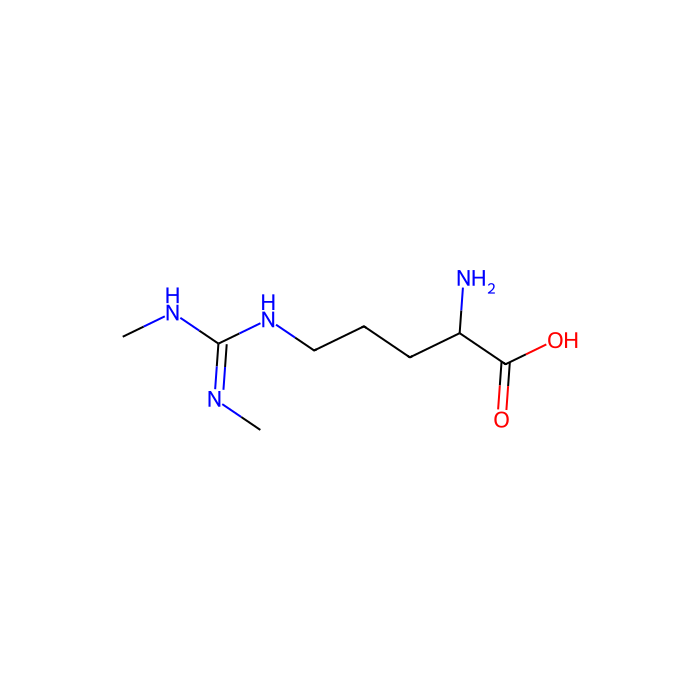
· · COA & SDS für jedes Produkt verfügbar · Versand am selben Tag für Lagerartikel SDMA - Moligand™, ≥98% , CAS No.30344-00-4
QUALITÄT & REINHEIT Moligand™ ? Moligand™ — Aladdin's line of ligands and bioactive small molecules. Use for receptor, pathway, and binding studies needing defined small-molecule tools. ≥98% Synonyms
(S)-2-Amino-5-((bis(methylamino)methylene)amino)pentanoicacid|N(G1),N(G2)-Dimethylarginine|N(omega),N'(omega)-dimethyl-L-arginine|N,N'-Dimethylarginine|(S)-2-Amino-5-((bis(methylamino)methylene)amino)pentanoic acid|N5-((methylamino)(methylimino)methyl)-L-Ornithine|CHLOROSULFONIC ACID [HSDB]|L-Ornithine, N5-((methylamino)(methylimino)methyl)-|N3,N4-dimethylarginine|E 104 (dye)|Guanidino-N(1),N(2)-dimethylarginine|N5-[bis(methylamino)methylene]-L-Ornithine|N~5~-(N,N'-dimethylcarbamimidoyl)-L-ornithine|N~5~-(N,N'-Dimethylcarbamimidoyl)ornithine|Symmetric dimethyl-L-arginine|MAGNESIUM CHLORIDE HEXAHYDRATE [MI]|N(3),N(4)-dimethylarginine|(2S)-2-amino-5-[(E)-2,3-dimethylcarbamimidamido]pentanoic acid|L-Ornithine, N5-[(methylamino)(methylimino)methyl]-|omega-N,omega-N'-dimethyl-L-arginine|L-Ornithine, N5-[bis(methylamino)methylene]-|(2S)-2-amino-5-[(E)-1,2-dimethylcarbamimidamido]pentanoic acid|symmetric dimethylarginine|(S)-2-amino-5-(N',N''-dimethylguanidino)pentanoic acid|N(5)-(N,N'-dimethylcarbamimidoyl)-L-ornithine|NG,N'G-Dimethyl-L-arginine|NG,NG'-Dimethyl-L-arginine|sulfur dichloride dioxide|Symmetric dimethylarginine; NG,NG'-Dimethyl-L-arginine|N5-(N,N'-dimethylamidino)-L-Ornithine|(2S)-2-amino-5-(N',N''-dimethylcarbamimidamido)pentanoic acid|AMMONIUM PERCHLORATE, (HIGH EXPLOSIVE)|(2S)-2-amino-5-[(N,N'-dimethylcarbamimidoyl)amino]pentanoic acid|NG,N'G-dimethylarginine|NG,NG'-dimethylarginine|SDMA
Shipped In
Ice chest + Ice pads
Übersicht
SDMA (Symmetric dimethylarginine) is an endogenous inhibitor of nitric oxide (NO) synthase activity. SDMA, a novel kidney biomarker, permits earlier diagnosis of kidney disease than traditional creatinine testing.
Information
SMDA (symmetric dimethylarginine) is a methylated form of arginine found within all nucleated cells that is released into circulation after proteolysis, then excreted through the kidneys, and correlates well with GFR (glomerular filtration rate) in people, dogs, and cats.
Spezifikationen Synonyme
(S)-2-Amino-5-((bis(methylamino)methylene)amino)pentanoicacid | N(G1),N(G2)-Dimethylarginine | N(omega),N'(omega)-dimethyl-L-arginine | N,N'-Dimethylarginine | (S)-2-Amino-5-((bis(methylamino)methylene)amino)pentanoic acid | N5-((methylamino)(methylimino)methyl)-L-Ornithine | CHLOROSULFONIC ACID [HSDB] | L-Ornithine, N5-((methylamino)(met Show more
Spezifikationen & Reinheit
Moligand™, ≥98%
Biochemische und physiologische Mechanismen
SDMA (Symmetric dimethylamine) is an endogenous inhibitor of nitric oxide (NO) synthase activity.
Verschickt in
Ice chest + Ice pads
Dieses Produkt erfordert Kühlkettenversand. Grundversand und andere Economy-Optionen sind nicht verfügbar.
Produkteigenschaften Namen und Kennungen Pubchem Sid Url
https://pubchem.ncbi.nlm.nih.gov/substance/488188426
SMILES
CNC(=NC)NCCCC(C(=O)O)N
IUPAC Name
(2S)-2-amino-5-[(N,N'-dimethylcarbamimidoyl)amino]pentanoic acid
InChIKey
HVPFXCBJHIIJGS-LURJTMIESA-N
InChI
1S/C8H18N4O2/c1-10-8(11-2)12-5-3-4-6(9)7(13)14/h6H,3-5,9H2,1-2H3,(H,13,14)(H2,10,11,12)/t6-/m0/s1
Isomere SMILES
CNC(=NC)NCCC[C@@H](C(=O)O)N
Reaxys-RN_link_address
https://www.reaxys.com/reaxys/secured/hopinto.do?context=S&query=IDE.XRN=4134786&ln=
Erweiterte Daten Taxonomic Classification Kingdom Organic compounds Superclass Organic acids and derivatives Klasse Carboxylic acids and derivatives Subclass Amino acids, peptides, and analogues Intermediate Tree Nodes Amino acids and derivatives - Alpha amino acids and derivatives Direct Parent Arginine and derivatives Alternative Parents L-alpha-amino acids Fatty acids and conjugates Guanidines Amino acids Propargyl-type 1,3-dipolar organic compounds Monocarboxylic acids and derivatives Carboxylic acids Carboximidamides Organopnictogen compounds Organic oxides Monoalkylamines Imines Hydrocarbon derivatives Carbonyl compounds Molecular Framework Aliphatic acyclic compounds Substituents Arginine or derivatives - Alpha-amino acid - L-alpha-amino acid - Fatty acid - Guanidine - Amino acid - Carboxylic acid - Monocarboxylic acid or derivatives - Carboximidamide - Propargyl-type 1,3-dipolar organic compound - Organic 1,3-dipolar compound - Amine - Primary amine - Organooxygen compound - Organonitrogen compound - Organic nitrogen compound - Primary aliphatic amine - Imine - Organic oxygen compound - Carbonyl group - Organopnictogen compound - Organic oxide - Hydrocarbon derivative - Aliphatic acyclic compound Beschreibung This compound belongs to the class of organic compounds known as arginine and derivatives. These are compounds containing arginine or a derivative thereof resulting from reaction of arginine at the amino group or the carboxy group, or from the replacement of any hydrogen of glycine by a heteroatom. External Descriptors guanidines - non-proteinogenic L-alpha-amino acid - L-arginine derivative - dimethylarginine Data sources 1. Djoumbou Feunang Y, Eisner R, Knox C, Chepelev L, Hastings J, Owen G, Fahy E, Steinbeck C, Subramanian S, Bolton E, Greiner R, and Wishart DS. ClassyFire: Automated Chemical Classification With A Comprehensive, Computable Taxonomy. Journal of Cheminformatics, 2016, 8:61.
3D-Struktur Zertifikate (CoA, COO, BSE/TSE und Analyse-Diagramm) Chemische und physikalische Eigenschaften DMSO (mg/ml) Maximale Löslichkeit 40 DMSO (mM) Maximale Löslichkeit 197.775030902349 Wasser (mg/ml) Maximale Löslichkeit 40 Wasser (mM) Maximale Löslichkeit 197.775030902349 Molekulargewicht 202.25 XLogP3 -3.700 Hydrogen Bond Donor Count 4 Hydrogen Bond Acceptor Count 4 Rotatable Bond Count 7 Exact Mass 202.143 Da Monoisotopic Mass 202.143 Da Topological Polar Surface Area 99.700 Ų Heavy Atom Count 14 Formal Charge 0 Complexity 206.000 Isotope Atom Count 0 Defined Atom Stereocenter Count 1 Undefined Atom Stereocenter Count 0 Defined Bond Stereocenter Count 0 Undefined Bond Stereocenter Count 0 The total count of all stereochemical bonds 0 Covalently-Bonded Unit Count 1
Sicherheit und Gefahren (GHS) Gefahrenhinweise
H302: Harmful if swallowed
H315: Causes skin irritation
H319: Causes serious eye irritation
H335: May cause respiratory irritation
Sicherheitshinweise
P261: Avoid breathing dust/fume/gas/mist/vapors/spray.
P305+P351+P338: IF IN EYES: Rinse cautiously with water for several minutes. Remove contact lenses if present and easy to do - continue rinsing.
Reaxys-RN_link_address
https://www.reaxys.com/reaxys/secured/hopinto.do?context=S&query=IDE.XRN=4134786&ln=
FAQs und Artikel Citations of This Product Lösungsrechner Molarity Calculator Determine the necessary mass, volume, or concentration for preparing a solution.
Dilution Calculator Determine the dilution needed to prepare a stock solution.
Reconstitution Calculator Bewertungen Benötigen Sie Hilfe bei der Auswahl der Qualität? Unser Leitfaden zur Qualitätsauswahl behandelt Reinheit, Stabilisatorstatus und Anwendungseignung für alle Varianten in unserem Katalog.
Moligand™ Qualitätsleitfaden ansehen →
Wir verwenden Cookies, um die ordnungsgemäße Funktion der Website sicherzustellen und, soweit zulässig, Ihr Nutzererlebnis zu verbessern. Sie können Ihre Einstellungen jederzeit unter „Einstellungen“ verwalten. Weitere Informationen finden Sie in unserer
Cookie-Richtlinie. Einstellungen Alle akzeptieren Ablehnen
Dürfen wir Sie über Rabattaktionen informieren?
Später erinnern Erlauben
Vielen Dank! Bitte überprüfen Sie Ihren E-Mail-Posteingang, um zu bestätigen.
Hoppla! Benachrichtigungen sind deaktiviert.
Products are supplied to verified businesses, institutions, and qualified professionals for research and development use only. Not for use in humans, animals, diagnosis, or therapy.
Copyright © 2023–present Aladdin Scientific Corporation. All rights reserved.

 J2513083