GRADE & PURITYMoligand™?Moligand™ — Aladdin's line of ligands and bioactive small molecules. Use for receptor, pathway, and binding studies needing defined small-molecule tools.10 mM in DMSO
Determine the necessary mass, volume, or concentration for preparing a solution.
Dilution Calculator
Determine the dilution needed to prepare a stock solution.
Reconstitution Calculator
Bewertungen
Kundenbewertungen
Application Protocols
Tested applications and recommended dilutions: Not specified for this item; refer to CoA/Spec Sheet.
General guidance for small-molecule screening compounds
Stock preparation: Dissolve in anhydrous DMSO to a convenient concentration (e.g., 10–50 mM). Filter if particulate remains after dissolution.
Aliquotting: Dispense into single-use vials or plates to avoid repeated freeze–thaw. Record exact concentration by weight or by UV if an extinction coefficient is established.
Assay use: Dilute into assay medium to the desired working concentration, maintaining consistent DMSO percentage across all wells/samples. Include vehicle controls and, where applicable, a known reference compound.
Documentation: Record lot number, preparation date, solvent, concentration, and storage conditions for each stock.
Biological Roles
Item-specific biological roles: Not specified for this item; refer to CoA/Spec Sheet.
General literature context
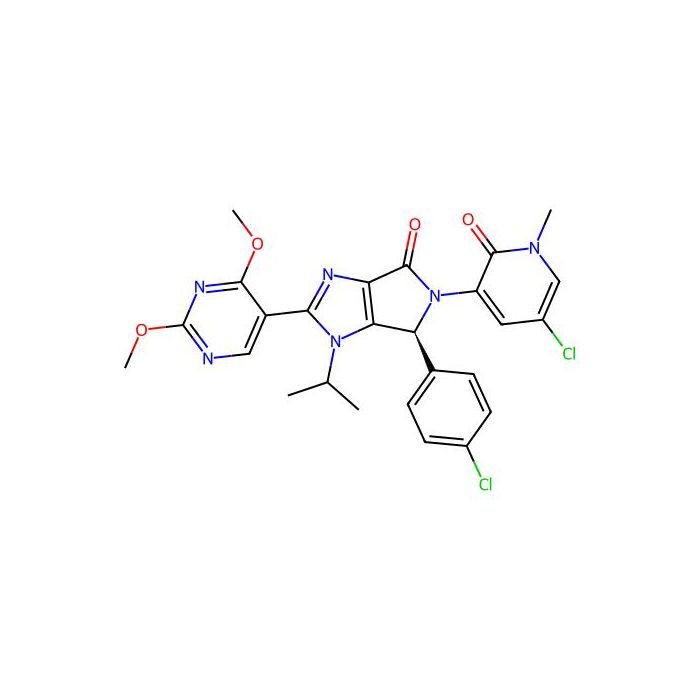
Siremadlin is referenced in the scientific literature as a small-molecule modulator designed to engage a protein–protein interaction in a defined signaling pathway. Users should consult primary publications and databases (e.g., PubChem CID 71678098) to understand reported mechanisms, targets, and assay contexts.
Practical research considerations
Before deploying in biological systems, confirm identity and purity, assess solubility and stability in the relevant media, and determine appropriate vehicle controls.
Establish baseline cytotoxicity and off-target profiles in your specific cell model/assay format using standardized viability assays and selectivity panels.
For quantitative work, determine the compound’s free fraction in protein-containing media (e.g., via equilibrium dialysis or ultrafiltration) to contextualize potency readouts.
Buffer Applications
This product is not a buffering reagent. It does not form classical buffer systems and is not intended to control pH.
Practical note
When using in biochemical or cell-based assays, select a buffer compatible with the biological target and ensure the final organic co-solvent fraction (e.g., DMSO) remains within tolerated limits. Document buffer composition, pH, ionic strength, and any additives (detergents, carrier proteins) used to maintain solubility.
Green Alternatives
Because Siremadlin is a discrete screening compound rather than a process solvent or reagent, “green alternative” considerations focus on solvent systems and handling during assay preparation rather than replacing the compound itself.
Greener solvent choices for stock/assay preparation (general)
Prefer high-purity DMSO with controlled water content; although not “green,” it minimizes the need for halogenated solvents.
Where feasible, use ethanol or aqueous buffers with minimal co-solvent fractions to reduce DMSO usage, provided solubility and assay performance are acceptable.
Operational improvements
Prepare concentrated master stocks and distribute to small, single-use aliquots to reduce waste from freeze–thaw discard.
Use low-loss, recyclable polypropylene consumables and sealed 96/384-well plates to limit evaporation and VOC exposure.
Small comparison (general)
DMSO vs ethanol: DMSO offers greater solubilization power for heteroatom-rich scaffolds; ethanol is more benign but may not reach the same stock concentrations. A hybrid approach (DMSO stock, ethanol-buffer dilution) can balance performance and sustainability.
Waste minimization
Consolidate organic waste streams and avoid chlorinated solvents in cleanup where possible. Validate greener cleaning solutions for assay equipment to limit hazardous waste.
Pharmaceutical Uses
Item-specific pharmaceutical/formulation status: Not specified for this item; refer to CoA/Spec Sheet.
Context
Supplied strictly for research use. Not formulated as a drug product, API standard, or excipient. No pharmacopeial monograph information is provided for this item.
Lab formulation guidance (research only)
For in vitro applications, prepare DMSO stocks and dilute into the assay matrix with attention to vehicle controls.
For any in vivo exploratory research performed under institutional approvals, consult institutional policies and the literature for acceptable vehicles; this catalog entry provides no dosage, route, or clinical guidance.
Physical Properties
Item-specific specs
Appearance: Not specified for this item; refer to CoA/Spec Sheet.
Thermophysical data
Melting point, boiling point, density, refractive index: Not specified for this item; refer to CoA/Spec Sheet.
Solubility and partitioning
Item-specific solubility and logP/logD: Not specified for this item; refer to CoA/Spec Sheet.
General/literature practice for screening compounds: stock solutions are typically prepared in anhydrous DMSO at 10–50 mM, then diluted into assay buffers to ≤0.5% v/v DMSO final. Actual solubility limits should be confirmed experimentally for this lot.
Ionization
pKa values (if any) are not provided for this item. Literature values vary by scaffold and measurement method; verify experimentally for your conditions.
Notes for users
Because detailed physicochemical constants are not specified for this catalog item, pre-screen the compound for solubility and stability under your assay conditions (e.g., kinetic solubility in PBS, pH 7.4; DMSO stability at working temperature; light sensitivity).
If UV quantitation is planned, determine the extinction coefficient empirically in your solvent system.
Quality and Grades
Item-specific grade
Grade: Moligand™ (from Product Data). This denotes a screening-grade small-molecule ligand suitable for discovery workflows, library screening, and SAR follow-up.
What Moligand™ typically implies (general guidance)
Prepared and packaged with an emphasis on structural identity and suitability for biochemical/cellular assays.
Intended for research screening and mechanistic studies rather than quantitative analytical reference standard use, unless otherwise stated on the CoA.
What is and isn’t specified for this item
Purity, residual solvents, water content, counter-ions/salt form, stabilizers, and chromatographic absorbance profiles: Not specified for this item; refer to CoA/Spec Sheet.
If your application requires trace analysis (e.g., LC–MS quantitation) or stringent elemental/UV specifications, request and review the lot-specific CoA and analytical package.
Practical implications
For reproducible screening, document lot numbers and prepare master stocks under controlled conditions (solvent, concentration, aliquotting, light protection).
If using in cell-based assays, pre-qualify for cytotoxicity of the vehicle and confirm absence of interfering fluorescence/absorbance in assay windows.
Reaction and Applications
This product is supplied as a research-grade small-molecule for screening and mechanistic studies. It is not typically employed as a reagent or solvent in synthetic transformations.
Applicable research uses (general, literature-informed)
Employed as a reference ligand/chemical probe candidate in biochemical binding assays, biophysical assays (e.g., fluorescence polarization, SPR), and cellular pathway interrogation studies after appropriate validation.
Suitable for concentration–response profiling, selectivity panels, and orthogonal assay confirmation when identity and purity are verified.
Not typically applicable
It is not used to promote named organic reactions (e.g., cross-couplings, oxidations) and does not serve as a catalyst or stoichiometric reagent in synthesis.
Practical notes
Establish solubility and stability in the assay matrix prior to screening.
Include vehicle controls and, when available, an internal positive control compound characterized under identical conditions.
Verify identity/purity by LC–MS or NMR if results will be used for SAR or publication.
Reaction Conditions
Not typically applicable. This compound is supplied for biological screening and discovery research, not as a reagent for promoting chemical reactions.
If using in assays
Define solvent composition (e.g., DMSO percentage), temperature, incubation time, and plate format for reproducibility.
Validate compound stability over the assay window (e.g., 0–48 h at room temperature/37°C) and under light exposure as relevant.
Confirm adsorption losses to plastics or glass and mitigate with carrier proteins or surface treatments when appropriate.
Safety and Handling
Regulatory/SDS status
Research Use Only. Not for human or veterinary use.
GHS classification, signal word, pictograms, and H-statements: Not specified for this item; refer to the product SDS for authoritative hazard information.
General laboratory precautions (good practice)
Handle in a chemical fume hood; avoid inhalation of dust or aerosols.
Wear appropriate PPE: lab coat, safety glasses, and chemically resistant gloves (e.g., nitrile). Consider double-gloving for DMSO solutions due to enhanced skin permeation.
Avoid contact with skin and eyes. Wash thoroughly after handling.
Incompatibilities and stability
Avoid strong oxidizers and strong acids/bases unless compatibility is known.
Solutions in DMSO should be protected from moisture and light; minimize freeze–thaw cycles to prevent degradation.
First-aid overview (consult SDS for details)
Inhalation: Move to fresh air; seek medical attention if symptoms persist.
Skin/eye contact: Rinse with plenty of water for at least 15 minutes; remove contaminated clothing; seek medical attention if irritation persists.
Ingestion: Rinse mouth; do not induce vomiting; seek medical attention.
Spill and waste
Absorb small spills with inert material and dispose as organic chemical waste in accordance with institutional and local regulations.
Decontaminate surfaces with suitable solvent/detergent; collect rinsates as hazardous waste.
Solvent Selection
Item-specific solvent data: Not specified for this item; refer to CoA/Spec Sheet.
General practice for small-molecule screening compounds
Primary solvent: Anhydrous DMSO is commonly used to prepare concentrated stocks (10–50 mM). Ensure high-purity DMSO and filter if needed.
Secondary solvents/co-solvents: DMF or ethanol can be considered if DMSO solubility is inadequate; evaluate assay compatibility and cytotoxicity of the vehicle.
Aqueous media: For working solutions, dilute into assay buffers to keep final DMSO ≤0.1–0.5% v/v where possible; include matched vehicle controls.
Practical tips
Warm gently (25–37°C) and vortex/sonicate to aid dissolution; avoid prolonged heating.
If precipitation occurs upon dilution, increase dilution steps, add nonionic surfactant compatible with the assay (e.g., 0.01–0.05% Tween-20), or adjust ionic strength/pH as compatible.
Comparison snapshot (general)
DMSO: highest solvating power; excellent chemical compatibility; may permeate gloves and cells—use carefully.
Ethanol: more benign; lower solvating power for many heteroatom-rich scaffolds.
Storage and Reconstitution
Item-specific conditions (from Product Data)
Storage: Store at -80°C.
Shipping: Shipped on dry ice packs + cold packs.
Stability guidance
Keep container tightly closed and under inert headspace if possible. Protect from moisture and light.
For best reproducibility, prepare single-use aliquots of DMSO stocks and store at -80°C in amber vials/plates.
Minimize freeze–thaw cycles; thaw on ice or at room temperature just prior to use. Do not keep thawed solutions for extended periods unless stability has been established.
Reconstitution
Solvent: Anhydrous DMSO is commonly used for small-molecule screening compounds. Item-specific solubility is not specified; determine empirically.
Technique: Allow vial to equilibrate to room temperature in a desiccated environment before opening to avoid condensation. Add pre-warmed solvent, vortex/sonicate to dissolve fully.
Shelf-life
Expiry and retest intervals are not specified for this item; refer to CoA/Spec Sheet. Reassess by LC–MS/HPLC after prolonged storage or if visual changes are observed.
Structure and Identity
Item-specific identifiers (from Product Data)
SKU: S1498777
Product name: Siremadlin
CAS: 1448867-41-1
Grade: Moligand™
SMILES: Not specified for this item; refer to CoA/Spec Sheet.
InChIKey: Not specified for this item; refer to CoA/Spec Sheet.
Molecular formula: Not specified for this item; refer to CoA/Spec Sheet.
Molecular weight: Not specified for this item; refer to CoA/Spec Sheet.
Literature/registry identifiers (general reference, not item-specific specs)
PubChem CID: 71678098 (literature)
Synonym: Siremadlin is commonly referred to as HDM201 in the literature.
Structural description (general, literature)
Siremadlin is a small-molecule, heteroatom-rich organic compound designed as a protein–protein interaction modulator. In published sources it is described as an MDM2–p53 interaction antagonist scaffold. Detailed 2D atom connectivity, stereochemistry, and ring system annotations should be taken from primary databases (e.g., PubChem CID 71678098) or the CoA for the specific lot.
Important note
For exact structural strings (SMILES/InChI) and any stereochemical details applicable to this catalog item, consult the lot-specific CoA/Spec Sheet. Do not use third-party strings as specifications for QC without verification.
Synthetic Utility
Siremadlin is a finished small-molecule research compound and is not typically used as a building block, reagent, or catalyst in synthesis.
Practical implications
Do not rely on it for synthetic transformations or as a protecting-group reagent.
If analog synthesis or SAR is planned, use the literature to identify tractable substructures and retrosynthetic disconnections; this item itself serves as a reference standard/assay tool rather than a synthetic intermediate.
Quality control for reference use
Verify identity by LC–MS and, if needed, 1H/13C NMR against literature spectra before using as a comparator in synthetic campaigns.
Establish a reference retention time and mass-to-charge profile under your LC method to support future lot-to-lot comparisons.
Target Specificity
Item-specific target, affinity, selectivity, species reactivity, and related attributes: Not specified for this item; refer to CoA/Spec Sheet and primary literature.
Note
For projects requiring target attribution (e.g., enzyme, receptor, or PPI specificity), consult peer-reviewed publications and validate in-house using orthogonal assays. This section is intentionally limited to product-data-supported information.
Häufig gestellte Fragen
What is Moligand??
Moligand? is one of Aladdin Scientific's premium product lines, formulated for high-purity applications across multiple workflows. Compared to standard grades in the same workflow, Moligand? products typically offer tighter specifications, more rigorous QC, and stronger lot-to-lot consistency.
How should this product be stored?
Store at ?80 °C. Ultra-low temperature storage is required to maintain the specified shelf life.
How is this product shipped?
This product ships frozen with dry ice and cold packs. Unpack on arrival and transfer it to the storage condition stated above; handle dry ice with insulated gloves in a ventilated area.
What are the CAS number, molecular formula and molecular weight?
The CAS Number is 1448867-41-1, the molecular formula is C26H24Cl2N6O4, and the molecular weight is 555.41 g/mol.
What documentation is provided?
Available product documentation, including Certificates of Analysis (COA), Safety Data Sheets (SDS), and specification sheets, is shown in the product document area. Document availability and access follow the current site policy.
Wir verwenden Cookies, um die ordnungsgemäße Funktion der Website sicherzustellen und, soweit zulässig, Ihr Nutzererlebnis zu verbessern. Sie können Ihre Einstellungen jederzeit unter „Einstellungen“ verwalten. Weitere Informationen finden Sie in unserer Cookie-Richtlinie.
Dürfen wir Sie über Rabattaktionen informieren?
Später erinnern
Vielen Dank! Bitte überprüfen Sie Ihren E-Mail-Posteingang, um zu bestätigen.
Products are supplied to verified businesses, institutions, and qualified professionals for research and development use only. Not for use in humans, animals, diagnosis, or therapy.