Zertifikate (CoA, COO, BSE/TSE und Analyse-Diagramm)
C of A & Other Certificates(BSE/TSE, COO):
Analytical Chart:
Lösungsrechner
Molarity Calculator
Determine the necessary mass, volume, or concentration for preparing a solution.
Dilution Calculator
Determine the dilution needed to prepare a stock solution.
Reconstitution Calculator
Bewertungen
Kundenbewertungen
Application Protocols
Validated application data (e.g., WB, IHC, IF, FC, enzyme assays) are not provided in the Product Data for this SKU.
General guidance for small-molecule use in biological assays:
Stock preparation: Dissolve in high-purity DMSO to the highest practical concentration consistent with solubility; vortex and, if necessary, sonicate briefly. Filter sterilize when required.
Dilution: Add stock to pre-warmed buffer or media with rapid mixing to avoid localized precipitation. Keep final DMSO typically ≤0.1–0.5% v/v.
Controls: Include vehicle controls, positive reference ligands (if applicable), and counter-screens to evaluate off-target or assay-interference effects.
Stability: Use fresh working solutions; avoid repeated freeze–thaw of concentrated stocks by aliquoting upon initial preparation.
For protocol specifics validated on this SKU, please refer to the product CoA/Spec Sheet or contact technical support.
Biological Roles
Item-specific target/class information is not provided in the Product Data.
Literature/context note (do not substitute for item specifications):
Compounds in the SKF series are frequently described in the neuroscience and receptor pharmacology literature as ligands for monoaminergic receptors. However, exact target, potency, and selectivity can vary widely by SKF identifier and salt form. Users should consult primary literature and the lot-specific CoA to confirm identity and intended use for this SKU.
General experimental considerations for small-molecule bioactives:
Prepare concentrated stocks (e.g., 10–50 mM in DMSO) and dilute into assay buffer immediately before use to limit degradation.
Control for vehicle effects with solvent-matched negatives and include counter-screens to assess off-target activity, if relevant.
Verify concentration by analytical methods (e.g., LC–UV with calibrated standards) when quantitative pharmacology is required.
Consider light and temperature sensitivity; maintain samples on ice during setup where appropriate and avoid extended room-temperature exposure.
Note: For definitive biological role, mechanism, and profiling for SKF 83692 from this supplier, please refer to the product CoA/Spec Sheet and any associated technical bulletins.
Buffer Applications
This product is a small-molecule life-science reagent and is not itself a buffering agent. Therefore, buffer formulation guidelines (pH ranges, recipes) are generally not applicable.
Practical guidance (general):
Select assay buffers that maintain compound solubility and stability (e.g., PBS, HEPES, or Tris-based systems), considering pH-dependent ionization of the compound if known.
Maintain final organic solvent content (e.g., DMSO) at levels tolerated by the biological system, typically ≤0.1–0.5% v/v.
Filter-sterilize working solutions if sterility is required for cell-based assays.
Green Alternatives
Green chemistry substitution is typically discussed for bulk solvents and reagents. For a specialized life-science small molecule like SKF 83692, there are no direct “green” substitutes with identical biochemical activity.
General sustainability guidance (where applicable):
Minimize DMSO volumes and prepare concentrated stocks to reduce solvent waste.
Use microscale assay formats (96–1536 well) to reduce material usage.
Choose greener co-solvents (e.g., water/ethanol systems) when compatible with the compound’s solubility and assay performance.
Implement closed, low-evaporation systems and validated LC–MS methods to minimize rework and repeated preparations.
Pharmaceutical Uses
This product is supplied strictly for research use only and is not approved for human or veterinary use.
General formulation context (non-clinical, laboratory scale):
In preclinical research, small-molecule tool compounds are sometimes formulated for in vitro assays (DMSO stocks diluted into buffer) or for in vivo exploratory studies using vehicles such as PEG400/saline, Captisol, or aqueous systems adjusted for pH and tonicity. Such procedures must follow institutional approvals and are outside the scope of this product listing.
No pharmacopeial monograph or excipient role is provided for this SKU. Do not use in manufacturing of finished pharmaceuticals.
Item-specific pharmaceutic information (grade, residuals, sterility): Not specified for this item; refer to CoA/Spec Sheet.
Physical Properties
Item-specific physical constants are not provided in the Product Data.
Appearance: Not specified for this item; refer to CoA/Spec Sheet.
Melting point (MP): Not specified for this item; refer to CoA/Spec Sheet.
Boiling point (BP): Not specified for this item; refer to CoA/Spec Sheet.
Density: Not specified for this item; refer to CoA/Spec Sheet.
Refractive index: Not specified for this item; refer to CoA/Spec Sheet.
pKa/logP: Not specified for this item; refer to CoA/Spec Sheet.
Solubility: Not specified for this item; refer to CoA/Spec Sheet.
General laboratory guidance (literature/general):
Many bioactive small molecules are supplied as crystalline solids or powders, with stock solutions commonly prepared in anhydrous DMSO or ethanol before aqueous dilution.
Solubility and stability can be highly dependent on salt form and pH; confirm the exact form on the CoA.
If solubility screening is required, test DMSO, ethanol, and buffered aqueous media across a pH range, monitoring by HPLC/UPLC for stability and by UV/vis or LC for concentration verification.
Protect from moisture and light unless documentation indicates otherwise. Use amber vials for photosensitive materials (general practice).
Quality and Grades
Grade/Purity: Not specified for this item; refer to CoA/Spec Sheet.
How to interpret grade and documentation (general guidance):
For small-molecule life-science reagents, CoA typically includes purity (e.g., HPLC or GC), identity confirmation (NMR/LC–MS), residual solvents, and water content. Always verify that the analytical method used (e.g., HPLC area%) aligns with your assay’s sensitivity to impurities.
If a specific salt form or polymorph is supplied, this will be noted on the label/CoA. Salt form impacts molecular weight (for dosing), solubility, and pH behavior.
If your application is quantitative (e.g., receptor pharmacology), consider lot qualification by independent HPLC and HRMS, and verify counterion content by titration or ion chromatography when relevant.
UV cutoff, metal limits, or stabilizer content: Not specified for this item; refer to CoA/Spec Sheet.
Documentation best practices:
Retain the lot-specific CoA with your lab records and reference it when reporting concentrations, especially if comparing to literature that may refer to different salt forms or purity criteria.
Reaction and Applications
This product is categorized as a life-science research reagent rather than a synthetic building block or solvent. Classical synthetic reaction applications (e.g., cross-coupling, reductions, organometallic transformations) are not typically relevant.
If chemical modification or derivatization is intended (general guidance):
Confirm structural identity and functional groups from the CoA/Spec Sheet before planning reactions.
Establish stability in proposed reaction media (e.g., resistance to hydrolysis/oxidation) by small-scale trials and LC–MS monitoring.
Protect light- or air-sensitive motifs as needed; conduct reactions under inert atmosphere if instability is observed.
Primary uses are expected to be in biochemical/pharmacological experiments; see Biological Roles and Application Protocols (if available).
Reaction Conditions
Not typically applicable. SKF 83692 is provided as a bioactive research chemical rather than a reagent for performing chemical transformations.
General notes (if chemical modification is pursued):
Solvents: Choose dry, oxygen-free solvents if sensitive motifs are present (confirmed from structure). Work under inert gas for air/moisture-sensitive functionalities.
Temperatures: Start at ambient and adjust as needed based on stability testing; monitor by LC–MS.
Workup: Quench carefully, extract with suitable solvents, and purify by preparative HPLC or flash chromatography as dictated by polarity.
For standard usage, see Solvent Selection, Biological Roles, and Storage & Reconstitution.
Safety and Handling
GHS classification: Not specified for this item; refer to SDS.
Signal word / H-statements / pictograms: Not specified for this item; refer to SDS.
Primary hazards: Not specified for this item; refer to SDS.
General laboratory precautions (professional guidance):
Handle in a fume hood with appropriate PPE: lab coat, safety glasses, and chemically resistant gloves. Avoid inhalation and skin contact. Prevent aerosol generation when weighing.
Storage incompatibilities: Until specific data are available, avoid strong oxidizers and strong acids/bases. Keep container tightly closed to limit moisture ingress.
Spill/cleanup: Absorb small spills with inert material (e.g., vermiculite), collect for disposal according to institutional and regulatory requirements. Decontaminate surfaces with suitable solvent while observing compatibility and ventilation.
First aid (overview; defer to SDS for authoritative instruction): Inhalation—move to fresh air; Skin/Eyes—flush with water for at least 15 minutes; Ingestion—rinse mouth. Seek medical attention in all exposure scenarios.
Waste: Dispose of as organic laboratory chemical waste in accordance with local regulations.
Note: EHS controls should be based on a task-specific risk assessment and the official Safety Data Sheet for this SKU.
Research Use: For research use only (not for human or veterinary use).
Solvent Selection
Item-specific solubility data are not provided.
General selection principles for small-molecule bioactives (literature/general):
Primary stock solvent: DMSO is most commonly used for 10–50 mM stocks due to broad solubilizing power and compatibility with biological assays at ≤0.1–0.5% v/v final concentration.
Alternatives: Ethanol or methanol for organic stocks; co-solvent mixtures (DMSO/H2O or EtOH/PEG400/H2O) may improve solubility and reduce precipitation upon dilution.
Aqueous work: If the compound is ionizable, adjust pH to favor the soluble ionic form (acidic analytes in basic buffer; basic analytes in acidic buffer). Use volatile buffers if LC–MS quantitation is planned.
Filtration: Use low-protein-binding 0.2 µm PTFE or PVDF filters for sterilization of working solutions; pre-wet filters with solvent to minimize adsorption.
Adsorptive losses: Hydrophobic compounds may adsorb to plastics; consider polypropylene or glass vials. Validate recovery by LC when working at low micromolar or nanomolar concentrations.
Precipitation check: After dilution from DMSO into assay buffer, visually inspect for turbidity and confirm by light scattering or HPLC injection tests.
Storage and Reconstitution
Storage conditions (item-specific): Store at −20°C (per Product Data). Keep container tightly closed.
Shipping: Shipped in ice chest with ice pads (per Product Data) to maintain low temperature during transit.
Appearance: Not specified for this item; refer to CoA/Spec Sheet.
Reconstitution and handling (general guidance):
Allow the sealed container to equilibrate to room temperature before opening to minimize moisture condensation. If hygroscopic, handle quickly under dry conditions.
Prepare concentrated stocks in anhydrous DMSO or suitable solvent based on solubility; confirm concentration by weight and, where critical, by LC–UV against a standard curve.
Aliquot stock solutions into single-use vials to avoid freeze–thaw cycles; store aliquots at −20°C in amber containers if the compound is light-sensitive (general best practice).
Thaw working aliquots on ice immediately before use. Discard solutions showing precipitation, discoloration, or analytical evidence of degradation.
Stability/shelf-life specifics, solubility limits, and light sensitivity: Not specified for this item; refer to CoA/Spec Sheet and SDS.
Molecular formula: Not specified for this item; refer to CoA/Spec Sheet.
Molecular weight: Not specified for this item; refer to CoA/Spec Sheet.
SMILES: Not specified for this item; refer to CoA/Spec Sheet.
InChIKey: Not specified for this item; refer to CoA/Spec Sheet.
Synonyms: Not specified for this item; refer to CoA/Spec Sheet.
Structural description (general guidance):
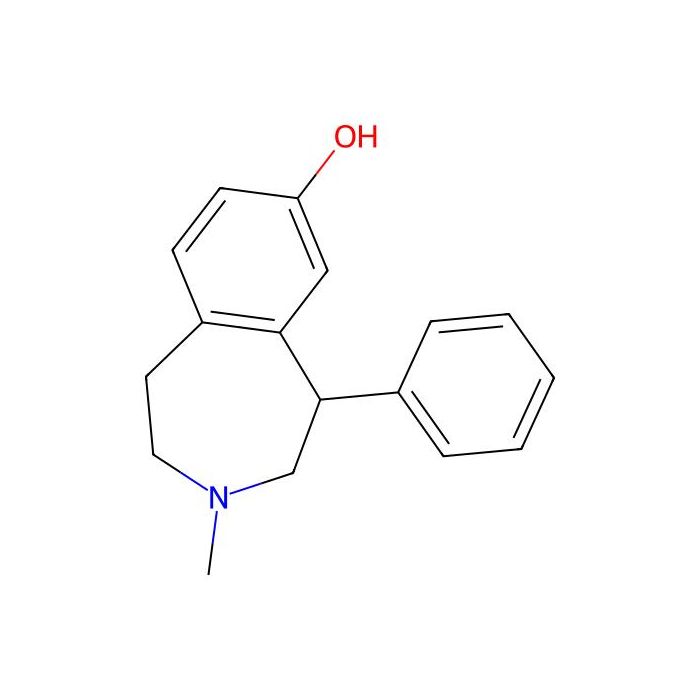
Item-specific structural features are not provided in the current Product Data. For unambiguous identity confirmation, consult the product CoA/Spec Sheet and, if needed, verify by independent analytical methods (e.g., 1H/13C NMR, LC–MS, HRMS, HPLC purity profile).
If you are cross-referencing literature: ensure that the CAS, exact salt form (free base vs. hydrochloride, etc.), and stereochemistry match your experimental needs, as SKF-series compounds may exist in multiple forms in publications (literature note).
Synthetic Utility
SKF 83692 is offered as a life-science research reagent, not as a synthetic building block. As such, it is not typically employed as a reagent or intermediate in general organic synthesis.
If a derivatization or probe-synthesis project is contemplated (general considerations):
Obtain the exact structure and functional group map from the CoA/Spec Sheet before planning protection/derivatization.
Assess compatibility of any phenolic, amine, or heteroaromatic functions (if present) with planned transformations; perform micro-scale scouting experiments monitored by LC–MS.
Validate that any modified analogs retain desired biological activity through side-by-side assays.
Target Specificity
No target, selectivity, or potency data are provided in the Product Data for this SKU.
Target class, species reactivity, and assay-validated applications: Not specified for this item; refer to CoA/Spec Sheet and supplier technical notes.
Users are advised to consult primary literature for SKF 83692 and confirm that the CAS, salt form, and purity match the requirements of their biological assays.
Wir verwenden Cookies, um die ordnungsgemäße Funktion der Website sicherzustellen und, soweit zulässig, Ihr Nutzererlebnis zu verbessern. Sie können Ihre Einstellungen jederzeit unter „Einstellungen“ verwalten. Weitere Informationen finden Sie in unserer Cookie-Richtlinie.
Shall we send you a message when we have discounts available?
Remind me later
Thank you! Please check your email inbox to confirm.
Products are supplied to verified businesses, institutions, and qualified professionals for research and development use only. Not for use in humans, animals, diagnosis, or therapy.