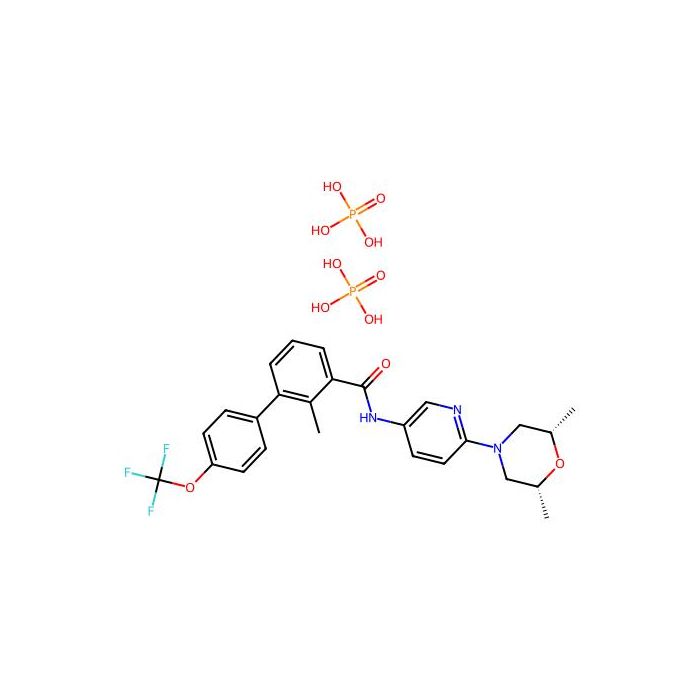
Sonidegib diphosphate - ≥99% , Smoothened homolog inhibitor, CAS No.1218778-77-8, Smoothened homolog inhibitor

CAS: 1218778-77-8 Cat. No.: S649283 Summenformel: C26H32F3N3O11P2 Molekulargewicht: 681.5 PubChem CID: 45138699
Zu bestellen verfügbar
QUALITÄT & REINHEIT ≥99%
Synonyms
CHEBI:90864 | N-(6-((2R,6S)-2,6-Dimethylmorpholino)pyridin-3-yl)-2-methyl-4'-(trifluoromethoxy)-[1,1'-biphenyl]-3-carboxamide bis(phosphate) | Sonidegib phosphate | SONIDEGIB PHOSPHATE [USAN] | Erismodegib phosphate | NVP-LDE 225 diphosphateSonidegib diph
Storage
Store at 2-8°C,Desiccated
Shipped In
Wet ice
★
Größe
Deutschland (EU)
USA*
Preis
Menge
5mg
S649283-5mg
Auf Bestellung · 8–12 Wochen

89,29€

134,41€
Speichern 45,12 € (33.57%)
10mg
S649283-10mg
Auf Bestellung · 8–12 Wochen

160,44€

241,14€
Speichern 80,70 € (33.47%)
50mg
S649283-50mg
Auf Bestellung · 8–12 Wochen

465,89€

699,31€
Speichern 233,42 € (33.38%)
100mg
S649283-100mg
Auf Bestellung · 8–12 Wochen

839,02€

1.259,00€
Speichern 419,99 € (33.36%)
Enter a quantity for the sizes you want to add.
🧪
Warum diese Qualität

≥99% für empfindliche chromatographische und analytische Workflows, die minimale Basislinieninterferenzen erfordern.

🌡

Lagerung & Versand

Store at 2-8°C,Desiccated Versand Wet ice. Genaue Spezifikationen finden Sie im chargenspezifischen COA.

📋

Qualitätsdokumente

SDS, COA, Datenblatt und Spezifikationsblatt stehen zum Download bereit. Chargenspezifische COA über Chargennummernsuche abrufbar.

📚

Literaturbeleg

In 0 peer-reviewten Publikationen zu Chromatographie, organischer Synthese und Kreuzkupplungsreaktionen zitiert.

Übersicht

Sonidegib diphosphate (Erismodegib diphosphate) is a potent and selective Smo antagonist with IC 50 of 1.3 nM and 2.5 nM for mouse and human Smo in binding assay, respectively

In Vitro

The IC 50 values for Sonidegib (NVP-LDE225) for the major human CYP450 drug metabolizing enzymes is greater than 10 μM. Sonidegib (LDE225), a small molecule, clinically investigated SMO inhibitor, used alone and in combination with Nilotinib, inhibits the Hh pathway in CD34 + chronic phase (CP)-chronic myeloid leukaemia (CML) cells, reducing the number and self-renewal capacity of CML leukaemia stem cell (LSC). Sonidegib interacts directly with SMO, in a similar fashion to cyclopamine, to reduce expression of downstream Hh signaling targets. Primary CD34 + CP-CML cells are cultured in serum free media (SFM)±Sonidegib for 6, 24 and 72 hours (h). At 72 h, while there is variability between the biological samples, GLI1 is significantly downregulated following exposure to Sonidegib (10 nM; 0.78-fold and 100 nM; 0.73-fold, respectively (p<0.01). MCE has not independently confirmed the accuracy of these methods. They are for reference only.

In Vivo

Sonidegib (NVP-LDE225) is a weak base with a measured pK a of 4.2 and exhibits relatively poor aqueous solubility. In the subcutaneous Ptch +/- p53 -/- medulloblastoma allograft mouse model, Sonidegib demonstrates dose-related antitumor activity after 10 days of oral administration of a suspension of the diphosphate salt. At a dose of 5 mg/kg/day qd, Sonidegib significantly inhibits tumor growth, corresponding to a T/C value of 33% (p<0.05 as compared to vehicle controls). When dosed at 10 and 20 mg/kg/day qd, Sonidegib affords 51 and 83% regression, respectively . Bone marrow cells and spleen cells from a subset of treated mice are transplanted into secondary recipient mice. Transplantation of either bone marrow (BM) or spleen cells from mice treated with Sonidegib (LDE225)+Nilotinib results in reduced white cell count (WCC) and reduces leukaemia development in secondary recipients compared to Sonidegib or Nilotinib alone. MCE has not independently confirmed the accuracy of these methods. They are for reference only.

Cell Assay

CD34 + CP-CML cells are seeded in SFM alone±Sonidegib±Nilotinib and cultured for 24-72 h prior to assessment. Proliferation is measured using colorimetric assessment of BrDU incorporation. Proportion of viable cells versus those in early and late apoptosis is assessed by flow cytometry using annexin V-FITC and 7-amino-actinomycin D (7-AAD, Via-Probe solution). Cell cycle status is assessed using Ki67 (FITC) expression and 7-AAD incorporation. MCE has not independently confirmed the accuracy of these methods. They are for reference only.

Animal administration

Mice The transgenic EGFP + /SCLtTA/TRE-BCR-ABL mouse model is used to investigate the effect of Sonidegib treatment on CML LSC in vivo. Scl-tTa-BCR-ABL mice in the FVB/N background are crossed with transgenic GFP-expressing mice. Bone marrow cells are obtained 4 weeks post induction, GFP + cells are selected by flow cytometry and transplanted by tail vein injection (10 6 cells/mouse) into wild-type FVB/N recipient mice, irradiated at 900 cGy, generating a large cohort of mice with similar time of onset of leukemia. Blood samples obtained 4 weeks post transplantation confirmed a neutrophilic leukocytosis in recipient mice. Mice are treated with Nilotinib (50 mg/kg by gavage, daily), Sonidegib (80 mg/kg by gavage, daily), Sonidegib+Nilotinib, or with vehicle alone (control). After 3 weeks of treatment, animals are euthanised and marrow content of femurs and tibiae, spleen cells and blood obtained. Total white cell count (WCC), GFP-expressing WCC, myeloid cells, and GFP+ progenitors and stem cells are measured by flow cytometry. Survival is assessed in a subset of mice for 120d post discontinuation of treatment. Spleen and BM cells from a subset of mice in each arm are pooled and 5×10 6 cells/mouse (8 mice/condition) are transplanted into wild-type FVB/N recipient mice irradiated at 900 cGy. Engraftment is monitored by drawing peripheral blood (PB) every 4 weeks. The percentage of GFP + cells in PB is analyzed by flow cytometry. aladdin has not independently confirmed the accuracy of these methods. They are for reference only.

Form:Solid

IC50& Target:IC50: 1.3 nM (mSmo), 2.5 nM (hSmo)

Spezifikationen

Synonyme
CHEBI:90864 | N-(6-((2R,6S)-2,6-Dimethylmorpholino)pyridin-3-yl)-2-methyl-4'-(trifluoromethoxy)-[1,1'-biphenyl]-3-carboxamide bis(phosphate) | Sonidegib phosphate | SONIDEGIB PHOSPHATE [USAN] | Erismodegib phosphate | NVP-LDE 225 diphosphateSonidegib diph
Spezifikationen & Reinheit
≥99%
Biochemische und physiologische Mechanismen
Sonidegib diphosphate (Erismodegib diphosphate) is a potent and selective Smo antagonist with IC 50 of 1.3 nM and 2.5 nM for mouse and human Smo in binding assay, respectively.
Storage
Store at 2-8°C,Desiccated
Verschickt in
Wet ice
Dieses Produkt erfordert Kühlkettenversand. Grundversand und andere Economy-Optionen sind nicht verfügbar.
Aktionsart
INHIBITOR
Mechanismus der Wirkung
Smoothened homolog inhibitor
Reinheit
≥99%
Namen und Kennungen
Kanonisches Lächeln
CC1CN(CC(O1)C)C2=NC=C(C=C2)NC(=O)C3=CC=CC(=C3C)C4=CC=C(C=C4)OC(F)(F)F.OP(=O)(O)O.OP(=O)(O)O
IUPAC Name
N-[6-[(2R,6S)-2,6-dimethylmorpholin-4-yl]pyridin-3-yl]-2-methyl-3-[4-(trifluoromethoxy)phenyl]benzamide;phosphoric acid
InChIKey
RWIVSVMMGFFZIJ-VWDRLOGHSA-N
INCHI
1S/C26H26F3N3O3.2H3O4P/c1-16-14-32(15-17(2)34-16)24-12-9-20(13-30-24)31-25(33)23-6-4-5-22(18(23)3)19-7-10-21(11-8-19)35-26(27,28)29;2*1-5(2,3)4/h4-13,16-17H,14-15H2,1-3H3,(H,31,33);2*(H3,1,2,3,4)/t16-,17+;;
Isomere SMILES
C[C@@H]1CN(C[C@@H](O1)C)C2=NC=C(C=C2)NC(=O)C3=CC=CC(=C3C)C4=CC=C(C=C4)OC(F)(F)F.OP(=O)(O)O.OP(=O)(O)O
PubChem CID
45138699
Molekulargewicht
681.5

Dokumentation

📋 Sicherheitsdatenblatt (SDS)

Umfassendes Dokument zu Gefahren, Handhabung, Lagerung und Einhaltung regulatorischer Vorschriften.

<<<<<<< HEAD SDS herunterladen → ======= SDS herunterladen → >>>>>>> release248-p3

✅ Analysezertifikat (COA)

Chargenspezifische Qualitätsdaten. Geben Sie Ihre Chargennummer ein, um das genaue COA abzurufen.

COA nachschlagen →

📊 Datenblatt

Kurzübersicht über Produktspezifikationen und Anwendungen.

Datenblatt ansehen →

🔬 Spezifikationsblatt

Vollständige Qualitätsmerkmale und Akzeptanzkriterien für diese Qualität.

Spezifikationsblatt ansehen →

Erweiterte Daten

Taxonomic Classification

Taxonomy Tree

KingdomOrganic compounds
SuperclassBenzenoids
KlasseBenzene and substituted derivatives
SubclassBiphenyls and derivatives
Intermediate Tree Nodes Not available
Direct ParentBiphenyls and derivatives
Alternative Parents o-Toluamides  Benzamides  Phenoxy compounds  Phenol ethers  Benzoyl derivatives  Dialkylarylamines  Aminopyridines and derivatives  Organic phosphoric acids and derivatives  Morpholines  Imidolactams  Heteroaromatic compounds  Trihalomethanes  Secondary carboxylic acid amides  Oxacyclic compounds  Azacyclic compounds  Dialkyl ethers  Organofluorides  Organopnictogen compounds  Alkyl fluorides  Organic oxides  Hydrocarbon derivatives  
Molecular FrameworkAromatic heteromonocyclic compounds
Substituents Biphenyl - Benzamide - Benzoic acid or derivatives - O-toluamide - Toluamide - Phenoxy compound - Benzoyl - Phenol ether - Dialkylarylamine - Aminopyridine - Toluene - Morpholine - Organic phosphoric acid derivative - Oxazinane - Pyridine - Imidolactam - Heteroaromatic compound - Secondary carboxylic acid amide - Trihalomethane - Carboxamide group - Azacycle - Oxacycle - Organoheterocyclic compound - Carboxylic acid derivative - Dialkyl ether - Ether - Alkyl fluoride - Halomethane - Organohalogen compound - Hydrocarbon derivative - Organofluoride - Organonitrogen compound - Organooxygen compound - Organic oxide - Organopnictogen compound - Organic oxygen compound - Organic nitrogen compound - Alkyl halide - Aromatic heteromonocyclic compound
BeschreibungThis compound belongs to the class of organic compounds known as biphenyls and derivatives. These are organic compounds containing to benzene rings linked together by a C-C bond.
External Descriptors Not available
3D-Struktur
Interaktives chemisches Strukturmodell


Zertifikate (CoA, COO, BSE/TSE und Analyse-Diagramm)
C of A & Other Certificates(BSE/TSE, COO):
Analytical Chart:
Chemische und physikalische Eigenschaften
LöslichkeitDMSO : 100 mg/mL (146.74 mM; Need ultrasonic) H2O : 0.25 mg/mL (0.37 mM; Need ultrasonic)
Molekulargewicht681.500 g/mol
XLogP3
Hydrogen Bond Donor Count7
Hydrogen Bond Acceptor Count16
Rotatable Bond Count5
Exact Mass681.146 Da
Monoisotopic Mass681.146 Da
Topological Polar Surface Area219.000 Ų
Heavy Atom Count45
Formal Charge0
Complexity741.000
Isotope Atom Count0
Defined Atom Stereocenter Count2
Undefined Atom Stereocenter Count0
Defined Bond Stereocenter Count0
Undefined Bond Stereocenter Count0
The total count of all stereochemical bonds0
Covalently-Bonded Unit Count3
FAQs und Artikel
Lösungsrechner
Bewertungen

Kundenbewertungen

Application Protocols

Only product-data-sourced protocols may be listed here.

  • Item-specific (Product Data)
    • Tested applications, recommended dilutions, and positive controls: Not specified for this item; refer to CoA/Spec Sheet.

General guidance (not item specifications)

  • Typical handling for small-molecule tool compounds: Prepare a 10–50 mM DMSO stock, aliquot, store at ≤−20°C protected from moisture, and dilute into assay medium immediately before use. Keep final DMSO within validated assay limits.
  • Confirm compound identity and concentration in your lab as needed (e.g., LC–MS for identity, UV/qNMR for concentration) prior to critical studies.
Biological Roles
  • Item-specific (Product Data)

    • No target or mechanism details are specified for this item.
  • Literature/general context (not product specifications; for research background only)

    • Pathway: Sonidegib is widely described in the literature as a modulator of the Hedgehog signaling pathway via interaction with the transmembrane protein Smoothened (SMO). In cellular systems, this pathway governs transcriptional programs mediated by GLI factors.
    • Research uses: Employed to dissect ligand–receptor signaling, feedback regulation, and crosstalk between Hedgehog and other developmental pathways. Researchers use it to benchmark the dynamic range of pathway-responsive reporters and to study resistance mechanisms in pathway-dependent models.
    • Biochemical considerations: Assays often measure suppression of GLI‑dependent transcription, modulation of SMO localization/trafficking, or changes in pathway biomarker expression. Binding/engagement may be profiled using thermal shift, CETSA, or competition binding where available.

Note: The above information summarizes general scientific literature to aid experimental design. For this specific catalog item, no target specificity or potency data are provided; consult primary literature and verify activity in your system of interest.

Buffer Applications

Not typically applicable. Sonidegib diphosphate is a bioactive small-molecule salt, not a buffering reagent. For practical handling:

  • Prepare concentrated DMSO stocks and dilute into compatible assay buffers (e.g., HEPES, PBS) while maintaining acceptable final DMSO levels (often 0.1–1% v/v, assay-dependent).
  • If precipitation occurs on dilution, adjust pH within the assay’s permissible range or include minimal non-ionic surfactant as allowed by your protocol.

No specific buffer formulations are specified for this item; refer to your assay’s validated conditions.

Green Alternatives

This product is a bioactive small molecule, not a process solvent or bulk reagent; green-alternative considerations are therefore limited.

  • Applicability

    • Not typically substituted on “green” grounds within a pathway-targeted screening panel because biological specificity, not solvent metrics, governs selection.
  • General greener-practice guidance (literature/general)

    • Minimize DMSO volume by preparing concentrated stocks and using low final solvent percentages in assays.
    • Prefer aqueous buffers where feasible; evaluate gentle solubilizing excipients (e.g., cyclodextrins, polysorbates) to reduce organic solvent content.
    • Implement microscale operations to reduce chemical use and waste; adopt high-throughput, low-volume assay formats.
    • Ensure proper segregation and disposal of DMSO/organic waste streams to facilitate recycling programs where available.
  • Tradeoffs

    • Substituting the active with a different chemical entity to improve EHS metrics may compromise pathway specificity and benchmarking comparability; any substitution must be justified by biological objectives rather than solvent greenness.
Pharmaceutical Uses

This product is supplied strictly for research use only.

  • Item-specific (Product Data)

    • Research Use Note: For research use only.
  • Literature/general (formulation science context; no medical claims)

    • The diphosphate salt form is often preferred in formulation research because counterions can enhance aqueous compatibility and enable salt‑specific solid forms. In preformulation studies, variables such as pH–solubility profiles, hygroscopicity, and polymorphism/hydrate state are evaluated.
    • In analytical development, the compound may serve as a reference material for LC–MS method development, stability-indicating assays, and forced degradation studies to understand degradation pathways.

No pharmacopeial monograph or excipient role is specified for this item. Do not use in humans or animals. Any discussion of dosage forms in the literature is outside the scope of this catalog entry and must not be inferred as an approved use.

Physical Properties
  • Item-specific (Product Data)

    • Appearance: Not specified for this item; refer to CoA/Spec Sheet.
    • Molecular weight: Not specified for this item; refer to CoA/Spec Sheet.
  • Literature/general values and guidance (do not treat as item specifications)

    • Physical state: Typically supplied as a solid salt (diphosphate) for improved handling and aqueous compatibility compared with the free base.
    • Solubility notes: Bioactive small molecules are commonly dissolved at high concentration in anhydrous DMSO to make stock solutions; phosphate salts often show improved water/buffer solubility relative to their free bases, though exact solubility must be determined empirically for each lot.
    • pKa/logP: The free base is generally considered lipophilic with one or more basic centers; salt formation modulates apparent lipophilicity and pH-dependent solubility. Specific numerical values should be taken from primary references or computed for the exact protonation state.
    • Melting point, boiling point, density, refractive index, UV cutoff: Not specified for this item. Typical solid bioactives exhibit a defined melting range; however, values can shift with hydration level or counterion stoichiometry. Verify on CoA/Spec Sheet.

Practical note: Because salt stoichiometry (e.g., mono-, di-, or tri-phosphate equivalents; hydration state) can change physical constants, rely on the lot-specific CoA for precise formula weight and solubility parameters when preparing analytic standards or dose–response series.

Quality and Grades
  • Item-specific (Product Data)

    • Grade/purity: Not specified for this item; refer to CoA/Spec Sheet.
  • How to interpret grade/purity (general guidance)

    • Research use grade: Intended for laboratory research applications (screening, target validation, method development). Not for diagnostic, therapeutic, or human/animal consumption.
    • Purity reporting: For small-molecule actives, purity is commonly assayed by HPLC/UPLC area% with orthogonal identity confirmation (NMR, HRMS). If residual solvents, water content (KF), or counterion stoichiometry are critical for your application, consult the lot-specific CoA.
    • Salt form implications: Diphosphate salts may have defined counterion ratios and potential hydration. Accurately calculate dosing by using the lot-specific formula weight and assay purity to determine the active free-base equivalent.
  • What is specific vs general

    • Specific to this item: Storage at 2–8°C, desiccated; shipped on wet ice; research use only.
    • Not specified for this item: Purity threshold, residual solvent limits, water content, metal content, UV profile. Use the CoA/Spec Sheet for definitive specifications.

Quality tips

  • For quantitative biology or analytical benchmarking, prepare calibration using the precise lot molecular weight (including phosphate(s) and hydration) and confirm concentration by UV or qNMR where possible.
Reaction and Applications

This product is supplied as a research bioactive; it is not typically used as a synthetic reagent. Applications focus on chemical biology and screening.

  • Item-specific (Product Data)

    • Manufacturer applications: Not provided for this item.
    • Research use note: For research use only.
  • Literature/general applications (context only)

    • Target pathway studies: Widely used in the literature as a tool compound for interrogating Hedgehog pathway signaling in mammalian cells, typically through modulation of Smoothened (SMO) activity. Employed in reporter gene assays (e.g., Gli-luciferase), qPCR of downstream transcriptional targets, and protein-level readouts by WB/IF.
    • Phenotypic screening: Included in small-molecule libraries to benchmark pathway engagement, develop SAR hypotheses, and validate assay windows.
    • Reference standard: Utilized as a system-suitability or positive-control standard in biochemical/biophysical binding formats where applicable.
  • Practical notes (general)

    • Prepare DMSO stocks under dry, inert conditions if long-term frozen storage is planned. Avoid repeated freeze–thaw cycles; aliquot upon first use.
    • Because phosphate stoichiometry and hydration influence the effective concentration of active base, calculate dosing on a free-base equivalent basis when precise potency comparisons are required.
    • Confirm lack of assay interference (intrinsic fluorescence/absorbance or detergent-like behavior) under your readout conditions.
Reaction Conditions

Not typically applicable as a transformation substrate. This product is intended for biological assays and analytical work rather than for use as a reagent in chemical reactions.

  • Practical laboratory notes (general)
    • Dissolution: Prepare stocks in anhydrous DMSO; warm gently (room temperature) and vortex/sonicate if needed. Avoid high heat or strong acid/base.
    • Filtration: If particulate persists, pass through a 0.22 µm PTFE or PVDF syringe filter compatible with organic solvents.
    • Compatibility: Verify that assay plates and reservoir plastics are DMSO‑compatible to prevent leaching.

For any synthetic manipulation of the molecule, refer to medicinal chemistry literature for the free-base form and validated stepwise conditions; no reaction conditions are specified for this catalog item.

Safety and Handling
  • Item-specific (Product Data)

    • Storage conditions: Store at 2–8°C, desiccated.
    • Shipping: Shipped on wet ice.
    • GHS signal word, hazard statements, pictograms, classification: Not specified for this item; refer to SDS.
  • General laboratory safety (literature/standard best practices; defer to SDS for authority)

    • PPE: Wear lab coat, safety glasses, and appropriate chemical-resistant gloves. Handle powders/salts in a fume hood to avoid inhalation exposure.
    • Avoid: Dust generation, contact with skin/eyes, and ingestion. Use dedicated tools for weighing small-molecule bioactives to minimize cross-contamination.
    • First aid overview: If on skin/eyes, flush with water for ≥15 minutes; remove contaminated clothing. If inhaled, move to fresh air. Seek medical advice after exposure. Consult SDS for substance-specific measures.
    • Incompatibilities: Strong oxidizers or strong acids/bases may degrade organic actives or alter salt composition; avoid prolonged exposure to moisture that can change hydration state.
    • Environmental/ventilation: Work in a chemical fume hood or ventilated enclosure. Capture and dispose of waste according to institutional hazardous waste protocols.

Special notes

  • Potent bioactive small molecules should be treated with heightened caution; implement micro‑scale handling practices (weighing boats with covers, anti-static measures).
  • Maintain desiccation to prevent clumping or hydration drift that can impact accurate dosing by mass.
Solvent Selection

Context: Sonidegib diphosphate is a bioactive small-molecule salt. Solvent choice impacts solubility, stability, and assay compatibility.

  • Item-specific (Product Data)

    • No solvent recommendations are specified for this item; refer to CoA/Spec Sheet.
  • Literature/general guidance (not item specifications)

    • Primary stock preparation: Anhydrous DMSO is commonly used to prepare concentrated stocks (e.g., 10–50 mM) for small‑molecule screening libraries. Filter‑sterilize if needed through PTFE or PVDF (0.22 µm).
    • Aqueous compatibility: The diphosphate salt often improves solubility in water/buffer relative to the free base. If precipitates occur on aqueous dilution from DMSO, maintain final DMSO at 0.1–1% v/v, adjust pH (within assay limits), or use co‑solvent systems (DMSO:H2O or DMSO:buffer).
    • Polarity/miscibility class: DMSO is fully miscible with water and many organic solvents; it is the default for assay stocks. Alternative co‑solvents include ethanol or PEG400, balancing cytotoxicity/assay interference considerations.
    • Stability considerations: Avoid strong acid/base and prolonged high temperatures. Protect from moisture to preserve exact salt stoichiometry.
  • When to choose alternatives

    • For cell-based assays sensitive to DMSO, consider lower DMSO percentages or pre-dissolution in minimal DMSO followed by dilution into buffer containing solubilizing excipients (e.g., 0.01–0.1% Tween-80) as permitted by assay design.
    • For analytical LCMS, dissolve in MeOH, ACN, or DMSO; add formic acid or ammonium acetate only if consistent with your method and compound stability.
Storage and Reconstitution
  • Item-specific (Product Data)

    • Storage conditions: Store at 2–8°C, desiccated.
    • Shipped in: Wet ice.
  • Reconstitution guidance (general; not item specifications)

    • Solvent: Dissolve first in anhydrous DMSO to create a concentrated stock solution. If aqueous use is required, dilute the DMSO stock into buffer immediately before use while monitoring for precipitation.
    • Aliquoting: Upon first opening, partition into single‑use aliquots in moisture‑barrier tubes or vials to avoid repeated freeze–thaw and ambient moisture uptake.
    • Working solutions: Prepare fresh daily where possible. If storage of working solutions is necessary, keep at 2–8°C and use within a short, validated timeframe.
  • Stability considerations (general)

    • Protect from moisture to maintain defined salt stoichiometry and prevent caking. Limit light exposure if your assays indicate photolability.
    • Long-term: For DMSO stocks, many laboratories store at −20 to −80°C in amber vials under inert atmosphere; confirm stability empirically.

Always refer to the lot-specific CoA and SDS for definitive guidance on storage, handling, and reconstitution for this item.

Structure and Identity

Brief overview: Sonidegib diphosphate is the diphosphate salt of the small molecule sonidegib, provided here for research screening and assay development.

  • Item-specific (Product Data)

    • SKU: S649283
    • Product name: Sonidegib diphosphate
    • CAS: 1218778-77-8
    • Category: Small molecules and compound libraries (研究/筛选用途)
    • InChIKey: 327833 (as provided; appears truncated/incomplete in product data)
    • SMILES: Not specified for this item; refer to CoA/Spec Sheet.
    • Molecular formula: Not specified for this item; refer to CoA/Spec Sheet.
    • Molecular weight: Not specified for this item; refer to CoA/Spec Sheet.
  • Literature/general (for context; not item-specific specifications)

    • Identity: “Sonidegib” is widely referenced in the literature as a Smoothened (SMO) pathway modulator; the “diphosphate” denotes a protonated salt with phosphate counterions to enhance aqueous handling.
    • Structural features (qualitative): Typically described as a heteroatom-containing, polyaromatic small molecule; the diphosphate form indicates protonated basic centers paired with phosphate anions. Exact atom-level structure should be confirmed from a trusted structure database when needed.
  • 2D structural description (qualitative, literature): The free base consists of an aromatic/heteroaromatic scaffold bearing basic nitrogen functionality; conversion to the diphosphate generates a multi-ionic salt. Please verify exact ring systems and substituents with an authenticated structure file (SDF/SMILES) from the CoA or a curated database.

Synthetic Utility

Not a typical synthetic building block.

  • Applicability

    • Sonidegib diphosphate is provided as a finished bioactive small molecule. It is seldom used as a reactant or intermediate in routine organic synthesis due to its complexity and specific target-oriented design.
  • Literature/general guidance

    • If analog generation or derivatization is desired, medicinal chemistry campaigns generally operate on the corresponding free base or protected intermediates rather than on the phosphate salt. Salt forms can complicate reaction setup and workup, and counterions must be exchanged prior to most transformations.
  • Recommendation

    • For synthetic efforts, obtain or prepare appropriate intermediates or the free base, confirm identity/purity by NMR/HRMS, and use standard protecting-group strategies as needed. Use this diphosphate form primarily for biological testing, reference standards, or analytical benchmarking.
Target Specificity

Only product-data-sourced details may be listed here.

  • Item-specific (Product Data)
    • Target/epitope/clone/isotype/species reactivity: Not specified for this item; refer to CoA/Spec Sheet.

Note: While the broader literature discusses biological targets for sonidegib, no target specificity is provided for this specific catalog entry. Users should verify target engagement and activity empirically in their systems.

Häufig gestellte Fragen

What is the purity of this product?
This product is supplied at ≥99% purity (chemical assay). Lot-specific values are stated on the Certificate of Analysis.
How should this product be stored?
Store at 2–8 °C, desiccated. Keep the container tightly closed with desiccant — the material is moisture-sensitive.
How is this product shipped?
This product ships chilled on wet ice. Unpack on arrival and transfer it to the storage condition stated above.
What are the CAS number, molecular formula and molecular weight?
The CAS Number is 1218778-77-8, the molecular formula is C26H32F3N3O11P2, and the molecular weight is 681.5 g/mol. InChIKey RWIVSVMMGFFZIJ-VWDRLOGHSA-N.
What documentation is provided?
Available product documentation, including Certificates of Analysis (COA), Safety Data Sheets (SDS), and specification sheets, is shown in the product document area. Document availability and access follow the current site policy.

Dürfen wir Sie über Rabattaktionen informieren?

Später erinnern

Vielen Dank! Bitte überprüfen Sie Ihren E-Mail-Posteingang, um zu bestätigen.

Hoppla! Benachrichtigungen sind deaktiviert.