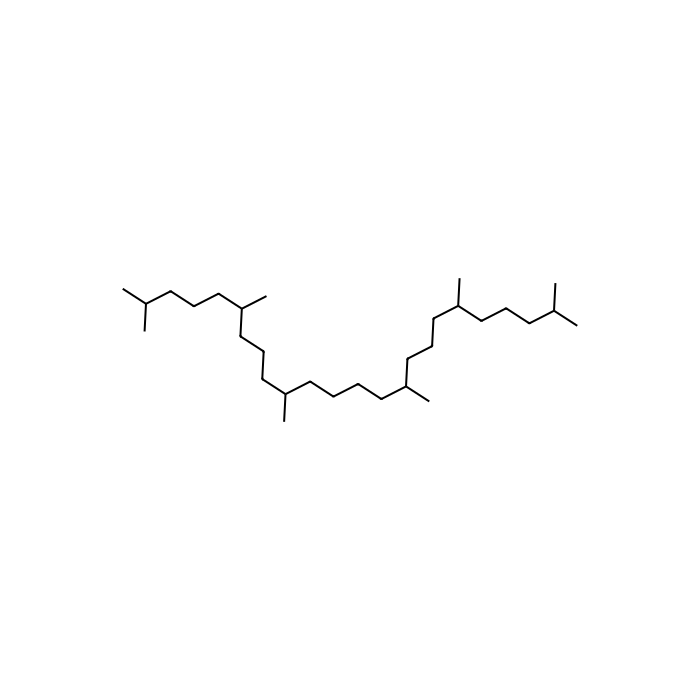
Squalane - 10mM in DMSO , CAS No.111-01-3

CAS: 111-01-3 Cat. No.: S420613 Summenformel: C30H62 Molekulargewicht: 422.81 Beilstein Registry Number: 776019 EG-Nummer: 203-825-6
Zu bestellen verfügbar
GRADE & PURITY 10mM in DMSO
Synonyms
H0096 | SQUALANE [II] | Squalane, European Pharmacopoeia (EP) Reference Standard | squalane-d62 | H12051 | s5407 | SQUALANE [MART.] | EPA Pesticide Chemical Code 045503 | EINECS 203-825-6 | UNII-GW89575KF9 | Squalane, analytical standard | CAS-111-01-3 |
Storage
Store at -80°C
Shipped In
Dry ice packs + Cold packs
★
Size
Deutschland (EU)
USA*
Price
Qty
1ml
S420613-1ml
Auf Bestellung · 8–12 Wochen

51,11€

60,65€
Speichern 9,55 € (15.74%)
Enter a quantity for the sizes you want to add.
🧪
Why this grade

10mM in DMSO for sensitive chromatographic and analytical workflows requiring minimal baseline interference.

🌡

Storage & shipping

Store at -80°C Ships Dry ice packs + Cold packs Check lot-specific COA for exact specifications.

📋

Quality documents

SDS, COA, datasheet, and spec sheet available for download. Lot-specific COA accessible via lot number lookup.

📚

Literature proof

Cited in 12 peer-reviewed publications across chromatography, organic synthesis, and cross-coupling reactions.

Übersicht

product description:

Dielectrophoretic deformation of thin liquid fillm of squalane has been investigated. Microfluidized squalenes are efficient adjuvants, eliciting both humoral and cellular immune responses.

Squalane influence on the vital pathway that transforms glucose into cholesterol may be pivotal. It regulates or controls the rate of synthesis of the enzyme HMG Co-A reductase, and may contribute to effective treatments for cancer and heart disease. It plays an important role as a terminator in the biomembrane.

Specifications

Synonyme
H0096 | SQUALANE [II] | Squalane, European Pharmacopoeia (EP) Reference Standard | squalane-d62 | H12051 | s5407 | SQUALANE [MART.] | EPA Pesticide Chemical Code 045503 | EINECS 203-825-6 | UNII-GW89575KF9 | Squalane, analytical standard | CAS-111-01-3 |
Spezifikationen & Reinheit
10mM in DMSO
Storage
Store at -80°C
Verschickt in
Dry ice packs + Cold packs
Dieses Produkt erfordert Kühlkettenversand. Grundversand und andere Economy-Optionen sind nicht verfügbar.
Namen und Kennungen
Kanonisches Lächeln
CC(C)CCCC(C)CCCC(C)CCCCC(C)CCCC(C)CCCC(C)C
IUPAC Name
2,6,10,15,19,23-hexamethyltetracosane
InChIKey
PRAKJMSDJKAYCZ-UHFFFAOYSA-N
INCHI
1S/C30H62/c1-25(2)15-11-19-29(7)23-13-21-27(5)17-9-10-18-28(6)22-14-24-30(8)20-12-16-26(3)4/h25-30H,9-24H2,1-8H3
Isomere SMILES
CC(C)CCCC(C)CCCC(C)CCCCC(C)CCCC(C)CCCC(C)C
WGK Deutschland
3
RTECS
XB6070000
Alternative CAS-Nummer
111-01-4
Molekulargewicht
422.81
Beilstein
776019
Reaxy-Rn
776019

Documentation

📋 Safety Data Sheet (SDS)

Comprehensive hazard, handling, storage, and regulatory compliance document.

Download SDS →

✅ Certificate of Analysis (COA)

Lot-specific quality data. Enter your lot number to retrieve the exact COA.

Look up COA →

📊 Datasheet

Quick-reference summary of product specifications and applications.

View datasheet →

🔬 Specification Sheet

Full quality attributes and acceptance criteria for this grade.

View spec sheet →

Advanced Data

Taxonomic Classification

Taxonomy Tree

KingdomOrganic compounds
SuperclassLipids and lipid-like molecules
KlassePrenol lipids
SubclassTriterpenoids
Intermediate Tree Nodes Not available
Direct ParentTriterpenoids
Alternative Parents Branched alkanes  
Molecular FrameworkAliphatic acyclic compounds
Substituents Triterpenoid - Branched alkane - Acyclic alkane - Saturated hydrocarbon - Alkane - Hydrocarbon - Aliphatic acyclic compound
BeschreibungThis compound belongs to the class of organic compounds known as triterpenoids. These are terpene molecules containing six isoprene units.
External Descriptors Not available
3D-Struktur
Interaktives chemisches Strukturmodell


Wirkungsmechanismen
Zertifikate (CoA, COO, BSE/TSE und Analyse-Diagramm)
C of A & Other Certificates(BSE/TSE, COO):
Analytical Chart:
Chemische und physikalische Eigenschaften
Brechungsindex1.45-1.452
Flammpunkt (°F)424.4 °F
Flammpunkt (°C)218 °C
Siedepunkt (°C)350 °C
Schmelzpunkt (°C)-38 °C
Molekulargewicht422.800 g/mol
XLogP314.700
Hydrogen Bond Donor Count0
Hydrogen Bond Acceptor Count0
Rotatable Bond Count21
Exact Mass422.485 Da
Monoisotopic Mass422.485 Da
Topological Polar Surface Area0.000 Ų
Heavy Atom Count30
Formal Charge0
Complexity308.000
Isotope Atom Count0
Defined Atom Stereocenter Count0
Undefined Atom Stereocenter Count4
Defined Bond Stereocenter Count0
Undefined Bond Stereocenter Count0
The total count of all stereochemical bonds0
Covalently-Bonded Unit Count1
FAQs und Artikel
Nanowires: Properties, Preparation Routes, and Process Selection (Comprehensive Analysis of Top-Down and Bottom-Up Approaches with Recommended Aladdin Reagents)
Why Limonene Can Soften Greasy Soils Yet Is Difficult to Dissolve in Water: Understanding the Cleaning Mechanism and Formulation Applications of Naturally Derived Solvents from Molecular Structure
Understanding Ceramides from the Perspective of the Stratum Corneum Lipid Barrier: Moisturizing and Barrier-Repair Mechanisms, Ingredient Selection, and Formulation Research Considerations
Mechanistic Analysis of Topical Glutathione in Skincare: Cellular Redox Regulation, Skin Delivery Challenges, and SLN-Based Delivery Strategies
Tocopherols in the Vitamin E Family: How They Block the Chain Reaction of Lipid Peroxidation in Skin Lipids
Analysis of Hydrolyzed Pearl as a Cosmetic Raw Material: Preparation Process, Active Components, and Skincare Formulation Applications
Antioxidant Mechanisms, Stability, and Delivery Strategies of Resveratrol in Skincare Research
How Do Collagen Peptides Act on the Skin? From Surface Hydration and Percutaneous Delivery to Fibroblasts and Collagen Homeostasis
The Moisturizing and Low-Moisture Protective Mechanisms of Trehalose: From Its α,α-1,1 Structure and Hydration Dynamics to In Vitro Skin Barrier Research
Mechanism of Action of Porous Silica in Oil-Control Loose Powder: Pore Structure, Capillary Imbibition, and Surface Modification
Anti-Photoaging Potential of Artemia Extract: UV-Induced Damage Cascades, HSP70-Related Stress Protection, and GP4G Metabolic Insights
Structure, Stratum Corneum Distribution, and Stratum Corneum Conditioning Mechanism of Capryloyl Salicylic Acid: Barrier Effects and Safety Evaluation
Potential Mechanisms of Tea Polyphenols in Oily, Acne-Prone Skin: Effects of EGCG on Sebum Production, Lipid Peroxidation, and Inflammatory Responses
Gentiana Root Extract and Gentiopicroside: Chemical Composition, Antioxidant and Inflammation-Modulating Mechanisms, and Their Potential Effects on Skin Barrier Homeostasis
Mechanism of Action of Tranexamic Acid in Pigmentation Care: From the Plasmin System to Regulation of Inflammation-Driven Pro-Melanogenic Signaling
How Coenzyme Q10 Acts on the Skin: Mitochondrial Electron Transfer, Antioxidant Protection of Membrane Lipids, and Lipid-Carrier Delivery
Mechanistic Basis of Acetyl Hexapeptide-8 in the Management of Expression Lines: SNARE Complex Interference, Constraints on Percutaneous Delivery, and Combination Strategies
Solid Supports in Packed Gas Chromatography Columns: Definition, Mechanisms of Action, Classification, and Selection
How Ectoine Regulates Skin Hydration: Zwitterionic Structure, Preferential Hydration, and Barrier-Support Mechanisms
Structure, Emollient and Moisturizing Effects, and Source Identification of Squalane: From Complete Hydrogenation of Squalene to Stable Isotope Analysis
Citations of This Product
Lösungsrechner
Bewertungen

Kundenbewertungen

Dürfen wir Sie über Rabattaktionen informieren?

Später erinnern

Vielen Dank! Bitte überprüfen Sie Ihren E-Mail-Posteingang, um zu bestätigen.

Hoppla! Benachrichtigungen sind deaktiviert.