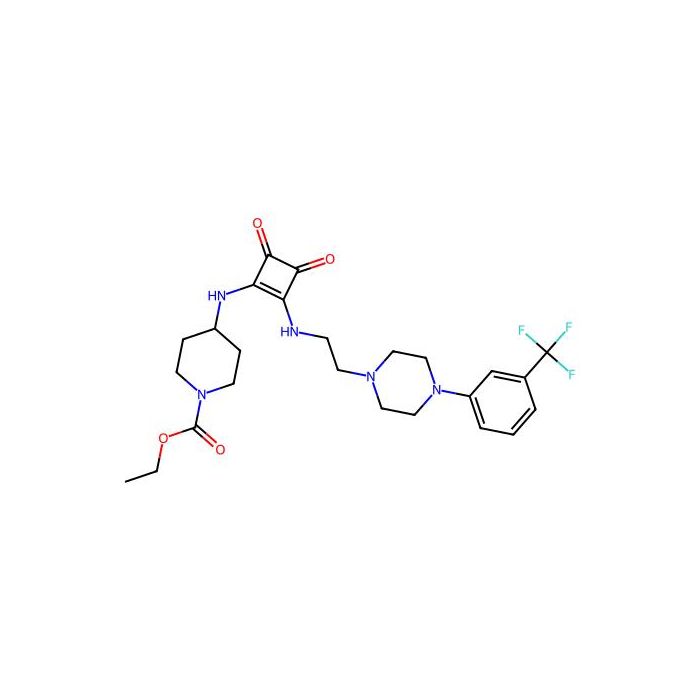
Squarunkin A is a potent and selective UNC119-cargo interaction inhibitor, interrupting the UNC119A -myristoylated Src N-terminal peptide interaction ( IC 50 =10 nM). Squarunkin A interferes with the activation of Src kinase in cells
In Vitro
Squarunkin A (2.5 μM, 0.625 μM, 0.078 μM, and 0.01 μM) treatment leads to a concentration-dependent reduction of Src phosphorylation. Squarunkin A does not target the lipoprotein-binding sites of other lipoprotein chaperones, such as PDE6d, AIPL1, and RhoGDI, which bind S-prenylated proteins. Squarunkin A binds to UNC119 in cell lysate and interferes with Src activation. MCE has not independently confirmed the accuracy of these methods. They are for reference only.
Squarunkin A is a potent and selective UNC119-cargo interaction inhibitor, interrupting the UNC119A -myristoylated Src N-terminal peptide interaction ( IC 50 =10 nM). Squarunkin A interferes with the activation of Src kinase in cells.
Storage
Store at -20°C
Verschickt in
Ice chest + Ice pads
Dieses Produkt erfordert Kühlkettenversand. Grundversand und andere Economy-Optionen sind nicht verfügbar.
Zertifikate (CoA, COO, BSE/TSE und Analyse-Diagramm)
C of A & Other Certificates(BSE/TSE, COO):
Analytical Chart:
Chemische und physikalische Eigenschaften
Löslichkeit
DMSO : 9.62 mg/mL (18.37 mM; ultrasonic and warming and heat to 60°C)
Molekulargewicht
523.500 g/mol
XLogP3
3.300
Hydrogen Bond Donor Count
2
Hydrogen Bond Acceptor Count
11
Rotatable Bond Count
9
Exact Mass
523.241 Da
Monoisotopic Mass
523.241 Da
Topological Polar Surface Area
94.200 Ų
Heavy Atom Count
37
Formal Charge
0
Complexity
880.000
Isotope Atom Count
0
Defined Atom Stereocenter Count
0
Undefined Atom Stereocenter Count
0
Defined Bond Stereocenter Count
0
Undefined Bond Stereocenter Count
0
The total count of all stereochemical bonds
0
Covalently-Bonded Unit Count
1
Lösungsrechner
Molarity Calculator
Determine the necessary mass, volume, or concentration for preparing a solution.
Dilution Calculator
Determine the dilution needed to prepare a stock solution.
Reconstitution Calculator
Bewertungen
Kundenbewertungen
Application Protocols
No item-specific, validated protocols are provided. The following general guidance is offered for deploying small-molecule screening compounds in discovery assays.
General HTS/assay workflow (non-item-specific):
Stock preparation: Dissolve in DMSO to a convenient concentration (e.g., 10–50 mM). If solubility is uncertain, perform a micro-scale solubility screen across DMSO, MeOH, ACN, and DMF.
Aliquoting: Dispense single-use aliquots in low-binding tubes/plates; minimize headspace and freeze–thaw events.
Dilution: For biochemical/cell assays, target ≤0.5–1% final DMSO. Add stock last with thorough mixing to avoid precipitation.
Controls: Include vehicle controls, positive/negative controls, and orthogonal counterscreens to detect assay interference.
Data quality: Use plate QC metrics (e.g., Z′-factor, signal window). Confirm hits with dose–response curves and independent batches when possible.
Analytical confirmation: Verify identity/purity by LC–MS before and after assays to detect degradation or adsorption losses.
Note: These are general research guidelines. For any specific application, adapt conditions based on the verified structure and your assay’s tolerance to solvents and concentrations.
Biological Roles
Item-specific biological roles, targets, or pathway annotations are not provided in this listing.
Known biological functions: Not specified for this item; refer to primary literature via CAS 2101958-02-3 or PubChem CID 134611887.
Mechanism of action, binding partners, and metabolic fate: Not specified for this item; consult the literature or supplier technical notes if available.
General guidance for users in chemical biology:
Validate any observed activity with orthogonal assays to rule out assay interference or nonspecific effects.
Establish concentration–response curves and calculate key parameters (e.g., AC50/IC50/EC50) with appropriate statistical models.
Evaluate cytotoxicity/cell health counterscreens alongside efficacy assays when using cellular systems.
Reminder: This product is for research use only. No clinical/therapeutic claims are made or implied. For definitive biological annotations, rely on peer-reviewed sources and your own experimental confirmation.
Buffer Applications
This item is a small-molecule screening compound and is not a buffering agent. No buffering capacity, pKa profile, or buffer recipes are provided for this product.
Buffer systems: Not applicable for this item.
Practical note: When introducing DMSO stocks of small molecules into biological buffers, keep final co-solvent at ≤1% v/v if compatible with your assay, and add compound stock last with thorough mixing to minimize precipitation.
For buffer preparation guidance, refer to dedicated buffering reagents (e.g., phosphate, HEPES, Tris) rather than this product.
Green Alternatives
In the absence of compound-specific solvent/processing requirements, environmental impact can be reduced by solvent choice and workflow design.
Greener handling strategies (general guidance):
Prefer EtOH or MeOH over DMF where assay compatibility allows; use ACN judiciously as a lower-toxicity polar aprotic alternative.
Maintain concentrated stocks (e.g., 10–50 mM) to minimize solvent volume and shipment mass; aliquot to reduce waste from degraded leftovers.
Use microscale dissolution screens (≤1–2 mg) to avoid unnecessary solvent consumption.
For purification or analytical work, consider UPLC methods (short columns, lower flow) to reduce solvent usage.
Illustrative comparison (general, not item-specific):
DMF: strong solvency; worker exposure and waste concerns; avoid if DMSO/EtOH suffice.
DMSO: broadly usable; good safety profile relative to DMF; manage hygroscopicity and skin permeation risks.
EtOH: renewable routes available; high assay compatibility at low percentages; volatility can aid solvent recovery.
Note: No compound-specific green metrics (e.g., E-factor contribution, biodegradability) are available for this item. Implement institutional green-chemistry policies focusing on solvent selection, energy (cold storage optimization), and waste segregation.
Pharmaceutical Uses
No pharmacopeial status, excipient role, or formulation utility is provided for this item. This product is supplied for research use only and is not intended for clinical or GMP manufacturing applications.
General considerations for discovery-stage compounds (not item-specific):
If formulation-like studies are required for in vivo research models, conduct independent preformulation assessments (solubility, stability, pH/vehicle effects) and adhere to institutional approvals. This listing does not constitute suitability for such use.
No information on residual solvents, heavy metals, or microbiological limits is provided; consult the CoA/Spec Sheet if available or perform internal QC as needed.
Conclusion: There are no declared pharmaceutical/excipient uses for this product in its current specification.
Physical Properties
Item-specific properties are not provided in this listing. When planning experiments, rely on the CoA/Spec Sheet or determine properties empirically on a small scale.
Appearance: Not specified for this item; refer to CoA/Spec Sheet.
Molecular weight: Not specified for this item; refer to CoA/Spec Sheet.
Molecular formula: Not specified for this item; refer to CoA/Spec Sheet.
Melting point (MP): Not specified for this item; refer to CoA/Spec Sheet.
Boiling point (BP): Not specified for this item; refer to CoA/Spec Sheet.
Density: Not specified for this item; refer to CoA/Spec Sheet.
Refractive index: Not applicable/unknown for solids; Not specified for this item; refer to CoA/Spec Sheet.
LogP/logD, pKa: Not specified for this item; refer to CoA/Spec Sheet.
Solubility: Not specified for this item; refer to CoA/Spec Sheet.
General laboratory guidance (literature/practice-based):
For screening compounds, initial dissolution is commonly evaluated in DMSO (e.g., 10–50 mM stocks), then diluted into assay buffers with ≤1% DMSO final.
If DMSO solubility is insufficient, evaluate MeOH, EtOH, acetonitrile, or DMF, and consider co-solvent systems with aqueous buffers.
For ionizable compounds (pKa unknown here), modest pH adjustment can markedly change solubility; perform micro-scale solubility screens.
Assess stability with a short thermal/photostability check (e.g., LC–MS after 24–48 h at ambient vs. refrigerated, with/without light exposure).
Quality and Grades
Item-specific grade/purity is not stated in this listing.
Grade/Purity: Not specified for this item; refer to CoA/Spec Sheet.
Interpretation and best practices (general guidance for screening compounds):
Analytical confirmation typically includes LC–MS purity, UV trace, and, when available, 1H NMR/HRMS. Many screening compounds target ≥95% HPLC purity, but this threshold is not specified for this item.
If your application is SAR, HTS, or biochemical assays, confirm purity and identity on receipt (e.g., quick LC–MS check) to avoid false positives/negatives.
If enantiomeric purity is relevant, request or determine chiral purity (e.g., chiral HPLC). Not specified for this item.
Stabilizers/additives: Not specified for this item; refer to CoA/Spec Sheet. If none are listed, assume neat material.
Documentation:
Retain the lot-specific CoA and any chromatograms. Align internal barcode/plate well IDs to the supplier lot for traceability.
If low UV background is important (e.g., HPLC method development), verify UV cutoffs and impurity profile; these are not provided here.
Reaction and Applications
This product is cataloged under small-molecule and compound libraries, suggesting primary use in discovery research rather than as a synthetic reagent.
Typical research applications (general):
High-throughput or focused screening in biochemical, biophysical, or cell-based assays to probe pathway responses or identify preliminary hits.
Orthogonal reconfirmation in secondary assays (e.g., counter-screens, biophysical binding methods) after initial activity observation.
Structure–activity relationship (SAR) exploration by comparing responses across analogs (if available) and conducting concentration–response profiling.
Best practices for assay deployment:
Prepare fresh DMSO stocks and avoid multiple freeze–thaw cycles; aliquot into single-use volumes.
Verify chemical identity and purity (LC–MS) before screening to reduce artifacts.
Monitor compound stability under assay conditions (light, temperature, buffer composition) using LC–MS or HPLC.
Control for assay interference (inner-filter effects, redox reactivity, aggregation) using suitable counterscreens or detergents.
Not a typical synthetic reagent: Without structural data, no specific reaction classes (e.g., cross-coupling, nucleophilic substitutions) can be recommended for this item. If derivatization is planned, obtain the full structure and consult literature precedents for the corresponding scaffold.
Reaction Conditions
Not applicable: This product is not supplied with structural or functional-group information, and it is not positioned as a reagent for specific synthetic reactions.
General guidance (if derivatization is later pursued after confirming structure):
Choose solvents and bases/acids according to the functional groups present (e.g., amide couplings in DMF/MeCN with carbodiimides or uronium reagents; cross-couplings in toluene/1,4-dioxane/MeCN with Pd catalysts).
Control moisture/oxygen as needed (e.g., glovebox or Schlenk for air-/moisture-sensitive motifs).
Establish small-scale scouting (0.01–0.05 mmol) to map temperature, equivalents, and catalyst loading before scale-up.
Because no literature conditions are associated with this specific item in the listing, please refer to the primary literature after confirming the exact structure.
Safety and Handling
Hazard information is not provided for this specific item. Handle as a potentially hazardous research chemical.
Signal word: Not specified for this item; refer to SDS.
GHS classification and H-statements: Not specified for this item; refer to SDS.
Pictograms: Not specified for this item; refer to SDS.
General laboratory precautions:
Use in a chemical fume hood. Avoid inhalation, ingestion, and skin/eye contact.
PPE: lab coat, safety glasses or goggles, and appropriate chemically resistant gloves (e.g., nitrile). Change gloves frequently when handling DMSO solutions.
Incompatibilities: Unknown for this item; as a precaution, avoid strong oxidizers, strong acids/bases, and reactive metals until compatibility is confirmed.
First aid (general): If on skin/eyes, rinse with water for ≥15 minutes; remove contaminated clothing. If inhaled, move to fresh air. If ingested or exposure is significant, seek medical attention. Always follow your institution’s EHS procedures.
Waste: Collect in appropriate organic waste streams. Do not dispose to drain.
Stability risks: Specific data are not available. Protect from heat and light as a precaution and minimize freeze–thaw cycles for solutions.
Authoritative source: Always consult the product-specific Safety Data Sheet (SDS) and your local regulations for definitive hazard and handling instructions.
Solvent Selection
Because structural and physicochemical data are not specified, choose solvents empirically starting with broadly compatible options for screening compounds.
Recommended workflow (general guidance):
Primary solvent: DMSO for initial stock solutions (e.g., 10–50 mM), due to broad solvating power and assay compatibility at ≤1% v/v.
Alternatives: MeOH, EtOH, acetonitrile, or DMF for solids poorly soluble in DMSO; evaluate material compatibility and assay tolerability.
Aqueous use: Prepare co-solvent dilutions into buffer (e.g., 0.1–1% DMSO or ACN) with vigorous mixing to avoid precipitation. Add compound stock last.
For highly lipophilic materials, consider non-protic solvents (ACN) or inclusion of solubilizers (e.g., 0.01–0.1% nonionic surfactant) if assay-compatible.
Quick comparison (general):
DMSO: broad solubility, high boiling point, hygroscopic; widely accepted in screening.
MeOH/EtOH: volatile, miscible with water, may affect enzyme/biocell assays at >1–2%.
ACN: low viscosity, miscible with water, relatively low proticity; good for LC.
DMF: strong solvent but less desirable toxicologically; minimize where possible.
Note: Specific polarity class, dielectric constant, and solubility parameters for this item are not available; verify with micro-scale solubility and stability tests.
Storage and Reconstitution
Item-specific storage conditions are provided; solution handling guidance is general and not item-specific.
Storage (as supplied): Store at −20°C.
Shipped in: Ice chest + ice pads.
Light/moisture sensitivity: Not specified for this item; refer to CoA/Spec Sheet. As a precaution, store in a dry, dark place.
Stabilizers/additives: Not specified for this item; refer to CoA/Spec Sheet.
Reconstitution and handling (general guidance for small molecules):
Solvents: Start with DMSO for stock solution preparation; if insoluble, test MeOH, EtOH, ACN, or DMF. Record the final solvent system used.
Concentration: Common screening stocks are 10–50 mM. Filter (0.22 µm PTFE) if particulates are present and filtration is compatible.
Aliquoting: Prepare single-use aliquots to avoid repeated freeze–thaw. Clearly label with compound ID, lot, solvent, and concentration.
Storage of solutions: Keep at −20°C or −80°C, protected from light. Define an internal use-by period based on LC–MS stability checks (e.g., 1–3 months unless stability is demonstrated).
Thawing: Thaw quickly at room temperature, mix thoroughly, and return unused aliquots promptly to cold storage.
Note: For definitive stability and reconstitution parameters specific to this item, consult the lot-specific CoA/Spec Sheet.
Structure and Identity
Brief overview: This product is listed as a small-molecule screening compound. However, essential structural identifiers are not fully provided in the current product record.
Product name: Squarunkin A (SKU: S649430)
CAS: 2101958-02-3
PubChem CID: 134611887
InChIKey: Not specified for this item; refer to CoA/Spec Sheet. (Note: the provided string "459385" is not a valid full InChIKey.)
SMILES: Not specified for this item; refer to CoA/Spec Sheet.
Molecular formula: Not specified for this item; refer to CoA/Spec Sheet.
Molecular weight: Not specified for this item; refer to CoA/Spec Sheet.
Structural features (general note):
2D/3D structural details, functional groups, ring systems, and stereochemical assignments are not included in this listing. Please consult the Certificate of Analysis (CoA), Spec Sheet, or authoritative databases (e.g., PubChem via the provided CID) for definitive structure, naming, and identifiers.
Identity verification best practices (general guidance):
Cross-verify CAS and CID across databases (PubChem, ChemSpider) to confirm exact structure and synonyms.
Confirm batch identity by orthogonal methods (e.g., LC–MS retention time vs. standard, HRMS, 1H/13C NMR) before critical use.
If the compound is part of a screening library, retain the supplier’s batch ID with your internal plate/aliquot map to ensure traceability.
Synthetic Utility
The structure and functional groups of this item are not provided; therefore, specific synthetic transformations or reactivity cannot be recommended.
General notes (when structure becomes available):
Identify key functional groups to plan derivatization (e.g., halides for cross-coupling, amines for acylation/sulfonylation, acids for amidation). Confirm protecting-group compatibility if multi-step synthesis is intended.
Use retrosynthetic analysis to map feasible disconnections and to select enabling methodologies (e.g., C–H activation vs. classical cross-couplings) appropriate to the scaffold.
Until full structural data are confirmed for this item, treat it primarily as a finished screening compound rather than a reagent or building block. For analog synthesis, consult the primary literature corresponding to the verified structure (via CAS/CID) and adapt conditions accordingly.
Target Specificity
Target, epitope, and species reactivity data are not applicable for a small-molecule screening compound and none are provided in this listing.
Target name/class: Not specified for this item; refer to literature.
Assay-validated specificity: Not provided.
For chemical probes: If this compound is later validated as a probe, document the on-target and off-target profiles (e.g., kinome scan, thermal shift, CETSA, or proteomics) in your internal records. No such data are supplied here.
Häufig gestellte Fragen
What is the purity of this product?
This product is supplied at ≥99% purity (chemical assay). Lot-specific values are stated on the Certificate of Analysis.
How should this product be stored?
Store at ?20 °C. Freezer storage is required to maintain the specified shelf life.
How is this product shipped?
This product ships in an insulated container with ice pads. Unpack on arrival and transfer it to the storage condition stated above.
What are the CAS number, molecular formula and molecular weight?
The CAS Number is 2101958-02-3, the molecular formula is C25H32F3N5O4, and the molecular weight is 523.55 g/mol. InChIKey ZKITWOVRRSBKFG-UHFFFAOYSA-N.
What documentation is provided?
Available product documentation, including Certificates of Analysis (COA), Safety Data Sheets (SDS), and specification sheets, is shown in the product document area. Document availability and access follow the current site policy.
Wir verwenden Cookies, um die ordnungsgemäße Funktion der Website sicherzustellen und, soweit zulässig, Ihr Nutzererlebnis zu verbessern. Sie können Ihre Einstellungen jederzeit unter „Einstellungen“ verwalten. Weitere Informationen finden Sie in unserer Cookie-Richtlinie.
Dürfen wir Sie über Rabattaktionen informieren?
Später erinnern
Vielen Dank! Bitte überprüfen Sie Ihren E-Mail-Posteingang, um zu bestätigen.
Products are supplied to verified businesses, institutions, and qualified professionals for research and development use only. Not for use in humans, animals, diagnosis, or therapy.