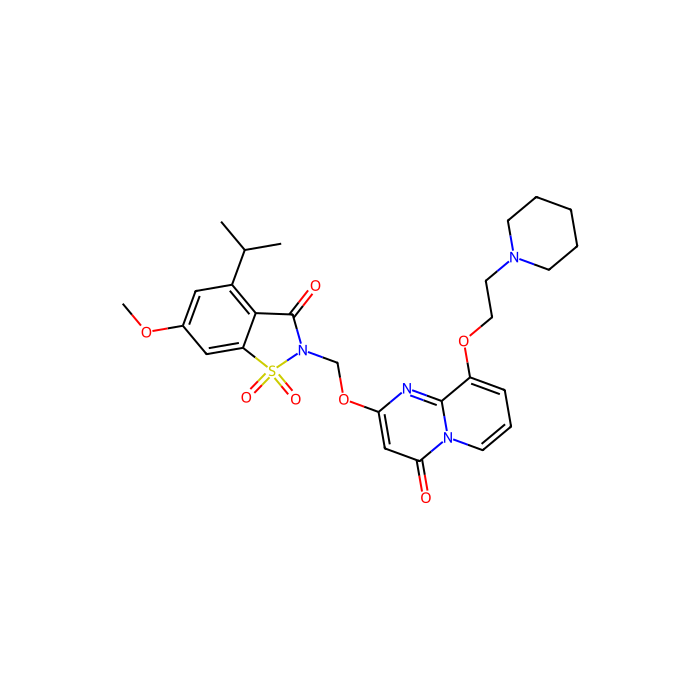
High affinity, potent inhibitor of human leukocyte elastase (HLE) (IC50= 3.9 nM). Displays species-selectivity (Kivalues are 0.017, 1.70, 3.01, 58 and > 100 nM for human, mouse, rat, rabbit and porcine elastase respectively). Inhibits HLE-induced lung he
Storage
Store at 2-8°C
Verschickt in
Wet ice
Dieses Produkt erfordert Kühlkettenversand. Grundversand und andere Economy-Optionen sind nicht verfügbar.
This compound belongs to the class of organic compounds known as pyridopyrimidines. These are compounds containing a pyridopyrimidine, which consists of a pyridine fused to a pyrimidine. Pyridine is 6-membered ring consisting of five carbon atoms and a nitrogen atom. Pyrimidine is a 6-membered ring consisting of four carbon atoms and two nitrogen centers at the 1- and 3- ring positions.
External Descriptors
Not available
1. Djoumbou Feunang Y, Eisner R, Knox C, Chepelev L, Hastings J, Owen G, Fahy E, Steinbeck C, Subramanian S, Bolton E, Greiner R, and Wishart DS. ClassyFire: Automated Chemical Classification With A Comprehensive, Computable Taxonomy. Journal of Cheminformatics, 2016, 8:61.
Zertifikate (CoA, COO, BSE/TSE und Analyse-Diagramm)
C of A & Other Certificates(BSE/TSE, COO):
Analytical Chart:
Chemische und physikalische Eigenschaften
Löslichkeit
Solvent:ethanol, Max Conc. mg/mL: 5.57, Max Conc. mM: 10; Solvent:DMSO, Max Conc. mg/mL: 13.92, Max Conc. mM: 25
Molekulargewicht
556.600 g/mol
XLogP3
2.900
Hydrogen Bond Donor Count
0
Hydrogen Bond Acceptor Count
9
Rotatable Bond Count
9
Exact Mass
556.199 Da
Monoisotopic Mass
556.199 Da
Topological Polar Surface Area
126.000 Ų
Heavy Atom Count
39
Formal Charge
0
Complexity
1200.000
Isotope Atom Count
0
Defined Atom Stereocenter Count
0
Undefined Atom Stereocenter Count
0
Defined Bond Stereocenter Count
0
Undefined Bond Stereocenter Count
0
The total count of all stereochemical bonds
0
Covalently-Bonded Unit Count
1
Lösungsrechner
Molarity Calculator
Determine the necessary mass, volume, or concentration for preparing a solution.
Dilution Calculator
Determine the dilution needed to prepare a stock solution.
Reconstitution Calculator
Bewertungen
Kundenbewertungen
Application Protocols
Item-specific, validated application protocols are not provided for SSR 69071.
General laboratory protocol templates (for discovery use only; adapt as needed):
Preparation of DMSO stock
Weigh appropriate amount of compound quickly to minimize ambient exposure.
Prepare a 10 mM stock in anhydrous DMSO. Vortex and sonicate if needed. Record exact concentration by mass and volume; optionally verify by qNMR.
Plate-based serial dilution
Perform a 1:3 or 1:2 serial dilution in DMSO across a 96- or 384-well source plate.
Transfer small volumes to assay plates to achieve desired final concentrations while keeping DMSO ≤0.5–1% v/v.
Solubility check in buffer
After dilution, inspect for haze/precipitate at assay temperature. If present, reduce top concentration or adjust vehicle composition.
Storage of aliquots
Dispense single-use aliquots, cap tightly, purge headspace with inert gas if practical, and store refrigerated (2–8°C) per item guidance. Avoid repeated freeze–thaw.
Note: These are general practices; validate for your system.
Biological Roles
Item-specific biological function/target: Not specified for this item; refer to primary literature or supplier CoA if available.
General note:
Without structural and target information, no assertions can be made regarding endogenous roles, pathways, or interactions. If SSR 69071 appears in the literature, consult peer-reviewed sources to understand any reported activity, keeping in mind batch-to-batch and salt-form differences.
For any exploratory biological work, document vehicle, final solvent percentage, and compound lot, and include appropriate negative and vehicle controls.
Compliance:
Research use only. Not for human or veterinary use, diagnostics, or clinical applications.
Buffer Applications
Applicability: SSR 69071 is not a buffer reagent, and no acid/base characteristics are provided.
Practical handling in buffered systems (general guidance):
Prepare a concentrated stock in DMSO or ethanol, then dilute into the desired buffer (e.g., PBS, HEPES, Tris) ensuring final organic content ≤0.5–1% v/v unless your assay tolerates more.
If precipitation occurs upon dilution, consider
Increasing the dilution factor of the stock
Adding a small amount of non-ionic surfactant (e.g., 0.01–0.05% Tween 80) if assay-compatible
Adjusting buffer pH based on the compound’s pKa (unknown here; empirical testing recommended)
Filter sterilization (0.22 µm) may adsorb hydrophobic compounds; evaluate recovery by LC/MS.
Item-specific pKa and buffer recipes: Not specified for this item; refer to CoA/Spec Sheet.
Green Alternatives
Because structure and solubility are not provided for SSR 69071, specific substitutions cannot be prescribed. The following are general greener-practice considerations for handling small molecules:
Greener solvent choices for stock preparation (general guidance)
Prefer ethanol or 2-propanol over methanol where feasible (lower toxicity), recognizing their lower solvency for highly lipophilic compounds.
Consider PEG-400 or propylene glycol as co-solvents for aqueous delivery when DMSO must be minimized; verify assay compatibility.
Greener chromatography
Replace acetonitrile with ethanol or methanol where method performance allows; use buffer systems compatible with waste treatment.
Employ supercritical CO2 (SFC) for chiral/semi-preparative work to reduce organic solvent usage.
Process mass intensity (PMI) awareness
Even at discovery scale, minimize repeat dissolutions and use microscale assays to reduce solvent consumption.
Example comparison (general, not item-specific):
DMSO vs 2-pyrrolidone: DMSO offers broader solvency and lower viscosity; 2-pyrrolidone is less volatile but can be harder to remove and may interfere with some assays.
ACN vs EtOH: ACN provides sharper peaks in RP-LC; EtOH is greener but increases backpressure and may alter selectivity.
Trade-offs: Greener options may reduce hazard and waste but can compromise solubility, assay background, or chromatographic performance—evaluate case by case.
Pharmaceutical Uses
Item-specific pharmacopeial or excipient status: Not specified for this item; no pharmacopeial monograph is indicated.
Scope note:
SSR 69071 is supplied for research use only and is not approved for human or veterinary use. No clinical, diagnostic, or therapeutic claims are made.
General formulation context (non-clinical, discovery-stage):
For in vitro assays, compounds are commonly dosed from DMSO stocks; maintain matched vehicle controls.
For preclinical formulation method development (in vitro only), typical approaches include cosolvent systems (e.g., PEG-400/saline/ethanol), micellar solubilization, or cyclodextrin inclusion. Any in vivo-related formulation is outside the permitted scope for this product listing.
Physical Properties
Item-specific specifications:
Appearance: Not specified for this item; refer to CoA/Spec Sheet.
Molecular weight: Not specified for this item; refer to CoA/Spec Sheet.
Melting point: Not specified for this item; refer to CoA/Spec Sheet.
Boiling point: Not specified for this item; refer to CoA/Spec Sheet.
Density: Not specified for this item; refer to CoA/Spec Sheet.
Solubility: Not specified for this item; refer to CoA/Spec Sheet.
LogP/logD, pKa, refractive index: Not specified for this item; refer to CoA/Spec Sheet.
General guidance (literature/practice-based, not item-specific):
For unknown small molecules, initial solubility screening commonly uses DMSO (up to 10–50 mg/mL), followed by methanol, ethanol, acetonitrile, and buffered aqueous systems with 1–2% cosolvent.
If crystalline, a narrow melting endotherm by DSC and a sharp MP can indicate a single phase; broad transitions may suggest solvation/polymorphism.
Light sensitivity and hygroscopicity should be assessed empirically (mass drift on exposure; color changes).
If pKa data are unknown, empirical pH–solubility profiling (pH 2–10) can reveal ionization behavior to support formulation and assay conditions.
For analytical methods, start with reverse-phase LC (C18, 5–95% water–acetonitrile with 0.1% formic acid or ammonium formate) and adjust based on retention/ionization.
Quality and Grades
Item-specific quality details:
Grade/purity: Not specified for this item; refer to CoA/Spec Sheet.
Stabilizers/inhibitors: Not specified for this item; refer to CoA/Spec Sheet.
General guidance on library-compound quality (context, not item-specific):
Discovery/collection compounds are commonly supplied with an identity confirmation (1H NMR and/or HRMS) and a purity determination by HPLC/UPLC or GC. Typical reporting includes chromatographic purity (area %) and water/residual solvent by KF/GC.
If chirality is relevant, chiral purity may be reported by chiral HPLC/SFC; otherwise, racemic mixtures may be provided.
For LC/MS-based workflows, low non-volatile residues and minimal inorganic salts are desirable; request volatile-counterion forms where applicable.
If a stabilizer is present (e.g., BHT for easily oxidized compounds), this can affect bioassays and analytical baselines; account for co-eluting stabilizer peaks in chromatography.
Recommended verification upon receipt: orthogonal purity check (LC at two wavelengths), quick 1H NMR screen, and confirmation of form (free base vs salt, solvate/hydrate) to ensure consistency with your method needs.
Action items:
Request the latest CoA/SDS for SSR 69071 to confirm identity, purity basis, salt form, and any stabilizers prior to critical use.
Reaction and Applications
Item-specific applications from the manufacturer: Not specified for this item.
General research-use contexts for library small molecules (not item-specific, for planning only):
Chemical biology and screening: compounds like SSR 69071 are often formatted as reference or test articles for in vitro assays, target deconvolution workflows, or profiling panels. Confirm identity/purity and solubility before screening.
Analytical reference: may serve as a system-suitability or retention-time marker in LC/MS method development when target-relevant standards are lacking.
Medicinal chemistry enablement: can be used as a comparative control in SAR sets, subject to confirmed structure and activity provenance from literature or internal data.
Practical tips:
Document batch number and prepare frozen aliquots of stock solution to minimize freeze–thaw cycles and concentration drift.
Verify concentration by UV (if chromophore known) or quantitative NMR (qNMR with internal standard) when potency determinations require accuracy and no extinction coefficient is available.
For adsorption losses at low nM–µM levels, pre-rinse plasticware with dilute DMSO or use low-bind plates/tubes.
Note: No biochemical or cellular activity is claimed or implied for this specific item; all use is for research only.
Reaction Conditions
Item-specific reaction conditions are not available.
General guidance for handling unknown small molecules in chemical operations (not item-specific):
Stability screening: Before applying heat or base/acid, run small-scale stress tests (e.g., 1 mg/mL in MeOH, ACN/water, and pH 2/7/10 at room temperature and 40°C for 24 h), assessing degradation by LC/MS.
Photostability: Conduct a light exposure test versus foil-wrapped control; many aromatic nitro/azo/halogenated motifs are light sensitive.
Workup choices: If lipophilicity is unknown, plan for both aqueous/organic partitioning and solid-phase extraction pilots to identify efficient cleanup.
Catalysis compatibility: Unknown heteroatoms can poison metal catalysts; if using as substrate or standard in metal-catalyzed reactions, evaluate on micro-scale first.
Expected yields: Not applicable; no literature data specific to SSR 69071 is provided.
Safety and Handling
Item-specific hazard information:
GHS classification: Not specified for this item; refer to SDS.
Signal word: Not specified for this item; refer to SDS.
Hazard statements (H-phrases): Not specified for this item; refer to SDS.
Pictograms: Not specified for this item; refer to SDS.
Storage conditions (from Product Data): Store at 2–8°C. Shipped on wet ice.
General laboratory precautions (supplemental, not item-specific):
Handle as a research chemical of unknown toxicity. Avoid inhalation, ingestion, and skin/eye contact. Use in a chemical fume hood.
Recommended PPE: lab coat, safety glasses, and appropriate chemical-resistant gloves (e.g., nitrile). For weighing fine powders, consider a balance enclosure.
Incompatibilities: Absent structural data, segregate from strong oxidizers and acids/bases until compatibility is confirmed. Avoid reactive metals if organohalide or nitro content is suspected.
First aid overview: In case of skin contact, wash with soap and water. For eye exposure, rinse cautiously with water for several minutes and seek medical advice. If inhaled, move to fresh air. If ingested, rinse mouth and seek medical attention. Always follow the SDS.
Spill response: Absorb small spills with inert material (vermiculite), collect for disposal as hazardous waste. Prevent dust formation.
Waste: Dispose in accordance with institutional and local regulations; do not discharge to drains.
Deferral: For authoritative safety data, consult the product-specific SDS.
Solvent Selection
Item-specific solvent properties are not provided for SSR 69071.
General selection strategy for small molecules (guidance, not item-specific):
Stock solutions for screening
Start with DMSO due to broad solvency and assay compatibility; typical stocks are 10–50 mM.
If DMSO is inadequate, test DMF, methanol, ethanol, acetonitrile. Warm gently (≤40°C) or sonicate to aid dissolution.
Aqueous work
For buffers, pre-dissolve in a miscible organic (e.g., DMSO or ethanol) then dilute into buffer to ≤0.5–1% cosolvent to minimize assay interference.
Use surfactants (e.g., 0.01–0.05% Tween 80 or Pluronic F-127) if precipitation occurs, subject to assay tolerance.
Purification and analytics
Reverse-phase LC (water/acetonitrile or water/methanol with 0.1% FA/NH4FA) provides broad coverage. Adjust pH to modulate ionization and retention.
Stability considerations
Avoid strong base/acid unless stability is confirmed by LC/MS. Protect from light if chromophores are suspected. Limit aqueous residence time to reduce hydrolysis risk of labile functionalities (esters, lactams, anhydrides).
Comparison snapshot (general):
DMSO: very high polarity/proticity index, miscible with water/organics, strong solvency; may affect biological assays above ~0.5% v/v.
ACN: low viscosity, good LC compatibility; limited water miscibility at high analyte loads.
MeOH/EtOH: protic; can participate in transesterification under strong base/acid.
Storage and Reconstitution
Item-specific conditions (from Product Data):
Storage: Store at 2–8°C.
Shipping: Shipped on wet ice.
Appearance: Not specified for this item; refer to CoA/Spec Sheet.
General guidance (not item-specific):
If supplied as a solid: Keep tightly closed in original container with desiccant. Allow vial to equilibrate to room temperature before opening to prevent condensation. Minimize atmospheric exposure if hygroscopic.
If supplied as a solution: Verify solvent and concentration on the label/CoA. Store as instructed at 2–8°C; protect from light if amber vial supplied. Avoid multiple freeze–thaw cycles.
Reconstitution suggestions: Begin with anhydrous DMSO to prepare a concentrated stock (e.g., 10–50 mM), then dilute into assay media as needed. Sonication and gentle warming (≤40°C) can aid dissolution. Filter only if necessary and after confirming acceptable analyte recovery.
Aliquoting: Prepare single-use aliquots to limit headspace and oxidative degradation. Consider inert gas backfill if the compound is air-sensitive (unknown here).
Documentation: Record lot number, preparation date, solvent, and calculated concentration on the vial and in your ELN.
Research use only: Not for human or veterinary use.
Structure and Identity
Brief overview: SSR 69071 is listed as a small-molecule library compound. However, structural descriptors are not provided in this listing.
Item-specific identifiers (from Product Data)
SKU: S287419
Product name: SSR 69071
CAS: 344930-95-6
PubChem CID: 9872438
InChIKey: 71318 (format appears atypical; verify against CoA/SDS)
SMILES: Not specified for this item; refer to CoA/Spec Sheet.
Molecular formula: Not specified for this item; refer to CoA/Spec Sheet.
Molecular weight: Not specified for this item; refer to CoA/Spec Sheet.
Structural features (functional groups, ring systems, stereochemistry): Not specified for this item; refer to CoA/Spec Sheet.
Interpretive notes (general):
Without SMILES/InChI or a definitive structure, functional group analysis, 2D description, and stereochemical details cannot be provided. Please request the latest CoA or spectral package (1H/13C NMR, HRMS, HPLC/UPLC purity, and, if applicable, chiral SFC) for structural confirmation prior to use in screening or method development.
Synthetic Utility
Item-specific synthetic roles cannot be described without structural information.
General considerations (not item-specific):
If SSR 69071 contains common functional handles (e.g., aryl halide, nitrile, carboxylate, amine), it might be derivatized for SAR exploration. However, do not assume reactivity or stability without confirmed structure and spectra.
For method development, obtain the precise structure and test small-scale transformations while monitoring by LC/MS.
Should a salt form be provided, ensure you understand the counterion for stoichiometry and workup planning.
Action point: Request structural data (SMILES/InChI) and CoA to evaluate whether SSR 69071 can serve as a building block or requires protection/deprotection strategies in synthesis.
Target Specificity
Item-specific target, mechanism, or selectivity information: Not specified for this item; refer to primary literature if available.
Note: No claims are made about binding targets, enzyme classes, receptors, or pathway specificity for SSR 69071 within this listing.
Häufig gestellte Fragen
What is the purity of this product, and how is it determined?
This product is supplied at ≥98% purity, determined by HPLC. Lot-specific values are stated on the Certificate of Analysis.
How should this product be stored?
Store at 2–8 °C. Refrigerated storage is required to maintain the specified shelf life.
How is this product shipped?
This product ships chilled on wet ice. Unpack on arrival and transfer it to the storage condition stated above.
What are the CAS number, molecular formula and molecular weight?
The CAS Number is 344930-95-6, the molecular formula is C??H??N?O?S, and the molecular weight is 556.63 g/mol. InChIKey DRZXDZYWZSKFDL-UHFFFAOYSA-N.
What documentation is provided?
Available product documentation, including Certificates of Analysis (COA), Safety Data Sheets (SDS), and specification sheets, is shown in the product document area. Document availability and access follow the current site policy.
Wir verwenden Cookies, um die ordnungsgemäße Funktion der Website sicherzustellen und, soweit zulässig, Ihr Nutzererlebnis zu verbessern. Sie können Ihre Einstellungen jederzeit unter „Einstellungen“ verwalten. Weitere Informationen finden Sie in unserer Cookie-Richtlinie.
Dürfen wir Sie über Rabattaktionen informieren?
Später erinnern
Vielen Dank! Bitte überprüfen Sie Ihren E-Mail-Posteingang, um zu bestätigen.
Products are supplied to verified businesses, institutions, and qualified professionals for research and development use only. Not for use in humans, animals, diagnosis, or therapy.