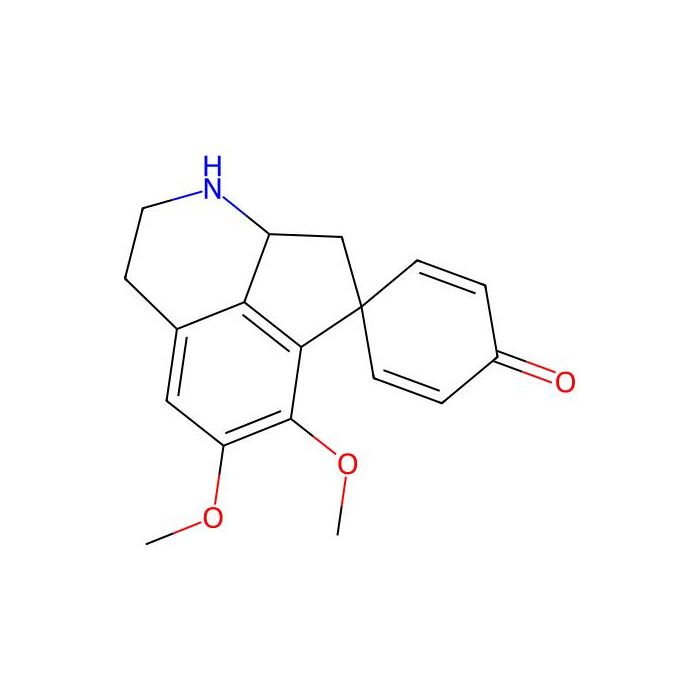
Stepharine - ≥98% , CAS No.2810-21-1

CAS: 2810-21-1 Cat. No.: S649554 Summenformel: C18H19NO3 Molekulargewicht: 297.35 PubChem CID: 98455
Zu bestellen verfügbar
QUALITÄT & REINHEIT ≥98%
Storage
Protected from light,Store at -80°C
Shipped In
Dry ice packs + Cold packs
★
Größe
Deutschland (EU)
USA*
Preis
Menge
1mg
S649554-1mg
Auf Bestellung · 8–12 Wochen
729,68€
Enter a quantity for the sizes you want to add.

Übersicht

Stepharine, an natural alkaloid, directly interactes with TLR4 and binds to the TLR4/MD2 complex (TLR4 inhibitor). Stepharine possesses anti-aging , anti-viral and anti-hypertensive effects.

In Vitro

Stepharine (10, 30 μM) substantially inhibits nitric oxide (NO) release as well as the mRNA and protein expression of pro-inflammatory mediators [inducible nitric oxide synthase, interleukin (IL)-6, tumor necrosis factor (TNF)-α, IL-1β] in LPS-activated BV-2 cells. Stepharine (10, 30 μM) inhibits LPS-induced increase of TLR4 expression, IκBα phosphorylation, and NF-κB p65 nuclear translocation. Stepharine exhibits neuroprotective effects on SH-SY5Y cells cultured with LPS-treated conditioned medium. Stepharine has also shown to inhibit cholinesterase in vitro. MCE has not independently confirmed the accuracy of these methods. They are for reference only.

In Vivo

Stepharine (500 μg/kg) inhibited NeuN + cells loss and Iba-1 + cells increase in the MCAO ischemic cortex . MCE has not independently confirmed the accuracy of these methods. They are for reference only. Animal Model: Middle cerebral artery occlusion (MCAO) rat model . Dosage: 500 μg/kg (20 μL). Administration: Intranasally injected into rats 1h after MCAO. Result: Attenuated the neuronal loss induced by MCAO (MCAO+ stepharine) group.

Form:Solid

Spezifikationen

Spezifikationen & Reinheit
≥98%
Biochemische und physiologische Mechanismen
Stepharine, an natural alkaloid, directly interactes with TLR4 and binds to the TLR4/MD2 complex (TLR4 inhibitor). Stepharine possesses anti-aging , anti-viral and anti-hypertensive effects.
Storage
Protected from light,Store at -80°C
Verschickt in
Dry ice packs + Cold packs
Dieses Produkt erfordert Kühlkettenversand. Grundversand und andere Economy-Optionen sind nicht verfügbar.
Reinheit
≥98%
Namen und Kennungen
SMILES
COC1=C(C2=C3C(CC24C=CC(=O)C=C4)NCCC3=C1)OC
IUPAC Name
10,11-dimethoxyspiro[5-azatricyclo[6.3.1.04,12]dodeca-1(12),8,10-triene-2,4'-cyclohexa-2,5-diene]-1'-one
InChIKey
OGJKMZVUJJYWKO-UHFFFAOYSA-N
InChI
1S/C18H19NO3/c1-21-14-9-11-5-8-19-13-10-18(6-3-12(20)4-7-18)16(15(11)13)17(14)22-2/h3-4,6-7,9,13,19H,5,8,10H2,1-2H3
Isomere SMILES
COC1=C(C2=C3C(CC24C=CC(=O)C=C4)NCCC3=C1)OC
Alternative CAS-Nummer
2810-21-1
PubChem CID
98455
NSC-Nummer
135069
MeSH-Eintrag
stepharine;stepharine monohydrochloride;stepharine tosylate
Molekulargewicht
297.35

Erweiterte Daten

Taxonomic Classification

Taxonomy Tree

KingdomOrganic compounds
SuperclassAlkaloids and derivatives
KlasseProaporphines
SubclassNot available
Intermediate Tree Nodes Not available
Direct ParentProaporphines
Alternative Parents Tetrahydroisoquinolines  Indanes  Anisoles  Aralkylamines  Alkyl aryl ethers  Cyclic ketones  Dialkylamines  Azacyclic compounds  Organopnictogen compounds  Organic oxides  Hydrocarbon derivatives  
Molecular FrameworkAromatic heteropolycyclic compounds
Substituents Proaporphine - Tetrahydroisoquinoline - Indane - Anisole - Alkyl aryl ether - Aralkylamine - Benzenoid - Ketone - Cyclic ketone - Secondary aliphatic amine - Ether - Secondary amine - Azacycle - Organoheterocyclic compound - Organonitrogen compound - Organic oxide - Organopnictogen compound - Amine - Organic nitrogen compound - Organooxygen compound - Hydrocarbon derivative - Organic oxygen compound - Carbonyl group - Aromatic heteropolycyclic compound
BeschreibungThis compound belongs to the class of organic compounds known as proaporphines. These are benzylisoquinoline derivatives characterized by the presence of a spirocyclohexane ring that can occur in various oxidation levels, from cyclohexadienone to cyclohexanol.
External Descriptors Not available
3D-Struktur
Interaktives chemisches Strukturmodell


Zugehörige Ziele (menschlich)
A498 (42825 Activities)
Activity TypeRelationActivity valueUnitsAction TypeJournalPubMed IddoiAssay Aladdin ID
ACHN (49357 Activities)
Activity TypeRelationActivity valueUnitsAction TypeJournalPubMed IddoiAssay Aladdin ID
CAKI-1 (44928 Activities)
Activity TypeRelationActivity valueUnitsAction TypeJournalPubMed IddoiAssay Aladdin ID
CCRF-CEM (65223 Activities)
Activity TypeRelationActivity valueUnitsAction TypeJournalPubMed IddoiAssay Aladdin ID
COLO 205 (50209 Activities)
Activity TypeRelationActivity valueUnitsAction TypeJournalPubMed IddoiAssay Aladdin ID
DU-145 (51482 Activities)
Activity TypeRelationActivity valueUnitsAction TypeJournalPubMed IddoiAssay Aladdin ID
HL-60 (67320 Activities)
Activity TypeRelationActivity valueUnitsAction TypeJournalPubMed IddoiAssay Aladdin ID
HT-29 (80576 Activities)
Activity TypeRelationActivity valueUnitsAction TypeJournalPubMed IddoiAssay Aladdin ID
K562 (73714 Activities)
Activity TypeRelationActivity valueUnitsAction TypeJournalPubMed IddoiAssay Aladdin ID
KM12 (47707 Activities)
Activity TypeRelationActivity valueUnitsAction TypeJournalPubMed IddoiAssay Aladdin ID
M14 (47487 Activities)
Activity TypeRelationActivity valueUnitsAction TypeJournalPubMed IddoiAssay Aladdin ID
MCF7 (126967 Activities)
Activity TypeRelationActivity valueUnitsAction TypeJournalPubMed IddoiAssay Aladdin ID
MOLT-4 (49676 Activities)
Activity TypeRelationActivity valueUnitsAction TypeJournalPubMed IddoiAssay Aladdin ID
OVCAR-3 (48710 Activities)
Activity TypeRelationActivity valueUnitsAction TypeJournalPubMed IddoiAssay Aladdin ID
OVCAR-4 (44535 Activities)
Activity TypeRelationActivity valueUnitsAction TypeJournalPubMed IddoiAssay Aladdin ID
OVCAR-5 (45555 Activities)
Activity TypeRelationActivity valueUnitsAction TypeJournalPubMed IddoiAssay Aladdin ID
OVCAR-8 (47708 Activities)
Activity TypeRelationActivity valueUnitsAction TypeJournalPubMed IddoiAssay Aladdin ID
PC-3 (62116 Activities)
Activity TypeRelationActivity valueUnitsAction TypeJournalPubMed IddoiAssay Aladdin ID
RPMI-8226 (44974 Activities)
Activity TypeRelationActivity valueUnitsAction TypeJournalPubMed IddoiAssay Aladdin ID
RXF 393 (41971 Activities)
Activity TypeRelationActivity valueUnitsAction TypeJournalPubMed IddoiAssay Aladdin ID
SF-295 (48000 Activities)
Activity TypeRelationActivity valueUnitsAction TypeJournalPubMed IddoiAssay Aladdin ID
SK-MEL-2 (46422 Activities)
Activity TypeRelationActivity valueUnitsAction TypeJournalPubMed IddoiAssay Aladdin ID
SK-MEL-28 (48833 Activities)
Activity TypeRelationActivity valueUnitsAction TypeJournalPubMed IddoiAssay Aladdin ID
SK-MEL-5 (47095 Activities)
Activity TypeRelationActivity valueUnitsAction TypeJournalPubMed IddoiAssay Aladdin ID
SK-OV-3 (52876 Activities)
Activity TypeRelationActivity valueUnitsAction TypeJournalPubMed IddoiAssay Aladdin ID
SN12C (47755 Activities)
Activity TypeRelationActivity valueUnitsAction TypeJournalPubMed IddoiAssay Aladdin ID
SNB-19 (46794 Activities)
Activity TypeRelationActivity valueUnitsAction TypeJournalPubMed IddoiAssay Aladdin ID
TK-10 (45540 Activities)
Activity TypeRelationActivity valueUnitsAction TypeJournalPubMed IddoiAssay Aladdin ID
U-251 (51189 Activities)
Activity TypeRelationActivity valueUnitsAction TypeJournalPubMed IddoiAssay Aladdin ID
UACC-257 (46019 Activities)
Activity TypeRelationActivity valueUnitsAction TypeJournalPubMed IddoiAssay Aladdin ID
UACC-62 (47335 Activities)
Activity TypeRelationActivity valueUnitsAction TypeJournalPubMed IddoiAssay Aladdin ID
786-0 (47912 Activities)
Activity TypeRelationActivity valueUnitsAction TypeJournalPubMed IddoiAssay Aladdin ID
A549 (127892 Activities)
Activity TypeRelationActivity valueUnitsAction TypeJournalPubMed IddoiAssay Aladdin ID
NCI/ADR-RES (33767 Activities)
Activity TypeRelationActivity valueUnitsAction TypeJournalPubMed IddoiAssay Aladdin ID
T47D (39041 Activities)
Activity TypeRelationActivity valueUnitsAction TypeJournalPubMed IddoiAssay Aladdin ID
EKVX (44102 Activities)
Activity TypeRelationActivity valueUnitsAction TypeJournalPubMed IddoiAssay Aladdin ID
NCI-H322M (45589 Activities)
Activity TypeRelationActivity valueUnitsAction TypeJournalPubMed IddoiAssay Aladdin ID
HCC 2998 (41480 Activities)
Activity TypeRelationActivity valueUnitsAction TypeJournalPubMed IddoiAssay Aladdin ID
HCT-116 (91556 Activities)
Activity TypeRelationActivity valueUnitsAction TypeJournalPubMed IddoiAssay Aladdin ID
HOP-92 (41141 Activities)
Activity TypeRelationActivity valueUnitsAction TypeJournalPubMed IddoiAssay Aladdin ID
Hs-578T (29457 Activities)
Activity TypeRelationActivity valueUnitsAction TypeJournalPubMed IddoiAssay Aladdin ID
NCI-H460 (60772 Activities)
Activity TypeRelationActivity valueUnitsAction TypeJournalPubMed IddoiAssay Aladdin ID
SF-268 (49410 Activities)
Activity TypeRelationActivity valueUnitsAction TypeJournalPubMed IddoiAssay Aladdin ID
IGROV-1 (47897 Activities)
Activity TypeRelationActivity valueUnitsAction TypeJournalPubMed IddoiAssay Aladdin ID
LOX IMVI (44321 Activities)
Activity TypeRelationActivity valueUnitsAction TypeJournalPubMed IddoiAssay Aladdin ID
HOP-62 (47048 Activities)
Activity TypeRelationActivity valueUnitsAction TypeJournalPubMed IddoiAssay Aladdin ID
MDA-MB-435 (38290 Activities)
Activity TypeRelationActivity valueUnitsAction TypeJournalPubMed IddoiAssay Aladdin ID
MDA-N (28205 Activities)
Activity TypeRelationActivity valueUnitsAction TypeJournalPubMed IddoiAssay Aladdin ID
Malme-3M (44254 Activities)
Activity TypeRelationActivity valueUnitsAction TypeJournalPubMed IddoiAssay Aladdin ID
MDA-MB-231 (73002 Activities)
Activity TypeRelationActivity valueUnitsAction TypeJournalPubMed IddoiAssay Aladdin ID
Wirkungsmechanismen
Zertifikate (CoA, COO, BSE/TSE und Analyse-Diagramm)
C of A & Other Certificates(BSE/TSE, COO):
Analytical Chart:
Chemische und physikalische Eigenschaften
LöslichkeitDMSO : 25 mg/mL (84.08 mM; Need ultrasonic)
Molekulargewicht297.3
XLogP32.100
Hydrogen Bond Donor Count1
Hydrogen Bond Acceptor Count4
Rotatable Bond Count2
Exact Mass297.136 Da
Monoisotopic Mass297.136 Da
Topological Polar Surface Area47.600 Ų
Heavy Atom Count22
Formal Charge0
Complexity510.000
Isotope Atom Count0
Defined Atom Stereocenter Count0
Undefined Atom Stereocenter Count1
Defined Bond Stereocenter Count0
Undefined Bond Stereocenter Count0
The total count of all stereochemical bonds0
Covalently-Bonded Unit Count1
Lösungsrechner
Bewertungen

Kundenbewertungen

Application Protocols

No item-specific validated application protocols are provided for this SKU.

General guidance for common research workflows:

  • Preparation of stock solutions: dissolve in DMSO or methanol to 10–50 mM. Filter through 0.2 µm PTFE if particulate is present. Record concentration by weight and verify by UV or qNMR if required.
  • Cell-free biochemical assays: dilute stock into assay buffer to desired concentration, ensuring final organic solvent content is within assay limits (e.g., ≤0.1–1%). Include vehicle controls.
  • Analytical HPLC/UPLC: develop a gradient using water (0.1% formic acid) and acetonitrile; monitor at multiple wavelengths (254/280 nm) due to aromatic chromophores; confirm identity by MS.
  • Stability checks: incubate aliquots at room temperature, 4 °C, and 37 °C in assay-relevant media; assess by LC–MS for degradation; protect from light per storage guidance.

For any specialized use (e.g., crystallography, electrochemistry), conduct small-scale feasibility tests and consult the CoA for any lot-specific notes.

Biological Roles

Context: No item-specific biological data are provided. The following is general background on aporphine/isoquinoline alkaloids and should not be construed as product specifications or medical claims.

Literature/general insights:

  • Origin: Aporphine alkaloids are biosynthesized via the benzylisoquinoline pathway in plants (e.g., species of Stephania), arising from L-tyrosine-derived dopamine/4-hydroxyphenylacetaldehyde condensations and subsequent oxidative couplings.
  • Structural features: Planar polyaromatic cores with a tertiary amine often confer membrane permeability; phenolic/methoxy substitution modulates pKa and lipophilicity.
  • Molecular interactions: These scaffolds can engage GPCRs, ion channels, and enzymes in vitro; binding is influenced by ring substitution patterns and protonation state (literature).
  • ADME-relevant properties: Basic nitrogen leads to pH-dependent solubility and potential for lysosomal sequestration in cells; aromaticity supports π–π interactions with protein or nucleic acid surfaces (conceptual, literature).

Use in research:

  • Stepharine may be used as a comparator or control in receptor-binding panels, transporter assays, or enzyme inhibition studies in chemical biology laboratories, subject to local approvals. Ensure that concentrations, exposure times, and vehicles are optimized to minimize nonspecific effects.

Important: This product is for research use only. No biological activity is claimed or warranted for any particular application of this SKU.

Buffer Applications

Not typically applicable. Stepharine is a small-molecule alkaloid, not a buffer component. Its role in aqueous systems is generally as an analyte or test article rather than a buffering agent.

Practical notes for assay buffers (general):

  • If dissolution in aqueous buffers is required, acidify the buffer slightly (e.g., 0.1%–1% HCl or formic acid) to protonate the amine and enhance solubility, provided the biological system tolerates the pH.
  • Maintain consistent cosolvent content (e.g., ≤0.1–1% DMSO) across controls and treatments to avoid vehicle effects.

For pH-controlled studies or stability testing, select standard biological buffers (phosphate, acetate, citrate, HEPES) based on target pH, but these buffers are not functions of the compound itself.

Green Alternatives

While Stepharine is itself a target compound rather than a solvent, greener choices can be applied to its handling, purification, and transformations.

Greener solvent considerations (literature/general):

  • Stock solutions: prefer ethanol or water/ethanol (with mild acidification) over DMF/DCM when compatible with the application.
  • Reaction media: consider 2-methyltetrahydrofuran (2-MeTHF) or cyclopentyl methyl ether (CPME) instead of THF/MTBE; ethyl acetate over dichloromethane for extractions and chromatography where resolution allows.
  • Workups: employ aqueous ethanol or isopropanol in place of chlorinated solvents when solubility permits.

Comparison (general guidance):

  • DCM vs EtOAc: EtOAc has lower toxicity and better environmental profile; may require method re-optimization for separation.
  • DMF/DMSO vs bio-based solvents: Cyrene and PolarClean are emerging options for polar aprotic roles; check solubility and stability with aporphine scaffolds.
  • THF vs 2-MeTHF: 2-MeTHF offers improved safety/peroxide profile and renewable sourcing; water content and partition behavior differ.

Process tips:

  • Reduce solvent volumes by using higher-loading stationary phases or supercritical CO2 chromatography when feasible.
  • Implement light/oxygen control to minimize degradants, reducing the need for repeat purifications (less waste).

Note: Validate any solvent substitutions for recovery, purity, and stability of this specific SKU.

Pharmaceutical Uses

Not applicable for clinical or therapeutic use. This product is supplied strictly for research use only.

General context (non-item-specific, non-clinical):

  • Small-molecule alkaloids like aporphines are sometimes investigated as reference materials in preformulation studies, permeability assays, and metabolism research. In such studies, they can serve as model compounds to evaluate extraction, crystallization, or salt-screening workflows.
  • Excipient status: Stepharine is not an excipient and has no pharmacopeial monograph indicated here. Do not use in drug product manufacturing.

Laboratory development guidance:

  • If performing salt screening for solubility enhancement, consider pharmaceutically relevant counterions (HCl, maleate, citrate) strictly within a research context, documenting solid forms (XRPD/DSC/TGA) and solution behavior.
  • For in vitro ADME method development, create qualified reference standards with traceability to a characterized lot (CoA) and store under the conditions specified for this item.

Compliance reminder: No medical, diagnostic, or therapeutic application is intended or permitted for this SKU.

Physical Properties

Item-specific specifications:

  • Appearance: Not specified for this item; refer to CoA/Spec Sheet.
  • Molecular weight: Not specified for this item; refer to CoA/Spec Sheet.
  • Molecular formula: Not specified for this item; refer to CoA/Spec Sheet.
  • Melting point, boiling point, density, refractive index, pKa, logP, solubility: Not specified for this item; refer to CoA/Spec Sheet.

Literature/general expectations for aporphine alkaloids (non-binding guidance):

  • Physical state: typically crystalline solids or amorphous powders with high aromatic content; colors range off-white to tan depending on purity and substitution.
  • Solubility: free bases are often sparingly soluble in water at neutral pH but soluble in organic solvents such as DMSO, DMF, MeOH, EtOH, CHCl3; protonated salts are more water-soluble (literature).
  • Ionization: tertiary amine basicity often yields pKa in the 6–9 range for the conjugate acid (varies by substitution; literature).
  • Lipophilicity: polyaromatic scaffolds with multiple methoxy groups often show moderate-to-high logP (literature).

Practical notes:

  • For method development, begin with small-scale solubility screening in DMSO, MeOH, and aqueous buffers at pH 2–3 (with appropriate acids) versus pH 7.4; confirm with the actual lot.
  • Record exact values from the CoA when establishing analytical methods (HPLC/LC–MS) and stability protocols. Do not treat literature values as item specifications.
Quality and Grades

Item-specific quality information:

  • Grade/Purity: Not specified for this item; refer to CoA/Spec Sheet.

Guidance on interpreting quality for small-molecule reference standards and building blocks:

  • If labeled as analytical/reference grade, expect high chemical purity and documented identity (NMR, HPLC, LC–MS). HPLC grade refers to suitability of solvents, not solids; for solids, look for assay percentage and chromatographic purity on the CoA.
  • If an inhibitor/screening library grade, typical documentation includes identity confirmation and minimum purity threshold by HPLC/UPLC (e.g., ≥95%) suitable for screening; verify on the CoA for this SKU.
  • Stabilizers: None specified for this item. If stabilizers or counterions are present (e.g., HCl salt), they will appear on the CoA and influence solubility and handling.
  • Trace-level specifications (water, metals, residual solvents, UV cutoff): Not specified for this item; refer to CoA/Spec Sheet.

Best practices:

  • Record the lot-specific purity assay, residual solvent profile, and analytical method parameters from the CoA before use in quantitative studies.
  • For biological screening, consider re-purifying (if necessary) or confirming purity via orthogonal methods (qNMR, LC–MS) to match internal acceptance criteria.
Reaction and Applications

Scope: Stepharine is primarily used as a research reference compound and as a scaffold in alkaloid chemistry. No manufacturer applications were provided; the following are literature/general uses for aporphine alkaloids.

  • Reference standard: employed to benchmark analytical methods (HPLC/UPLC, LC–MS) in natural products research and plant metabolomics; useful in retention time libraries and MS/MS spectral databases.
  • SAR and chemobiology: the aporphine core is studied for receptor-binding profiles and enzyme modulation in exploratory assays. Use strictly for research—no clinical/therapeutic claims.
  • Semisynthesis and derivatization: typical transformations include O-demethylation/remethylation, O-alkylation/acylation, N-oxidation/reduction to tune physicochemical properties. Electrophilic aromatic substitution reactions can proceed on activated rings.
  • Chiral studies: aporphines can exhibit stereochemical features; chiroptical and chiral HPLC analyses are common when enantiopurity matters.
  • Analytical method development: optimize ionization in ESI(+) via acidified mobile phases; monitor characteristic fragment ions of aporphine frameworks (literature).

Practical tips:

  • Protect from light and heat during reactions; many aporphines are prone to oxidative discoloration—use degassed solvents and inert atmosphere when necessary.
  • For nucleophilic substitutions on O-protected positions, confirm compatibility with the tertiary amine; consider transient salt formation to modulate basicity and solubility.
Reaction Conditions

No item-specific reaction conditions are provided. The following are literature/general conditions commonly used for aporphine-type alkaloids; verify compatibility with Stepharine’s exact substitution pattern before use.

  • O-Demethylation to phenols: BBr3 in CH2Cl2, −78 to 0 °C, 1–6 h; quench carefully. Alternative: AlCl3/thiols or TMSI. Yields vary widely (40–90%) depending on sterics.
  • O-Alkylation/acylation: base (K2CO3/Cs2CO3) in DMF/acetone or pyridine, rt to 60 °C, 2–24 h; use mild conditions to avoid N-alkylation. Typical yields 60–85%.
  • N-Oxidation: mCPBA or peracetic acid in CH2Cl2/MeOH, 0–25 °C; subsequent Polonovski rearrangement under Ac2O/base gives C–N bond manipulations.
  • Electrophilic aromatic substitution: NBS/NCS for benzylic/allylic halogenation if positions are activated; FeCl3-mediated chlorination or nitration under controlled temperature.
  • Hydrogenation: Pd/C in EtOH/EtOAc under H2 (1–5 bar), rt to 40 °C; monitor to avoid over-reduction.

Analytical and purification conditions:

  • LC–MS: ESI(+), MeCN/H2O with 0.1% formic or formic/ammonium formate buffer improves ionization and peak shape.
  • Flash chromatography: gradients of hexanes/EtOAc or DCM/MeOH with 0.1–1% Et3N to suppress tailing of basic analytes.

Cautions:

  • Protect from light; maintain inert atmosphere for air-sensitive steps. Confirm identity and purity after each transformation by NMR and HRMS.
Safety and Handling

Authoritative source: Always consult the SDS for this SKU for definitive hazard, PPE, and response information.

Item-specific hazard data from Product Data:

  • Signal Word: Not specified for this item; refer to SDS.
  • H-Statements: Not specified for this item; refer to SDS.
  • GHS Classification/Pictograms: Not specified for this item; refer to SDS.

General laboratory safety guidance for small-molecule alkaloids (literature/standard practice):

  • Potential hazards: alkaloids can exhibit bioactivity; avoid inhalation, ingestion, and skin contact. Handle in a fume hood.
  • PPE: lab coat, safety glasses, and appropriate chemical-resistant gloves (e.g., nitrile). For weighing or handling powders, consider a particulate respirator if dust generation cannot be controlled; use in ventilated enclosure.
  • First aid (general):
    • Inhalation: move to fresh air; seek medical attention.
    • Skin/eye contact: rinse with water for at least 15 minutes; remove contaminated clothing; seek medical attention if irritation persists.
    • Ingestion: rinse mouth; do not induce vomiting; seek medical attention.
  • Storage incompatibilities: separate from strong oxidizers and strong acids/bases unless intentionally forming salts; avoid prolonged light exposure as instructed for this item.
  • Waste: collect organic solutions and contaminated disposables as hazardous chemical waste per institutional and regulatory guidance.

Special risks and mitigation:

  • Light sensitivity: this item is specified to be protected from light.
  • Thermal sensitivity: store at −80°C as specified to minimize degradation pathways (oxidation, O-demethylation, or polymerization typical of phenolic/methoxy aromatics under harsh conditions).
Solvent Selection

Applicability: Stepharine is a polyaromatic alkaloid. Without item-specific solubility data, solvent choice should be guided by small-scale screening.

General solvent behavior of aporphine alkaloids (literature):

  • Likely good solvents: DMSO, DMF, methanol, ethanol, acetonitrile, dichloromethane, and chloroform often dissolve neutral aporphines.
  • Aqueous systems: poor solubility near neutral pH for free bases; solubility can increase markedly in acidic aqueous media due to protonation (e.g., 0.1%–1% HCl in water or buffer). Salt forms (if provided) are more water compatible.
  • Polarity: mid-to-high lipophilicity suggests preferring dipolar aprotic or alcoholic media for stock solutions.

Practical recommendations:

  • Prepare concentrated DMSO stocks (e.g., 10–50 mM) and dilute into assay buffer with vigorous mixing; maintain final DMSO below assay tolerance (commonly ≤0.1–1%).
  • For chromatography, start with MeCN/H2O (0.1% formic acid) for LC–MS and MeOH/CH2Cl2 or hexanes/EtOAc for flash purification; adjust by observation.
  • If the item is supplied as a free base, consider in situ salt formation (e.g., HCl, TFA) to enhance water compatibility; verify stability.

Note: Exact solubility/logP/pKa for this SKU are not specified; confirm empirically and document in your method files.

Storage and Reconstitution

Item-specific instructions (from Product Data):

  • Storage conditions: Store at −80 °C. Protect from light.
  • Shipping: Shipped on dry ice packs + cold packs to maintain low temperature.

Recommended handling practices:

  • Upon receipt: keep sealed and cold. Minimize time at ambient temperature during inventory and aliquoting.
  • Aliquoting: prepare single-use aliquots under low-light conditions (amber vials) to avoid repeated freeze–thaw and photodegradation.
  • Reconstitution: if solid, dissolve in a suitable solvent (e.g., DMSO, methanol, or acidified water for salt forms) to prepare a concentrated stock. If supplied in solution, verify solvent and concentration on the CoA before dilution.
  • Freeze–thaw: avoid multiple cycles; thaw on ice and use immediately. Refreezing small remaining volumes is discouraged.
  • Light protection: use amber glassware and foil wrapping during handling and storage.

Stability notes:

  • Long-term stability is enhanced by low temperature, oxygen exclusion, and protection from light. Consider purging vial headspace with inert gas before long-term storage.

Any unspecified details (e.g., exact solvent for initial dissolution, solubility limits, salt form) are not specified for this item; refer to the CoA/Spec Sheet or contact Technical Support.

Structure and Identity

Brief overview: Stepharine is a small-molecule natural product in the aporphine/isoquinoline alkaloid family (literature). Item-specific structural identifiers are not supplied in the Product Data.

  • Item-specific identifiers (from Product Data):
    • CAS: 2810-21-1
    • InChIKey: Not specified for this item; refer to CoA/Spec Sheet. (Product Data field shows a nonstandard placeholder.)
    • SMILES: Not specified for this item; refer to CoA/Spec Sheet.
    • Molecular formula: Not specified for this item; refer to CoA/Spec Sheet.
    • Molecular weight: Not specified for this item; refer to CoA/Spec Sheet.
  • Literature/general structural context (not item-specific):
    • Compound class: aporphine-type isoquinoline alkaloid, typically featuring a tetracyclic benzylisoquinoline framework.
    • Common motifs: many aporphines bear methoxy and/or methylenedioxy substituents on the aromatic rings and a tertiary amine within the heterotetracycle (literature).
    • 2D description: a fused polycyclic aromatic system (four rings) incorporating a nitrogen within the central heterocycle, often decorated by O-alkoxy groups; planar/aromatic character dominates (literature).
  • Stereochemistry (literature): aporphines can possess axial or point chirality depending on substitution; concrete stereochemical assignment for stepharine should be taken from an authenticated reference standard or the item’s CoA.

Notes:

  • Where exact identifiers are required for method development or registration, consult the item’s CoA/Spec Sheet or contact Technical Support to obtain verified SMILES/InChI/InChIKey corresponding to this SKU.
Synthetic Utility

General synthetic roles for an aporphine scaffold (literature; not item-specific):

  • Platform for late-stage functionalization: O-alkylation/acylation of phenolic/methoxy sites; N-oxidation to N-oxide, followed by Polonovski-type rearrangements; selective demethylation (e.g., with BBr3 or demethylases in biocatalysis) to access phenols.
  • Aromatic functionalization: electrophilic aromatic substitutions (nitration, halogenation) at activated positions; cross-coupling after halogenation to diversify substitution.
  • Redox manipulations: hydrogenation of double bonds (if present), oxidative dearomatization to generate spiro or quinone-like intermediates useful for scaffold hopping.
  • Chiral resolution/derivatization: formation of diastereomeric salts with chiral acids (e.g., tartaric/camphorsulfonic acid) to study stereochemical effects.

Retrosynthetic perspective:

  • Aporphines arise from intramolecular oxidative coupling of benzylisoquinolines (biomimetic or metal-mediated), offering entry to analog libraries by varying substituents on the precursor isoquinoline.

Analytical utility:

  • Serves as a calibration or system-suitability compound when developing methods for alkaloid-rich extracts; provides a test case for resolving highly aromatic, basic analytes.

Note: Confirm the functional groups and substitution pattern from the item’s CoA or authenticated literature before planning chemoselective steps.

Target Specificity

Not applicable. This SKU is a small-molecule alkaloid, not a biological macromolecule or antibody. No antigen, epitope, or isotype information applies.

General note (literature): In exploratory pharmacology, aporphine scaffolds may be profiled against receptor/enzyme panels to map interaction preferences, but any such data are context-specific and are not provided or claimed for this product.

Häufig gestellte Fragen

What is the purity of this product?
This product is supplied at ≥98% purity (chemical assay). Lot-specific values are stated on the Certificate of Analysis.
How should this product be stored?
Store at ?80 °C, protected from light. The material is light-sensitive — keep it in its original opaque or amber container.
How is this product shipped?
This product ships frozen with dry ice and cold packs. Unpack on arrival and transfer it to the storage condition stated above; handle dry ice with insulated gloves in a ventilated area.
What are the CAS number, molecular formula and molecular weight?
The CAS Number is 2810-21-1, the molecular formula is C18H19NO3, and the molecular weight is 297.35 g/mol. InChIKey OGJKMZVUJJYWKO-UHFFFAOYSA-N.
What documentation is provided?
Available product documentation, including Certificates of Analysis (COA), Safety Data Sheets (SDS), and specification sheets, is shown in the product document area. Document availability and access follow the current site policy.

Dürfen wir Sie über Rabattaktionen informieren?

Später erinnern

Vielen Dank! Bitte überprüfen Sie Ihren E-Mail-Posteingang, um zu bestätigen.

Hoppla! Benachrichtigungen sind deaktiviert.