GRADE & PURITYMoligand™?Moligand™ — Aladdin's line of ligands and bioactive small molecules. Use for receptor, pathway, and binding studies needing defined small-molecule tools.10 mM in DMSO
Moligand™, 10 mM in DMSO Moligand™ for sensitive chromatographic and analytical workflows requiring minimal baseline interference.
🌡
Storage & shipping
Store at -80°C Ships Dry ice packs + Cold packs Check lot-specific COA for exact specifications.
📋
Quality documents
SDS, COA, datasheet, and spec sheet available for download. Lot-specific COA accessible via lot number lookup.
📚
Literature proof
Cited in 1 peer-reviewed publications across chromatography, organic synthesis, and cross-coupling reactions.
Übersicht
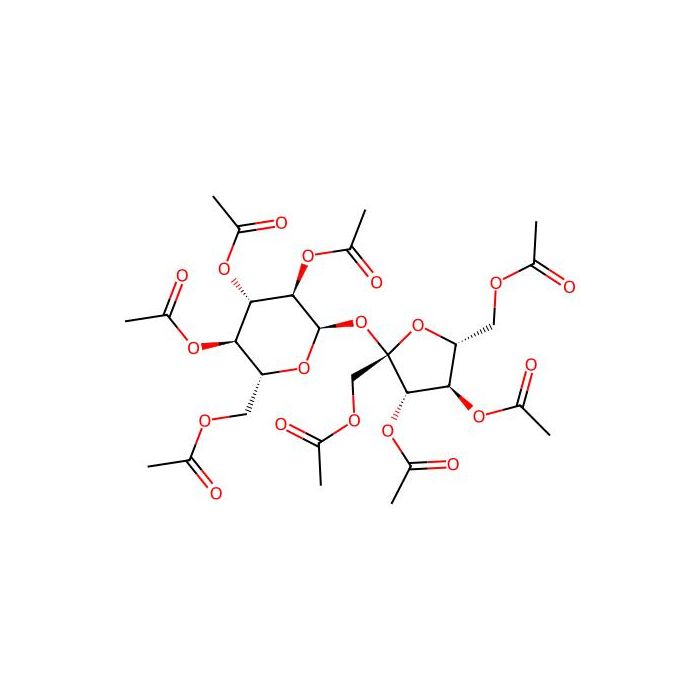
Sucrose octaacetate is an acetylated derivative of sucrose with an intensely bitter tasting and can be used as bitter tasting surrogate. Sucrose octaacetate can be used as food additive and also used as an adhesive and plasticizer. Sucrose octaacetate also used in many pesticides, insecticides, and other toxic products as a deterrent to accidental poisoning. Sucrose octaacetate can also be used as an in situ seed and a soft template to synthesize polyaniline (PANI) nanofibers.
Specifications
Spezifikationen & Reinheit
Moligand™, 10 mM in DMSO
Storage
Store at -80°C
Verschickt in
Dry ice packs + Cold packs
Dieses Produkt erfordert Kühlkettenversand. Grundversand und andere Economy-Optionen sind nicht verfügbar.
1.Xiu-Xian Guo, Zi-Lin He, Jing-Hua Chen, Jian-Bin Luo, Jun-Hua Wei, Qing-Peng Peng, Dai-Bin Kuang. (2025) Tailoring the Emission Properties of Cs2NaLuCl6 for Anti-Counterfeiting, X-Ray Scintillation, and Night Vision Applications. Advanced Optical Materials, 13 (9):(2402845). [PMID:][10.1002/adom.202402845]
Lösungsrechner
Molarity Calculator
Determine the necessary mass, volume, or concentration for preparing a solution.
Dilution Calculator
Determine the dilution needed to prepare a stock solution.
Reconstitution Calculator
Bewertungen
Kundenbewertungen
Application Protocols
No vendor-validated biological assay protocols are provided for this item. However, representative literature-style procedures are included for research planning (not product specifications):
Dissolve sucrose octaacetate at 10–100 mM in acetonitrile or ethanol. If needed, warm gently (≤40 °C) and sonicate. For aqueous assays, dilute into buffer to a final organic content ≤5–10% v/v while vortexing.
Enzymatic hydrolysis screening (esterase/lipase):
Prepare 1–5 mM substrate in buffer (50 mM phosphate, pH 7.4) with 5% MeCN. Add enzyme (e.g., 0.1–1 mg/mL CALB or PLE). Incubate at 30 °C with shaking. Sample at intervals, quench with equal volume of MeCN + 1% AcOH, analyze by HPLC-UV at 210–230 nm.
TLC monitoring:
Silica gel; eluent EtOAc/hexanes 1:1 to 3:1. Visualize with UV (shortwave, weak) and stain with anisaldehyde/sulfuric for carbohydrates/esters.
Purification:
Flash chromatography on silica using EtOAc/hexanes gradients. Avoid basic modifiers to prevent on-column deacetylation.
Note: These are generalized literature protocols; adjust concentrations, temperatures, and times to your system. For GLP/GMP or validated methods, develop and document procedures specific to your laboratory and consult the item’s CoA/Spec Sheet.
Biological Roles
Item-specific biological data: Not specified for this item; refer to CoA/Spec Sheet.
Literature/general context:
Not an endogenous metabolite: Sucrose octaacetate is a fully acetylated derivative of sucrose and does not occur naturally in metabolic pathways. The acetyl groups block enzymatic recognition typical for native sucrose transporters and hydrolases.
Bitter taste receptor activation: Widely used as a standard bitterant in chemosensory research, activating subsets of human and animal bitter taste receptors (T2R family). This property underpins its use in behavioral assays and in vitro receptor studies (no clinical claims).
Enzymatic processing: Certain esterases and lipases can hydrolyze acetate groups under appropriate conditions, progressively regenerating partially deacetylated sucrose; rates depend strongly on enzyme source, solvent, and water activity.
Cellular interaction considerations: Due to hydrophobic surface masking, passive membrane interactions can increase relative to sucrose, but the molecule remains non-ionic and bulky; cellular uptake is typically limited without carrier systems.
Stability in biological media: In neutral aqueous buffers without specific esterases, it is relatively stable; in serum or enzyme-rich environments, gradual deacetylation can occur.
Implications for research use:
As a probe substrate to assess esterase activity/selectivity.
As a model hydrophobic carbohydrate for studying transport, partitioning, and protein–ligand interactions where hydrogen bonding is attenuated.
Buffer Applications
Sucrose octaacetate is not a buffering agent and does not participate in defined acid–base equilibria in the physiological pH range (all hydroxyls are masked as acetate esters). Consequently, it is not used to prepare or maintain buffer pH.
Practical note for buffer-containing assays (literature guidance):
If introducing sucrose octaacetate into aqueous buffers (e.g., for enzymatic tests), dissolve first in a minimal amount of a miscible organic co-solvent (MeCN, DMSO, or ethanol), then add to the buffer with vigorous mixing to avoid precipitation. Keep co-solvent fraction low (typically ≤5–10% v/v) to maintain enzyme activity.
Maintain neutral pH if the acetylation state must be preserved; basic buffers accelerate deacetylation.
Green Alternatives
Given sucrose octaacetate’s typical reliance on halogenated solvents for dissolution and processing, greener choices can reduce environmental impact without compromising performance.
Solvent substitutions (literature-informed):
Replace dichloromethane/chloroform with ethyl acetate or 2-methyltetrahydrofuran (2-MeTHF) for extractions and chromatography when feasible; expect slightly slower dissolution and potential need for warming.
Use acetone or acetonitrile in place of DCM for sample prep and HPLC compatibility; MeCN offers good solvency and is readily recoverable by distillation.
For enzymatic work, replace DMSO with greener co-solvents like glycerol derivatives or ethanol at low percentages, balancing enzyme tolerance and substrate solubility.
Processing considerations:
Prefer normal-phase mobile phases with EtOAc/hexanes over chlorinated eluents; for reverse-phase, aqueous MeCN systems with low additive burdens are effective.
Minimize base-catalyzed steps that drive saponification, reducing need for neutralization and salt generation downstream.
Comparison (general):
DCM vs EtOAc: EtOAc is biodegradable and less toxic; may require increased volumes or mild heating for full dissolution of sucrose octaacetate.
CHCl3 vs 2-MeTHF: 2-MeTHF is bio-based and has lower persistence; polarity differences may modestly alter solubility and chromatographic behavior.
Note: Verify compatibility of green solvents with your assay (especially enzymes), as solvent choice can shift hydrolysis rates and regioselectivity.
Pharmaceutical Uses
Item-specific pharmacopeial status and excipient grade: Not specified for this item; refer to CoA/Spec Sheet.
Literature/general formulation roles (no therapeutic/clinical claims):
Bitterant/aversive agent: Employed in research and development settings to impart a strong bitter taste to coatings or matrices, useful in studies aimed at discouraging accidental ingestion or in taste-masking/contrast investigations.
Coating/plasticization studies: The hydrophobic, glass-forming nature makes it a candidate component in experimental film coatings and polymer blends to modulate barrier properties, Tg, and taste profile.
Analytical standard: Used as a reference compound in bitterness quantification assays and for validating esterase activity assays.
Considerations for formulation research:
Solubility control: Poor water solubility necessitates organic solvents or melt processes; for aqueous-based coatings, consider dispersion or emulsification strategies.
Stability: Stable under neutral conditions; avoid alkaline excipients or high moisture/heat that could accelerate hydrolysis to acetic acid and partially deacetylated sugars.
Interactions: Can plasticize certain polymers; screen compatibility with matrix excipients to avoid undesired softening or migration.
Regulatory note: Any use beyond laboratory research requires verification of excipient grade, impurities, and compliance; such details for this item are Not specified and must be confirmed with the CoA/Spec Sheet.
Physical Properties
Item-specific specifications (this lot): Not specified for this item; refer to CoA/Spec Sheet.
Literature/computed values (for general guidance; not item specifications):
Appearance: crystalline solid (literature)
Melting point: ~83–85 °C (literature)
Boiling point: not typically reported; compound decomposes before boiling under ambient pressure (literature)
Density: not widely tabulated; expect >1.2 g/cm³ typical of heavily oxygenated esters (qualitative, literature)
Solubility:
Water: essentially insoluble (literature)
Organic solvents: soluble in chlorinated solvents (e.g., CH2Cl2, CHCl3), acetone, acetonitrile, ethyl acetate; moderately soluble in ethanol/methanol; poor in alkanes (literature)
LogP: high (hydrophobic) due to eight acetate groups and absence of free OH (qualitative, literature)
Refractive index: not commonly reported for solids (literature)
pKa: not applicable (no ionizable protic groups after per-acetylation; literature)
Notes for practice:
The peracetylated surface diminishes hydrogen bonding, drastically lowering water affinity compared to sucrose. This underpins its use as a hydrophobic model carbohydrate in organic media.
For analytical quantitation, HPLC-UV at 210–230 nm is feasible due to ester carbonyl absorbance; exact UV cutoff/ε: Not specified for this item; refer to CoA/Spec Sheet.
Quality and Grades
Product-specific grade: Moligand™ (as listed). Detailed grade definition, acceptance criteria, and assay methodology: Not specified for this item; refer to CoA/Spec Sheet.
Context for professional users:
Per our catalog taxonomy, Moligand™ items are positioned within research-grade reagents for life-science and chemical workflows. In absence of explicit purity/assay and stabilizer disclosures, end-users should consult the Certificate of Analysis for:
Purity specification and limits on residual acetic acid/solvent
Water content (e.g., KF), residual monoor poly-acetylated byproducts
Heavy metals/elemental analysis (if applicable to your use)
Any stabilizers/additives (typically none for neutral carbohydrate esters; item-specific status Not specified)
Practical guidance:
For sensitive enzymology or taste-receptor research, low levels of hydrolysis products (e.g., acetic acid, partially deacetylated sucrose) may affect results. Request chromatographic profiles if critical.
If using as an analytical standard or matrix modifier, consider secondary verification (qNMR or HPLC) under your method conditions, as ester cleavage can be matrix-dependent.
UV background: Not specified for this item; for LC-UV work, confirm low-UV impurities on your system prior to quantitative use.
Reaction and Applications
Research applications (literature; expand on general uses):
Model substrate for ester hydrolysis and transesterification: The eight acetate esters provide a platform to study chemoselectivity, regioselectivity, and rate effects in chemical (base- or acid-catalyzed) and enzymatic (lipase/esterase) deacetylation. Useful for probing active-site specificity and solvent effects.
Taste receptor studies: Sucrose octaacetate is a potent bitterant used to activate bitter taste receptors (T2R family) in in vitro systems and behavioral assays (organismal studies). It serves as a standard stimulus for chemosensory research (no clinical claims).
Material and coating science: As a hydrophobic, glass-forming carbohydrate derivative, it can act as a plasticizer component, bitterant additive, or barrier modifier in polymer and coating research.
Carbohydrate protection chemistry: Functions as a peracetylated sugar framework; selective deprotection of one or more acetate groups affords partially protected sucrose derivatives for further derivatization.
Practical tips:
Avoid strong bases if retention of acetyl protection is essential; even trace alkoxide promotes cleavage in methanol.
For enzymatic hydrolysis, pre-dissolve in a minimal amount of DMSO/MeCN and add slowly to buffered enzyme solution to prevent precipitation; maintain low cosolvent fractions to protect enzyme activity.
Monitor progress by TLC (EtOAc/hexanes 1:1 to 3:1) or HPLC-UV (210–230 nm).
For analytical bitterness assays, prepare fresh stocks to avoid variable results from partial hydrolysis.
Manufacturer Applications: Not specified beyond “Research use only”; suitable contexts include the above fundamental research uses.
Reaction Conditions
General literature guidance for common transformations involving sucrose octaacetate (not item specifications):
Basic deacetylation (partial or full):
Reagents: NaOMe in MeOH (0.01–0.5 equiv, titrated to target conversion).
Solvent: anhydrous MeOH (or MeOH/CH2Cl2 for solubility control).
Temperature: 0–25 °C.
Time: minutes to hours depending on loading and target selectivity.
Notes: Strictly control base equivalents; quench with acidic ion-exchange resin or AcOH to stop deacetylation and minimize acetyl migration.
Expected yields: Highly procedure-dependent; selective manipulations often give 50–85% for targeted mono-/di-deacetylated products (literature ranges). Always optimize for your enzyme/base system.
Safety and Handling
Authoritative safety data: Not specified for this item; refer to SDS.
General laboratory guidance for sucrose octaacetate (literature-based; not product-specific):
GHS/Classification: Not specified for this item; refer to SDS. Sucrose octaacetate is generally considered of low acute toxicity but may cause eye/skin irritation and respiratory irritation as a dust.
Signal word / H-statements / pictograms: Not specified for this item; refer to SDS.
Best practices:
PPE: laboratory coat, safety glasses or goggles, and appropriate gloves (e.g., nitrile). Avoid generating dust/aerosols.
Handling: work in a well-ventilated area or fume hood when weighing/transfer to limit dust inhalation. Prevent contact with strong bases (risk of ester saponification) and strong acids (risk of transesterification/hydrolysis under forcing conditions).
Incompatibilities: strong nucleophiles/bases (alkoxides, amines) and strong acids/catalysts can cleave acetate esters. Avoid prolonged exposure to moisture if composition must be preserved; hydrolysis is slow but can occur under basic or enzymatic conditions.
First aid (overview):
Skin: wash with soap and water.
Eyes: rinse cautiously with water for several minutes; remove contact lenses if present and easy to do.
Inhalation: move to fresh air; seek medical attention if symptoms persist.
Ingestion: rinse mouth; do not induce vomiting; seek medical advice if unwell.
Fire safety: Organic solid; use CO2, dry chemical, or foam. Combustion may produce CO/CO2 and acetic acid/irritant fumes.
Waste: Collect solid/contaminated disposables as organic waste; avoid sewer discharge. Follow institutional and local regulations.
Solvent Selection
Sucrose octaacetate is a neutral, highly oxygenated but hydrophobic ester. It dissolves readily in moderately polar aprotic organic solvents and poorly in water/alkanes.
Acceptable: ethanol/methanol (warming/sonication may be needed), isopropanol.
Poor: hexanes/heptane, cyclohexane; limited in toluene unless heated.
Water: effectively insoluble.
Selection guidance:
For weighing and stock solutions: CH2Cl2 or EtOAc provide rapid dissolution at room temperature; MeCN offers LC compatibility.
For biocatalysis (esterase/lipase assays): choose low-water, enzyme-compatible cosolvents (e.g., 5–20% v/v acetonitrile or tert-butanol in buffer) to balance substrate solubility and enzyme activity; screen empirically.
For preparative workup: EtOAc enables efficient partitioning versus aqueous phases; avoid basic aqueous washes that induce deacetylation.
For chromatography: normal-phase silica with EtOAc/hexanes or DCM/MeOH gradients works; minimize basic modifiers.
Brief comparison (literature-based):
Dichloromethane vs Ethyl acetate: DCM offers faster dissolution and tighter spots on silica; EtOAc is greener and compatible with LC-UV. Choose EtOAc when halogenated solvent avoidance is desired.
Acetone vs MeCN: acetone improves solubility but can compete in transesterification with strong bases; MeCN is inert and LC-friendly.
Storage and Reconstitution
Item-specific storage (from Product Data): Store at -80 °C. Shipped on dry ice packs + cold packs.
Research use note: For research use only.
Handling and stability (general guidance; not item specifications):
Solid stability: When protected from moisture, heat, and light, sucrose octaacetate is typically stable for extended periods. The ultra-low storage temperature provided (-80 °C) minimizes any slow hydrolysis or acetyl migration.
Working aliquots: To reduce freeze–thaw and moisture exposure, aliquot into small, tightly sealed vials under dry air or inert gas. Allow vials to equilibrate to room temperature before opening to prevent condensation.
Reconstitution/solubilization:
Preferred solvents: dichloromethane, ethyl acetate, acetone, or acetonitrile. For aqueous assays, prepare a concentrated stock in MeCN or ethanol and dilute into buffer with rapid mixing.
Typical stock concentrations: 10–100 mM depending on application and solvent; filter through 0.22 µm PTFE if particulate is present.
In-use storage: Keep solutions at 2–8 °C for short periods (hours to days) and at -20 °C for longer-term storage; avoid basic conditions to prevent deacetylation. Protect from moisture.
Specifications not provided for this item (consult CoA/Spec Sheet): moisture limits, residual solvent content, stabilizers (if any), and shelf-life/retest date.
Structure and Identity
Sucrose octaacetate is the fully O-acetylated derivative of sucrose, comprising an acetal-linked disaccharide (glucopyranose–fructofuranose) whose eight free hydroxyl groups are masked as acetate esters.
Item-specific identifiers (from Product Data):
SKU: S1495191
CAS: 126-14-7
Grade: Moligand™
SMILES: Not specified for this item; refer to CoA/Spec Sheet.
InChIKey: Not specified for this item; refer to CoA/Spec Sheet.
Literature identity details (for reference; not item specifications):
Molecular formula: C28H38O19 (literature)
Molecular weight: ~678.6 g/mol (literature)
Core scaffold: nonreducing disaccharide (sucrose) with a 1,2-acetal linkage between D-glucopyranose (chair, 6-membered ring) and D-fructofuranose (5-membered ring).
Functional groups: eight acetate esters (O–C(=O)–CH3), acetal, multiple ether linkages; no free hydroxyl groups remain.
Stereochemistry: multiple defined stereocenters inherited from sucrose; no new stereocenters introduced by acetylation.
2D structure (described):
A glucopyranose ring fused via the anomeric oxygen to a fructofuranose ring (sucrose linkage). Each ring oxygen and exocyclic oxygens carry acetyl substituents (–O–C(=O)–CH3) at all positions that are hydroxyl in sucrose, giving a dense periphery of acetate groups that render the molecule hydrophobic relative to sucrose.
Synthetic Utility
From a synthetic perspective, sucrose octaacetate is a per-protected disaccharide scaffold that enables selective manipulations on a densely functionalized, stereochemically defined framework.
Key features (literature):
Protecting group platform: The eight acetate esters are readily cleaved under mild basic or enzymatic conditions, enabling stepwise access to selectively protected sucrose derivatives.
Chemoselectivity studies: Differential reactivity among acetate positions (axial/equatorial; primary/secondary) provides a testbed for regioselective deacetylation strategies (e.g., NaOMe/MeOH at low temperature, lipase-catalyzed hydrolysis).
Derivatization: After partial deacetylation, free OH groups can be refunctionalized (e.g., re-acylation with alternative acyl groups, carbonate formation, etherification), allowing construction of tailored amphiphiles or glycoconjugates.
Linker introduction: Through selective deprotection at primary positions, the molecule can be converted into tethered sucrose derivatives useful for materials or affinity probes.
Practical notes:
Maintain neutral to slightly acidic conditions for operations where acetate retention is required (e.g., electrophilic substitutions on other appended groups).
For selective hydrolysis, employ low base loadings (≤0.1 equiv) in anhydrous MeOH at 0–25 °C and short times, or use enzyme catalysis in biphasic/low-water media to exploit active-site preferences.
Monitor using TLC/HPLC due to the potential for acetyl migration under certain acidic/basic conditions; quench carefully and neutralize acetic acid byproducts.
Target Specificity
Not applicable. This product is a small-molecule carbohydrate ester, not an antibody, enzyme, nucleic acid, or targeted biological reagent. No target/epitope specificity, clone, isotype, or species reactivity data apply to this item.
Wir verwenden Cookies, um die ordnungsgemäße Funktion der Website sicherzustellen und, soweit zulässig, Ihr Nutzererlebnis zu verbessern. Sie können Ihre Einstellungen jederzeit unter „Einstellungen“ verwalten. Weitere Informationen finden Sie in unserer Cookie-Richtlinie.
Shall we send you a message when we have discounts available?
Remind me later
Thank you! Please check your email inbox to confirm.
Products are supplied to verified businesses, institutions, and qualified professionals for research and development use only. Not for use in humans, animals, diagnosis, or therapy.