GRADE & PURITYIndicator?Indicator grade — characterized dye giving a defined color change at a known transition. Use to signal pH or titration endpoints visually.
indicator Indikator for sensitive chromatographic and analytical workflows requiring minimal baseline interference.
🌡
Storage & shipping
Protected from light,Room temperature Ships Normal Check lot-specific COA for exact specifications.
📋
Quality documents
SDS, COA, datasheet, and spec sheet available for download. Lot-specific COA accessible via lot number lookup.
📚
Literature proof
Cited in 1 peer-reviewed publications across chromatography, organic synthesis, and cross-coupling reactions.
Specifications
Spezifikationen & Reinheit
indicator
Storage
Protected from light,Room temperature
Verschickt in
Normal
Note
Indikator
Hinweis
Wherever possible, you should prepare and use solutions on the same day. However, if you need to make up stock solutions in advance, we recommend that you store the solution as aliquots in tightly sealed vials at -20°C. Generally, these will be useable for up to one month. Before use, and prior to opening the vial we recommend that you allow your product to equilibrate to room temperature for at least 1 hour. Need more advice on solubility, usage and handling? Please visit our frequently asked questions (FAQ) page for more details.
Determine the necessary mass, volume, or concentration for preparing a solution.
Dilution Calculator
Determine the dilution needed to prepare a stock solution.
Reconstitution Calculator
Bewertungen
Kundenbewertungen
Application Protocols
No tested biological application protocols (WB, IHC, IF, FC, etc.) are provided in the Product Data for this indicator reagent.
General laboratory protocol sketches (non‑validated; adapt to your SOP):
Preparation of aqueous indicator stock: Dissolve an appropriate mass to obtain 0.5–5% w/v in DI water. Mix until clear. Filter (0.45 μm) if needed. Store in amber glass at room temperature.
Colorimetric metal assay (example framework): Buffer the sample (e.g., acetate, pH ~2–4), add a defined aliquot of indicator solution, then introduce metal standard or sample. Measure absorbance at the established λmax versus blank. Construct calibration curve, checking linearity and matrix effects.
Protein precipitation (analytical prep): Add an equal volume of 3–15% w/v sulfosalicylic acid solution to protein‑containing sample. Mix, incubate briefly, and clarify by centrifugation. Proceed with analysis of supernatant or resolubilize pellet as required by the method.
These outlines are provided for conceptual guidance only; validate concentrations, times, and wavelengths for your specific application.
Biological Roles
Not typically applicable for an analytical indicator reagent.
General chemistry context (literature):
Sulfosalicylic acid is not a native metabolite. Its principal relevance in biosciences is operational—precipitating proteins to remove them from solution prior to analytical measurements and serving as a ligand to detect/quantify certain metal ions in research samples.
Because of protein denaturation/precipitation capacity, handle with care around biological materials; avoid unintended exposure to enzymes or cells during research protocols.
No biological function, signaling role, or metabolic pathway is attributed to this reagent in living systems. Use strictly for research/laboratory applications as indicated by the product’s Research Use Note.
Buffer Applications
This material is not a buffering agent in the classical sense; its strong acid character and chelation behavior make it unsuitable for maintaining a stable pH over a range as a primary buffer component.
Practical laboratory use (general):
It may be dissolved in an existing buffer (e.g., acetate, citrate) to act as an indicator or complexing dye at a defined pH. In such cases, the buffer system—not sulfosalicylic acid—controls pH.
When preparing indicator working solutions, select a buffer with minimal metal contamination and known complexation background. Filter/chelate‑clean as needed (e.g., pre‑treat with metal scavengers or use high‑purity salts) to avoid false positives in metal assays.
If you require a buffer with aromatic acid components, consider benzoate, salicylate, or citrate/acetate systems depending on the pH range—keeping in mind potential competitive binding to target metal ions (general guidance).
Green Alternatives
Perspective: As an indicator/reagent, sulfosalicylic acid is used in small quantities; nevertheless, greener analytical choices can reduce hazard, waste, and metal chelator persistence.
Comparative considerations (general):
Sulfosalicylic acid vs salicylic acid: Sulfonation increases water solubility, enabling fully aqueous methods and avoiding organic co‑solvents—beneficial from a green chemistry standpoint. However, sulfonated aromatics can be more persistent in the environment.
Alternative colorimetric ligands (example classes):
Ferrozine/ferene derivatives for Fe2+/Fe total assays (often high sensitivity, aqueous). Some may have lower acute hazards but are synthetically complex.
Catechol‑type ligands (e.g., pyrocatechol violet) offer strong metal color responses in water; waste streams may require chelator management.
Biobased acids (tannic/gallic derivatives) can complex metals with lower synthetic footprint, though selectivity and stability may be inferior.
Process changes:
Minimize indicator concentration to the lower validated limit for visual clarity or absorbance sensitivity.
Use microplate or microvolume cuvette formats to cut solvent and reagent use.
Implement on‑site treatment for chelator‑containing aqueous waste (e.g., advanced oxidation where permitted) to mitigate persistence.
Illustrative comparison (general; not item‑specific)
Aqueous operability: Sulfosalicylic acid – excellent; many alternatives – variable.
Hazard profile: Strong acid/irritant; alternatives may have different irritation or sensitization risks—always consult SDS.
Selectivity: Good for specific metals under controlled pH; alternatives may offer superior selectivity but can demand tighter pH/ligand control.
Pharmaceutical Uses
Not applicable as an active pharmaceutical ingredient. This product is offered for research use only.
Indicators and complexing agents like sulfosalicylic acid are occasionally used in QC analytical methods (e.g., assay of metal impurities, colorimetric tests) within pharmaceutical laboratories, not in patient‑facing formulations.
If used within a GMP/GLP setting, ensure reagent grade, lot traceability, and appropriate compendial alignment of the analytical method. No pharmacopeial monograph is cited here for this specific indicator use; consult your validated method suite.
No claims are made regarding therapeutic applications, excipient status, or clinical use for this item.
Physical Properties
Item-specific specifications (this product):
Appearance: Not specified for this item; refer to CoA/Spec Sheet.
Molecular formula: Not specified for this item; refer to CoA/Spec Sheet.
Molecular weight: Not specified for this item; refer to CoA/Spec Sheet.
Other physico-chemical specs (mp, bp, density, UV cutoff, water/peroxide/metal limits): Not specified for this item; refer to CoA/Spec Sheet.
Literature/typical properties for 5‑sulfosalicylic acid (for reference; not product specifications):
Physical state: typically a white to off‑white crystalline solid; frequently available as anhydrous or dihydrate forms (literature).
Melting behavior: reported decomposition >300 °C for the anhydrous form; hydrates may dehydrate before melting (literature, varies by form).
Solubility: highly soluble in water; moderate in polar protic solvents (MeOH, EtOH); limited in aprotic/nonpolar solvents (literature). Strong acidity from –SO3H promotes high aqueous solubility as sulfonate salts at neutral/alkaline pH.
UV–Vis behavior: forms colored complexes with certain metal ions (e.g., Fe3+) producing absorbance in the visible region; the uncomplexed acid shows strong UV absorbance typical of substituted benzoic acids (literature).
Practical notes:
For analytical indicator use, prepare freshly in deionized water and record pH/ionic strength, as spectral properties can shift with protonation state and counterion (general guidance).
Indicator grade denotes suitability for colorimetric/complexometric analytical work where reagent background color, insoluble residue, and interfering impurities are controlled to avoid false endpoints or spectral background.
This is distinct from synthetic or technical grades that may contain chromophoric impurities, and from ultra‑low UV/LC grades intended for chromatographic eluents.
What “indicator grade” implies (general guidance):
Low background absorbance in the relevant spectral window for the intended color change/complexation.
Tight control of inorganic impurities (e.g., Fe, Al, heavy metals) that could pre‑complex or bias metal assays.
Controlled moisture level and crystalline form to ensure reproducible solution molarity and color response.
Stabilizers/additives: Not specified for this item; refer to CoA/Spec Sheet.
Trace specifications (metals, water, UV cutoff, ash): Not specified for this item; refer to CoA/Spec Sheet.
Practical QA recommendations:
For sensitive metal assays, verify blank spectra of freshly prepared solutions and run standard additions to confirm response linearity.
Retain CoA lot records to correlate any observed endpoint drift with incoming quality attributes (loss on drying, trace metals, etc.).
Reaction and Applications
This product is intended as an analytical indicator/reagent rather than a general synthetic intermediate.
Analytical applications (literature/general for sulfosalicylic acid):
Complexometric/colorimetric indicator: Forms intensely colored complexes with certain metal ions (notably Fe3+, also Al3+ and some rare earths), enabling photometric assays and visual endpoints in titrations under controlled pH.
Protein precipitation reagent: Sulfosalicylic acid is widely used to precipitate proteins from biological samples for downstream nitrogen/protein determinations (e.g., Kjeldahl preparation) and for qualitative turbidity tests. Note: Use is for research/analytical lab workflows; not for diagnostic use.
Masking/conditioning agent: In some EDTA titration schemes, aromatic sulfonated acids can modulate metal availability or serve as auxiliary indicators within specific pH windows.
Practical tips (general):
pH control: Metal complex colors are pH‑dependent; maintain a well‑buffered medium (acetate or citrate buffers are common for Fe3+ assessments) and verify with standards.
Order of addition: For reliable endpoints, add indicator to the sample/buffer before titrant or metal spike to allow full ligand equilibration.
Matrix effects: Competing chelators (phosphate, citrate, tartrate) or high ionic strength can reduce complex intensity or shift λmax; run matrix‑matched calibrations.
Spectrophotometry: Record baseline against reagent blank; verify linearity across the working range (Beer’s law) and monitor for slow drift due to photobleaching or oxidation of co‑reagents.
Note: Exact assay parameters (pH, concentration, λmax) vary by method and metal; consult validated procedures or standards relevant to your application.
Reaction Conditions
Because this product functions primarily as an indicator/complexing reagent, “reaction conditions” pertain to analytical complex formation rather than chemical transformation. The following are general, literature‑style guidance points and should be adapted to your validated method.
Metal complexation (e.g., Fe3+):
Medium: Aqueous buffer (commonly acetate or citrate) to maintain mildly acidic pH (typical working pH ~1.5–4 for Fe3+ color development; method‑dependent, literature).
Indicator concentration: Often 0.05–1 mM in the cuvette or titration medium to balance sensitivity with baseline absorbance.
Spectral window: Complexes can exhibit visible absorbance; determine λmax empirically with standards and record against reagent blank.
Equilibration time: Color typically develops within seconds to a few minutes; verify stability over the measurement time frame.
Protein precipitation (analytical prep):
Typical working concentrations: 3–15% w/v aqueous solutions are common in literature protocols to denature/precipitate proteins. Contact times range from seconds to several minutes before clarification by centrifugation/filtration.
Interferences and controls:
Competing chelators (EDTA, citrate, phosphate) and reducing agents can suppress or alter complex colors; include matrix‑matched blanks and spikes.
Metal contamination from glassware/reagents can produce false positives; employ acid‑washed glassware and high‑purity water/salts.
Note: No item‑specific validated method parameters are provided here; consult your SOP, standard methods, or primary literature.
Safety and Handling
Authoritative safety information must be taken from the product’s SDS.
Item-specific data from Product Data:
Storage conditions: Protect from light; Store at room temperature.
Shipping: Shipped at ambient conditions (Normal).
GHS classification, pictograms, hazard statements, signal word: Not specified for this item; refer to SDS.
General laboratory safety guidance (not item-specific; follow your institution’s SOPs):
Expected hazards (literature/general): Strong organic acid; may cause skin/eye irritation and is harmful if swallowed or inhaled. Dust may be irritating. Some sulfonated aromatics can stain on contact.
PPE: Use lab coat, safety glasses or face shield, and appropriate chemical-resistant gloves (e.g., nitrile). Handle powders in a fume hood to control dust/aerosols.
Incompatibilities: Avoid strong bases (will form salts with heat evolution), strong oxidizers, and reactive metals in the presence of moisture. Mixtures with nitrites under strongly acidic conditions can evolve NOx (general acid caution). Avoid contact with carbonates/bicarbonates if gas evolution is problematic.
First aid (overview; consult SDS):
Skin/eye: Rinse with water for 15 minutes; remove contaminated clothing; seek medical attention for persistent irritation.
Inhalation: Move to fresh air; seek medical attention if symptoms occur.
Ingestion: Rinse mouth; do not induce vomiting; obtain medical attention.
Handling tips for indicator solutions: Prepare in clean glass or HDPE; label with concentration and date; protect solutions from strong light which may induce slow photodegradation of aromatic acids/complexes (general).
Solvent Selection
This product is a solid indicator reagent rather than a solvent; solvent selection pertains to preparing stock solutions and assay media.
General solvent guidance (literature/context for sulfosalicylic acid):
Aqueous media: Highly recommended. Sulfonic acid functionality affords excellent water solubility across a wide pH range; buffering may be necessary to stabilize the indicator’s protonation state.
Alcohols (MeOH, EtOH): Useful co‑solvents when formulating mixed‑phase assays or when drying kinetics matter on test papers; note potential shifts in acidity and complex equilibria relative to water.
Polar aprotic solvents (DMSO, DMF): Increase solubility of the neutral form but may alter complexation behavior and spectral properties; typically avoided for routine colorimetric titrations.
Nonpolar solvents: Generally unsuitable due to poor solubility.
Dielectric/ion pairing considerations (general):
Metal–ligand complex formation (e.g., Fe3+ with sulfosalicylic acid) is sensitive to ionic strength and competing ligands. Use defined buffer/ionic backgrounds for reproducibility.
Practical preparation tips:
Prepare 0.1–5% w/v aqueous stock solutions (concentration per method) using deionized water; filter if necessary (0.22–0.45 μm) to remove particulates.
Protect solutions from strong light and store in amber glass at room temperature unless your method specifies otherwise.
Record pH of the working solution; minor pH shifts can change color intensity or complex stoichiometry (general guidance).
Storage and Reconstitution
Item-specific storage from Product Data:
Storage conditions: Protect from light; Store at room temperature.
Shipping: Normal (ambient).
Item-specific appearance, hydration state, stabilizers: Not specified for this item; refer to CoA/Spec Sheet.
General handling and reconstitution (indicator reagents):
Solid handling: Keep container tightly closed to avoid moisture uptake and contamination. Minimize headspace exposure; consider desiccant if local humidity is high.
Solution preparation: Use freshly prepared deionized water. For routine indicator use, aqueous stocks in the 0.1–5% w/v range are typical; adjust per method. Filter if necessary to remove particulates that can scatter light.
Light protection: Store solutions in amber glass or foil‑wrapped containers to limit photodegradation of the aromatic ligand or metal complexes.
Stability: Aqueous solutions are generally stable for days to weeks when protected from light and contamination; verify performance by running a standard curve or blank before critical measurements (general guidance; not a product specification).
Freeze–thaw: Not typically required; avoid freezing unless your validated protocol specifies it, as repeated freeze–thaw may change solution concentration via crystallization/evaporation.
Always consult the product’s CoA and SDS for definitive storage, stability, and handling instructions.
Structure and Identity
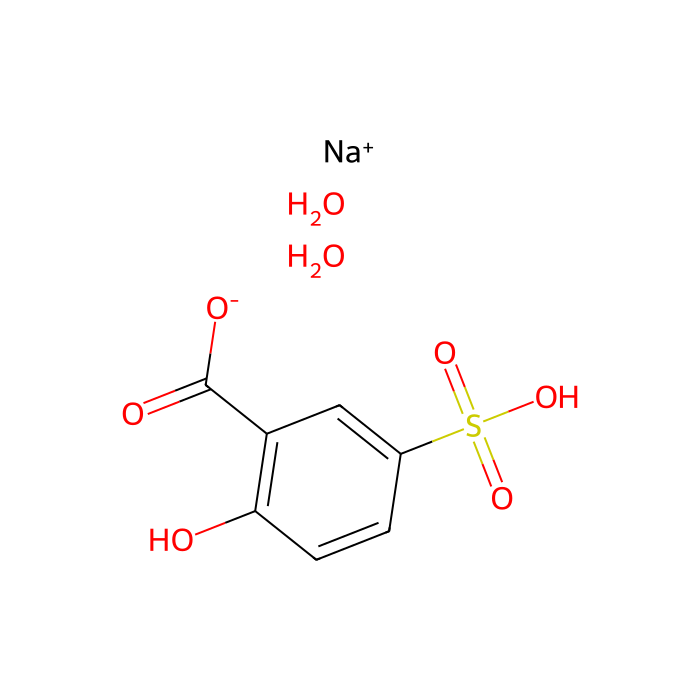
Brief description: Sulfosalicylic acid indicator is supplied as an analytical/indicator-grade reagent for laboratory use (SKU S299396). This listing does not include a definitive structure specification beyond the product name; consult the CoA/SDS for item-specific identity details.
Item-specific identifiers (from Product Data)
SKU: S299396
Product Name: Sulfosalicylic acid indicator
CAS: 1300-61-4 (as provided)
Grade: Indicator
InChIKey: Not specified for this item; refer to CoA/Spec Sheet.
SMILES: Not specified for this item; refer to CoA/Spec Sheet.
Molecular formula: Not specified for this item; refer to CoA/Spec Sheet.
Molecular weight: Not specified for this item; refer to CoA/Spec Sheet.
Structural features (general chemistry, literature context)
“Sulfosalicylic acid” commonly refers to 5‑sulfosalicylic acid (2‑hydroxy‑5‑sulfobenzoic acid), an aromatic carboxylic acid bearing phenolic –OH and sulfonic acid –SO3H substituents on a benzenoid ring (literature).
Key functional groups (literature): phenol, carboxylic acid, sulfonic acid; capable of metal chelation (via phenolate/carboxylate) and acid–base color behavior depending on pH/complexation.
Typical (literature) identifiers for 5‑sulfosalicylic acid (for reference only; not item‑specific):
2D description (general): A benzene ring substituted by ortho‑hydroxy and meta‑carboxyl groups relative to a strongly electron‑withdrawing sulfonic acid substituent, enabling intramolecular H‑bonding and metal-binding motifs (literature).
Synthetic Utility
Primary role: analytical indicator/complexing reagent. It is not commonly employed as a building block in multistep synthesis, but its functional group set offers some niche reactivity (general literature context).
Functional group profile (literature):
Strong sulfonic acid (–SO3H): can form sulfonate salts; rarely used directly as a sulfonating agent.
Carboxylic acid (–CO2H) and phenol (–OH): can, in principle, be derivatized (esterification, acylation, etherification) to tune solubility or ligand properties.
O,O‑ or O,O,O‑chelating motifs enable stable complexes with hard metal cations (Fe3+, Al3+), leveraged in analytical chemistry more than in synthesis.
Potential (less common) synthetic uses:
As a phase‑transferable acid catalyst in aqueous media due to high acidity and solubility (method‑dependent; uncommon).
As a ligand probe to characterize Lewis acidity of metal centers spectroscopically before applying catalytic systems.
Given the compound’s strong tendency to remain in aqueous phase and its analytical value, most users will find greater utility in measurement/assay workflows rather than in preparative synthesis.
Target Specificity
Not applicable. This product is not a biological targeting reagent (e.g., antibody, inhibitor) and has no item‑specific target selectivity data in the Product Data.
General analytical context: Sulfosalicylic acid exhibits ligand selectivity influenced by hard–soft acid–base considerations; it complexes more strongly with hard trivalent cations (e.g., Fe3+, Al3+) under acidic conditions than with many divalent transition metals. However, such behavior is method‑ and pH‑dependent and should not be construed as biological target specificity.
Häufig gestellte Fragen
What does indicator mean?
indicator is a defined analytical purity tier suitable for quantitative analytical methods. It specifies a minimum assay percentage, controlled limits on common impurities (water, heavy metals, residue on ignition), and lot-to-lot consistency. indicator is one of several purity tiers — choose based on the sensitivity and regulatory requirements of your method.
How should this product be stored?
Store at room temperature, protected from light. The material is light-sensitive — keep it in its original opaque or amber container.
How is this product shipped?
This product ships under standard ambient conditions. No temperature-controlled packaging is required.
What are the CAS number, molecular formula and molecular weight?
The CAS Number is 1300-61-4, the molecular formula is C7H5NaO6S·2H2O, and the molecular weight is 276.20 g/mol. InChIKey OOMQZSZNGQGEEN-UHFFFAOYSA-M.
What documentation is provided?
Available product documentation, including Certificates of Analysis (COA), Safety Data Sheets (SDS), and specification sheets, is shown in the product document area. Document availability and access follow the current site policy.
Wir verwenden Cookies, um die ordnungsgemäße Funktion der Website sicherzustellen und, soweit zulässig, Ihr Nutzererlebnis zu verbessern. Sie können Ihre Einstellungen jederzeit unter „Einstellungen“ verwalten. Weitere Informationen finden Sie in unserer Cookie-Richtlinie.
Shall we send you a message when we have discounts available?
Remind me later
Thank you! Please check your email inbox to confirm.
Products are supplied to verified businesses, institutions, and qualified professionals for research and development use only. Not for use in humans, animals, diagnosis, or therapy.

 K2528499