GRADE & PURITYMoligand™?Moligand™ — Aladdin's line of ligands and bioactive small molecules. Use for receptor, pathway, and binding studies needing defined small-molecule tools.10 mM in DMSO
Zertifikate (CoA, COO, BSE/TSE und Analyse-Diagramm)
C of A & Other Certificates(BSE/TSE, COO):
Analytical Chart:
Lösungsrechner
Molarity Calculator
Determine the necessary mass, volume, or concentration for preparing a solution.
Dilution Calculator
Determine the dilution needed to prepare a stock solution.
Reconstitution Calculator
Bewertungen
Kundenbewertungen
Application Protocols
No validated application protocols are provided for this item in the Product Data.
General RUO protocols for small-molecule screening compounds:
Stock preparation: Dissolve the compound in anhydrous DMSO to a convenient concentration (e.g., 10–50 mM). Vortex and, if needed, sonicate gently. Filter through a low-binding 0.22 µm PTFE membrane if particulate is observed.
Aliquoting: Dispense single-use aliquots in low-bind tubes or assay plates to avoid freeze–thaw cycles. Record exact concentrations and lot identifiers in your ELN/LIMS.
Assay dilution: Add stock to assay media using serial dilution to maintain consistent final DMSO (commonly ≤1–2% v/v). Include solvent controls and, where relevant, positive/negative reference controls.
Plate management: For HTS, use acoustic or pin-tool transfer to reduce volume and variability. Seal plates to minimize evaporation and edge effects.
Data quality: Monitor Z′-factor, S/B ratio, and CV%. Investigate anomalies with counterscreens (e.g., detergent sensitivity, redox interference, autofluorescence checks) as appropriate.
For any lot-specific recommendations, consult the CoA/Spec Sheet.
Biological Roles
Item-specific biological mechanism or target information is not provided in this listing. No claims are made regarding biological activity, efficacy, or clinical relevance.
General context for small-molecule research ligands:
These compounds are used to probe biochemical pathways, identify target engagement, and explore structure–activity relationships (SAR) in discovery-stage research.
Depending on chemical class and properties, ligands may interact with enzymes, receptors, transporters, or nucleic acids. Definitive assignments require experimental validation (e.g., binding assays, activity assays, chemoproteomics).
For phenotypic studies, implement orthogonal assays and target deconvolution strategies (e.g., thermal shift profiling, CETSA, affinity capture, or CRISPR-based sensitivity mapping) to connect phenotype to mechanism.
Recommended best practices:
Establish concentration–response curves with appropriate solvent controls; check for assay interference (e.g., fluorescence quenching, redox cycling, colloidal aggregation) using standard counterscreens.
Confirm reversibility/irreversibility and time-dependence where relevant.
If progressing toward in vivo research, perform basic DMPK characterization (solubility, stability, permeability) under institutional approvals—note: this product is for research use only.
Buffer Applications
Not typically applicable. This item is a discrete small molecule for screening, not a buffering agent.
Practical notes (general):
When diluting DMSO stocks into aqueous assay buffers, maintain consistent final DMSO percentage across all wells and controls.
Use assay-compatible buffers (e.g., HEPES, Tris, phosphate) as dictated by the biological target, adding surfactant (e.g., 0.01–0.05% Tween-20) or carrier protein (e.g., 0.1% BSA) to reduce nonspecific adsorption and precipitation if compatible.
Filter buffers (0.22 µm) and degas to improve assay consistency.
No buffer capacity, pKa, or recipe information is provided or implied for this compound.
Green Alternatives
Not typically applicable. This item is a discrete small molecule intended for screening and is not being used as a bulk solvent, reagent, or process chemical where greener substitutes are commonly evaluated.
General sustainable practices for small-molecule screening (literature/general):
Minimize DMSO concentration in assays and reduce plate dead volumes to limit solvent waste.
Use low-volume formats (384/1536-well plates) and acoustic dispensing where possible to cut consumables and solvent use.
Consolidate analytical runs and employ short LC methods with water-rich mobile phases when compatible with analyte properties.
Adopt recyclable secondary containment and cold-chain shippers; return dry-ice shippers when feasible.
If the compound is later incorporated into a synthetic route or formulation workflow, evaluate green chemistry metrics (E-factor, PMI) and solvent guides (e.g., CHEM21, ACS GCI) for process optimization. Such considerations, however, are outside the typical scope for a screening ligand like this product.
Pharmaceutical Uses
No excipient role, pharmacopeial status, or formulation use is specified for this item. This product is supplied strictly for research use only and is not intended for human or veterinary use.
General notes for researchers (non-clinical, non-therapeutic):
If evaluating preformulation properties for research, assess solubility in biorelevant media, chemical stability across pH 2–8, and compatibility with common cosolvents or enabling systems (e.g., cyclodextrins, lipid vehicles) as allowed by institutional policies.
Any discussion of therapeutic application is outside scope and is not implied by this listing. Do not use in diagnostic or clinical settings.
Regulatory disclaimer:
For research use only (RUO). Not for use in humans or for clinical/diagnostic procedures. No claims of safety or efficacy are made.
Physical Properties
Item-specific physicochemical properties are not provided in this listing.
Appearance: Not specified for this item; refer to CoA/Spec Sheet.
Molecular weight: Not specified for this item; refer to CoA/Spec Sheet.
Molecular formula: Not specified for this item; refer to CoA/Spec Sheet.
Melting point: Not specified for this item; refer to CoA/Spec Sheet.
Boiling point: Not specified for this item; refer to CoA/Spec Sheet.
Density: Not specified for this item; refer to CoA/Spec Sheet.
Solubility: Not specified for this item; refer to CoA/Spec Sheet.
LogP/logD: Not specified for this item; refer to CoA/Spec Sheet.
pKa: Not specified for this item; refer to CoA/Spec Sheet.
Refractive index/UV cutoff: Not specified for this item; refer to CoA/Spec Sheet.
General laboratory considerations (literature/general):
Small-molecule screening compounds are commonly reconstituted in anhydrous DMSO (e.g., 10–50 mM stock) and then diluted into assay buffers. Assess solubility empirically.
If the compound contains ionizable functional groups, apparent solubility may improve upon adjusting pH within assay-compatible limits.
Evaluate chemical stability under light, air, and at working temperature; protect from moisture and oxidants where applicable.
Note: For authoritative specifications for this item/lot (including purity and water/impurity limits, if applicable), consult the lot-specific CoA or Specification Sheet.
Quality and Grades
Grade: Moligand™
What Moligand™ typically implies (general description):
Intended for discovery chemistry workflows, including hit identification, high-throughput/medium-throughput screening, and SAR exploration.
Emphasis on structural integrity and suitability for bioassay screening. Lot documentation (CoA) typically includes identity confirmation (e.g., LC–MS) and purity by chromatographic methods; refer to the item’s CoA for exact tests and acceptance criteria. Specific numeric purity for this item is not provided here.
Packaged in research-use format to support rapid dissolution and minimal contamination risk.
How to use this grade effectively:
Verify solubility in your preferred solvent system (commonly anhydrous DMSO) and filter if necessary (PTFE or PVDF microfilters) prior to plate preparation.
For assay reproducibility, prepare fresh aliquots from frozen stock to avoid freeze–thaw degradation and moisture uptake.
For informatics tracking, link the SKU, CAS, and CID to your ELN/LIMS and attach the CoA to the lot record.
Item-specific notes:
Purity, water content, residual solvents, and elemental limits are Not specified for this item; refer to CoA/Spec Sheet.
Stabilizers/inhibitors: Not specified for this item; refer to CoA/Spec Sheet.
UV characteristics for HPLC detection: Not specified for this item; refer to CoA/Spec Sheet.
Reaction and Applications
This product is supplied as a small-molecule research ligand for screening and SAR—not as a synthetic reagent or solvent. Therefore, classical synthetic “reaction application” guidance (e.g., as a catalyst, base, or coupling partner) is not typically applicable.
Discovery and screening applications (general guidance):
Hit identification: Use in biochemical, biophysical (e.g., SPR, MST, DSF), or cell-based assays to probe target engagement and phenotypic effects. Validate activity with orthogonal readouts and counter-screens.
SAR development: Combine with close analogs to map structure–activity trends; maintain consistent assay conditions and DMSO percentages to ensure comparability.
ADME profiling: If progressing as a hit, evaluate intrinsic solubility, microsomal stability, permeability, and protein binding to inform optimization.
Analytical support: Quantify exposure and carryover in assay plates by LC–MS/MS, especially for low-solubility or sticky chemotypes.
Practical tips:
Prepare concentrated DMSO stocks (e.g., 10–50 mM), confirm clarity, and store aliquots at the recommended temperature to minimize degradation.
For kinetic assays, equilibrate compound to assay temperature to avoid precipitation during dilution.
Include solvent-only controls at matched DMSO % and assess potential aggregation (detected via detergent sensitivity, light scattering, or high Hill slopes).
Reaction Conditions
Not applicable for this product’s primary use. TBI-223 is supplied as a screening compound rather than a reagent or solvent; therefore, typical reaction conditions (temperature, catalysts, equivalents, yields) are not relevant.
If the compound is to be modified for research purposes:
Select conditions based on known reactivity of the confirmed functional groups from the verified structure (consult CoA and databases). Avoid conditions that could epimerize stereocenters or degrade sensitive motifs.
Employ inert atmosphere and anhydrous solvents when handling moisture- or air-sensitive chemotypes, as a general precaution.
Validate product identity and purity post-reaction by orthogonal methods (LC–MS, NMR, and, if needed, HRMS).
No item-specific reaction condition data are provided for this product.
Safety and Handling
Hazard data for this specific item are not provided here. Handle as a potentially hazardous laboratory chemical.
GHS classification: Not specified for this item; refer to SDS.
Signal word / H-statements / Pictograms: Not specified for this item; refer to SDS.
General laboratory precautions (defer to SDS for authoritative guidance):
PPE: Use lab coat, safety glasses, and suitable chemical-resistant gloves. Handle powders/solids in a fume hood to avoid inhalation of dust or aerosols.
Avoid contact with skin and eyes; avoid inhalation and ingestion. Wash thoroughly after handling.
Incompatibilities (general): Strong oxidizers, strong acids/bases, and reactive reducing/oxidizing agents may pose risks depending on functional groups; segregate until compatibility is known.
Environmental precautions: Prevent release to drains. Collect waste in appropriate organic waste containers per local regulations.
First aid overview: In case of skin/eye contact, rinse with water for at least 15 minutes; remove contaminated clothing. If inhaled, move to fresh air. If ingested, seek medical attention. Always follow the SDS.
Analytical verification: If handling in screening quantities, verify identity/purity to minimize exposure to unknown impurities.
Storage and transport notes:
Store at the temperature specified under Storage Conditions for this item (see Storage & Reconstitution tab). Maintain cold chain during transport as indicated (dry ice/cold packs).
Solvent Selection
Item-specific solubility data are not provided. For small-molecule screening compounds, the following general practices apply (literature/general guidance):
Primary stock solvent: Anhydrous DMSO is typically preferred due to broad solvating power and assay compatibility at low final percentages (≤1–2% v/v in most biochemical assays).
Alternative solvents: DMF, ethanol, or acetonitrile can be considered if DMSO is unsuitable for the assay or if compound solubility is limited. Always verify assay tolerance to organic cosolvents.
Aqueous buffer compatibility: Many hydrophobic ligands precipitate upon direct dilution into water; pre-dilute DMSO stocks stepwise into buffer containing surfactants (e.g., 0.01–0.05% Tween-20) or carrier proteins (e.g., 0.1% BSA) when assay-compatible.
pH effects: If the compound possesses ionizable groups, modest pH adjustments within biological ranges (pH 6.5–8.0) can improve apparent solubility; confirm chemical stability at the chosen pH.
Quick comparison (general):
DMSO: highest solvating power; most common for HTS/biochemical assays.
DMF: good solvency; higher toxicity; ensure compatibility and remove promptly post-assay.
Ethanol: volatile; suitable for some cell-based assays at ≤0.5% v/v; limited for hydrophobic compounds.
Acetonitrile: miscible with water; useful for analytical prep and some enzymatic assays at low %.
Note: Determine the minimal cosolvent percentage that maintains solubility without impacting assay readouts.
Storage and Reconstitution
Storage conditions (item-specific): Store at -80°C.
Shipped in: Dry ice packs + Cold packs.
Reconstitution (general guidance for screening compounds):
Solvent: Reconstitute in anhydrous DMSO to prepare concentrated stocks (e.g., 10–50 mM), unless your assay requires an alternative compatible solvent. Item-specific solubility is not provided.
Technique: Allow container to equilibrate briefly to reduce condensation, then open under dry atmosphere if feasible. Add solvent, vortex thoroughly, and verify clarity. If insoluble material remains, consider gentle warming (≤40°C) and brief sonication; avoid prolonged heating.
Filtration: If particulates persist, pass through a 0.22 µm low-binding PTFE filter.
Aliquoting and stability (general):
Prepare single-use aliquots to avoid repeated freeze–thaw. Store aliquots tightly sealed at -80°C, protected from light and moisture.
Working solutions in aqueous buffer are typically less stable than DMSO stocks; prepare fresh before use and keep on ice during assay setup when compatible.
Specifically not provided for this item:
Stabilizers/inhibitors, exact shelf-life, thaw cycles tolerated, and solubility limits: Not specified for this item; refer to CoA/Spec Sheet.
Always refer to the product’s SDS and lot-specific CoA for authoritative handling and stability information.
Structure and Identity
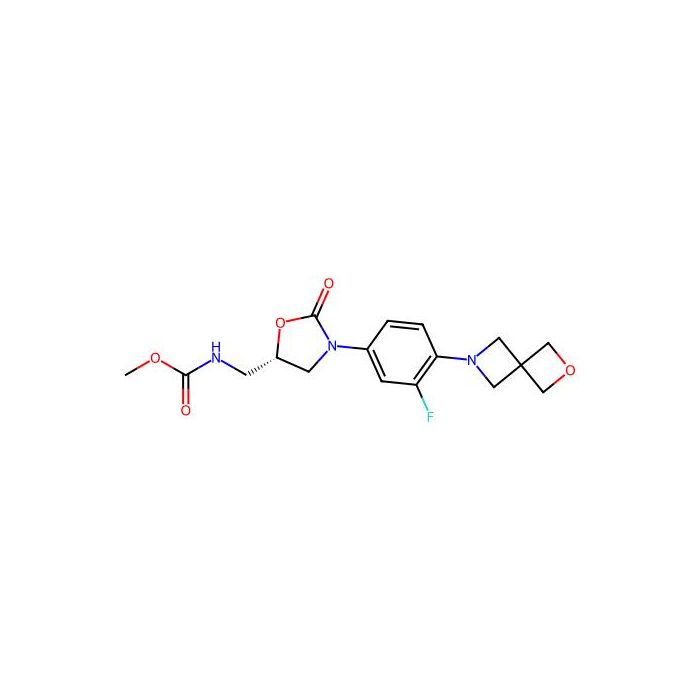
Brief overview: TBI-223 is supplied as a Moligand-grade small molecule intended for discovery research and screening applications. Item-specific structure descriptors are not provided in this listing.
Product name: TBI-223 (SKU: T1496786)
CAS: 2071265-08-0
PubChem CID: 126494519
Molecular formula: Not specified for this item; refer to CoA/Spec Sheet.
Molecular weight: Not specified for this item; refer to CoA/Spec Sheet.
SMILES: Not specified for this item; refer to CoA/Spec Sheet.
InChIKey: Not specified for this item; refer to CoA/Spec Sheet.
Structural features (general guidance):
Specific ring systems, substituents, and stereochemistry are not disclosed here. Consult the product CoA/SDS or authoritative databases for the definitive 2D/3D structure.
If using in informatics or docking workflows, retrieve canonical SMILES/InChI from the CID listed above (literature/external database) and verify against the lot-specific CoA.
Identity verification practices (general):
Confirm identity via LC–MS or HRMS (accurate mass and isotopic pattern) and, if needed, 1H/13C NMR in an appropriate deuterated solvent.
Cross-check CAS and CID in external databases as part of data provenance for screening libraries.
For quantitative work, verify purity and identity against the supplied CoA and conduct incoming QC as required by your workflow.
Synthetic Utility
Not typically applicable. TBI-223 is provided as a finished small-molecule research ligand for screening, not as a synthetic building block or reagent.
General considerations if derivatization is desired in a research setting:
Prior to any chemistry, confirm the exact structure (including stereochemistry) from the CoA or authoritative databases. Identify functional handles amenable to diversification (e.g., halogens, amines, carboxyls, heteroaryl positions), if present.
Conduct small-scale derivatization for SAR only after confirming compound purity and stability. Monitor reactions by LC–MS and purify by preparative HPLC as needed.
Maintain a clear chain of custody between the parent compound and derivatives in your LIMS, including new identifiers and analytical data.
Because functional groups and reactive sites for this specific item are not disclosed in the Product Data, no specific named-reaction guidance can be provided here without risk of inaccuracy.
Target Specificity
No target, selectivity profile, or binding constants are provided for this item in the Product Data.
Target/Pathway: Not specified for this item; refer to CoA/Spec Sheet or internal screening results.
Species reactivity, isotype/clone (for biologics): Not applicable to this small-molecule product.
Guidance for researchers (general):
Establish target specificity empirically using a combination of biochemical assays, cellular phenotyping, and selectivity panels as appropriate for your research area.
Confirm on-target activity with orthogonal methods and evaluate off-target liabilities via profiling panels when progressing hits.
Need help choosing the grade?
Our grade selection guide covers purity, stabilizer status, and application suitability for all variants in our catalog.
Wir verwenden Cookies, um die ordnungsgemäße Funktion der Website sicherzustellen und, soweit zulässig, Ihr Nutzererlebnis zu verbessern. Sie können Ihre Einstellungen jederzeit unter „Einstellungen“ verwalten. Weitere Informationen finden Sie in unserer Cookie-Richtlinie.
Shall we send you a message when we have discounts available?
Remind me later
Thank you! Please check your email inbox to confirm.
Products are supplied to verified businesses, institutions, and qualified professionals for research and development use only. Not for use in humans, animals, diagnosis, or therapy.