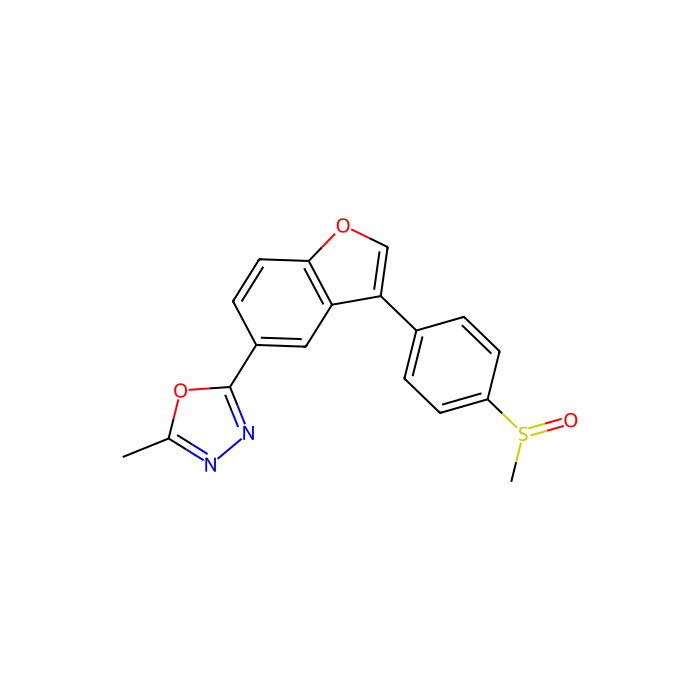
This compound belongs to the class of organic compounds known as phenylbenzofurans. These are organic aromatic compounds that contain a phenyl group attached to a benzofuran moiety. Benzofuran is a bicyclic compound containing a benzene fused to a furan.
External Descriptors
Not available
1. Djoumbou Feunang Y, Eisner R, Knox C, Chepelev L, Hastings J, Owen G, Fahy E, Steinbeck C, Subramanian S, Bolton E, Greiner R, and Wishart DS. ClassyFire: Automated Chemical Classification With A Comprehensive, Computable Taxonomy. Journal of Cheminformatics, 2016, 8:61.
Determine the necessary mass, volume, or concentration for preparing a solution.
Dilution Calculator
Determine the dilution needed to prepare a stock solution.
Reconstitution Calculator
Bewertungen
Kundenbewertungen
Application Protocols
Tested applications, recommended dilutions, and positive controls are not provided for this item in the Product Data.
General guidance for small-molecule tool compounds (research use only):
Stock preparation: Prepare a concentrated stock (e.g., 10–100 mM) in DMSO or another compatible solvent after confirming solubility. Filter if necessary using solvent-resistant 0.22 µm membranes.
Storage of stocks: Aliquot and store at 2–8°C as recommended; for longer-term storage, freezing at −20°C may be suitable if the compound is stable—verify by LC–MS.
Assay setup: Include vehicle controls and, where applicable, a reference compound. Confirm lack of precipitation upon dilution into assay buffer/media. Record final solvent percentage.
Because no validated protocols are provided for TCS 2002, develop and qualify procedures under your laboratory’s SOPs.
Biological Roles
Item-specific biological function/target information is not provided in the current Product Data for TCS 2002.
General guidance (for research-only reagents):
If TCS 2002 is used as a biochemical probe, researchers typically evaluate target engagement through in vitro enzymology, thermal shift assays, CETSA, or cellular reporter systems. Confirm the biological role by cross-referencing the CAS 1005201-24-0 in the primary literature and by running orthogonal assays.
Off-target assessment is commonly performed via counterscreens against related enzymes/receptors, broad kinase/panel profiling (if applicable), and cytotoxicity baselines in relevant cell lines.
For data integrity, document lot number, stock preparation, and exact assay conditions. Include vehicle controls and, where possible, a positive control probe with known activity.
No medical/therapeutic claims are made. This product is intended strictly for laboratory research use.
Buffer Applications
This section is not typically applicable without confirmed ionizable groups or intended biochemical modality for TCS 2002. No buffer system guidance is specified for this item.
General notes:
If preparing aqueous working solutions from an organic stock (e.g., DMSO), choose assay buffers compatible with the biological system of interest (e.g., PBS, HEPES, Tris) and validate compound stability across the relevant pH range.
Filter sterilize buffers (0.22 µm) if using in cell-based assays, and verify that the compound remains in solution at the final working concentration after dilution.
Green Alternatives
Item-specific green metrics (e.g., solvent, stabilizer, hazard class) are not specified for this item; refer to SDS/CoA.
General guidance for greener practice with small-molecule reagents:
Solvent selection: Prefer water, ethanol, 2-MeTHF, CPME, or ethyl acetate where feasible. Reserve DMF, DMAc, NMP, and chlorinated solvents for cases with clear technical necessity.
Energy efficiency: Many manipulations (dissolution, reactions) can be run at ambient temperature if the compound is sufficiently soluble and stable; avoid unnecessary heating/cooling.
Waste minimization: Use microscale assays and parallel screening to reduce solvent and material consumption. Capture DMSO and acetonitrile wastes separately for optimized disposal.
Safer alternatives: If literature suggests TCS 2002 is used as a probe for a given target class, evaluate whether less hazardous or more selective probes exist with better safety or persistence profiles.
Tradeoffs to consider:
Greener solvents may reduce solubility or alter assay readouts. Validate performance and stability empirically.
Higher selectivity or stability often comes at cost or reduced availability; balance environmental performance with experimental requirements.
Pharmaceutical Uses
No pharmacopeial status, excipient role, or formulation usage is specified for this item. TCS 2002 is supplied for research use only and is not intended for human or veterinary use.
General formulation context (for research materials only):
When used as an in vitro tool compound, typical vehicles include DMSO stocks diluted into buffered media. For in vivo research (if permitted by institutional approvals), vehicles may include PEG400, ethanol, and saline mixes; however, no such use is endorsed or specified here—consult institutional guidelines and the SDS.
Stability-indicating methods (HPLC/UPLC with photodiode array and MS) should be developed if long-term formulation is required for laboratory studies.
Note: No therapeutic or clinical claims are made for this product.
Physical Properties
Item-specific facts (from Product Data):
Appearance: Not specified for this item; refer to CoA/Spec Sheet.
Commonly reported physicochemical parameters for precise method development (literature/general):
Melting point, boiling point, density, refractive index, pKa, logP/logD, and aqueous/organic solubility are not specified for this item. If required, determine experimentally or consult peer-reviewed sources for the exact compound corresponding to CAS 1005201-24-0.
Practical guidance:
If the material is a small-molecule solid (typical for many TCS-series research reagents), begin with a solubility screen at room temperature in DMSO, DMF, ethanol, methanol, acetonitrile, and buffers at pH 2–9. Record clear solution limits and any precipitation upon dilution into aqueous media.
If supplied as a solution, note solvent composition and concentration from the CoA and verify compatibility with your assay buffer or reaction medium.
For spectral identity, acquire 1H NMR, 13C NMR, HRMS, and, if stereochemistry is relevant, chiroptical data or chiral HPLC. Retain spectra with lot numbers for traceability.
Important: None of the physicochemical values are specified for this catalog item; rely on the CoA/Spec Sheet and SDS for authoritative specifications.
Quality and Grades
Item-specific facts (from Product Data):
Grade/Purity: Not specified for this item; refer to CoA/Spec Sheet.
How to interpret grades (general guidance):
Research-grade small molecules may be specified by an assay purity (e.g., HPLC or GC, often ≥95%). Chromatographic traces, residual solvent content, and water content are typically reported on the CoA. In absence of a stated grade, assume research-use only and verify suitability for critical applications by independent QC.
If an inhibitor/ligand: low UV background and known extinction coefficients can be important for biochemical assays; check CoA or request from technical support.
Stabilizers: None specified for this item. If present (e.g., BHT in certain hydrophobic compounds or acid stabilizers for reactive species), they will be listed on the CoA and may affect downstream assays or reactions.
Recommendations:
Request lot-specific analytical data (1H/13C NMR, HPLC chromatogram, MS) when establishing methods.
For quantitative biology/chemistry, perform an incoming identity and purity check and document lot-to-lot comparability.
Reaction and Applications
Manufacturer Applications: Not provided in Product Data.
General research contexts (literature/general):
The TCS series often denotes research-grade small molecules investigated as biochemical probes. If TCS 2002 is used as a modulator in enzyme or signaling studies, typical applications include in vitro assays, cell-based pathway interrogation, and target identification. Verify specifics in primary literature associated with CAS 1005201-24-0.
Practical tips:
If using in biochemical assays: Prepare fresh aliquots from concentrated stocks, minimize freeze–thaw cycles, and include solvent-only controls.
If using in chemical synthesis: Absent defined functionality, pilot small reactions to gauge stability toward nucleophiles/electrophiles, oxidants, and bases. Monitor by LC–MS and TLC; document degradation pathways.
For screening: Employ dose–response curves with at least 10 concentrations over 3–4 log units, ensuring compound stays in solution (monitor for turbidity/precipitation).
Important: Because specific reactivity and mechanism are not provided for this item, consult peer-reviewed references tied to the provided CAS/CID or request technical support for application guidance.
Reaction Conditions
Item-specific reaction conditions are not specified for this product.
General guidance for handling unknown or variably reported small-molecule reagents:
Solubility mapping: Establish solvent compatibility by small tests in DMSO, DMF, MeOH, EtOH, MeCN, EtOAc, and buffers (pH 3–9). Monitor by LC–MS for 24–72 h to assess stability.
Thermal stability: Run differential scanning or simple heat stress tests (e.g., 50–60°C for 24 h in sealed vials) to check for decomposition before scaling reactions.
Light/air sensitivity: If colored or known to be photosensitive in literature, handle under low light and with inert gas. Otherwise, inert-atmosphere work is a prudent default for sensitive transformations.
Catalysis: If employing metal catalysts (Pd, Cu, Ni), test for catalyst poisoning or chelation by running micro-scale trials; adjust ligand/base accordingly.
Workup: Choose quench and extraction conditions that minimize pH extremes until the compound’s stability profile is known.
All parameters above are general and should be validated experimentally for TCS 2002.
Safety and Handling
Item-specific facts (from Product Data):
GHS classification, signal word, pictograms, and H-statements: Not specified for this item; refer to SDS.
Storage: Store at 2–8°C. Shipped on wet ice.
Research use only.
General safety guidance (for laboratory use; defer to SDS):
Handle in a chemical fume hood with appropriate PPE: lab coat, safety glasses, and chemically resistant gloves. Avoid inhalation, ingestion, and skin/eye contact.
If solid: minimize dust formation; use microspatulas and antistatic measures.
If solution: check solvent hazards (e.g., DMSO facilitates dermal absorption). Contain spills with inert absorbent; dispose per institutional and regulatory requirements.
Incompatibilities: Without confirmed functional groups, avoid strong oxidizers/reducers, strong acids/bases, and reactive metals until compatibility is known. Do not heat or aerosolize unless a risk assessment is performed.
First aid (general): In case of skin/eye contact, rinse with water for at least 15 minutes and seek medical attention. If inhaled, move to fresh air. If ingested, do not induce vomiting; seek medical assistance immediately.
Always consult the product-specific SDS for definitive hazard classification, exposure controls, and disposal guidance.
Solvent Selection
Item-specific facts: Solubility and solvent recommendations are not specified for this item; refer to CoA/Spec Sheet.
General approach for small-molecule reagents (literature/practice):
Initial stock solutions: Screen DMSO (up to 100 mM), DMF, ethanol, and acetonitrile. Record solubility ceilings and stability over 24–72 h at 2–8°C and room temperature.
Aqueous work: If water solubility is low, prepare concentrated DMSO stocks and dilute into buffer, keeping final DMSO ≤0.1–1% v/v for biochemical assays. Use surfactants (e.g., 0.01–0.05% Tween-20) judiciously to mitigate precipitation if compatible with the assay.
Acid/base sensitivity: If the compound contains acid-labile or base-labile motifs (unknown here), maintain neutral pH during dissolution. Avoid strong acids/bases until compatibility is confirmed by a small test.
Nonpolar media: For hydrophobic compounds, consider EtOAc, THF, or 2-MeTHF for synthetic use; for biology, co-solvents with DMSO are typical.
Comparison note:
DMSO offers broad solubilizing power and good freezer stability but can perturb biological membranes.
Ethanol is more benign biologically but has lower solubilizing power for many heteroaromatics.
Acetonitrile provides low viscosity and volatility; confirm assay compatibility.
Storage and Reconstitution
Item-specific facts (from Product Data):
Storage conditions: Store at 2–8°C.
Shipping: Shipped on wet ice.
Appearance: Not specified for this item; refer to CoA/Spec Sheet.
Reconstitution guidance (general):
If supplied as a solid: Allow the container to equilibrate to room temperature in a desiccator before opening to prevent moisture condensation. Dissolve in a suitable solvent (commonly DMSO, DMF, ethanol, or acetonitrile) after confirming solubility. Prepare single-use aliquots to avoid repeated freeze–thaw.
If supplied as a solution: Note the solvent and concentration from the label/CoA. Mix gently after bringing to room temperature, and avoid repeated temperature cycling.
Stability monitoring: Track any color changes, precipitation, or potency drift by periodic HPLC/LC–MS. Protect from light if the CoA or literature suggests photosensitivity.
Disposal and documentation:
Dispose of unused material and solvent according to local regulations and your institution’s chemical hygiene plan.
Record lot number, preparation date, solvent, and concentration for all aliquots. For any missing specifications, consult the CoA/Spec Sheet and SDS for definitive instructions.
Structure and Identity
Item-specific facts (from Product Data):
Product name: TCS 2002 (SKU: T288676)
CAS: 1005201-24-0
PubChem CID: 24855958
InChIKey: 312737 (as provided)
Molecular formula: Not specified for this item; refer to CoA/Spec Sheet.
Molecular weight: Not specified for this item; refer to CoA/Spec Sheet.
SMILES: Not specified for this item; refer to CoA/Spec Sheet.
Notes on structural description:
Detailed 2D/3D structural features (functional groups, ring systems, stereochemistry) are not provided in the current Product Data. Please consult the CoA/SDS or primary literature linked to the CAS/CID for definitive structural descriptors.
General guidance (literature):
“TCS 2002” is used in the literature as a small-molecule research reagent name. Always verify identity by cross-checking CAS and CID and by confirming structure with the supplier’s CoA or through independent NMR/MS as needed for critical work.
Synthetic Utility
Item-specific functional groups and reactivity are not provided in the Product Data for TCS 2002; therefore, no definitive synthetic roles can be assigned here.
General perspective (literature/practice):
If TCS 2002 is a small heteroaromatic or polyfunctional scaffold (common among research probes), potential synthetic utilities might include use as a reference standard, a ligand in binding studies, or a building block if reactive handles are present. Verify by consulting the CoA or literature for CAS 1005201-24-0.
For method development, establish stability toward bases (e.g., DBU, K2CO3), acids (TFA, HCl), and oxidants/reductants. Map degradation by LC–MS to inform protection strategies if derivatization is desired.
If isotopic or analog synthesis is planned, compile NMR and MS fingerprints of the parent material to confirm analog identity.
Because specific structural information is not provided for this catalog entry, treat these notes as general guidance only.
Target Specificity
Target/epitope/isotype/clone information is not provided for this item. No antigen or biological target specificity is specified in the Product Data for TCS 2002.
Note: If using TCS 2002 as a biochemical probe, consult primary literature linked to CAS 1005201-24-0 or PubChem CID 24855958 to determine any reported target engagement or selectivity profile. Such details are not provided here and should be verified independently.
Häufig gestellte Fragen
What is the purity of this product, and how is it determined?
This product is supplied at ≥99% purity, determined by HPLC. Lot-specific values are stated on the Certificate of Analysis.
How should this product be stored?
Store at 2–8 °C. Refrigerated storage is required to maintain the specified shelf life.
How is this product shipped?
This product ships chilled on wet ice. Unpack on arrival and transfer it to the storage condition stated above.
What are the CAS number, molecular formula and molecular weight?
The CAS Number is 1005201-24-0, the molecular formula is C??H??N?O?S, and the molecular weight is 338.38 g/mol. InChIKey RCKYSTKYIVULEK-UHFFFAOYSA-N.
What documentation is provided?
Available product documentation, including Certificates of Analysis (COA), Safety Data Sheets (SDS), and specification sheets, is shown in the product document area. Document availability and access follow the current site policy.
Wir verwenden Cookies, um die ordnungsgemäße Funktion der Website sicherzustellen und, soweit zulässig, Ihr Nutzererlebnis zu verbessern. Sie können Ihre Einstellungen jederzeit unter „Einstellungen“ verwalten. Weitere Informationen finden Sie in unserer Cookie-Richtlinie.
Dürfen wir Sie über Rabattaktionen informieren?
Später erinnern
Vielen Dank! Bitte überprüfen Sie Ihren E-Mail-Posteingang, um zu bestätigen.
Products are supplied to verified businesses, institutions, and qualified professionals for research and development use only. Not for use in humans, animals, diagnosis, or therapy.