QUALITÄT & REINHEITMoligand™?Moligand™ — Aladdin's line of ligands and bioactive small molecules. Use for receptor, pathway, and binding studies needing defined small-molecule tools.10mM in DMSO
Moligand™, 10mM in DMSO Moligand™ für empfindliche chromatographische und analytische Workflows, die minimale Basislinieninterferenzen erfordern.
🌡
Lagerung & Versand
Store at -80°C Versand Dry ice packs + Cold packs. Genaue Spezifikationen finden Sie im chargenspezifischen COA.
📋
Qualitätsdokumente
SDS, COA, Datenblatt und Spezifikationsblatt stehen zum Download bereit. Chargenspezifische COA über Chargennummernsuche abrufbar.
📚
Literaturbeleg
In 0 peer-reviewten Publikationen zu Chromatographie, organischer Synthese und Kreuzkupplungsreaktionen zitiert.
Übersicht
Information
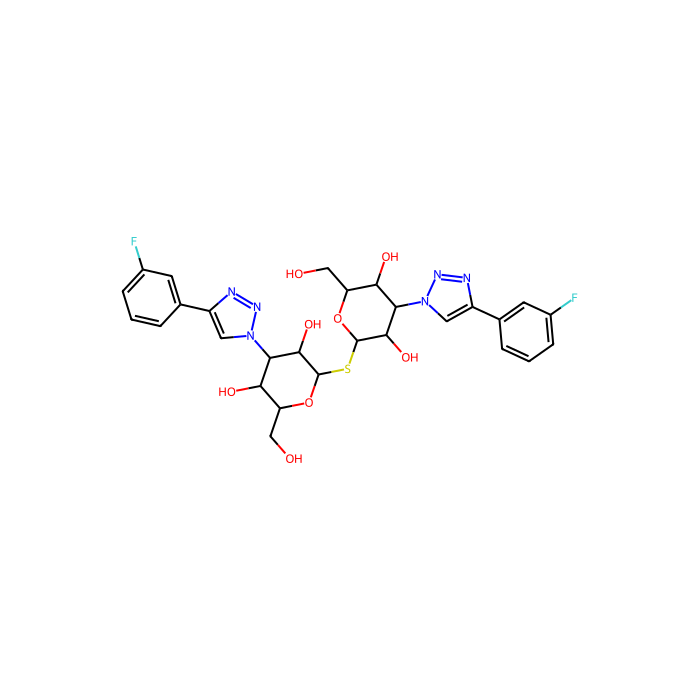
TD-139 TD-139 (GB0-139) is a potent and selective inhibitor of galectin-3 with Kd of 0.036 µM over galectin-1 and galectin-7 with Kd of 2.2 µM and 32 µM, respectively. TD-139 is used potentially for the treatment of idiopathic pulmonary fibrosis (IPF).
TD-139 (GB0-139) is a potent and selective inhibitor of galectin-3 with Kd of 0.036 µM over galectin-1 and galectin-7 with Kd of 2.2 µM and 32 µM, respectively. TD-139 is used potentially for the treatment of idiopathic pulmonary fibrosis (IPF).
Storage
Store at -80°C
Verschickt in
Dry ice packs + Cold packs
Dieses Produkt erfordert Kühlkettenversand. Grundversand und andere Economy-Optionen sind nicht verfügbar.
This compound belongs to the class of organic compounds known as disaccharides. These are compounds containing two carbohydrate moieties linked to each to each other through a glycosidic bond, no set of three or more glycosidically linked carbohydrate units.
External Descriptors
Not available
1. Djoumbou Feunang Y, Eisner R, Knox C, Chepelev L, Hastings J, Owen G, Fahy E, Steinbeck C, Subramanian S, Bolton E, Greiner R, and Wishart DS. ClassyFire: Automated Chemical Classification With A Comprehensive, Computable Taxonomy. Journal of Cheminformatics, 2016, 8:61.
Zertifikate (CoA, COO, BSE/TSE und Analyse-Diagramm)
C of A & Other Certificates(BSE/TSE, COO):
Analytical Chart:
Chemische und physikalische Eigenschaften
DMSO (mg/ml) Maximale Löslichkeit
100
DMSO (mM) Maximale Löslichkeit
154.16872224963
Wasser (mg/ml) Maximale Löslichkeit
˂1
Molekulargewicht
648.600 g/mol
XLogP3
0.200
Hydrogen Bond Donor Count
6
Hydrogen Bond Acceptor Count
15
Rotatable Bond Count
8
Exact Mass
648.181 Da
Monoisotopic Mass
648.181 Da
Topological Polar Surface Area
227.000 Ų
Heavy Atom Count
45
Formal Charge
0
Complexity
903.000
Isotope Atom Count
0
Defined Atom Stereocenter Count
10
Undefined Atom Stereocenter Count
0
Defined Bond Stereocenter Count
0
Undefined Bond Stereocenter Count
0
The total count of all stereochemical bonds
0
Covalently-Bonded Unit Count
1
Lösungsrechner
Molarity Calculator
Determine the necessary mass, volume, or concentration for preparing a solution.
Dilution Calculator
Determine the dilution needed to prepare a stock solution.
Reconstitution Calculator
Bewertungen
Kundenbewertungen
Application Protocols
No tested applications or recommended dilutions are provided in the Product Data for this item.
General protocol suggestions for small-molecule ligands (for adaptation to your assay):
DMSO stock preparation: Make 10–50 mM stocks; aliquot and store at −80 °C. Thaw immediately before use and avoid repeated freeze–thaw.
Biochemical assays: Prepare serial dilutions (e.g., 10-point, 3-fold) in assay buffer with matched DMSO. Include vehicle controls and, if available, a reference ligand.
Cellular assays: Dose at multiple concentrations to build full concentration–response curves. Keep DMSO ≤0.1–0.5% v/v unless cell type tolerates more.
Biophysical assays: For SPR/ITC/DSF/MST, confirm buffer compatibility and compound stability; filter solutions to remove particulates.
Please consult the CoA/Spec Sheet and SDS for any item-specific instructions that supersede these general recommendations.
Biological Roles
This Moligand™ entry is offered as a small-molecule research ligand for target and pathway studies. The Product Data do not specify a biological target or mechanism for this specific item; therefore, the following guidance is general and should be adapted to your research context.
Potential roles in discovery workflows:
Chemical probe candidate for interrogating protein function in biochemical and cellular systems.
Tool compound to explore structure–activity relationships (SAR) in a chemical series if used alongside analogs.
Reference ligand for biophysical binding techniques (SPR, ITC, DSF, MST) to establish assay tractability.
Assay considerations:
Validate on-target activity with orthogonal assays; include negative controls and inactive analogs when available.
Evaluate selectivity across related protein families and relevant off-target panels to deconvolute phenotypes.
Monitor for common small-molecule interferences (aggregation, redox, fluorescence/absorbance overlap with readouts).
ADME profiling (general):
Establish solubility and stability in assay media; consider protein binding as it can modulate free concentration.
If using in cells, assess cytotoxicity windows in the same matrix and time scale as functional assays.
Important: No medical or clinical claims are made. This product is for research use only, and any biological role must be experimentally determined for the specific system under study.
Buffer Applications
While TD-139 is not a buffering agent, buffers are central to its successful use in biochemical and cellular assays.
Practical guidance (general):
Biochemical assays: Use HEPES (10–50 mM) or PBS with defined pH (e.g., 7.2–7.5). Include 0.01–0.05% nonionic detergent (Tween-20 or Triton X-100) if aggregation is suspected, and 0.1% BSA to reduce nonspecific adsorption where appropriate.
Metal sensitivity: If the target is metalloenzyme-related, include appropriate divalent cation controls or chelators (EDTA) as dictated by the assay design.
Filtration/clarification: Clarify working solutions with 0.2 µm filtration to remove particulates; pre-wet filters to minimize analyte loss.
Stability checks: Monitor compound integrity in buffer at assay temperature by LC or by repeat activity measurements over time to detect degradation/adsorption.
Electrophoresis/cell culture notes:
For cell culture, prepare dosing solutions in complete media with minimal DMSO; verify absence of precipitation microscopically.
For protein-binding/gel-based assays, ensure the compound does not interfere with dye-based detections; include compound-only lanes/wells as controls.
Green Alternatives
Green chemistry considerations for this item focus on solvent usage during handling and assays rather than replacement of the compound itself.
Prefer greener solvents where compatible: If dissolution in DMSO is not essential for a given experiment, consider ethanol or mixtures of aqueous buffer with minimal cosolvent. However, ensure that assay performance and compound solubility remain acceptable.
Small comparison (general, not item-specific specifications):
DMSO: High solvency, widely used in screening; higher EHS burden than water/ethanol mixtures; typically ≤1% v/v in final assays.
Ethanol: Biodegradable and lower toxicity profile at low concentrations; may perturb membranes/cells; volatile and flammable.
Aqueous buffer with surfactant: Lowest solvent hazard; limited by compound solubility and potential protein interactions.
Operational tips to reduce environmental impact:
Use concentrated stocks and miniaturize assays (e.g., 384/1536-well formats) to reduce solvent consumption.
Employ sealed plates to limit evaporation and emissions.
Plan aliquoting to minimize waste due to repeated freeze–thaw degradation.
Note: No greener “alternative compound” is suggested here because the molecular identity and target use of this catalog entry are item-specific and not substitutable without altering research aims.
Pharmaceutical Uses
This product is supplied strictly for research use and is not intended for human or veterinary use, diagnostics, or clinical applications.
Formulation and development context (general, not item-specific specifications):
As a discovery-stage small molecule, typical non-clinical formulation approaches include DMSO stock solutions, aqueous cosolvent systems (e.g., PEG400/propylene glycol/saline), or cyclodextrin complexes for in vivo exploratory studies conducted under appropriate institutional oversight. None of these are specified for this item; they are mentioned as general practices.
No pharmacopeial monograph is associated with this compound to our knowledge. Excipient status and GMP documentation are not applicable to this Moligand™ catalog entry.
Manufacturing/CMC notes (general):
If scale-up or preformulation is contemplated, determine polymorph/solid state, residual solvent profile, and stability indicating methods. These aspects are not specified for this item and require dedicated study.
Reminder: Do not deploy this material in any clinical setting. All handling should remain within research laboratories with appropriate approvals.
Physical Properties
Item-specific physicochemical parameters are not disclosed in the Product Data and should be confirmed on the CoA/Spec Sheet for your lot.
Appearance: Not specified for this item; refer to CoA/Spec Sheet.
Molecular weight: Not specified for this item; refer to CoA/Spec Sheet.
Molecular formula: Not specified for this item; refer to CoA/Spec Sheet.
Melting point: Not specified for this item; refer to CoA/Spec Sheet.
Boiling point: Not applicable/rarely reported for complex research ligands; consult CoA if provided.
Density: Not specified for this item; refer to CoA/Spec Sheet.
Solubility: Not specified for this item; refer to CoA/Spec Sheet.
LogP/logD, pKa: Not specified for this item; refer to CoA/Spec Sheet.
Refractive index: Not applicable for solids; not specified for this item.
Literature/computational notes (general, not item-specific specifications):
For small-molecule ligands of this class, DMSO stock solutions (e.g., 10–50 mM) are commonly prepared for screening, with subsequent aqueous dilution into assay buffers containing surfactant to minimize precipitation. Specific solubility limits should be verified experimentally (turbidity, dynamic light scattering) for your lot.
If the PubChem CID is used to retrieve approximate calculated properties (cLogP, TPSA, HBD/HBA), treat those values as literature estimates and confirm with in-house measurements when exact numbers matter for formulation or biophysical assays.
Quality and Grades
Grade/Purity listed: Moligand™ (item-specific)
What Moligand™ implies (general guidance): This designation indicates inclusion in a curated small-molecule/ligand collection intended for screening, target validation, and SAR support. While high chemical identity and purity are expected, exact assay purity, residual solvent content, and metal/elemental specs are lot-dependent.
Key quality considerations for this item:
Analytical confirmation: For rigorous applications, request or consult the CoA for identity (e.g., 1H/13C NMR, HRMS) and purity by HPLC/UPLC or quantitative NMR.
Stabilizers: Not specified for this item; refer to CoA/Spec Sheet.
Water/peroxide/metal limits: Not specified for this item; refer to CoA/Spec Sheet.
UV cutoff/background: Not specified for this item; refer to CoA/Spec Sheet.
Practical guidance:
If the compound is used in optical assays (UV/Vis, fluorescence), obtain a background spectrum of the solvent-matched blank and of the working concentration to check baseline interference.
For bioassays, confirm endotoxin is not relevant (small molecules are not proteins) but pay attention to residual DMSO levels in final assay wells.
If you require specific pharmacopeial or analytical-grade conformance, contact Aladdin Scientific for availability; this Moligand™ entry is intended for research screening rather than regulated manufacturing.
Reaction and Applications
This product is positioned as a research ligand (Moligand™) rather than a synthetic reagent. Consequently, classical synthetic reaction applications (e.g., cross-couplings, condensations) are not the primary use case.
Relevant applications for this item in discovery workflows:
Biochemical binding studies: Assess ligand–protein interactions by SPR, ITC, DSF, MST, or equilibrium dialysis. Validate binding with orthogonal readouts to control for aggregation or fluorescence interference.
Cellular assays: Evaluate pathway modulation with appropriate controls and concentration–response curves. Keep final DMSO concentrations low (typically ≤0.1–0.5% v/v depending on cell type).
Selectivity profiling: Use panels of related proteins/enzymes to establish selectivity windows; include counter-screens for assay artifacts (redox cycling, PAINS behavior, detergent-sensitive aggregation).
Physicochemical assessment: Solubility, permeability (PAMPA/Caco-2), microsomal stability, and protein binding help interpret assay outcomes.
Practical notes:
Confirm identity/purity by analytical methods prior to critical experiments.
Establish a solubility ceiling in your specific assay buffer, monitoring for precipitation over the assay timeframe.
Include vehicle and positive/negative controls; consider time-dependence if the ligand shows slow binding kinetics.
If you intend to use the compound in chemical synthesis, treat it as a complex substrate with potentially sensitive functional groups; no specific reactivity guidance is provided for this item.
Reaction Conditions
Classical reaction-condition guidance is not applicable because this product is not offered as a reagent for performing named organic reactions. However, for operations related to handling and preparing the compound for assays, the following practical conditions are typical (general, not item-specific specs):
Stock solution preparation: Dissolve in anhydrous DMSO to 10–50 mM under inert atmosphere if the compound is air/moisture sensitive. Vortex and, if necessary, gently warm (≤37 °C) to aid dissolution; avoid prolonged heating.
Working solution dilution: Add DMSO stock to buffered aqueous media with thorough mixing to avoid localized supersaturation. Aim for final DMSO ≤0.1–1% v/v as assay-appropriate.
Filtration: 0.2 µm PTFE/RC for organic-rich solutions; PES/RC for mostly aqueous solutions.
Stability monitoring: Re-check concentration by UV or LC at intervals if the solution is stored for more than a few hours at room temperature; store cold when feasible.
If you plan to use the compound in chemical synthesis despite the above positioning, you will need to determine compatible solvents, temperatures, and catalysts empirically after establishing the exact structure; no literature reaction conditions are asserted for this item.
Safety and Handling
Safety information for this item is limited in the Product Data; consult the SDS for authoritative guidance.
GHS classification: Not specified for this item; refer to SDS.
Signal word and H-statements: Not specified for this item; refer to SDS.
Pictograms: Not specified for this item; refer to SDS.
General laboratory precautions (good practice for small-molecule ligands):
PPE: Use lab coat, nitrile gloves, and safety glasses. Handle powders and DMSO stocks in a fume hood to avoid inhalation and minimize skin contact.
Avoid exposure routes: ingestion, inhalation of dust/aerosols, and skin/eye contact. Wash thoroughly after handling.
Incompatibilities: Strong oxidizers and strong acids/bases may degrade sensitive functional groups. Avoid prolonged exposure to moisture and light if stability is unknown.
First aid (overview; see SDS for details): In case of skin/eye contact, rinse with water for at least 15 minutes; remove contaminated clothing. If inhaled, move to fresh air. If ingested, rinse mouth; seek medical attention.
Waste disposal: Dispose of residues and contaminated materials as organic chemical waste per institutional and local regulations.
Special risks/handling tips:
Many discovery ligands exhibit light/oxidative sensitivity; minimize air/light by storing as frozen aliquots under inert conditions when possible.
Use single-use aliquots to avoid repeated freeze–thaw, which can promote hydrolysis or oxidation.
Solvent Selection
Given the lack of item-specific solubility data, solvent selection should follow best practices for small-molecule screening ligands.
Primary stock solvent: Anhydrous DMSO is typically preferred due to broad solvency and biochemical compatibility at ≤1% v/v in assays. Confirm solubility empirically.
Alternative solvents: DMF or ethanol can be used for primary dissolution, followed by dilution into buffered aqueous media containing a small amount of DMSO or surfactant (e.g., 0.01–0.05% Tween-20) to maintain solubility.
Aqueous buffers: Use PBS, HEPES, or assay-specific buffers. Pre-warm and sonicate briefly if needed, taking care to avoid denaturation of biological assay components.
Filtration: If particulate remains, filter through a low-protein-binding 0.2 µm PTFE/RC syringe filter; avoid adsorption-prone membranes if compound is lipophilic.
Comparison (general guidance):
DMSO: Highest solvency, excellent for 10–50 mM stocks; can affect some enzymes/receptors above 1–2% v/v.
Ethanol: Good solvency, volatile; limit to ≤1% v/v in cell-based assays.
Aqueous with cosolvent: Reduces organic content but may precipitate on dilution; test with serial dilution and visual/turbidity checks.
Tips:
Prepare small, single-use DMSO aliquots to limit freeze–thaw cycles.
Check for precipitation after dilution into buffer and after incubation at assay temperature.
Storage and Reconstitution
Item-specific storage and shipping conditions are provided in the Product Data.
Storage conditions: Store at −80 °C (item-specific). Protect from light and moisture. Use desiccant and inert atmosphere if possible.
Shipped in: Dry ice packs + Cold packs (item-specific). Inspect upon arrival and return to −80 °C promptly.
Reconstitution: Not specified for this item; refer to CoA/Spec Sheet. General practice is to reconstitute in anhydrous DMSO to prepare concentrated stocks (e.g., 10–50 mM), then aliquot into single-use vials.
Working solution stability: Not specified for this item; verify experimentally. Prepare fresh dilutions in assay buffer immediately before use and monitor for precipitation.
Freeze–thaw guidance: Avoid repeated freeze–thaw cycles. Dispense single-use aliquots; thaw rapidly at room temperature, mix, and keep on ice during setup.
Long-term stability: Not specified for this item; refer to CoA/Spec Sheet. For maximum stability, minimize exposure to air, light, and moisture.
Research use note: For research use only. Not for use in humans or clinical diagnostics.
Structure and Identity
Brief overview: TD-139 is supplied as a research-use small molecule entry in the Moligand™ collection. Only limited structural identifiers are provided for this specific catalog item.
CAS: 1450824-22-2 (item-specific)
PubChem CID: 73774610 (item-specific)
InChIKey: 436629 (as provided in Product Data; truncated/atypical format)
SMILES: Not specified for this item; refer to CoA/Spec Sheet.
Molecular formula: Not specified for this item; refer to CoA/Spec Sheet.
Molecular weight: Not specified for this item; refer to CoA/Spec Sheet.
Structural features (general context):
This catalog entry is listed as a discrete small molecule for screening. Detailed functional groups, ring systems, and stereochemistry are not disclosed in the Product Data. If structural elucidation or confirmatory identity data are required (e.g., for QC or orthogonal analytics), request the current Certificate of Analysis (CoA), spectral package (NMR/HRMS), or a Spec Sheet.
2D structure description (general guidance):
Without a provided SMILES or structure diagram, a text description of rings, heteroatoms, and substituents cannot be furnished for this specific item. For cheminformatics work, use the PubChem CID supplied above to retrieve a literature structure, and cross-check against Aladdin’s CoA for lot-specific confirmation before use in SAR or modeling workflows.
Synthetic Utility
This item is supplied as a finished small-molecule ligand for screening and is not positioned as a building block or reagent.
Building-block usage: Not typical. The structure and functional group handles are not disclosed here, and no derivative chemistry is recommended based on the Product Data.
Derivatization considerations (general): If you intend to prepare labeled analogs (e.g., biotinylated or fluorophore-tagged), first confirm the structure and accessible modification sites from primary literature or CoA-provided structural information. Then evaluate whether tag addition alters binding or physicochemical properties.
Analytical support: For any synthetic modification program, develop LC-MS and NMR methods capable of distinguishing parent compound from regioisomers, protecting-group remnants, or tag linkers.
Bottom line: Treat TD-139 in this catalog entry as a research ligand rather than a synthetic synthon. If a functionalized precursor is needed, consider requesting custom synthesis or searching for designated building blocks with defined reactive handles.
Target Specificity
Target/epitope information is not specified in the Product Data for this item.
Target name: Not specified for this item; refer to CoA/Spec Sheet.
Mechanism of action: Not specified for this item; refer to CoA/Spec Sheet.
Species reactivity/selectivity panel: Not specified for this item; refer to CoA/Spec Sheet.
Guidance:
If a biological target is relevant to your program, confirm it via the CoA, the manufacturer’s Spec Sheet, or peer-reviewed literature cross-referenced to the CAS and CID provided. Validate activity in your own assays with appropriate positive and negative controls.
Häufig gestellte Fragen
What is Moligand??
Moligand? is one of Aladdin Scientific's premium product lines, formulated for high-purity applications across multiple workflows. Compared to standard grades in the same workflow, Moligand? products typically offer tighter specifications, more rigorous QC, and stronger lot-to-lot consistency.
How should this product be stored?
Store at ?80 °C. Ultra-low temperature storage is required to maintain the specified shelf life.
How is this product shipped?
This product ships frozen with dry ice and cold packs. Unpack on arrival and transfer it to the storage condition stated above; handle dry ice with insulated gloves in a ventilated area.
What are the CAS number, molecular formula and molecular weight?
The CAS Number is 1450824-22-2, the molecular formula is C28H30F2N6O8S, and the molecular weight is 648.64 g/mol. InChIKey YGIDGBAHDZEYMT-MQFIMZJJSA-N.
What documentation is provided?
Available product documentation, including Certificates of Analysis (COA), Safety Data Sheets (SDS), and specification sheets, is shown in the product document area. Document availability and access follow the current site policy.
Benötigen Sie Hilfe bei der Auswahl der Qualität?
Unser Leitfaden zur Qualitätsauswahl behandelt Reinheit, Stabilisatorstatus und Anwendungseignung für alle Varianten in unserem Katalog.
Wir verwenden Cookies, um die ordnungsgemäße Funktion der Website sicherzustellen und, soweit zulässig, Ihr Nutzererlebnis zu verbessern. Sie können Ihre Einstellungen jederzeit unter „Einstellungen“ verwalten. Weitere Informationen finden Sie in unserer Cookie-Richtlinie.
Dürfen wir Sie über Rabattaktionen informieren?
Später erinnern
Vielen Dank! Bitte überprüfen Sie Ihren E-Mail-Posteingang, um zu bestätigen.
Products are supplied to verified businesses, institutions, and qualified professionals for research and development use only. Not for use in humans, animals, diagnosis, or therapy.