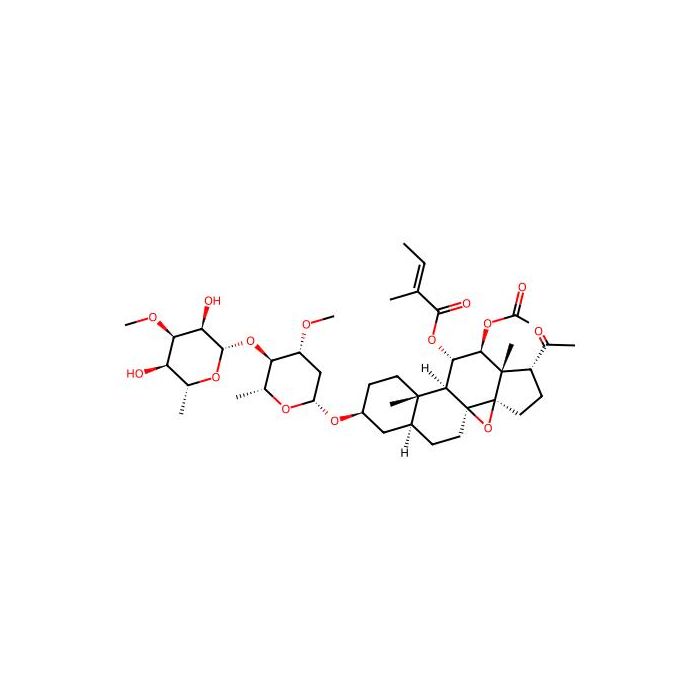
Tenacissoside G is a C21 steroid from the stems of Marsdenia tenacissima. Tenacissoside G reverses multidrug resistance in P-glycoprotein (Pgp)-overexpressing multidrug-resistant cancer cells.
Form:Solid
Spezifikationen
Biochemische und physiologische Mechanismen
Tenacissoside G is a C21 steroid from the stems of Marsdenia tenacissima . Tenacissoside G reverses multidrug resistance in P-glycoprotein (Pgp)-overexpressing multidrug-resistant cancer cells.
Storage
Protected from light,Store at -80°C
Verschickt in
Dry ice packs + Cold packs
Dieses Produkt erfordert Kühlkettenversand. Grundversand und andere Economy-Optionen sind nicht verfügbar.
This compound belongs to the class of organic compounds known as steroid esters. These are compounds containing a steroid moiety which bears a carboxylic acid ester group.
External Descriptors
Not available
1. Djoumbou Feunang Y, Eisner R, Knox C, Chepelev L, Hastings J, Owen G, Fahy E, Steinbeck C, Subramanian S, Bolton E, Greiner R, and Wishart DS. ClassyFire: Automated Chemical Classification With A Comprehensive, Computable Taxonomy. Journal of Cheminformatics, 2016, 8:61.
Zertifikate (CoA, COO, BSE/TSE und Analyse-Diagramm)
C of A & Other Certificates(BSE/TSE, COO):
Analytical Chart:
Chemische und physikalische Eigenschaften
Löslichkeit
DMSO : 100 mg/mL (126.11 mM; Need ultrasonic)
Molekulargewicht
792.900 g/mol
XLogP3
3.100
Hydrogen Bond Donor Count
2
Hydrogen Bond Acceptor Count
14
Rotatable Bond Count
12
Exact Mass
792.43 Da
Monoisotopic Mass
792.43 Da
Topological Polar Surface Area
178.000 Ų
Heavy Atom Count
56
Formal Charge
0
Complexity
1550.000
Isotope Atom Count
0
Defined Atom Stereocenter Count
19
Undefined Atom Stereocenter Count
0
Defined Bond Stereocenter Count
1
Undefined Bond Stereocenter Count
0
The total count of all stereochemical bonds
1
Covalently-Bonded Unit Count
1
Lösungsrechner
Molarity Calculator
Determine the necessary mass, volume, or concentration for preparing a solution.
Dilution Calculator
Determine the dilution needed to prepare a stock solution.
Reconstitution Calculator
Bewertungen
Kundenbewertungen
Application Protocols
No assay validations are provided for this specific item. The following are general, research-use guidelines for handling saponin standards and library compounds:
Preparation of stock solutions:
Dissolve Tenacissoside G in anhydrous DMSO at 10–50 mM. Vortex and, if needed, warm gently (≤37 °C) or sonicate briefly. Filter through 0.22 µm PTFE/PES.
Alternatively, prepare a methanolic stock (e.g., 1–10 mg/mL) for LC reference injections; store aliquots at −80 °C.
Working solutions for assays:
Dilute DMSO stocks into buffer or media with vigorous mixing; keep final DMSO ≤1–2% as permitted by the assay system.
For binding/biophysical studies, verify absence of aggregates by dynamic light scattering at working concentrations and adjust solvent or surfactant content accordingly.
Analytical method development:
LC–MS: Start with RP C18, water/MeOH or water/ACN with 0.1% formic or 5–10 mM ammonium formate/acetate; monitor in ESI± with ELSD/CAD if UV response is weak.
Stability checks: Assess freeze–thaw stability (3–5 cycles), bench-top stability (2–6 h at RT), and autosampler stability (4–24 h at 4–10 °C) to define handling windows.
Note: Parameters above are general literature practices and not product-specific recommendations. Optimize per your system.
Biological Roles
General, literature-based context (no medical claims):
Tenacissoside G is part of a class of plant secondary metabolites (steroidal saponins) reported from Marsdenia tenacissima. Saponins are amphiphilic glycosides combining a hydrophobic aglycone (here, typically a C21 pregnane) with hydrophilic sugars.
In plants, saponins are thought to contribute to defense mechanisms against herbivores and pathogens and to modulate membrane permeability and signaling at the cellular level (class-level roles).
Physicochemical attributes—surfactancy, micelle formation, and the ability to complex sterols—underpin many observed biological interactions of saponins in vitro (e.g., effects on membrane integrity and permeability in model systems).
In research, purified saponins are used to study carbohydrate–protein interactions, membrane disruption thresholds, and structure–activity relationships within glycoside families.
Important note: Any functional or phenotypic effects should be characterized empirically under controlled laboratory conditions. This product is for research use only and is not intended for human or veterinary use.
Buffer Applications
Not a buffering agent. Tenacissoside G does not serve as a pH buffer. For experimental work, it may be dissolved into existing buffers.
Practical handling in buffers (general guidance):
Prepare a concentrated DMSO or ethanol stock, then dilute into the target buffer (e.g., PBS, HEPES, Tris) with vigorous mixing. Keep final organic cosolvent low (typically ≤1–2%).
Avoid strongly acidic or basic buffers that can promote glycosidic hydrolysis; neutral pH (≈6.5–7.5) is generally suitable.
If precipitation occurs upon dilution, increase temperature slightly (to 25–37 °C), reduce concentration, or adjust the co-solvent percentage within assay tolerance.
Green Alternatives
Context: As a specialized natural product, Tenacissoside G itself is not a solvent or commodity reagent; greener considerations relate mainly to solvent choices during dissolution, purification, and analysis.
Greener solvent choices (general guidance):
Prefer ethanol or water–ethanol mixtures over methanol when assay tolerances permit (lower toxicity profile). Warm gently to aid solubility.
Minimize DMSO percentage in final working solutions; consider aqueous buffers with small ethanol content if compatible with the assay.
For flash/column cleanup (if performed): replace chlorinated solvents with ethyl acetate/ethanol/water biphasic systems or greener HILIC/RP preparative methods.
Comparison (informational):
DMSO: excellent solvency; low volatility; not readily biodegradable—use minimal volumes and segregate waste.
Methanol vs ethanol: methanol offers slightly better solvency but is more toxic. Ethanol is preferred where feasible.
Acetonitrile vs methanol in LC: MeOH is greener; however, ACN can provide sharper peaks. Consider gradient methods using MeOH or mixed MeOH/IPA to reduce ACN usage.
Operational practices:
Scale solutions to immediate needs to reduce waste.
Use high-efficiency LC columns to lower solvent consumption.
Capture and recycle solvent where institutional infrastructure allows.
Pharmaceutical Uses
No clinical or therapeutic claims are made for this product. It is supplied strictly for research use only.
Analytical reference standard: Can be used to develop and validate chromatographic methods (e.g., RP–HPLC/UPLC–MS, ELSD/CAD) for quality control of botanical materials containing Marsdenia tenacissima constituents.
Excipient relevance: None—Tenacissoside G is not a common excipient.
Pharmacopeial status: Not specified for this item; consult relevant pharmacopeial monographs if applicable.
Formulation research considerations:
Solubility enhancers: co-solvents (DMSO, ethanol), cyclodextrins, or surfactant systems can be evaluated in preformulation studies if investigating delivery science in vitro.
Stability-indicating methods: Establish LC methods capable of separating potential hydrolysis/oxidation products to support forced-degradation and stability studies (research setting only).
Physical Properties
Item-specific specifications:
Appearance: Not specified for this item; refer to CoA/Spec Sheet.
Molecular weight: Not specified for this item; refer to CoA/Spec Sheet.
Molecular formula: Not specified for this item; refer to CoA/Spec Sheet.
Melting point, boiling point, density, refractive index, pKa, logP/logD, UV cut-off, metal content, water/peroxide ppm: Not specified for this item; refer to CoA/Spec Sheet.
General/literature expectations for pregnane-type saponin glycosides (informational only; not product specifications):
Physical state: typically amorphous solid or glassy foam; may appear as off-white powder depending on isolation.
Solubility profile: often readily soluble in DMSO and methanol; moderately soluble in ethanol; variable solubility in water (improves with warming or with small cosolvent fractions) due to amphiphilic character; poorly soluble in nonpolar solvents (hexanes, toluene).
Hygroscopicity: carbohydrate-rich saponins can be hygroscopic and may form gels or micelles in aqueous media.
Surface activity: saponins commonly lower surface tension and can form micelles above a critical micelle concentration (family-level behavior).
Practical handling tips (general):
Prepare concentrated stock solutions in anhydrous DMSO (e.g., 10–50 mM) or methanol, then dilute into aqueous buffers while keeping final organic content low (≤1–5%) to minimize precipitation.
Warm gently (room temp to 37 °C) and vortex/sonicate to aid dissolution; avoid prolonged heating or alkaline conditions that may promote glycosidic hydrolysis.
Quality and Grades
Item-specific quality information:
Grade/purity: Not specified for this item; refer to CoA/Spec Sheet.
How to interpret grades (general guidance):
Research-grade natural products are typically qualified by NMR and HRMS for identity, and HPLC/UPLC for purity (e.g., area % at a defined wavelength). If a stabilizer is used, it will be listed on the CoA; none is indicated here.
For use as an analytical reference standard, chemists often seek ≥95% HPLC purity with documented chromatographic conditions and spectral data.
What to look for on the CoA (recommended for this class):
Identity confirmation: 1H/13C NMR in appropriate deuterated solvent (e.g., DMSO-d6, CD3OD), high-resolution MS, and, where applicable, specific optical rotation.
Purity assessment: HPLC chromatogram (UV/ELSD) with method parameters; note that saponins may have weak UV at 254 nm and are often tracked at lower wavelengths or by ELSD/MS.
Residual solvents, water content (Karl Fischer), and counter-ions/additives if any.
Use-case alignment:
For screening libraries: batch-to-batch consistency and purity suffice.
For quantitative analytical work: obtain exact purity, extinction characteristics (if UV-quantified), and any assay-specific details from the CoA/SDS.
Reaction and Applications
This product is primarily a natural product standard/library member rather than a general-purpose reagent.
Common research applications (non-clinical):
Reference standard for analytical method development and quality assessment of Marsdenia tenacissima extracts or saponin-enriched fractions (e.g., LC–UV/ELSD–MS profiling).
Inclusion in small-molecule and natural-product libraries for biochemical or phenotypic screening (dissolved typically in DMSO).
Physicochemical studies of amphiphiles: micellization, membrane interaction models, and supramolecular assembly (family-level behavior for saponins).
Chemical manipulation (literature, class-level):
Glycoside chemistry: controlled acid-catalyzed hydrolysis or enzymatic deglycosylation to probe aglycone vs glycone contributions.
Derivatization: per-O-acetylation or benzoate formation on sugar hydroxyls for structure elucidation; selective oxidation (e.g., TEMPO) of primary alcohols on sugars.
Conjugation strategies: formation of esters/ethers at accessible hydroxyls for probe development (requires protection strategies due to multiplicity of –OH groups).
Practical tips:
Use mild, neutral conditions for storage/handling; avoid prolonged exposure to pH <3 or >9 to limit decomposition.
For LC–MS quantitation, consider using negative ESI with adduct management (formate/acetate) or positive ESI with ammonium adducts. ELSD or CAD aids detection given weak chromophores in some saponins.
Reaction Conditions
Guidance below is general for steroidal saponin chemistry (literature) and not specific to this item. Verify experimentally and consult primary sources.
Acidic hydrolysis of glycosides: Aqueous methanolic HCl (e.g., 0.05–0.5 M) at 40–60 °C for 1–6 h can cleave labile glycosidic bonds to release aglycone; monitor by LC–MS. Minimize over-degradation by using buffered acids (e.g., formic acid) and lower temperatures.
Enzymatic deglycosylation: Glycosidases (β-glucosidase, etc.) in acetate/phosphate buffers (pH 4.5–6.5) at 25–37 °C; times from 2–24 h depending on substrate accessibility.
Per-O-acetylation: Ac2O/pyridine or Ac2O/DMAP in CH2Cl2 at 0–25 °C, 1–12 h; quench with MeOH and purify by silica/flash or RP chromatography.
Selective oxidation (primary alcohols on sugars): TEMPO (0.05–0.2 equiv), NaOCl/NaBr in biphasic H2O/CH2Cl2 or MeCN/H2O at 0–5 °C to room temp; monitor to avoid over-oxidation.
Protection strategies: TBSCl/imidazole in DMF for silylation (0–25 °C); hydrogenolysis for benzyl protections (H2, Pd/C, 1–3 bar) if introduced.
Solvents and conditions:
DMSO, DMF, MeOH, MeCN, and CH2Cl2 are commonly used; ensure strict dryness for acylation/silylation steps.
Workup: Given amphiphilicity, emulsions can form—use brine, centrifugation, or switch to RP cleanup. ELSD/CAD can aid fraction tracking.
Yields and times vary widely with substitution pattern; pilot reactions on milligram scale with intensive LC–MS monitoring are recommended.
Safety and Handling
Item-specific hazard data from Product Data:
GHS classification: Not specified for this item; refer to SDS.
Signal word: Not specified for this item; refer to SDS.
Hazard (H-) statements and pictograms: Not specified for this item; refer to SDS.
General safety guidance (for saponin glycosides; informational only—consult the SDS for authoritative instructions):
Hazards: Many saponins are irritants and may be harmful if swallowed or inhaled. Dusts can be irritating to eyes, skin, and respiratory tract. Avoid aerosol/dust generation.
PPE: Lab coat, nitrile gloves, safety glasses; use a chemical fume hood during weighing/dissolution.
First aid (general): In case of contact, rinse affected area with water for several minutes. If inhaled, move to fresh air. If ingested, rinse mouth; seek medical advice. Always follow institutional protocols and the product SDS.
Handling: Use antistatic measures when weighing fine powders. Minimize repeated freeze–thaw by aliquoting solutions (see Storage & Reconstitution).
Incompatibilities: Strong acids/bases and elevated temperatures can catalyze glycosidic bond hydrolysis or ester cleavage (if present). Oxidants may degrade polyol moieties over time.
Environmental: Avoid release to environment; collect aqueous waste and organic solutions according to local regulations.
Storage (from Product Data):
Protect from light; store at −80 °C. Shipments are on dry ice and cold packs. Maintain frozen chain-of-custody to preserve integrity.
Solvent Selection
Applicability: Tenacissoside G is a polyhydroxylated steroidal glycoside; solvent selection is critical for dissolution and assay compatibility.
General solvent behavior (literature/class):
High polarity/protic solvents (DMSO, methanol) typically dissolve saponins well. Ethanol can work with warming. Water solubility is variable and may require co-solvent or surfactant-like self-solubilization.
Poor solubility in nonpolar solvents (hexanes, cyclohexane); limited solubility in moderately polar aprotics (EtOAc, MTBE).
Practical guidance:
Stock solutions: Prepare in anhydrous DMSO (e.g., 10–50 mM). Alternatively, methanol can be used for LC sample prep.
Aqueous use: Dilute DMSO stocks into buffer slowly with vigorous mixing; keep final DMSO ≤1–2% for cell-free biochemical assays or analytical injections, and match matrix for LC quantitation.
pH sensitivity: Avoid strong base or acid; neutral pH buffers are preferred to prevent glycosidic hydrolysis.
Quick comparison (general):
DMSO: maximal solubility, broad assay compatibility; can affect some enzymes—use minimal %.
Methanol: good solubility; fully miscible with water; volatile—use in LC and for short-term preparations.
Ethanol: often acceptable; may need warming to fully dissolve.
Water/buffer: may need co-solvent; micelle formation can occur at higher concentrations.
Tip: Filter solutions (0.22 µm PTFE or PES) after dissolution to remove particulates prior to analytical or screening workflows.
Storage and Reconstitution
Item-specific storage (from Product Data):
Store at −80 °C, protected from light.
Shipped on dry ice packs + cold packs. Maintain frozen/cold chain upon receipt.
General reconstitution guidance (research-use):
Allow vial to warm to approximately 0–4 °C in a desiccated environment before opening to avoid moisture condensation on cold material.
Reconstitute in anhydrous DMSO or methanol to prepare a concentrated stock (e.g., 10–50 mM or 1–10 mg/mL). Mix thoroughly (vortex) and, if needed, gently warm (≤37 °C) or sonicate briefly to achieve a clear solution.
If aqueous solutions are required, add the organic stock slowly to buffer with vigorous mixing to prevent precipitation; target final organic content ≤1–2% if compatible.
Aliquoting and stability (general):
Aliquot stock solutions into single-use portions (amber vials or light-protective tubes) to minimize freeze–thaw and light exposure.
Short-term storage of solutions: keep at −20 to −80 °C (DMSO/MeOH stocks) in the dark; verify stability empirically.
Solid-state stability parameters, exact shelf life, and re-test dates: Not specified for this item; refer to CoA/Spec Sheet.
Always consult the product-specific CoA/SDS for definitive instructions on storage limits, stability, and safe handling. For research use only.
Structure and Identity
**Item-specific identifiers (from Product Data):
SKU: T650723
Product name: Tenacissoside G
CAS: 191729-43-8
PubChem CID: 44561398
InChIKey: Not specified for this item; refer to CoA/Spec Sheet. (Product Data listed "257856", which is not a full InChIKey.)
SMILES: Not specified for this item; refer to CoA/Spec Sheet.
Molecular formula: Not specified for this item; refer to CoA/Spec Sheet.
Molecular weight: Not specified for this item; refer to CoA/Spec Sheet.
General structural description (literature/class information):
Tenacissoside G belongs to the tenacissoside family of plant saponins isolated from Marsdenia tenacissima (Apocynaceae).
Structural class: typically a C21 pregnane-type steroidal aglycone bearing one or more glycosidic chains (oligosaccharides). Such structures present multiple oxygenated stereocenters and acetyl/angeloyl substituents in some congeners (literature, family-level).
Functional groups: multiple secondary/tertiary alcohols on the steroidal core, glycosidic O-linkages (acetal), numerous hydroxyls on carbohydrate units; possible ester substituents depending on congener (literature).
Stereochemistry: polycyclic steroidal framework with defined trans-fused rings and several chiral centers in both aglycone and sugar residues (literature).
2D depiction (verbal): a tetracyclic steroidal nucleus (A–D rings) functionalized at C-3 (and/or other positions) with a β-glycosidic linkage to a short oligosaccharide; sugars arranged in a branched or linear chain featuring multiple –OH groups. These polar domains contrast with the lipophilic steroidal backbone, conferring amphiphilicity.
Synthetic Utility
Although Tenacissoside G is primarily a target molecule/standard, it provides a rich platform for synthetic and analytical transformations in research:
Functional group landscape (general):
Multiple secondary/tertiary alcohols on the steroidal aglycone and polyhydroxy sugar units enable selective protection–deprotection strategies (silyl ethers, benzyl ethers, acyl protections).
Glycosidic linkages (O-glycosides) allow for controlled hydrolysis, transglycosylation, or enzymatic remodeling.
Potential ester substituents (if present in this congener) are handles for selective cleavage or substitution.
Typical transformations (literature/class):
Peracetylation or perbenzoylation of the glycone for structure elucidation and crystallinity enhancement.
Selective oxidation (e.g., TEMPO/BAIB) of primary alcohols on sugar residues to carboxylates for conjugation chemistry.
Aglycone liberation via mild acid hydrolysis, followed by derivatization (e.g., formation of carbonate/ester probes at C-3 OH).
Formation of reporter conjugates (e.g., fluorescein/biotin) through linker chemistry, enabling binding or permeability studies.
Analytical derivatization:
For GC–MS of sugar components, hydrolysis followed by alditol acetate or trimethylsilyl (TMS) derivatization is standard.
For LC–MS, introduction of UV-strong tags can enhance detection where native chromophores are weak.
Target Specificity
Not applicable. This product is a small-molecule natural product (steroidal saponin), not an antibody or biological macromolecule. No antigen/epitope, clone, isotype, or species-reactivity data are relevant.
Wir verwenden Cookies, um die ordnungsgemäße Funktion der Website sicherzustellen und, soweit zulässig, Ihr Nutzererlebnis zu verbessern. Sie können Ihre Einstellungen jederzeit unter „Einstellungen“ verwalten. Weitere Informationen finden Sie in unserer Cookie-Richtlinie.
Dürfen wir Sie über Rabattaktionen informieren?
Später erinnern
Vielen Dank! Bitte überprüfen Sie Ihren E-Mail-Posteingang, um zu bestätigen.
Products are supplied to verified businesses, institutions, and qualified professionals for research and development use only. Not for use in humans, animals, diagnosis, or therapy.