≥99% für empfindliche chromatographische und analytische Workflows, die minimale Basislinieninterferenzen erfordern.
🌡
Lagerung & Versand
Protected from light,Store at -80°C Versand Dry ice packs + Cold packs. Genaue Spezifikationen finden Sie im chargenspezifischen COA.
📋
Qualitätsdokumente
SDS, COA, Datenblatt und Spezifikationsblatt stehen zum Download bereit. Chargenspezifische COA über Chargennummernsuche abrufbar.
📚
Literaturbeleg
In 0 peer-reviewten Publikationen zu Chromatographie, organischer Synthese und Kreuzkupplungsreaktionen zitiert.
Übersicht
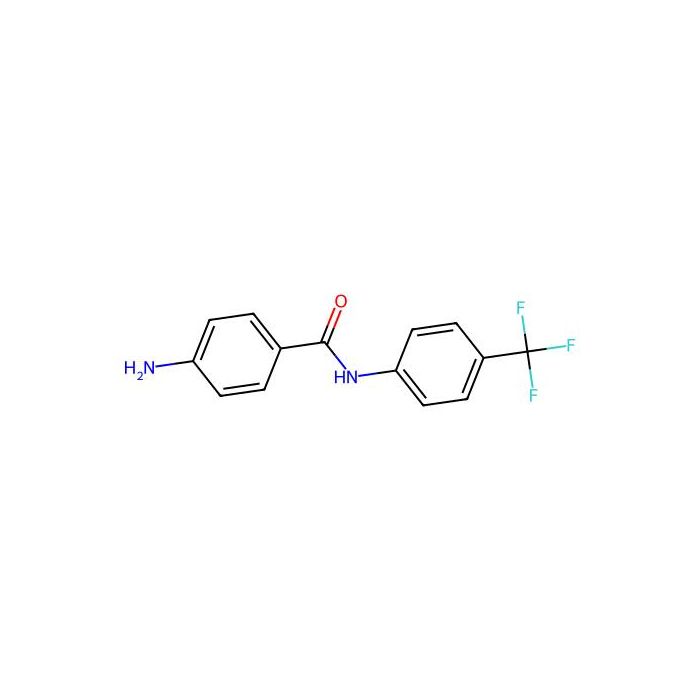
Teriflunomide impurity 3 (4-Amino-N-(4-trifluoromethylphenyl)benzamide) is a selective COX-1 inhibitor with an IC 50 of 30 µM. Teriflunomide impurity 3 is less active against COX-2 (IC 50 >100 µM)
In Vitro
Teriflunomide impurity 3 (4-Amino-N-(4-trifluoromethylphenyl)benzamide; compound 11q) is an amide-bond-reversed compound bearing trifluoromethyl and amino substituents showed potent COX-1-selective inhibitory activity. MCE has not independently confirmed the accuracy of these methods. They are for reference only.
Teriflunomide impurity 3 (4-Amino-N-(4-trifluoromethylphenyl)benzamide) is a selective COX-1 inhibitor with an IC 50 of 30 µM. Teriflunomide impurity 3 is less active against COX-2 (IC 50 >100 µM).
Storage
Protected from light,Store at -80°C
Verschickt in
Dry ice packs + Cold packs
Dieses Produkt erfordert Kühlkettenversand. Grundversand und andere Economy-Optionen sind nicht verfügbar.
This compound belongs to the class of organic compounds known as benzanilides. These are aromatic compounds containing an anilide group in which the carboxamide group is substituted with a benzene ring. They have the general structure RNC(=O)R', where R,R'= benzene.
External Descriptors
Not available
1. Djoumbou Feunang Y, Eisner R, Knox C, Chepelev L, Hastings J, Owen G, Fahy E, Steinbeck C, Subramanian S, Bolton E, Greiner R, and Wishart DS. ClassyFire: Automated Chemical Classification With A Comprehensive, Computable Taxonomy. Journal of Cheminformatics, 2016, 8:61.
Zertifikate (CoA, COO, BSE/TSE und Analyse-Diagramm)
C of A & Other Certificates(BSE/TSE, COO):
Analytical Chart:
Chemische und physikalische Eigenschaften
Löslichkeit
DMSO : 250 mg/mL (892.06 mM; Need ultrasonic)
Molekulargewicht
280.240 g/mol
XLogP3
2.800
Hydrogen Bond Donor Count
2
Hydrogen Bond Acceptor Count
5
Rotatable Bond Count
2
Exact Mass
280.082 Da
Monoisotopic Mass
280.082 Da
Topological Polar Surface Area
55.100 Ų
Heavy Atom Count
20
Formal Charge
0
Complexity
330.000
Isotope Atom Count
0
Defined Atom Stereocenter Count
0
Undefined Atom Stereocenter Count
0
Defined Bond Stereocenter Count
0
Undefined Bond Stereocenter Count
0
The total count of all stereochemical bonds
0
Covalently-Bonded Unit Count
1
Lösungsrechner
Molarity Calculator
Determine the necessary mass, volume, or concentration for preparing a solution.
Dilution Calculator
Determine the dilution needed to prepare a stock solution.
Reconstitution Calculator
Bewertungen
Kundenbewertungen
Application Protocols
General protocols for impurity standard use (method development and validation)
Stock preparation:
Calculate mass based on CoA assay and correct for residual solvents/water if reported. Dissolve in an appropriate strong solvent (e.g., DMSO or acetonitrile) under low light in amber vials to make a primary stock (concentration per your method needs).
Calibration curve:
Prepare at least 5–7 calibration levels spanning expected specification limits. Use independent weighings for top/mid/low points where feasible. Include matrix-matched blanks.
System suitability and ID:
Inject standard to establish retention time and spectral/mass identity. For LC–MS, record MS/MS fragments for confirmation criteria. Check peak purity with PDA if available.
Accuracy/recovery:
Spike known amounts of the impurity into teriflunomide API or product matrix at multiple levels (e.g., 50–150% of limit) and evaluate recovery and precision.
Robustness:
Vary flow, temperature, organic %, and pH within narrow ranges to ensure peak resolution and response stability.
Stability of solutions:
Assess short-term (bench-top), autosampler, freeze–thaw, and long-term stability under protected-from-light conditions. Define maximum hold times for standards and samples.
Note
Specific concentrations, wavelengths, and instrument parameters are method-dependent and are not specified for this item.
Biological Roles
Applicability
This product is an analytical impurity standard related to teriflunomide and is intended for research use only. No biological function or role is assigned for this item.
General context (informational)
Impurity standards are used to evaluate and control related substances in drug substances/products to ensure safety and quality; they are not intended to probe biological pathways.
If biological data are required
Consult peer-reviewed literature or vendor-provided technical packages specific to “Teriflunomide impurity 3” for any reported biochemical properties; none are provided here.
Buffer Applications
Not typically applicable
As a small-molecule impurity reference standard, this product is not used to prepare laboratory buffers.
Analytical note
When used in LC/LC–MS, prepare working solutions in the target mobile phase buffer system (e.g., ammonium formate/acetate, formic acid) to match chromatographic conditions and reduce solvent mismatch. Specific buffer recipes and pH ranges are method-dependent and not specified for this item.
Green Alternatives
Context
As an analytical impurity standard, the “green” discussion centers on solvent choices and chromatographic conditions rather than substitution of the analyte itself.
Prefer water-rich mobile phases and minimize acetonitrile where possible; methanol or ethanol can be evaluated for reduced environmental impact, acknowledging changes in selectivity and viscosity.
Evaluate supercritical fluid chromatography (SFC) for rapid separations with reduced solvent consumption when analyte polarity and stability allow.
Replace non-volatile buffers (phosphate) with volatile, MS-compatible salts (ammonium formate/acetate) to simplify waste streams.
Consider micro- or capillary-flow LC to lower solvent usage while maintaining sensitivity with modern detectors.
Illustrative comparison (general)
ACN vs MeOH as organic modifier:
ACN: Lower backpressure, often higher sensitivity in ESI; derived from petrochemical sources.
MeOH: Renewable sourcing possible, lower toxicity profile; higher backpressure and can alter selectivity.
Operational practices
Batch analyses to reduce start-up/shutdown waste, employ column equilibration protocols that minimize solvent purge volumes, and collect solvent waste separately for optimized disposal.
Note
These are general recommendations. Select conditions based on fitness-for-purpose while maintaining data integrity and analyte stability.
Pharmaceutical Uses
Non-therapeutic, research-only
This product is not a drug or excipient and carries no therapeutic indications.
Role in pharmaceutical quality (general)
Employed as a certified/qualified reference material for:
Method development and validation (specificity, linearity, accuracy, precision) of teriflunomide related-substances methods.
Establishing relative response factors (RRFs) when necessary.
Stability studies to verify that degradation pathways are well-resolved and quantified.
Release and ongoing stability testing of APIs and finished dosage forms to comply with ICH Q3A/B and regional pharmacopoeial expectations.
Documentation
Maintain full traceability: lot numbers, CoA, storage logs, and usage records to support regulatory submissions and audits.
Note
Pharmacopeial monograph cross-referencing is not provided for this item; consult the relevant compendia and your quality system for suitability assessment.
Physical Properties
Item-specific facts (from Product Data)
Appearance: Not specified for this item; refer to CoA/Spec Sheet.
Typical physico-chemical parameters (literature/general guidance for small organic impurity standards)
Melting point, boiling point, density, refractive index, logP, pKa, and aqueous/organic solubility: Not specified for this item; refer to CoA/Spec Sheet.
Practical guidance
Analytical impurity standards of drug-like molecules are commonly supplied as solids or concentrated solutions. If solid, initial dissolution screens typically include dry, anhydrous DMSO, acetonitrile, methanol, or DMF, followed by dilution into working mobile phase.
For LC use, prepare fresh stock solutions at known concentrations (e.g., 0.1–10 mg/mL) in a strong solvent, then serially dilute with mobile phase to mitigate precipitation and strong-solvent effects at the column head.
Light sensitivity is indicated for this item (protect from light). Use amber glassware/vials and minimize exposure during weighing and dissolution.
If hygroscopicity or polymorphism is a concern, equilibrate to room temperature in a desiccator before opening, then promptly reseal and return to ultracold storage.
Note
For quantitative method validation, rely on the lot-specific assay/purity, water/volatile content, and counter-ion/form information in the CoA to calculate exact solution concentrations.
Quality and Grades
Item-specific facts (from Product Data)
Grade/Purity: Not specified for this item; refer to CoA/Spec Sheet.
What to expect for impurity/reference standards (general guidance)
Identity/purity assignment: Impurity standards are commonly characterized by orthogonal techniques (e.g., 1H/13C NMR, high-resolution MS, HPLC/UPLC purity). The CoA typically reports assay on an area% basis and may include residual solvents and water (KF) content.
Traceability: Many labs require documented traceability for impurity quantitation. Request accompanying characterization package if needed for GMP-adjacent work.
Form and counter-ions: The exact form (free base/acid, salt, solvate) influences solution concentration calculations. Confirm by CoA to ensure accurate mass-to-mole conversions.
Stabilizers: Not specified for this item; refer to CoA/Spec Sheet. If present, stabilizers can influence UV response or mass spectra; account for them in method development.
Fit-for-purpose selection
For QC/ICH impurity profiling, select a lot with a well-defined purity and known uncertainty to support calibration curves and system suitability.
If UV cutoffs or low-UV requirements are critical (e.g., PDA-based methods), verify the background absorbance profile of the solvent/stabilizer package on the CoA or by blank runs.
Documentation
For audits and data integrity, archive the CoA/SDS for the exact lot used and note storage/handling history (light exposure, freeze–thaw events).
Reaction and Applications
Item-specific facts (from Product Data)
Manufacturer Applications: Not specified beyond product name; this product is intended for research use only.
Primary application (general for impurity standards)
Reference standard for analytical development and QC of teriflunomide and related substances:
System suitability and peak identification in stability-indicating HPLC/UPLC methods.
Calibration/quantitation of “Impurity 3” in API and finished product per ICH Q3A/Q3B.
LC–MS method development: retention mapping, ionization behavior, and fragmentation confirmation.
Practical tips
Establish a well-characterized stock concentration based on CoA assay and corrected for residual volatiles/water.
Use amber vials and minimize exposure to light to preserve analyte integrity during sequence runs.
For forced-degradation studies of teriflunomide, spike known levels of this impurity to validate specificity and recovery.
Orthogonal confirmation: match retention time and MS/MS fragments to the reference; if available, compare UV spectra.
Broader analytical contexts
Can support impurity mass-balance assessments in development and tech-transfer dossiers.
Useful as a selectivity probe when optimizing stationary phases (C18 vs phenyl-hexyl vs polar-embedded) and mobile-phase modifiers (formic acid vs ammonium acetate) for teriflunomide related-substances profiling.
Note
No synthetic or biological applications are specified or implied for this item beyond its role as an analytical reference standard.
Reaction Conditions
Not directly applicable
No preparative or synthetic reaction conditions are provided for this item. It is supplied for analytical use as an impurity standard.
Analytical conditions (general guidance)
LC/LC–MS: Typical reversed-phase methods use water/organic (ACN or MeOH) with volatile modifiers (e.g., 0.1% formic acid or 5–20 mM ammonium acetate/formate). Optimize gradient, temperature, and flow based on column dimensions and desired resolution; specific values are method-dependent and not specified for this item.
Detection: PDA/UV and ESI–MS/MS are commonly employed for related-substances; select wavelengths/ionization modes empirically.
Sample prep: Dissolve in strong solvent (DMSO or ACN), then dilute with mobile phase. Filter through 0.2 µm PTFE/RC if particulate is present.
Note
Reported temperatures, times, and yields are not applicable here; consult your internal method SOPs and validation protocols.
Safety and Handling
Item-specific facts (from Product Data)
Storage: Store at −80 °C, protected from light.
Shipping: Dry ice packs + cold packs.
GHS/Signal word/H-statements/Pictograms: Not specified for this item; refer to SDS.
General safety guidance (always defer to the SDS for authoritative information)
Handle in a chemical fume hood with appropriate PPE: lab coat, safety glasses, and nitrile gloves. For powder handling, consider double-gloving and antistatic precautions to minimize aerosolization and cross-contamination.
Avoid inhalation of dust/vapors and contact with skin/eyes. Wash hands thoroughly after handling. Prevent environmental release.
Incompatibilities are not defined here; as a precaution, keep away from strong oxidizers and strong acids/bases unless compatibility is verified.
Light sensitivity: work rapidly under reduced ambient light or with amber glassware and foil wrapping to prevent photodegradation.
First-aid overview (general)
Inhalation: Move to fresh air; seek medical attention if symptoms occur.
Skin/eye contact: Rinse with plenty of water for at least 15 minutes; remove contaminated clothing; obtain medical advice if irritation persists.
Ingestion: Rinse mouth; do not induce vomiting; seek medical attention.
Waste disposal
Collect waste and contaminated disposables in properly labeled containers for organic hazardous waste disposal according to institutional and local regulations.
Research use only
This product is for research use only; not for human or veterinary use.
Solvent Selection
Item-specific facts (from Product Data)
No solvent recommendations are specified for this item; refer to CoA/Spec Sheet.
General solvent strategy for drug-like impurity standards
Primary stock solvents (analytical-grade):
DMSO: Excellent solvating power for aromatic/heteroaromatic, moderately polar organics; miscible with water and common LC mobile phases.
Acetonitrile (ACN): LC-compatible, low viscosity; good for immediate injection after dilution, but check solubility.
Methanol (MeOH): Protic alternative; may affect MS ionization pathway relative to ACN.
DMF or THF: Use if other solvents fail; ensure LC compatibility and remove or dilute appropriately prior to injection.
Working solutions: Dilute stock into mobile phase (e.g., water/ACN or water/MeOH with volatile modifier) to reduce strong-solvent effects and peak distortion.
Solubility check workflow:
Start with 1–2 mg in 1 mL DMSO (or ACN) under amber conditions.
Sonicate gently; if insoluble, warm mildly (≤40 °C) briefly, then cool in the dark.
Prepare serial dilutions with mobile phase.
Adsorption mitigation: Use silanized or low-bind vials; add small amounts of organic modifier (e.g., 2–5% ACN) to minimize wall losses at low ng–µg/mL levels.
Comparative considerations
Choose ACN over MeOH for higher MS sensitivity (often) and lower backpressure; choose MeOH when greener solvent profiles or different selectivity are desired.
Storage and Reconstitution
Item-specific facts (from Product Data)
Storage conditions: Store at −80 °C. Protect from light.
Shipping: Shipped on dry ice packs + cold packs.
Reconstitution guidance (general)
Allow container to equilibrate to room temperature in the dark before opening to prevent moisture condensation.
Open in a low-humidity environment; promptly reseal any unused material. If supplied as a solid, prepare a concentrated primary stock in dry, anhydrous DMSO or acetonitrile under amber conditions.
Recommended handling:
Prepare single-use aliquots to avoid repeated freeze–thaw cycles.
Store aliquots at −80 °C in amber vials or foil-wrapped containers.
Record preparation date, solvent, and calculated concentration (corrected for assay and any residual content per CoA).
Stability considerations
Light sensitivity is indicated; minimize exposure during weighing, dissolution, and transfers. Use amber syringes/vials and cover autosampler positions when possible.
Define and verify solution stability (bench-top, autosampler at 4–10 °C, and frozen) as part of method validation; no item-specific hold times are provided.
Disposal
Dispose of unused solutions and materials in accordance with institutional procedures for organic hazardous waste.
Research use only
For research use only; not for human or veterinary use.
SMILES: Not specified for this item; refer to CoA/Spec Sheet.
Molecular formula: Not specified for this item; refer to CoA/Spec Sheet.
Molecular weight: Not specified for this item; refer to CoA/Spec Sheet.
General notes
This material is an impurity standard related to teriflunomide (A77 1726). “Impurity 3” denotes a specific, structurally defined related substance used for analytical characterization and control of teriflunomide; the exact structure and naming convention are method/compendial dependent.
Without an explicit structure, detailed functional-group or stereochemical description cannot be provided for this listing. Consult the product CoA/SDS for definitive structural identifiers.
2D structure description
Not available in the provided data. If structural data (SMILES/InChI/MF) are required for method set-up or MS tuning, please request the CoA/structure file from Aladdin Scientific.
Synthetic Utility
Limited applicability
As a designated impurity standard for teriflunomide, this item is primarily intended for analytical use. Without a disclosed structure, specific synthetic transformations or reactivity considerations cannot be detailed.
General considerations
If used as a synthetic intermediate or comparator in SAR studies, request full structural information (SMILES/InChI, MF, MW, and characterization data) to plan reactions, predict chemoselectivity, and ensure correct stoichiometry.
For any derivatization (e.g., to create stable isotopologues or analytical surrogates), confirm stability under proposed reaction conditions and protect against light as indicated for this item.
Target Specificity
Not applicable
This product is not a biological reagent (e.g., antibody, enzyme inhibitor with defined biological target for this listing). No target, epitope, clone, or isotype information applies.
Häufig gestellte Fragen
How is this product shipped?
This product ships frozen with dry ice and cold packs. Unpack on arrival and transfer it to the storage condition stated above; handle dry ice with insulated gloves in a ventilated area.
What are the CAS number, molecular formula and molecular weight?
The CAS Number is 1011244-72-6, the molecular formula is C14H11F3N2O, and the molecular weight is 280.25 g/mol. InChIKey YUWBBWHECQSIKL-UHFFFAOYSA-N.
What documentation is provided?
Available product documentation, including Certificates of Analysis (COA), Safety Data Sheets (SDS), and specification sheets, is shown in the product document area. Document availability and access follow the current site policy.
What is the purity of this product?
This product is supplied at ≥99% purity (chemical assay). Lot-specific values are stated on the Certificate of Analysis.
How should this product be stored?
Store at ?80 °C, protected from light. The material is light-sensitive — keep it in its original opaque or amber container.
Wir verwenden Cookies, um die ordnungsgemäße Funktion der Website sicherzustellen und, soweit zulässig, Ihr Nutzererlebnis zu verbessern. Sie können Ihre Einstellungen jederzeit unter „Einstellungen“ verwalten. Weitere Informationen finden Sie in unserer Cookie-Richtlinie.
Dürfen wir Sie über Rabattaktionen informieren?
Später erinnern
Vielen Dank! Bitte überprüfen Sie Ihren E-Mail-Posteingang, um zu bestätigen.
Products are supplied to verified businesses, institutions, and qualified professionals for research and development use only. Not for use in humans, animals, diagnosis, or therapy.