Dieses Produkt erfordert Kühlkettenversand. Grundversand und andere Economy-Optionen sind nicht verfügbar.
Hinweis
Wherever possible, you should prepare and use solutions on the same day. However, if you need to make up stock solutions in advance, we recommend that you store the solution as aliquots in tightly sealed vials at -20°C. Generally, these will be useable for up to one month. Before use, and prior to opening the vial we recommend that you allow your product to equilibrate to room temperature for at least 1 hour. Need more advice on solubility, usage and handling? Please visit our frequently asked questions (FAQ) page for more details.
This compound belongs to the class of organic compounds known as 1,2-diols. These are polyols containing an alcohol group at two adjacent positions.
External Descriptors
Not available
1. Djoumbou Feunang Y, Eisner R, Knox C, Chepelev L, Hastings J, Owen G, Fahy E, Steinbeck C, Subramanian S, Bolton E, Greiner R, and Wishart DS. ClassyFire: Automated Chemical Classification With A Comprehensive, Computable Taxonomy. Journal of Cheminformatics, 2016, 8:61.
Determine the necessary mass, volume, or concentration for preparing a solution.
Dilution Calculator
Determine the dilution needed to prepare a stock solution.
Reconstitution Calculator
Bewertungen
Kundenbewertungen
Application Protocols
No manufacturer-tested application protocols are provided in the Product Data for this item. The following generic workflows may assist in research use:
Preparation of stock solutions
Weigh the compound quickly under low light. Dissolve in anhydrous DMSO to 10–50 mM. Vortex and, if needed, sonicate briefly. Filter through 0.22 μm PTFE if particulate remains.
Aliquot into amber microvials to minimize freeze–thaw cycles; store at −20°C.
LC–MS reference standard setup
Prepare 1 mM DMSO stock; dilute to 1–10 μM in 50:50 ACN:H2O (+0.1% formic acid if positive mode) for direct injection. Record retention time and MS/MS fragments for method library.
In vitro assay dosing
Dilute DMSO stock into assay buffer or media to desired concentration, keeping final DMSO at ≤0.1–0.5% v/v as required. Mix gently and protect from light during incubation.
These are general research practices; adapt to your system and consult the CoA/SDS for any item-specific constraints.
Biological Roles
Context from literature (not product specification; for research planning only)
Origin: Terrein is a fungal secondary metabolite originally isolated from Aspergillus species. It is commonly discussed in the natural products literature as a polyketide-derived small molecule bearing a conjugated carbonyl system and hydroxyl groups.
Putative roles in producer organisms: Secondary metabolites of this class are often associated with ecological functions such as interspecies interactions or defense, although specific in vivo roles of terrein within the producing organism can vary with strain and conditions.
Biochemical reactivity: Molecules featuring α,β-unsaturated carbonyls may act as soft electrophiles toward biological nucleophiles (e.g., thiols), a point of interest in mechanistic biochemical studies.
Important limitations
Research Use Only: This product is not intended for human or veterinary use, clinical diagnostics, or as a drug substance.
No medical claims: Any biological discussion above is contextual; do not infer therapeutic properties or clinical suitability.
Practical considerations for biologists
Solubilize in DMSO to prepare concentrated stocks; dilute into assay buffers minimizing final DMSO content.
Protect from light and store at −20°C between uses to preserve integrity for reproducible biological experiments.
Buffer Applications
Terrein is not a buffer or pH control reagent. It does not define a conventional buffer system.
Practical guidance
For biological assays, dissolve terrein in DMSO or another suitable organic co-solvent, then dilute into your buffer of choice (e.g., PBS, HEPES, or Tris). Keep the final co-solvent fraction low to maintain buffer capacity and biological compatibility.
Select buffers that lack nucleophilic additives or strong bases which could react with conjugated carbonyl systems. Neutral pH (≈7.2–7.6) is commonly used for maintaining compound stability in short-term assays.
Green Alternatives
As terrein is a discrete natural product standard rather than a solvent or bulk reagent, “green alternatives” mainly concern solvent and process choices during its handling and analysis.
Greener solvent choices (general guidance)
Replace chlorinated solvents in workups and chromatography with ethyl acetate or MEK where feasible.
Prefer ethanol or isopropanol over methanol when compatible with your assay and detection (reduced toxicity, better EHS profile).
In LC separations, consider water–ethanol or water–acetone gradients when your method allows, acknowledging potential changes in selectivity and pressure.
Comparison snapshot (general)
Conventional: ACN/MeOH–water for LC; DMSO for stocks.
Greener shift: EtOH–water for LC where sensitivity allows; PEG-400 or propylene glycol as co-solvents for high-concentration stocks in non-cell assays.
Trade-offs
Solubility and UV transparency often favor ACN/MeOH; moving to EtOH may increase backpressure and alter selectivity.
DMSO has excellent solvency but environmental persistence; ethanol or glycerol-based co-solvents can be considered for certain biochemical assays at the cost of lower solubility.
Packaging and storage
The provided cold, light-protective packaging is already aligned with minimizing waste from degradation-related discards.
Pharmaceutical Uses
This product is supplied strictly for research use only. No pharmacopeial grade or excipient status is provided.
Regulatory/compendial status: Not specified for this item; refer to CoA/Spec Sheet.
Typical role in pharma R&D (general): Natural product reference standard for analytical method development, stability studies, and exploratory screening in discovery research.
Formulation context: When used in in vitro research, terrein is typically formulated as DMSO stock solutions and diluted into assay media; no clinical formulation guidance is applicable.
Note: Do not use in humans or animals for therapeutic, diagnostic, or any clinical purpose.
Physical Properties
Item-specific physico-chemical specifications
Appearance: Not specified for this item; refer to CoA/Spec Sheet.
Molecular weight: Not specified for this item; refer to CoA/Spec Sheet.
Literature/Computed reference values (context; not item specification)
General physical state: Small organic molecule; typically isolated as a solid in natural products literature.
Solubility profile (literature): Readily soluble in DMSO; moderate to good solubility reported in methanol and ethanol; sparingly soluble in water.
UV characteristics (literature): Conjugated enone systems often show UV absorption in the 220–330 nm region; exact λmax depends on solvent and pH.
pKa/logP (literature): Hydroxylated conjugated carbonyl systems typically exhibit weak acidity (phenolic/allylic OH) and moderate lipophilicity; specific values vary by measurement and are not standardized for terrein across sources.
Analytical handling tips (general)
For quantitative solution prep, weigh accurately under low humidity, dissolve in anhydrous DMSO or MeOH, then dilute into assay media as needed.
Protect from light during weighing and solution preparation to minimize photodegradation of conjugated systems.
Important
Any numerical property required for method validation (e.g., ε, logP, pKa, UV cutoffs) should be taken from the Certificate of Analysis/Specification Sheet for this lot. Values above are literature-style context only.
Quality and Grades
Item-specific grade/purity
Grade/Purity: Not specified for this item; refer to CoA/Spec Sheet.
How to interpret grade information (general guidance)
Natural product reference standard: When offered as a research chemical, focus is on identity confirmation (NMR, MS, HPLC/UPLC purity) and stability under recommended storage. The CoA typically details assay purity, residual solvents, and analytical methods.
HPLC/UPLC purity: If provided, indicates percentage of main component by area; look for chromatographic conditions (column, solvent, detection wavelength) to reproduce assays.
Water content: Karl Fischer values, if reported, help in accurate solution preparation for potency-critical work.
Residual solvents/heavy metals: Where applicable, these are listed on the CoA; absence here means Not specified for this item; refer to CoA/Spec Sheet.
Stabilizer/additives
Stabilizers: Not specified for this item; refer to CoA/Spec Sheet. Given light sensitivity, the product is typically packaged in amber vials with desiccant.
What is specific to this item
Storage is defined: protect from light, store at −20°C, desiccated; shipment on ice packs to preserve integrity. Verify post-receipt integrity by HPLC and NMR if your application is purity-sensitive.
Reaction and Applications
This product is primarily a research chemical/natural product standard rather than a commodity reagent. Consequently, its “applications” are typically as a reference compound, assay probe, or study substrate rather than as a stoichiometric reagent.
Analytical and preparative uses (general)
Reference standard: Suitable for method development in LC-UV/LC–MS due to characteristic UV absorbance of conjugated carbonyls. Validate retention time and fragmentation patterns against your method.
Stability studies: Useful for evaluating degradation pathways of conjugated enone/lactone scaffolds under pH, light, and redox stress.
Chemical transformation context (literature-style guidance)
Derivatization: Hydroxyl groups (if present as reported in literature for terrein) allow for silylation (TMS, TBDMS) or acylation to enhance GC/LC behavior or to probe structure–activity relationships.
Conjugate reactivity: α,β-Unsaturated carbonyls can undergo Michael-type additions; this is pertinent for mechanistic studies and adduct profiling.
Practical tips
Maintain low-light conditions during reactions and analytics to minimize photochemical isomerization or oxidation.
Use anhydrous solvents and avoid strong bases/oxidants that can degrade the conjugated system.
Note: No specific manufacturer application claims are provided for this item; the above are generalized research uses. For biological testing, observe the Research Use Only restriction and avoid any clinical or diagnostic application.
Reaction Conditions
No manufacturer-recommended synthetic reaction conditions are provided for this specific item. The following are general, literature-style considerations for handling conjugated, polyoxygenated small molecules like terrein.
Derivatization for analysis: Silylation (e.g., BSTFA, 60–80°C, 15–30 min) can improve GC behavior if applicable to your analytical workflow.
Conjugate additions: Soft nucleophiles (e.g., thiols, malonates) in polar aprotic solvents (ACN, DMF) with mild base (e.g., Et3N) at 0–25°C can yield Michael adducts; monitor by LC–MS to avoid overreaction.
Reductions: 1,4-Reduction with catalytic hydrogenation (H2, Pd/C, 1–3 atm, rt) or hydrosilanes with transition-metal catalysts has been reported for similar enones; tune to avoid 1,2-addition.
Protection of hydroxyls: TBDMS-Cl/imidazole in DMF (0–25°C) or acylation with Ac2O/pyridine (0–25°C) to stabilize during subsequent steps.
Analytical monitoring
LC–UV or LC–MS with ACN/H2O gradients, detection in the 230–320 nm range for conjugated carbonyl chromophores.
Note: All conditions above are general guidance derived from reactions of related functional motifs and should be optimized empirically for terrein. Always verify identity/purity after each operation.
Safety and Handling
GHS and item-specific hazard information
Signal word: Not specified for this item; refer to SDS.
H-statements: Not specified for this item; refer to SDS.
GHS classification and pictograms: Not specified for this item; refer to SDS.
General safety considerations for small organic natural products (guidance only)
Avoid inhalation of dust and contact with skin/eyes. Use in a chemical fume hood.
PPE: Lab coat, safety glasses, and suitable gloves (e.g., nitrile). Change gloves regularly when handling DMSO solutions due to skin permeation potential.
Light sensitivity: Product Data specifies protection from light; minimize exposure during handling and storage.
Incompatibilities: Strong oxidizers and strong bases/acids may promote degradation or side reactions in conjugated enones; avoid contact.
First aid (overview; defer to SDS)
Skin/eye contact: Rinse with water for several minutes; remove contaminated clothing; seek medical evaluation if irritation persists.
Inhalation: Move to fresh air; seek medical attention if symptoms occur.
Ingestion: Rinse mouth; do not induce vomiting; seek medical attention.
Waste and spill response
Small spills: Absorb with inert material, collect for disposal as organic waste.
Disposal: Follow institutional and local regulations for hazardous organic chemical waste.
Always consult the official SDS for authoritative hazard, exposure limits, and emergency procedures.
Solvent Selection
Solubility and solvent strategy (general, literature-informed)
Primary stock solvent: DMSO is commonly used to prepare concentrated stock solutions of hydrophobic natural products like terrein due to excellent solvating power and compatibility with bioassays.
Alternative organic solvents: Methanol, ethanol, and acetonitrile often dissolve terrein at useful concentrations; choose based on downstream assay compatibility and detection methods.
Aqueous media: Direct aqueous solubility is typically limited. For biological assays, prepare a DMSO stock and dilute into buffered media, keeping final DMSO ≤0.1–0.5% v/v when required by cells or enzymes.
Selection considerations
Polarity & proticity: Polar protic alcohols aid dissolution but may participate in hydrogen bonding; ACN is aprotic and UV-transparent at low wavelengths, helpful for HPLC.
Light sensitivity: Use amber glassware and minimize UV exposure during solution prep and chromatography.
Inert atmosphere: Not typically required, but excluding strong oxidants and bases helps preserve conjugated systems.
Comparison notes (general)
DMSO vs MeOH: DMSO enables higher stock concentrations and better long-term stability at −20°C; MeOH is preferable when low-boiling solvent removal is needed after preparative steps.
ACN for analytics: Favored for LC due to low viscosity and volatility, with water as co-solvent for gradient separations.
Storage and Reconstitution
Item-specific storage and shipping
Storage conditions (from Product Data): Protect from light; store at −20°C; keep desiccated.
Shipping: Ice chest with ice pads, consistent with maintaining a low-temperature chain.
Reconstitution and handling (general best practices)
Upon receipt: Allow the sealed container to equilibrate to room temperature before opening to prevent moisture condensation. Handle under low light.
Solid handling: If provided as a solid, minimize exposure to ambient humidity; recap promptly. Consider using a desiccator or glovebox for weighing sensitive lots.
Stock solution preparation: Dissolve in dry DMSO or MeOH to prepare a concentrated stock (e.g., 10–50 mM). Filter if needed through a PTFE membrane.
Aliquoting: Dispense into amber vials or light-protective microtubes to avoid repeated freeze–thaw. Store aliquots at −20°C.
Stability considerations
Working solutions in aqueous media should be prepared fresh and used promptly, particularly for conjugated carbonyl compounds which may be light- or pH-sensitive.
Long-term stability and retest date: Not specified for this item; refer to CoA/Spec Sheet.
Research Use Only: Not for human or veterinary use.
Structure and Identity
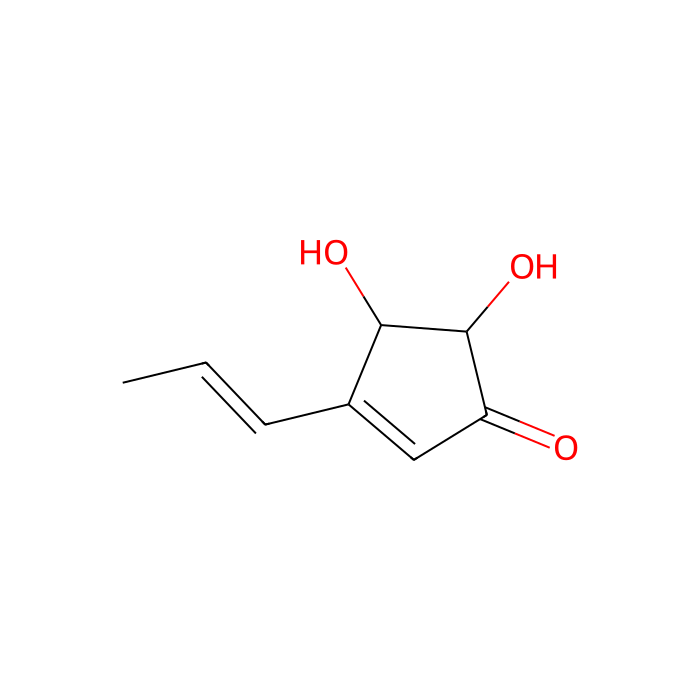
Terrein (CAS 582-46-7) is a small-molecule fungal secondary metabolite commonly isolated from Aspergillus species.
Item-specific identifiers (from Product Data)
CAS: 582-46-7
SKU: T275372
InChIKey: 219295 (as provided; note this is not the standard 27-character InChIKey format)
SMILES: Not specified for this item; refer to CoA/Spec Sheet.
Molecular formula: Not specified for this item; refer to CoA/Spec Sheet.
Molecular weight: Not specified for this item; refer to CoA/Spec Sheet.
Literature/Reference identity (for context; not item specification)
Key functional elements (literature): An α,β-unsaturated carbonyl system embedded in a small ring, with vicinal diol/phenolic-type hydroxylation patterns reported in several isolations of terrein and analogs.
2D structure description (literature)
A compact, oxygen-rich, unsaturated carbon framework with two hydroxyl substituents and a conjugated carbonyl. The ring system is typically depicted as a five-membered enone or lactone-like motif bearing an allylic side chain. No stereocenters are consistently assigned in the most common depiction of terrein.
Notes
Where precise identifiers (formula, SMILES, standard InChIKey) are required for method development, please consult the item’s CoA/Spec Sheet or contact Aladdin Scientific Technical Support.
Synthetic Utility
While terrein is mainly a study compound/reference standard, its functional group array offers points of chemical manipulation useful in synthesis method development.
Functional handles (literature context)
Conjugated carbonyl (enone/lactone-like): Amenable to Michael additions, reductions (1,2- or 1,4- depending on conditions), and photochemical isomerizations.
Hydroxyl groups (reported in literature): Allow O-acylation, O-alkylation, and protection (silyl, carbonate) for stability or analytical derivatization.
Potential uses in synthetic studies
Probe substrate for chemoselective conjugate addition or catalytic hydrogenation method development.
Benchmark for protecting-group strategies on polyoxygenated, conjugated small molecules.
Reference for assessing oxidation sensitivity and designing stabilization protocols under process conditions.
Caveats
Because terrein is a defined natural product with potential light/oxidation sensitivity, process design should minimize base/oxidant load and exposure to UV.
For scale-up or multistep use, confirm stability and purity by HPLC and NMR at each stage due to possible isomerization/degradation.
Target Specificity
Not applicable. This product is a small-molecule natural product, not a biological macromolecule or antibody. No target specificity, clone, isotype, or species reactivity information is provided in the Product Data.
Häufig gestellte Fragen
What are the CAS number, molecular formula and molecular weight?
The CAS Number is 582-46-7, the molecular formula is C8H10O3, and the molecular weight is 154.16 g/mol. InChIKey MHOOPNKRBMHHEC-HZIBQTDNSA-N.
What is the purity of this product?
This product is supplied at ≥98% purity (chemical assay). Lot-specific values are stated on the Certificate of Analysis.
How should this product be stored?
Store at ?20 °C, protected from light, desiccated. Keep the container tightly closed with desiccant — the material is moisture-sensitive.
How is this product shipped?
This product ships in an insulated container with ice pads. Unpack on arrival and transfer it to the storage condition stated above.
What documentation is provided?
Available product documentation, including Certificates of Analysis (COA), Safety Data Sheets (SDS), and specification sheets, is shown in the product document area. Document availability and access follow the current site policy.
Wir verwenden Cookies, um die ordnungsgemäße Funktion der Website sicherzustellen und, soweit zulässig, Ihr Nutzererlebnis zu verbessern. Sie können Ihre Einstellungen jederzeit unter „Einstellungen“ verwalten. Weitere Informationen finden Sie in unserer Cookie-Richtlinie.
Dürfen wir Sie über Rabattaktionen informieren?
Später erinnern
Vielen Dank! Bitte überprüfen Sie Ihren E-Mail-Posteingang, um zu bestätigen.
Products are supplied to verified businesses, institutions, and qualified professionals for research and development use only. Not for use in humans, animals, diagnosis, or therapy.