≥98% for sensitive chromatographic and analytical workflows requiring minimal baseline interference.
🌡
Storage & shipping
Protected from light,Store at -20°C,Argon charged Ships Ice chest + Ice pads Check lot-specific COA for exact specifications.
📋
Quality documents
SDS, COA, datasheet, and spec sheet available for download. Lot-specific COA accessible via lot number lookup.
📚
Literature proof
Cited in 0 peer-reviewed publications across chromatography, organic synthesis, and cross-coupling reactions.
Übersicht
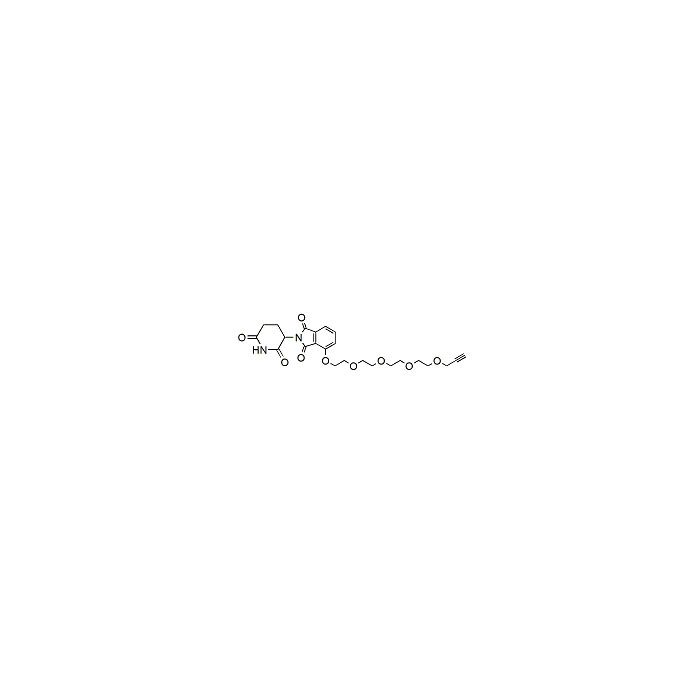
E3 ligase ligand-linker conjugate, Thalidomide-O-PEG4-Propargyl, is synthesized compound that incorporates the Thalidomide based cereblon ligand and 4-unit PEG linker used in PROTAC technology.
Specifications
Spezifikationen & Reinheit
≥98%
Storage
Protected from light,Store at -20°C,Argon charged
Verschickt in
Ice chest + Ice pads
Dieses Produkt erfordert Kühlkettenversand. Grundversand und andere Economy-Optionen sind nicht verfügbar.
Reinheit
≥98%
Namen und Kennungen
Molekulargewicht
488.50
Documentation
📋 Safety Data Sheet (SDS)
Comprehensive hazard, handling, storage, and regulatory compliance document.
Determine the necessary mass, volume, or concentration for preparing a solution.
Dilution Calculator
Determine the dilution needed to prepare a stock solution.
Reconstitution Calculator
Bewertungen
Kundenbewertungen
Application Protocols
No manufacturer-validated application protocols (e.g., WB, IHC, IF, FC) apply to this small-molecule linker. For synthetic use, typical protocols follow standard CuAAC or related alkyne chemistry workflows:
General CuAAC sketch (guidance only; optimize per substrate):
Dissolve Thalidomide-O-PEG4-Propargyl and the azide partner (1.0–1.2 equiv each) in degassed H2O/organic co-solvent.
Add CuSO4 and sodium ascorbate with a suitable ligand (e.g., BTTAA) under inert atmosphere.
Stir at ambient temperature until completion (HPLC/LC–MS monitoring), then quench copper with EDTA or a scavenger and purify.
Consult the primary literature and your internal SOPs for detailed step-by-step instructions relevant to your substrates and scale.
Biological Roles
This molecule is designed as a chemical biology tool component rather than a biological reagent per se. Its functional relevance stems from the thalidomide (phthalimide–glutarimide) core, which is widely used as a cereblon (CRBN) binder in targeted protein degradation (TPD) research (literature). Key points:
CRBN engagement (literature): thalidomide-class ligands bind the CRL4CRBN E3 ubiquitin ligase substrate receptor. The O-PEG4 substitution preserves the glutarimide N–H motif important for binding while providing a synthetic exit vector for conjugation.
Role in PROTACs and molecular glues: when linked to a protein-of-interest ligand, constructs can recruit CRBN to facilitate ubiquitination in cellular studies. This product provides the CRBN-recruiting half with a versatile alkyne handle.
PEG4 spacer effects: PEG linkers can modulate permeability, aqueous compatibility, and degrader-induced ternary complex formation by adjusting spatial reach and flexibility (general SAR trends in TPD literature).
No intrinsic biological activity claim is made for this catalog item. Any observed cellular effects arise from the final conjugate’s properties, linker length, and cell context.
All uses are for research only. This material is not intended for diagnostic, therapeutic, or in vivo clinical applications.
Buffer Applications
This product is not a buffering agent and does not constitute a pH buffer system.
Typical buffer relevance arises only indirectly when performing CuAAC or bioconjugation in mixed aqueous media (e.g., phosphate, HEPES, or Tris at pH ~7–8) to solubilize azide partners. Select buffers that do not chelate copper excessively and are compatible with your ligand system (e.g., BTTAA/THPTA).
For strictly chemical synthesis, prefer anhydrous organic solvents; for biomolecule conjugations, use degassed buffers with organic co-solvent per reaction requirements.
Green Alternatives
While the scaffold itself is fixed by design (thalidomide-PEG4-alkyne), you can implement greener practices in solvent and catalyst choices for typical transformations (especially CuAAC):
Greener solvent swaps (literature guidance):
Replace DMF/NMP with water-rich media (HEPES/phosphate buffer) plus 10–30% ethanol, t-BuOH, or propylene carbonate to maintain solubility.
Use 2-MeTHF or Cyrene as organic components where compatible with partners; evaluate solubility of the PEGylated linker and the azide counterpart.
Catalyst system optimization:
Employ water-soluble Cu(I) ligands (e.g., BTTAA, THPTA) to enable low copper loadings and purely aqueous or aqueous-ethanol systems, easing workup and reducing metal waste.
Consider supported copper catalysts for facile removal and recycling.
Degassing and scavenging: nitrogen/argon sparging minimizes Glaser byproducts; incorporate copper scavengers post-reaction to lower residual metals.
Copper-free click (SPAAC) is not directly applicable because this linker bears a terminal alkyne, not a strained alkyne; however, greener CuAAC implementations are well-established.
Pharmaceutical Uses
No excipient or clinical formulation role is claimed for this material.
Intended role: a research-grade linker–E3 ligand building block used to assemble chemical probes, PROTACs, and related conjugates in discovery chemistry.
Pharmacopeial status: Not specified for this item; refer to CoA/Spec Sheet.
GMP/clinical suitability: Not intended for human or veterinary use. No statements are made regarding GMP compliance.
Formulation context (research): Stocks are commonly prepared in anhydrous DMSO or DMF for subsequent dilution into assay-compatible media once conjugated to the desired partner. Residual copper from CuAAC should be rigorously removed if preparing materials for advanced preclinical studies (general best practice), but this product listing does not specify residual metal limits.
All uses are for laboratory research only.
Physical Properties
Item-specific physicochemical specifications have not been provided.
Appearance: Not specified for this item; refer to CoA/Spec Sheet.
Molecular weight: Not specified for this item; refer to CoA/Spec Sheet.
Melting point / Boiling point / Density / Refractive index: Not specified for this item; refer to CoA/Spec Sheet.
Water, residual solvents, UV cutoff, metals, peroxides: Not specified for this item; refer to CoA/Spec Sheet.
General expectations (literature/structure-based guidance; not product specifications):
Physical state: typically a solid (often off-white to light solid for PEGylated small molecules), with amorphous tendencies due to PEG chain.
Polarity & solubility: PEG4 increases polarity and H-bond acceptor count; good solubility is generally observed in polar aprotic solvents (e.g., DMSO, DMF, NMP) and mixed aqueous/organic systems with co-solvent. Aqueous solubility alone may be modest and formulation-dependent.
Acid/base behavior: the imide groups are weakly acidic; the terminal alkyne (pKa ~24, literature for simple alkynes) is not deprotonated under neutral conditions. The molecule is overall neutral.
Stability: imide rings may hydrolyze under strong basic or strongly acidic aqueous conditions over time; terminal alkynes are air-stable but can undergo Glaser-type coupling under oxidative Cu conditions.
Always confirm exact physical values and acceptance criteria from the current lot CoA/Specification Sheet.
Quality and Grades
Grade/Purity: Not specified for this item; refer to CoA/Spec Sheet.
Interpretation and guidance:
In absence of a declared grade (e.g., >98% purity, HPLC grade, AR, anhydrous), the definitive quality attributes are those on the Certificate of Analysis (CoA) and Specification Sheet for the specific lot you receive.
For linker/drug-conjugate building blocks like Thalidomide-O-PEG4-Propargyl, common QC elements typically include (literature/industry practice):
Identity by NMR (1H/13C), HRMS, and sometimes IR.
Purity by HPLC/UPLC with UV or MS detection.
Residual solvent limits, water (Karl Fischer), and sometimes inorganic residues (ICP) for catalytic metals if used in synthesis.
Stabilizers/antioxidants: None are specified for this item. If present, they will be noted on the CoA/Spec Sheet.
Chromatographic use: If employing this material for bioconjugation or TPD probe synthesis, choose lots with purity consistent with your intended downstream application (e.g., medicinal chemistry vs. analytical reference). For photo- or copper-sensitive applications, consider freshly opened material and document pre-use QC.
Traceable documentation: Retain SDS, CoA, and any method validation data for regulatory or publication support.
Reaction and Applications
This reagent is a thalidomide-based CRBN-recruiting handle equipped with a terminal alkyne for modular bioconjugation. Core applications include:
Cu-catalyzed azide–alkyne cycloaddition (CuAAC): attaches the thalidomide-PEG4 unit to azide-bearing warheads, dyes, or affinity tags to form triazoles. Widely used in constructing PROTACs, degron probes, and conjugate libraries.
Sonogashira-type couplings (less common): terminal alkynes coupling to aryl/vinyl halides (requires Pd/Cu, base, and anhydrous conditions). Ensure compatibility with imide and PEG segments.
Thiol–yne additions: radical or base-promoted hydrothiolation across the terminal alkyne to introduce thiol-bearing fragments; control for mono- vs bis-addition.
Post-assembly diversification: the PEG4 spacer imparts aqueous compatibility and distance from the thalidomide core, often improving binding preservation to CRBN (general literature on exit-vector engineering).
Practical notes:
Preserve the glutarimide N–H by selecting O-alkylated thalidomide scaffolds (as here) to maintain cereblon engagement in TPD tool compounds (general literature rationale).
For CuAAC, use degassed solvents/buffers; include a stabilizing ligand (e.g., TBTA, BTTAA) for enhanced kinetics and minimized off-target copper binding in biomolecule conjugation.
Minimize strong base/acid and prolonged aqueous exposure to limit imide hydrolysis.
Light and oxygen protection reduce side processes (e.g., Glaser coupling under Cu/O2) and align with the provided storage guidance.
The reagent is intended strictly for research use in chemical biology and medicinal chemistry workflows.
Reaction Conditions
Typical conditions for common transformations of the terminal alkyne (literature/general guidance; adjust per substrate):
CuAAC (azide–alkyne click)
Solvent: H2O/t-BuOH or H2O/DMSO (50:50 v/v) or ACN/H2O; degas to suppress Glaser coupling.
Catalyst: CuSO4·5H2O (0.05–0.5 equiv) + sodium ascorbate (0.5–2.0 equiv) to generate Cu(I) in situ.
Ligand: TBTA, BTTAA, or THPTA (0.05–0.5 equiv) to stabilize Cu(I) and accelerate reaction, especially in aqueous media.
Temperature: ambient (20–25°C) commonly sufficient; 1–4 h typical; overnight for hindered partners.
pH: ~7–8. Avoid strong base to limit imide hydrolysis.
Thiol–yne hydrothiolation
Radical initiation (photochemical or AIBN/thermal) or base-promoted in polar solvents (DMF, DMSO).
Control stoichiometry and irradiation to favor mono- vs bis-addition.
Sonogashira coupling (if coupling to aryl/vinyl halides)
Catalysts: Pd(PPh3)2Cl2 (1–5 mol%) + CuI (2–10 mol%); base: Et3N, i-Pr2NEt, or amines; solvent: DMF, DMSO, or toluene/amine mixtures.
Temperature: 25–60°C. Exclude moisture/air to protect the alkyne and imide function.
Workup tips:
Quench CuAAC with EDTA or specialized copper scavengers; filter supported catalysts.
Purify by reversed-phase or normal-phase chromatography depending on polarity of the conjugate. Monitor for any hydrolysis of imide rings under aqueous preparative conditions.
Safety and Handling
Authoritative safety information should be taken from the product’s SDS. No GHS elements are specified here.
Signal word / H-statements / GHS classification / Pictograms: Not specified for this item; refer to SDS.
Primary hazards (general guidance):
Thalidomide derivatives are often handled with care due to potential reproductive toxicity concerns in the parent class (literature). Avoid exposure; implement appropriate controls.
Imides/PEGylated linkers may cause irritation to skin, eyes, or respiratory tract upon contact with dust or solutions (general laboratory precaution).
PPE: lab coat, safety glasses, and suitable chemical-resistant gloves (e.g., nitrile). Work in a chemical fume hood.
Engineering controls: handle solutions and weighing in a ventilated enclosure; consider closed transfer for DMSO/DMF stock solutions to reduce exposure.
Handling notes specific to this item’s storage guidance:
Maintain an inert atmosphere (argon charged) to minimize oxidative processes and moisture uptake.
Protect from light to limit photodegradation of sensitive motifs.
Minimize exposure to moisture and strong bases/acids to avoid imide hydrolysis.
Incompatibilities (general): strong oxidizers, strong bases/acids, and copper/oxygen when unintended (to avoid Glaser coupling of the terminal alkyne outside planned click reactions).
First aid (overview; see SDS):
Skin/eye contact: rinse with water for ≥15 min; remove contaminated clothing.
Inhalation: move to fresh air; seek medical attention if symptoms persist.
Ingestion: rinse mouth; do not induce vomiting; seek medical attention.
For research use only. Not for diagnostic or clinical use.
Solvent Selection
Given its PEG4 chain and imide-containing thalidomide core, this linker typically shows good compatibility with polar aprotic solvents used for conjugation chemistry.
Preferred solvents (general guidance):
DMSO, DMF, NMP: high solvating power for PEGylated scaffolds; suitable for stock solutions and CuAAC.
Acetonitrile, t-BuOH, MeOH/EtOH (as co-solvents): for mixed aqueous click conditions; balance solubility with catalyst performance.
Aqueous buffers (pH ~7–8) with co-solvent (10–50% v/v): commonly used in CuSO4/sodium ascorbate click setups when the azide partner is biomolecular.
Less suitable: purely nonpolar solvents (hexanes, toluene) generally provide poor solubility; toluene may be used only if substantial polar co-solvent is added.
Dryness: Maintain anhydrous conditions for stock preparation and for reactions sensitive to hydrolysis. For aqueous click, use degassed buffer and defined co-solvent content.
Comparison (use-case oriented):
DMSO: maximal solubility; may interfere with some bioassays if carried over.
DMF: excellent solubility; easier removal than DMSO; consider amide exchange sensitivity of some partners.
MeCN: good for small-molecule click; limited solubility for larger PEGylated constructs without co-solvent.
Choose the solvent system to match the partner azide’s solubility and the intended catalyst/ligand system.
Storage and Reconstitution
Follow the item-specific storage guidance for best stability.
Storage conditions (from Product Data):
Store at −20°C
Protected from light
Argon charged (maintain an inert atmosphere)
Shipping: Ice chest + ice pads (cold chain). Inspect upon arrival and return to recommended storage.
Reconstitution and handling (general guidance; not product specification):
Prepare concentrated stocks in anhydrous DMSO or DMF (e.g., 10–50 mM depending on solubility). Filter if needed through PTFE (0.2 µm) to remove particulates.
Aliquot into amber vials or light-protective microtubes under inert gas to avoid repeated freeze–thaw cycles.
For aqueous reactions (e.g., CuAAC), dilute immediately before use into degassed buffer with suitable co-solvent. Avoid prolonged exposure to strong base/acid.
If crystallization/precipitation occurs on storage, warm gently to room temperature and vortex/sonicate after adding a small volume of dry solvent.
Stability limits / retest date: Not specified for this item; refer to CoA/Spec Sheet.
For research use only. Handle and dispose of contents according to laboratory safety protocols and SDS.
Structure and Identity
A thalidomide-based, alkyne-terminated, PEGylated linker designed for bioconjugation and targeted protein degradation research.
Molecular formula: Not specified for this item; refer to CoA/Spec Sheet.
Molecular weight: Not specified for this item; refer to CoA/Spec Sheet.
SMILES: Not specified for this item; refer to CoA/Spec Sheet.
InChIKey: Not specified for this item; refer to CoA/Spec Sheet.
Structural features (based on name; general description):
Thalidomide scaffold: bicyclic imide architecture comprising a phthalimide ring fused to an imide-bearing glutarimide (cereblon-binding pharmacophore). In this derivative, substitution occurs at an O-position on the phthalimide ring system rather than N-alkylation of the glutarimide.
PEG4 spacer: a tetraethylene glycol chain (–O–CH2–CH2–O– repeated 4 times) imparting hydrophilicity, flexibility, and added reach between the thalidomide core and the terminal handle.
Terminal propargyl group: a terminal alkyne (–C≡CH) appended at the distal end of PEG4 for copper-catalyzed azide–alkyne click chemistry (CuAAC) or other alkyne transformations.
2D description: phthalimide ring bearing an O-alkyl ether that extends into a four-unit PEG chain terminating in a propargyl moiety (–CH2–C≡CH); the glutarimide ring remains intact and unsubstituted at nitrogen, preserving cereblon-binding topology.
Notes:
No stereocenters are introduced by PEGylation; thalidomide’s known stereochemistry pertains to the glutarimide carbon but is racemization-prone in solution (general literature knowledge).
Synthetic Utility
Thalidomide-O-PEG4-Propargyl serves as a modular synthon merging a CRBN-binding headgroup with a handle (terminal alkyne) through a PEG4 spacer.
Key functional elements and reactivity (general literature guidance):
Terminal alkyne:
Highly chemoselective coupling via CuAAC with organic azides → robust triazoles under mild, aqueous-compatible conditions.
Amenable to thiol–yne additions (radical/base-promoted), hydroboration/oxidation, or Pd-mediated alkynyl couplings (with care to avoid imide degradation).
PEG4 spacer: enhances solubility in polar media, reduces aggregation, and spatially separates the CRBN binder from the payload—important in structure–property optimization for PROTACs.
Thalidomide core (O-alkylated): preserves the glutarimide N–H often favorable for CRBN engagement; the phthalimide oxygen provides a synthetically convenient exit vector minimizing alteration of the CRBN recognition elements.
Retrosynthetic value:
Enables convergent assembly: synthesize diverse azide-containing warheads/linkers, then append the CRBN unit late-stage via click chemistry.
Facilitates parallel synthesis and SAR: maintain a constant E3-ligand while varying linker composition distal to the triazole.
Overall, this building block is a workhorse for constructing CRBN-directed degraders and probes with reliable, high-yielding bond formations.
Target Specificity
Not applicable. This product is a small-molecule building block and is not an antibody, enzyme, or affinity reagent with defined biological target specificity validated by the manufacturer. In chemical biology, the thalidomide core is commonly used to engage CRBN (literature), but this listing provides no item-specific target validation data.
Wir verwenden Cookies, um die ordnungsgemäße Funktion der Website sicherzustellen und, soweit zulässig, Ihr Nutzererlebnis zu verbessern. Sie können Ihre Einstellungen jederzeit unter „Einstellungen“ verwalten. Weitere Informationen finden Sie in unserer Cookie-Richtlinie.
Shall we send you a message when we have discounts available?
Remind me later
Thank you! Please check your email inbox to confirm.
Products are supplied to verified businesses, institutions, and qualified professionals for research and development use only. Not for use in humans, animals, diagnosis, or therapy.

 J2528668